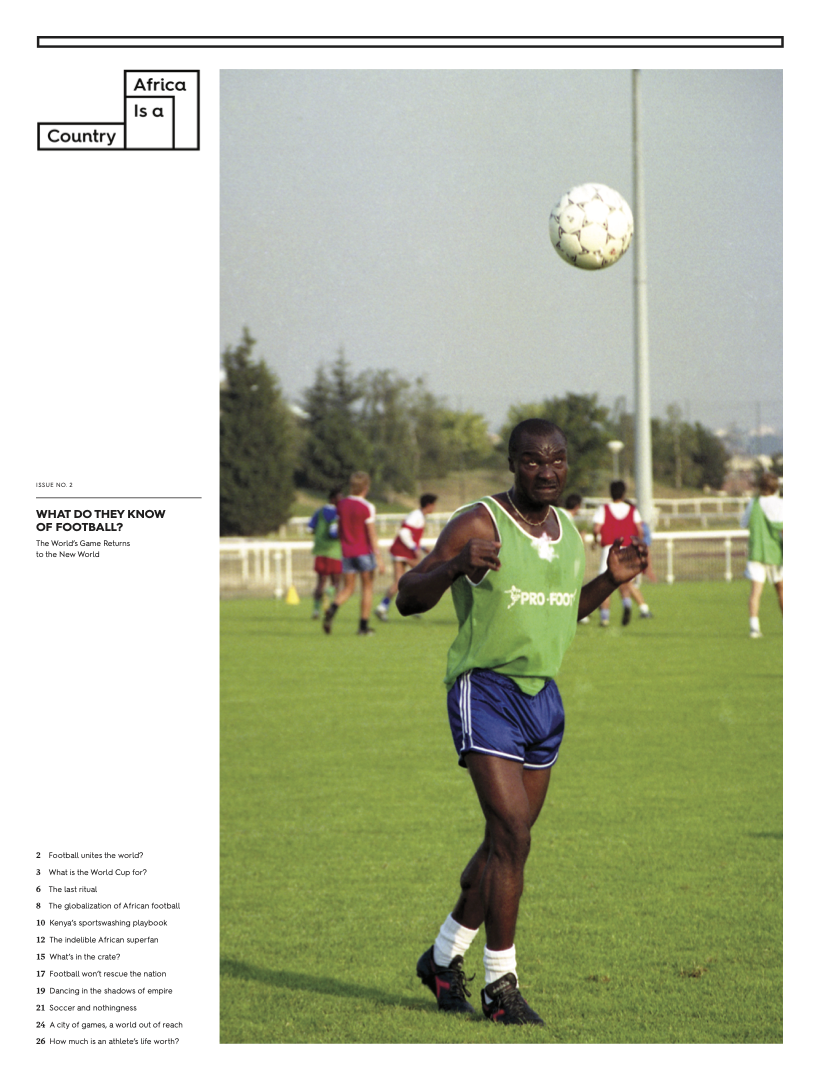
Rodolfo Gonzalez/AP The World Cup begins this week. It would be easy to treat it as a break from everything else: a month of fixtures, line‑ups, and refereeing conspiracies in which politics can be suspended. Our latest special issue—What Do The Know of Football?—was made in open defiance of that instinct. Football is not a world apart from modern life; it is one of the ways modern life explains itself. The issue asks what the World Cup tells us about the modern era from which it was born. It moves from the tournament’s birth in imperial rivalry and nationalist aspiration to the globalization of African football and the way fandom now travels along old colonial routes. It looks at sportswashing, at the migration of players and workers, at the way nostalgia for older tournaments often doubles as nostalgia for forms of public life that have since been hollowed out. The claim is simple: if you follow football closely enough, you begin to see the structure of the present. As the tournament arrives in the Americas, our attentions shift from the printed object to the place that will host the next month of our lives. Not just the United States, but the wider “America” that runs from Canada through the US to Mexico and beyond: a hemisphere that still insists on calling itself the New World even as many of its institutions feel very old. The question is not only who will win the World Cup, but what it means for this particular part of the world to invite everyone else in. There is a Tocquevillian impulse behind the way we want to approach this. Alexis de Tocqueville crossed the Atlantic from France in the 1830s to study a young republic on the make. He saw energy, expansion, and a democratic experiment that seemed to offer a preview of the future. Two centuries later, the same terrain looks different. The United States is no longer the promising outlier of his notebooks but a late empire: rich and powerful, but also politically decayed, socially brittle, and shorn of any shared story about what it is for. Where Tocqueville wrote about a society organized around aspirations of equality (“we the people”), what stands out now is inequality: money piled up at the top, insecurity at the bottom, and a fraying middle trying to pretend that nothing fundamental has changed. The dense associational life he thought would protect Americans from tyranny—church groups, town halls, civic clubs—has thinned out into something more atomized, even as wealth and power concentrate upward. By the time the knockout rounds begin,on July 4th the United States will be blowing out 250 candles—a birthday party for a republic that looks lost. It is now shadowed by a rival in China that tells a very different story about its legitimacy: not a recent invention, but an old civilization returning to its rightful place. Part of the antinomy of the present is that, even as the American model of governance feels increasingly exhausted, the idea of a polity held together by civic law and moral aspiration rather than blood and soil still seems, in principle, available to anyone, while China’s civilizational claim is stubbornly particular—hard to emulate, and harder to universalize as a template for how the world might be organized instead. The World Cup is a sharp way of bringing these tensions into focus. On the one hand, it is meant to be a borderless party in which flags, shirts, songs, and languages are supposed to mix without friction. On the other hand, it will take place in and around hardened frontiers, militarized cities, and a thick atmosphere of suspicion directed at Black and brown crowds. This is Trump’s America as World Cup host: a state that talks about “the world’s game” while sending ICE to patrol the same borderlands where fans, workers, and players will be trying to move. The event will serve as a kind of test case. How does a late empire tell a story about unity when its everyday practice is separation? This is why it matters that our vantage point is African. For most of the last century, the traffic has gone the other way: Europe and North America “cover” Africa, translating our crises, elections, uprisings, and tournaments for their own publics. This summer we want, in a small way, to turn the camera around. Greg Grandin’s America, América, a timely work published this year, is useful here. He reminds us that “America” has never been a stable name for a single state, but a shorthand for a whole tangle of conquest, revolutions, migrations, and rivalries across the hemisphere. It is also a place that African anti‑colonial movements and their successors—usually from afar—once treated, by turns, as an institutional exemplar (remember Nkrumah’s “United States of Africa”?), Cold War counterweight, and now a decaying empire. To write about this World Cup from an African perspective is to treat that tangle as the object of study rather than the invisible backdrop against which everyone else’s stories unfold. Over the next three weeks, the AIAC team will have our boots on the American ground, moving through host cities and the spaces between them, filing from stadium precincts and camp sites, from border crossings and bus depots, from watch parties in Newark, Queens, and the Bronx to Cape Verdean breakfasts in Brockton, Algerian gatherings in Montréal, Ghanaian corners of Toronto, a detour through Oklahoma (a reminder that the US, alongside Canada, were ground zero for the modern settler-colonial state), the heat around Dallas and Houston, and, finally, Guadalajara, Monterrey, and Los Angeles as the tournament tips into its later stages. The aim is not to assemble a sociological catalog or colorful backdrop, but to let particular places and conversations dictate the questions we ask. At each stop, we will be spending time with African and Afro‑diasporic communities, treating them as protagonists with their own histories, class positions, and political arguments. These are the people who have turned America into places that feel as much global South as global North. They are the reason that watching Senegal in Harlem can feel, for ninety minutes, like watching Dakar watch itself. They are also often the first to feel the pressures that the rest of the world only encounters later: police attention, precarity, algorithmic sorting, the endless work of making lives across borders that were never designed for them. But they are not only its victims; from elected officials like Ilhan Omar and Zohran Mamdani to organizers and artists whose names are less known, they keep daring America either to live up to its promises or admit, publicly, that it never will. None of this means the football itself is an afterthought. The game is the route and the lens. Matches are where the roads cross: the place where a logistics system, a security operation, a media machine, a migrant labor force, and a set of local traditions all briefly line up around a ball. Stadium projects tell you what city governments now think “development” looks like. Fan zones show you who is allowed to gather without being treated as a threat. Television coverage reveals which nations are accorded inner‑circle status and which are kept at the margins. Even the tournament’s format—how many teams, from where, playing under what conditions—tells you something about who gets to count as part of the world. One of the arguments running through our special issue is that the World Cup has survived this long not because it is beyond reproach, but because it remains one of the last rituals in which millions of people still experience something like simultaneity. In an age when most of life is consumed alone, on demand, and on a personalized feed, football still turns up, on time, in front of everyone. That is also why it is so politically charged. The same structures that make the game available everywhere—global media networks, platform capitalism, the migration of bodies and images—are the ones that have emptied out many other forms of public life. Football, in that sense, is a rehearsal space for futures that may not have anywhere else to go. From next week, much of our coverage will tilt towards the tournament. On the site, that will mean essays and dispatches rather than only match reports. On YouTube and other platforms, it will mean a rolling video diary: conversations in transit, quick debriefs after games, portraits of the people we meet along the way. Ultimately, the road (and our energy levels) will decide what forms the work takes. The commitment is simply to pay attention—to the ball, to the people following it, and to the hemisphere it will be moving through. On Wednesday, the day before the opening ceremony and first match in Mexico City, we will launch our special issue in the New York City of Mayor Zohran Mamadani. From 6pm, The Africa Center in Harlem will host a World Cup salon: four back‑to‑back panels and a live podcast taping, followed by an after‑party at The Shrine. Follow us on YouTube for the panels and on African Five a Side for the podcast: One room will move from New York’s own football history to Haiti’s return to the World Cup, while the other tracks football as protest and asks what a decolonized game might look like. Moderators and panelists include Tosin Makinde, Zito Madu, Marvin Heilbronn, Sofia Mussa, Shamira Ibrahim, Laurent Dubois, Nathalie Cerin, Achille Tenkiang, Sean Jacobs, Tony Karon, Martino Simcik, Anna Olimpia de Moura Leite, Simon Akindes, Noor Ahmad of Lifta Club, and Brenda Elsey, with Maher Mezahi hosting a live African Five‑a‑Side podcast with Zito Madu, Aleksandar Hemon, and Miguel Salazar to close the night. If the World Cup offers the fantasy of the world gathered in one place, our job this summer is to see what that fantasy rests on. The football will be real enough. So will the roads, the borders, the weather, the police lines, the ticket prices, the labor that makes the show possible, and the small, stubborn moments of joy that happen in spite of all of it. – William Shoki, editor |