My mother’s buried story
AI tools are built on Eurocentric datasets. For Brazil’s Afro-descendants — whose histories were already marginalized from literature, academia, and media — it poses the threat of industrial-scale erasure.
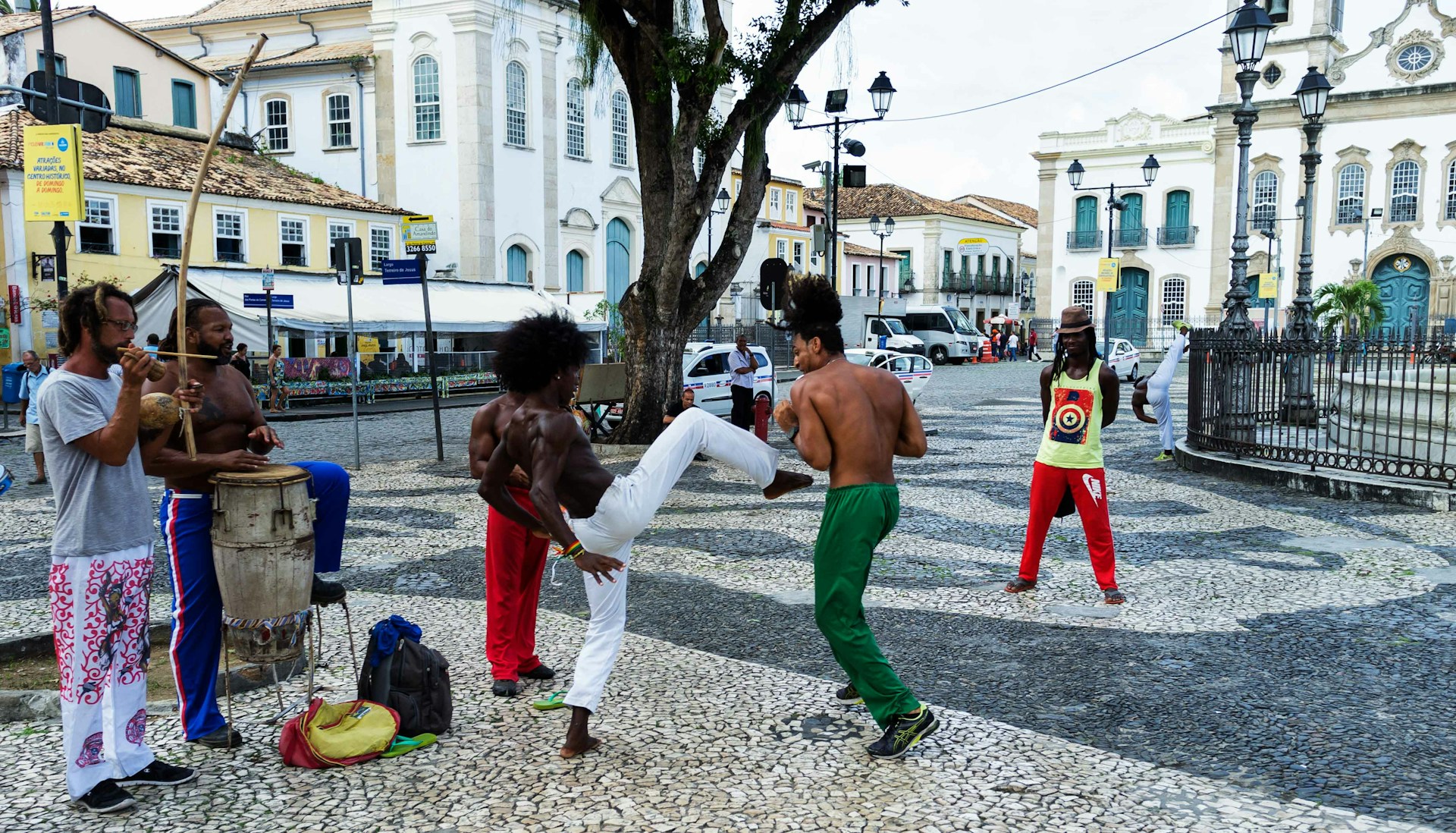
Photo by Nigel SB Photography on Unsplash.
Salvador da Bahia, the city where I was born, is the largest African Black city outside of Africa, with around 83 percent of the population being of African descent. In fact, in Latin America, over 133 million people are Afro-descendants, which is about one in four inhabitants of the region. Like in South Africa’s apartheid, the minority white population’s power and rule has been maintained through systemic violence, heavy policing, and public policies that often diminish the lifespan of disadvantaged—mostly African-descendant—citizens. In Latin America, these mostly white European descendants, a historically powerful minority, use the might of bureaucracy, financial institutions, and government to keep Afro-descendants at bay. It’s no surprise, then, that infant mortality rates in Brazil have always been high among low-income families. Most families living in poverty there are, to no one’s surprise, Afro-descendants.
At the time of my birth, in the mid-1970s, one in every three Black children didn’t survive. Of the two that did, one had a one-in-five chance of dying before turning five years of age. In a postcolonial society like Brazil, and in a segregated city like Salvador, a Black boy like me had no choice but to quickly learn which side I was on.
Making it to seven felt as rare as winning the lottery. I suppose, in a way, I did win the lottery of life.
My mother, Ms. Rosa, was at the time a member of an Afro-Brazilian dance and martial arts group practicing capoeira. Growing up, she used to take me everywhere; she knew the city like the palm of her hand. Having arrived there at 15 or 16 years old as a private, unpaid maid—enslaved?—my mother, to this day, still does not know her age for sure.
My memories from that time are mostly of going to the beaches, delighting in ice poles, and traveling with her inside long-haul buses. If I close my eyes, I can see my tiny hands holding her long maxi dresses, shaking side to side with the bus’s swings. During those travels, early in my young life, I had to learn to deal with hostile eyes, for, as many whites say in Brazil, “a Black boy of today is a potential threat of tomorrow.” Racism, it seems, doesn’t just come out of nowhere—it shapes itself in stereotypes, hearsay stories, and exaggerated tales.
There was a street market called the Feira de São Joaquim. The stands where people trade all sorts of foods, services, and crafts were sitting on top of old stilts and, when I entered, I could see the tide bouncing underneath the wooden, always muddy floor. The market was located on Salvador’s Cidade Baixa, a part of the city close to the port where mostly Black people, traveling sailors, and all sorts of poor folk lived. This is also where my mother used to take me to get coquinho (little coconut) necklaces. I would put them on my neck and slowly eat those tiny, delicious coconuts, one by one, with a smile on my face, until it was just a string sitting on my neckline. These small coconut beads come from the coquinho de licuri (solitary palm), a palm that is abundant in the Brazilian Sertão.
Sure, you can find some information online about that palm tree. But what you won’t find is how that palm threads through my mother’s life, back to the mid-20th century. The coquinhos I recall were a small, largely unknown fruit—but also a joyful way to sustenance and survival for generations of Indigenous and Afro-Brazilians.
“Growing up,” my mother tells me, “we used the licuri for everything. . . . to treat our hair, to make cooking oil, milk, flour, and arts and crafts. We played with it, we danced with it.” Then: “We could find it everywhere, just in the bush.” As if nature just knew where to place those palms.
As we speak over a WhatsApp call, she looks at me and says: “We used to travel by mule carrying a caçua [a type of donkey basket].” She pauses, looks up, sighs heavily, and, as if remembering something long buried, says nostalgically: “My mother was an artisan; she would make straw hats and sell them to strangers on our travels.”
The first Africans brought to Brazil arrived as early as the 1530s. By the time Brazil officially abolished slavery in 1888, over 358 years had passed. For comparison, the United States’ chattel slavery lasted 246 years.
By 1595, the Quilombo dos Palmares was already established. Probably the quilombola settlements began many years earlier, but the Portuguese only managed to officially document it then. These strongholds of resistance were built by Africans who fled the chains of the European colonizers, in an attempt to shape their own destiny. The Brazilian terrain, perhaps through the memory of Gondwana, was familiar yet unknown. This united Africans with the local Indigenous populations, sharing technologies, intermingling, and thriving. Oftentimes, even poor whites who were neglected by the Portuguese crown took part in quilombos or traded with them in peace. Palmares was the first (and only?) African kingdom outside of Africa. By the time it was destroyed by the Portuguese army, pirates, and bounty hunters in 1795, that autonomous Afro-Brazilian settlement, born from resistance, was possibly the largest city in Brazil at the time.
Centuries after Palmares, my mother was born in a similar settlement, in a rural vilarejo, in the Bahia countryside, in a family that embodied Palmares’ spirit and, why not, its history. In a house made of mud, wood, and straw, my grandfather, a blue-eyed Portuguese descendant, and my grandmother, both Indigenous Brazilian and African, lived side by side in a semi-nomadic life.
When my mother was around ten years old, her father passed away. After a brief period of hardship, she was handed over to a white family who needed help raising their toddler son and preteen daughter. It was never clear how it all happened. My mother has a vague memory of those traumatic times. It is impossible to know if my grandmother received any financial incentive to let my mother go, but one less mouth to feed would have been helpful at the time.
So, my mother went hundreds of kilometers away with the white family to a bigger town called Feira de Santana, near Salvador. She would never see her own mother again. When I ask my mother, she speaks in codes and grunts about this period of her life, but it is fair to say that it took many years, beatings, and loneliness until my mother escaped her captivity in her early 20s.
Although stories like my mother’s are common in Brazil, and the fact that the Portuguese enslavement of Africans and Indigenous peoples was the longest and possibly the cruelest in the world, there is a risk these stories won’t be known in the age of AI. At least not as I am telling them here. According to João José Reis in his book Rebelião Escrava no Brasil, repression in Brazil included extreme corporal punishment, with cases such as Pacífico Licutan, who was sentenced to 1,000 lashes, illustrating how enslaved individuals could be subjected to severe physical punishment for acts deemed insubordinate. In contrast, the worst punishments in the British-colonized United States, for example, were of about 150 lashes, according to Douglas A. Blackmon in his Pulitzer Prize–winning book Slavery by Another Name.
Modern tools like ChatGPT, Midjourney, and DeepSeek largely depend on Western Eurocentric narratives (mostly in the English language), perceptions, and stories to form their databases. African American stories often overwrite narratives coming from their cousins in the south of the American continent.
As more and more people use AI as search engines, and with 84 percent of all searches online influenced by AI-generated results, those stories tend to disappear. When I coined the term “AI Erasure” for my master’s thesis, completed at Victoria University in Australia, my fear was how AI could reshape our understanding of history and identity. In Brazil, African voices were historically marginalized and pushed out of literature, academia, and media. AI erasure will industrialize this eradication to levels never possible before.
Worse, because of the perception that AI isn’t biased, and the misguided idea that machines will be fairer when dealing with difficult issues—because “they don’t see race, class, ability, or gender”—combined with the anthropomorphizing of AI tools, we risk that these histories will disappear entirely.
In a future where AI tools become ubiquitous, you will still be able to find out what a licuri coconut is. But AI will never be able to tell you how it got here.