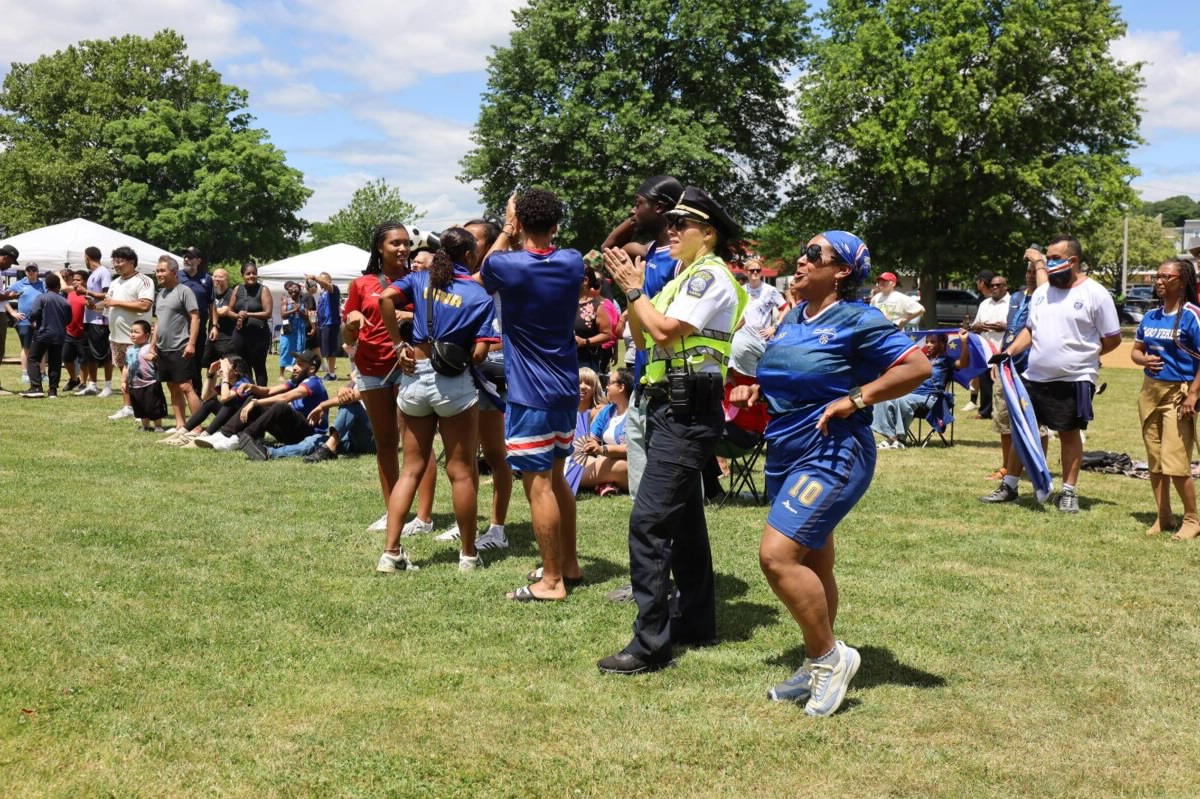
William Shoki for AIAC. Last week, we came to New England for Cabo Verde’s World Cup opener, still unsure what to make of this tournament. We had just left New York, where the loudest noise was the Knicks’ NBA championship victory, and the opening days of the World Cup—Omar Artan, the Iranian team’s marginalization, visa denials—had already earned it Ian Wright’s label: a World Cup of chaos. But our brief time in Pawtucket, Brockton, and Boston shifted the question for us, one now animating the remainder of our road trip: when the World Cup shows up, who actually makes it visible and meaningful in people’s lives? Southern New England has one of the densest Cabo Verdean diasporas in the world. In Brockton, we started in a small café that could just as easily have been in Praia. By mid‑morning, the room was mostly Cabo Verde jerseys and Kriolu. People were refreshing line‑ups on their phones, then looking up to argue about them. We’d also read that the city had received around $100,000 for a new mini pitch for the community, so after coffee, we went looking for it, assuming there’d be some kind of watch party there. There wasn’t. The pitch was empty, and there was no screen, no sound, no food, no kids, just no one. The surface itself was a hard, bouncy turf that looked almost unplayable for kids; we tried to imagine a slide tackle and winced. Whoever had put the project together hadn’t thought very hard about how to make it real in people’s lives, which was surprising because the World Cup provided a perfect occasion for it to be a gathering space for the people it’s meant to serve. Maybe we were being too harsh, and it was simply the case that nothing was ever scheduled. Maybe the idea was that “the community” would take it from here. Either way, coming straight from the café, it felt odd: a city that had managed to find six figures for turf but could not find anyone to open a gate or put up a screen. [After each triumph by the Cabo Verde national team, there are certainly impromptu street celebrations across the “11th island.”] So, we decided to drive up to Boston, to Dorchester, where a quick online search suggested that the Mayor of Boston had organized a watch party. Town Field is one of those parks that sits next to a busy road and a row of houses, nothing special at first glance. This time, as soon as we turned the corner, we could hear music. The city had set up a screen, a PA, and space for seating and standing on the grass. There was a water dispenser in the corner, and a DJ was playing Cabo Verdean tracks and reminding everyone to check out the vendors present, selling their wares. During the in-game “hydration breaks” and half-time, a short video from Mayor Michelle Wu came on the screen, saying welcome to the watch party, and then getting out of the way. None of it was fancy. No branded “fan experience,” no sponsor stage. It was just enough infrastructure for people to take over the place. Cabo Verde jerseys everywhere. Kids chasing each other at the edge of the crowd, and older people in camp chairs closer to the screen. When Cabo Verde went close, the noise was big enough that you could imagine someone two blocks away pausing to listen. Wu is the same mayor the president has threatened to punish by pulling World Cup games out of “unsafe” Boston, and who has replied, more or less, that the contracts are signed and the city is not going to contort itself to please him. That tension didn’t appear on the grass in Dorchester. What people saw was a screen, a welcome, and a sense that this corner of the city was theirs for the afternoon. Brockton and Dorchester are not opposites. The same people move between them. But it was hard not to miss the contrast: in one place, a new pitch sitting there, underutilized; in another, an old park that, for ninety minutes, clearly belonged to a specific group of people. Just under a week later, we reached Kansas City, the first stop on our route that felt genuinely all‑in on the World Cup (and where, not far away in Lawrence, a town is quietly falling in love with the Algerian national team and its diaspora). The games there will be played at Arrowhead, but the work has spilled out across the city: a revamped streetcar line, spruced‑up blocks downtown, and signage everywhere welcoming the world, promoting the local men’s and women’s teams, and reminding everyone that Kansas City is the “soccer capital of America.” The mayor talks about “legacy” in the usual way, but you can also see the more basic ambition: move people around without chaos, and give them places to watch and gather. Underneath that is a more nervous story. State lawmakers have been arguing about how much “emergency” power the governor should have during the tournament. Local police have been telling anyone who will listen that without federal money, they can’t staff the security plans they’ve been asked to write. Everyone wants the prestige of being a host; no one wants to end up paying for the full bill or taking the blame if something goes wrong. Whether all that leaves anything lasting for the people who live there is harder to see from a few days on the ground. In New York, where we actually started out our road trip, the fight looks different again. There, Mayor Zohran Mamdani has spent the past year arguing with football’s governing body over who can afford to walk through the turnstiles. He launched a campaign against dynamic ticket pricing, insisting that sports “cannot become a luxury,” and pushed for a block of cheap seats reserved for city residents. After months of back‑and-forth, he was able to pry loose around a thousand tickets at roughly fifty dollars each, and promised to show matches on hundreds of city kiosks so people without subscriptions or stadium money could at least stand on the pavement and watch. The federal layer sits on top of all this. Cabo Verde’s 40‑year‑old goalkeeper Vozinha has turned into one of the tournament’s first cult heroes. His mother almost missed the chance to see him play because of visa rules and financial guarantees that turned a family trip into an obstacle course. It took media attention and back‑channel pleading before the paperwork shifted. The machinery can bend, but it rarely bends first for someone like her. Seen from these four places, the World Cup stops looking like a single thing “hosted by America” or “run by FIFA” and starts to break down into smaller questions. There is a way of talking about the tournament that assigns ownership to presidents and federation bosses and then moves on: late empire, corrupt bureaucracy, a few new white elephants, case closed. From afar, that story is hard to resist. It can also slide over the fact that the United States—and even the world of international football administration—are messy terrains where people are constantly contesting how they are governed, and where fans, workers, and local officials keep trying to carve out spaces of use and joy inside what seems like someone else’s project. But the World Cup is bigger than the suited men in the castles, and humanity—as well as the questions of what makes our lives worth living and how we celebrate them—runs through the people in cafés and parks, not just the ones on the podium. A city can build a field and disappear, or it can string up a screen in a park and trust people to fill in the rest. It can redraw its transport map and talk itself into believing this will all matter after the final whistle. It can pick a fight over ticket prices or travel bans. A national government can decide who is allowed to turn up at all. None of this requires grand theory, because it’s mostly small work: who unlocks the gate; who thinks to book a DJ; who pays for the last bus home; who stamps a passport; who looks at a neighborhood and sees fans rather than a communal threat. For diasporas like the Cabo Verdeans of New England—often working‑class, some more established and others recent arrivals—those decisions are what turn “the world’s game” from a slogan into something you can step into after work on a weekday. As we move on from New England and the Midwest, the question we’ll keep coming back to is a simple one: when the World Cup passes through, who is it for, and who bothered to make room for them? – William Shoki, editor |