Always searching
Abdullah Ibrahim was difficult, suspicious, and brilliant. And beneath all of it, he was searching for home.
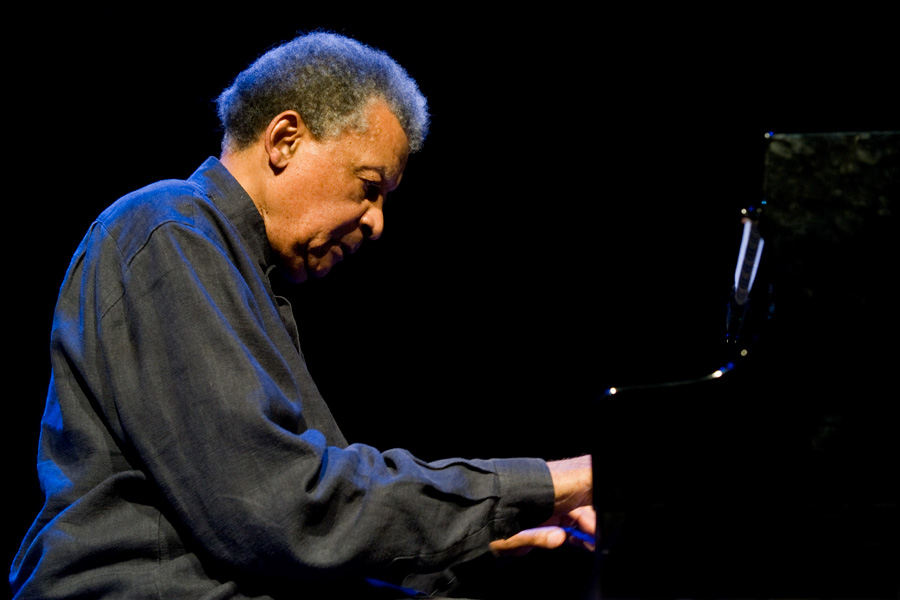
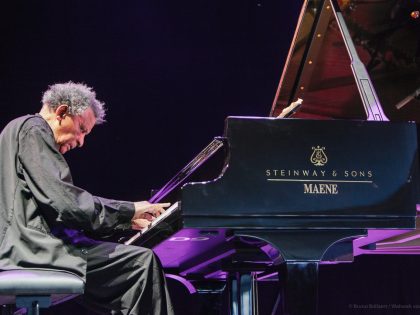
South African jazz pianist and composer Abdullah Ibrahim performs at the Moers Festival in Germany on 10 June 2011. Source: Michael Hoefner (Nomo)/Wikimedia Commons
Abdullah Ibrahim was a difficult man to interview.
He spoke in parables, metaphors, metaphysics, and cosmology. Ask him about a concert, and he might answer with a story about a shark and a monkey. Ask him about politics, and he would take you to the Green Kalahari, or Rumi, or Einstein’s curvature of time and space. Ask a straightforward question, and he would often refuse the invitation entirely. Then, three days later, you would realize he had answered the question after all.
Over the last seven years, I have had multiple conversations, interviews, and recordings with Abdullah Ibrahim. And we tended to circle the same question. Not music. Not politics. Not even South Africa. The question, in one form or another, was always identity. Who are we? How do we become who we are? What happens when history, exile, and circumstance place distance between us and ourselves?
The first time I literally bumped into Abdullah Ibrahim was on a rainy day in 2003 on Plein Street in Cape Town, not far from Parliament. He was walking anonymously with a turned-up collar and a brimmed hat. I greeted him. “Hello, Mister Ibrahim.” He growled and continued walking in the direction of Table Mountain. Years later, I discovered that wasn’t unusual. Abdullah was difficult. Period.
Now that he is gone, I hope we can resist the temptation to pretend otherwise.
We live in a time where our celebrated dead are quickly polished into saints. Their rough edges disappear. Their humanity is edited out in favor of a version that feels easier to celebrate. Yet our lionized heroes deserve the truth, too. Like many men of his generation, exile, apartheid, and unresolved wounds left marks not only on him but on those closest to him. Talent does not excuse hurt. Those stories belong to the people who lived them. They matter. They are true.
Those stories are not imaginary. They exist alongside the public legend.
During an online launch for In My Remaining Years, the memoir by Abdullah Ibrahim’s daughter, Tshidi, better known as the rapper Jean Grae, I asked via the chat function about her parents, Sathima Bea Benjamin and Abdullah Ibrahim. She expressed appreciation that South Africans still held her mother in such affection. Then she offered a far less romantic assessment of her father.
“AI [Abdullah Ibrahim] is shitty, and so is my dad. I don’t talk to him,” she replied.
The comment was startling only to those unfamiliar with the complexities of the family. It was no secret that Abdullah and Tshidi had long been estranged. The details of that relationship belong to them. They are not mine to tell. But the exchange served as a reminder that the private experience of a parent, partner, or child is often very different from the public experience of an artist.
Musically, however, Dollar Brand (Abdullah Ibrahim’s early stage name) could seem almost perfect. South Africa’s version of Beethoven or Mozart. But better. I remember a surprise pop-up concert he gave in central Cape Town in 2016. Construction around Church Square and Spin Street stopped. Office workers abandoned their desks. Workers and watchers gathered around the piano. Even the late-summer south-easter seemed to pause. For a brief moment, Cape Town stood still while Abdullah Ibrahim held church.
Church is probably the right word. Not because Abdullah was conventionally religious, but because people listened to him with the same attentiveness usually reserved for preachers. His music carried something larger than melody. It carried memory and place and longing. Even when audiences couldn’t fully explain why they were moved, they felt it. For me, in the same tune I could hear everything from ghoema music—Cape Town’s oldest percussive tradition—to marabi, the township jazz style that emerged in the 1920s, to the chords of a missionary spiritual from the AME (African Methodist Episcopal) or Congregational church. The Moravian church bands. And even the call of the Adhan.
The world called him a jazz musician. He hated the term. “This music they call jazz is a strange term,” he once told me. “We never call ourselves jazz musicians. It’s derogatory.” If you pushed him on the subject, he could become visibly irritated. His objection was never really about genre. Abdullah Ibrahim did not see himself as part of a musical category. He saw himself as part of a much longer story. Part Cape Town. Part Africa. Part diaspora. Part spiritual seeker. Part historian. Part storyteller.
He once told me he could play Bach and Beethoven but had no interest in doing so. Then, as he often did, he quoted Rumi. “There is only one sound. Everything else is echo.” That was Abdullah Ibrahim in a sentence. Equal parts frustrating and profound. Even when he drove you mad with his riddles, there was usually something compelling underneath them.
Looking back now, I suspect many of the answers that left journalists confused were attempts to answer a deeper question. Abdullah Ibrahim was searching for home.
Not home in the geographical sense but deep in spirituality and oral and aural storytelling. Home in the sense of understanding where one belongs in a world determined to define you.
During the Covid lockdown he would occasionally call into my nightly talk show from Munich. Text messages would arrive with a supportive message on a radio topic signed: “AI, Munich.” Some Sunday mornings there would be a WhatsApp message waiting on my phone. “Come Sunday. Mahalia Jackson.” Mahalia Jackson’s recording of “Come Sunday” remained deeply important to him. He had been around Duke Ellington’s Sacred Concerts and carried those memories throughout his life. Yet the conversations rarely remained on Mahalia Jackson; soon it was about Sunday rituals like koesiesters and memories of his childhood in Kensington. The conversation always drifted, but it somehow always arrived back in Cape Town.
That attachment to memory revealed itself most clearly in unexpected moments. In 2016, I told Abdullah Ibrahim why I had stopped listening to one of my favorite compositions, “The Wedding.” Long before I knew who I wanted to marry, I knew I wanted that piece played at my wedding. Years later, when I finally found the person I wanted to spend my life with, I imagined it as part of the soundtrack to the day. Then life intervened. The musician I had hoped would perform it landed a major opportunity in Johannesburg and couldn’t make it. I knew I was supposed to be understanding. I wasn’t. For almost two years, I couldn’t listen to “The Wedding.” Every time it played, it reminded me of something that hadn’t happened.
I told Abdullah the story after an interview ahead of his Maynardville concerts—Cape Town’s beloved open-air theater in Wynberg. He listened carefully. Then he smiled. “Don’t worry,” he said. “I’ll play it just for you.” Of course, it was already on the set list. Of course, he was probably going to play it anyway. But Abdullah had a remarkable ability to make you feel that, for a brief moment, the conversation mattered. When he started playing “The Wedding” that evening, I reached over and squeezed my wife’s hand. I sat there with tears running down my face.
That too was Abdullah. For all his distance, he could occasionally display extraordinary generosity. Yet the older he became, the more suspicious he seemed to become. Years on the road will do that to a person. Years of unpaid royalties. Years of watching others profit from your work. Years of people telling you who you are and what your music means. Years of others claiming ownership over your story.
Around 2021, he asked me to help research material for a possible book project. I tracked down contacts at the AME Church in Kensington, where his grandmother had founded a Sunday school. He was delighted to learn that some of the original hymnals still existed. Then, suddenly, he lost interest. The project vanished. Years later, I was copied in on an email from Ibrahim to his lawyer in New York. Apparently, I was researching his biography and sourcing funding:
Jonas. May I introduce you to Lester Kiewitt a radio presenter in Cape Town. He has been asking questions on my biography, engaged with pastors in my childhood church and he says that he is sourcing funding. I have no idea what this is about
Lester may I introduce you to Jonas with whom you can explain your project.
The reply from Jonas Herbsman Esq. read as if this had happened before.
Dear Lester: Thank you for the explanation below. At this time, there is no further request for your assistance. Kind regards, Jonas
One day, he would invite you into his story. The next day, he would wonder why you were there. Yet beneath all the contradictions sat the question that seemed to preoccupy him more than any other: identity.
One day, he spoke about the name on his identity document. “My name is on my ID card. It says Adolph Johannes Brand,” he told me. “It’s not me. My name is Sentso. My father is Mosotho.” His father had died when he was four years old. Then he explained that his grandmother had given him his identity. “This was my grandmother who gave me this identity so I can have an easier passage.” A reference to how, under apartheid, a colored identity meant slightly more privilege than his black African ancestry.
That sentence stayed with me.
It explained more about Abdullah Ibrahim than any discussion about music ever could. Here was a man whose life had been shaped by names. Dollar Brand. Abdullah Ibrahim. Sentso. South African. African. Exile. Jazz musician. Pilgrim. Every label captured something. Every label missed something. The world spent decades telling him who he was. He spent decades pushing back.
Perhaps that is why he spoke so often about homelessness. Not homelessness in the physical sense. Something deeper. People disconnected from themselves. People who no longer know their own story. People who no longer know who they are.
Cape Town always sat at the center of that story. Not the postcard version. Not the tourism campaign. The real Cape Town. The one carried in memory. The one carried in music. The one carried by grandmothers.
When I interviewed him in 2024 and asked why so many of his compositions carried women’s names, his answer was characteristically cryptic. “The keepers are the grandmothers,” he said. Then he spoke about Kensington, District Six, Lion’s Head, family, and community. The keepers. The custodians of memory. The people who carry a story when everyone else forgets it.
On one of his final tours home, I spent an entire day with him, from interview to soundcheck to backstage after the performance. There was an esoteric conversation that left me wondering what exactly we had discussed. There was the ill-tempered soundcheck where he demanded that someone be removed from Cape Town City Hall because they happened to walk through a doorway while he was playing. There was a frail old man backstage after two hours on stage, launching into a rambling monologue about Thelonious Monk while nobody dared interrupt him.
All of it existed together. The difficult man. The suspicious man. The searching man. The wounded man. The brilliant man.
The Cape Town boy who spent a lifetime trying to understand Africa, home, and himself.
We should not hide any of it.
Greatness is not diminished by flaws. If anything, it becomes more remarkable. The real achievement of Abdullah Ibrahim’s life was not that he became famous. It was that he spent a lifetime searching for something larger than fame. A way home. A language for memory. A sound that belonged to him and to the people who shaped him.
Perhaps that is why his music still feels so intimate. Notes were never merely notes. They were fragments of Kensington and District Six. Fragments of church halls and the market on the Grand Parade. Fragments of exile and return. Fragments of a man trying to answer a question that haunted him throughout his life.
Who am I? Who are we?
For all the debates about identity, exile, belonging, and memory, Abdullah Ibrahim always arrived at the same answer.
The music.
He could spend an hour talking about cosmology, homelessness, Rumi, and the curvature of time and space. Then he would sit down at a piano and tell you exactly how he felt.