The imperialism of progressive economics
Repair demands more than a new vocabulary for development or more humane management of debt.
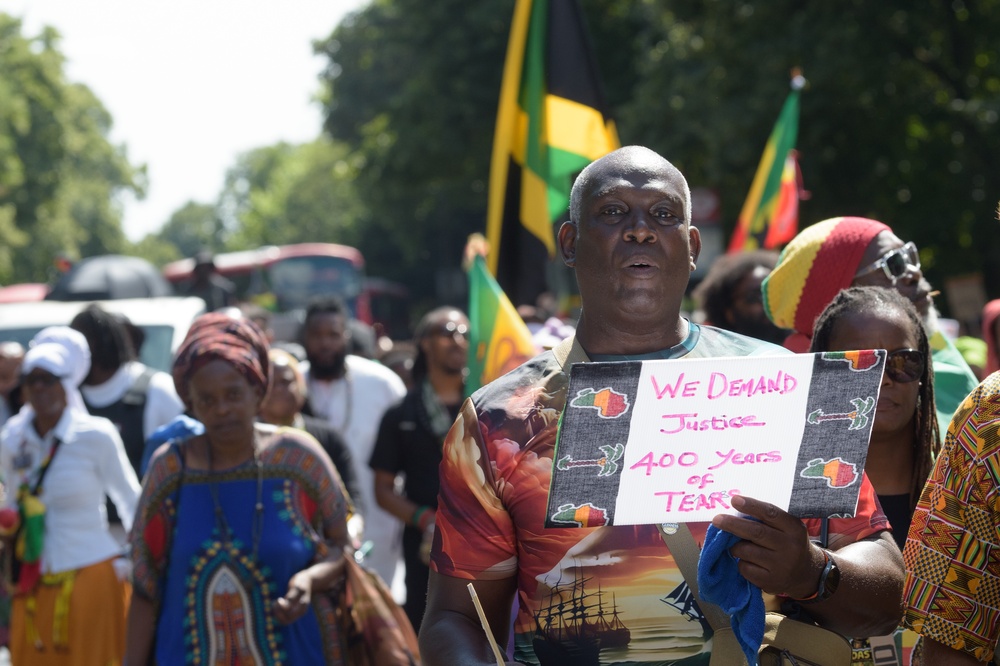
Demonstrators march through London on August 1, 2026, demanding reparations and justice for the historical legacy of slavery and colonialism. Photo: A Moses/Shutterstock.
Progressive economics has an imperial problem. It is possible to denounce inequality, defend redistribution, and criticize neoliberalism while preserving a deeper hierarchy: the presumption that experts, often based in powerful institutions in the Global North, can determine what justice should mean for societies shaped by slavery, colonial extraction, and imperial rule. The issue is not simply whether their intentions are good or their proposals sufficiently radical. It is who has the power to define the problem, decide which histories count and prescribe solutions after short field visits or, worse, on conference calls, before those most affected have determined the terms of repair.
This contradiction is particularly visible in debates about reparations and climate finance. Universal basic income, public ownership, cheaper credit, and expanded development finance can all be useful demands. None, however, returns stolen land, reverses accumulated colonial wealth, repairs ecological destruction, or restores collective authority over political and economic life. Redistribution and reparations can reinforce one another; they are not interchangeable. When the former is offered as a substitute for the latter, progressive universalism becomes a way of setting aside historically specific claims.
I encountered this argument during a debate about reparations in 2020. A senior economist asked where reparative claims should begin and end, questioned the feasibility of identifying descendants of enslaved people, and suggested universal income or shared dividends funded by wealth taxes as more practicable responses. The framing exposes an asymmetry: Why must restitution meet an exceptional test of feasibility while universal redistribution is treated as a reasonable starting point? Who decides which demands are too complicated to count as politics?
The point is not to dismiss universal social provision. It is to insist that the injuries of empire cannot be reduced to unequal household incomes. Colonialism reorganized property, labor, public finance, land tenure, and the authority to govern. Repair must be capable of transforming those relationships, not merely compensating people for living within them.
At a conference on African economic sovereignty in Dakar in 2022, I heard related arguments from progressive economists who treated nationalization or the green developmental state as ready-made alternatives to reparations. State ownership and planning can be indispensable instruments of transformation. Yet our meeting in the Museum of Black Civilizations was a striking setting in which to overlook the intellectual traditions and struggles through which African peoples have articulated their own visions of sovereignty. A model developed in one context does not become universal because its advocates consider themselves anti-neoliberal. The question is who defines the political horizon, and whose knowledge is allowed to unsettle it.
A similar dilemma runs through the international sustainability industry. Island and African societies confronting climate disasters are surrounded by consultants, conveners, investment platforms, and intermediaries promising innovation. International collaboration is not inherently objectionable. What matters is who controls the agenda, data, networks, and resulting resources. When communities supply experiences while outsiders translate them into fundable or bankable projects, an old division of labor survives under the language of partnership.
The Bridgetown Initiative brings these contradictions into focus. Barbados Prime Minister Mia Mottley has rightly drawn attention to the global financial system’s unequal treatment of climate-vulnerable countries. The initiative has pushed sovereign debt, liquidity, Special Drawing Rights, and multilateral development bank reform onto an international agenda that too often marginalizes small states. Yet recognition of an unjust financial architecture is not the same as transforming the relations of ownership and creditor power that sustain it. Expanded access to finance can leave the underlying distribution of wealth, risk, and power largely intact.
Consider what financial innovation means when disaster strikes. After Hurricane Beryl in 2024, Grenada activated a disaster clause that deferred debt-service payments. This created fiscal breathing room, but deferred payments were added to principal: relief in the timing of repayment, not cancellation of the obligation. Jamaica, meanwhile, received no payout from its catastrophe bond after Beryl because the contractual trigger was not met. Severe damage and financial eligibility are not the same thing.
Jamaica’s catastrophe bond subsequently paid out following Hurricane Melissa in 2025. That matters, and it would be misleading to suggest that these instruments never deliver resources. But the contrast between the two hurricanes sharpens the political question: Why is access to relief determined by predefined contractual thresholds rather than by the full extent of social need? A payout can be useful while the design of the instrument, its cost, its exclusions, and its distributional consequences remain open to criticism. Financial triggers are political choices, not laws of nature.
More fundamentally, why should societies that contributed so little to the climate crisis have to purchase protection against its consequences or assume further obligations to reconstruct after catastrophe? Debt pauses, contingent insurance, and additional lending may help manage immediate liquidity. They do not, on their own, undo the colonial and postcolonial processes that made public budgets fragile, infrastructure unequal, and coastlines vulnerable to extraction. An architecture organized around the next emergency risks treating the repeated production of vulnerability as a technical problem rather than a political relationship to be dismantled.
The critique cannot stop at international creditors. Caribbean leaders may invoke reparations on global stages while failing to confront land dispossession, concentrated ownership, and the exclusion of communities from decisions at home. Demands for justice from former colonial powers are legitimate and overdue. They do not exempt postcolonial governments from accountability for their own alliances with developers, financiers, and extractive industries. More money passing through the same structures of power does not necessarily produce more justice.
These questions connect Caribbean debates to African struggles over debt and restitution. The African Union made reparations for Africans and people of African descent a central theme in 2025. That agenda intersects with disputes over sovereign debt, resource extraction, the cost of capital, and the terms on which African states enter international markets. Across both regions, the question is not merely whether creditors can become more generous. It is how histories of colonial accumulation shaped the present distribution of wealth and risk—and who now possesses the power to change it.
There is also a tension between the reparative language of some political leaders and the demands of people confronting dispossession from below. Colonial rule organized economies around the extraction of labor and resources; independence did not automatically end that organization. Where postcolonial elites renew extraction through new partnerships and instruments, repair cannot be reduced to negotiating better terms for the same arrangements. It must ask who owns land and infrastructure, who defines value, who sets eligibility rules, and who decides what development is for.
What, then, would a different internationalism require? The Caribbean political economist Norman Girvan offered the language of “universality in diversity.” This is not an argument against shared emancipatory commitments. It is a refusal of the notion that every society must follow a single model formulated in a privileged intellectual center. A defensible universalism must emerge through exchange among different histories and political traditions, not through the export of supposedly complete solutions.
In practice, this means recognizing land defenders, workers, farmers, pastoralists, fisherfolk, Indigenous authorities, disenfranchised young people, and community organizers as producers of economic and political thought—not merely witnesses whose testimony experts interpret. It means communities exercising real authority over research agendas, ecological knowledge, budgets and the decisions that affect their land and livelihoods. Participation without the power to refuse, revise, or redirect a project is not self-determination.
It also requires changing the instruments and institutions of repair. Instead of asking only how to mobilize private capital, governments and international bodies should confront debt cancellation, grants rather than loans, land restitution and protection, public control of essential infrastructure, and community authority over reconstruction. Resources should sustain locally governed institutions and long-term ecological stewardship rather than subsidize projects designed elsewhere for private returns. These are not merely alternative funding mechanisms; they are different arrangements of power.
None of this romanticizes “the local” or assumes communities speak with one voice. Class, gender, race, indigeneity, and conflicts over land shape local politics too. Nor does it exclude economists, scientists, or lawyers from meaningful collaboration. Their expertise can be valuable when it is situated, contestable, and accountable to collective decision-making, rather than elevated above it.
The sequence must change. Instead of beginning with a universal instrument and asking communities to demonstrate their eligibility, begin with the histories, demands, and governing capacities of those confronting ecological and economic crises. Ask what they seek to repair, which institutions obstruct that repair and what material resources would enable them to exercise power. Only then ask which economic tools might serve those ends.
The imperial privilege of progressive economics lies in the authority to parachute in “feasible” solutions while treating the people whose lives are at stake as an afterthought. Good intentions cannot redeem that hierarchy. Repair demands more than a new vocabulary for development or more humane management of debt. It requires transforming the structures of ownership and knowledge that allow some to prescribe the future while others are expected to live with the consequences. The responsibility is not simply to listen, but to return power—and to change the conditions under which decisions are made.