We are not a novelty
Trans and gender diverse people are routinely told that what they are is new. In South Africa, they have not merely survived history, but they have also shaped it.
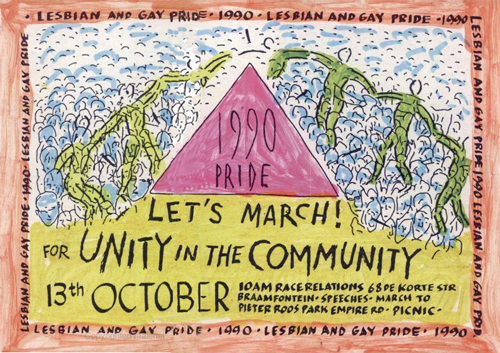
The first gay liberation march in Africa led by the lesbian activist Beverly Palesa Ditsie, the Theologian Dr. Hendrik Pretorius, Justice Edwin Cameron and the gay activist Simon Nkoli on October 13, 1990 in Braamfontein, Johannesburg, South Africa. Source: Wikimedia Commons.
Trans and gender-diverse people are routinely told that what they are is new—a sudden emergence, a recent contagion. In South Africa, this claim circulates with increasing force: In the surge of Christian fundamentalist organizing against trans rights, in the transphobic slurs directed at a trans contestant on Big Brother Mzansi earlier this year, and in the pronouncements of prominent political figures who have characterized transgender rights as a form of “woke” ideology. The implication is always the same: that we are a novelty. And novelties do not deserve the weight of rights.
The historical record tells a different story.
In 1815, a young British military surgeon arrived at the Cape Colony. James Barry was cantankerous, flamboyant, and conspicuously short. During his time at the Cape, he performed what is believed to be the first cesarean section in southern Africa in which both mother and child survived. The child was named after him: James Barry Munnik, who would grow up to become the grandfather of J. B. M. Hertzog—founder of the National Party in 1914 and one of the principal architects of apartheid.
J. B. M. was also the namesake of the hertzoggie, the apricot-jam-filled tartlet. When he reneged on promises, the Cape Malay community responded with the twee gevreetjie: a coconut-topped protest cookie whose name means, in Afrikaans, “two-faced” or “hypocrite.” On the eve of his death, Barry made one request: that no clothing be removed and that he be buried as is. The request was not honored. It was discovered that Barry was what we might now understand as a man of trans experience. His legacy is deeply ambivalent—he was a colonizer, an agent of empire. But his presence in the historical record asks us to complicate our timelines.
In 1966, Joan Kruger, Edna Hobles, and Sonia Kola were arrested under legislation known as the Disguises Acts—a set of pre-Union laws dating back to 1891 that criminalized “masquerading as women.” The three were well known enough to have been featured in Drum magazine that same year. Joan and Edna were eventually released. Sonia was charged. The distinction was this: Joan and Edna had no prior arrests. Sonia did. And she would not stop wearing dresses. S v. Kola (1966) became the case that set the precedent for what would later be amalgamated into the Prohibition of Disguises Act (1969).
Access to alternatives was starkly racialized. Gender-affirming surgery had been available to white people in South Africa since at least the early 1950s, and by 1974 the state had become directly involved—funding reassignment surgery under the belief that it constituted a cure for homosexuality. For Sonia, as a South African of color convicted in 1966, none of that access was available. She had her dresses.
What the case produced was a legal trace that ran forward through decades of jurisprudence—cited by Edwin Cameron in arguments that extended constitutional protection of sexual orientation, and by Justice Laurie Ackermann in the majority judgment that gave that protection a broad reading. A case about a woman who would not stop wearing dresses became part of the constitutional fabric of the new South Africa.
In 1992, Michelle Emmerich—a trans woman, an ANC member, and a civil servant—faxed a proposed Gender Rights Article to the Convention for a Democratic South Africa (CODESA), hoping it would be included in the Bill of Rights. No one responded. She was told she was too emotional and should tone it down. In her own words: “I for one sticks out like a sore thumb. I have decided to call it a day. Just imagine, being the only [transgender] human rights activist in the ANC.” And so she quit, leaving almost no trail. That unanswered fax, now archived at Constitution Hill in Johannesburg, is a marker in the record, evidence that the argument for an expansive understanding of gender was already being made in 1992, long before it found a hearing.
Before any formal trans organization in South Africa, there was a small group known as the Phoenix Society—founded in the 1980s and composed of white transvestites, crossdressers, transsexuals, and those who called themselves “transgenderists.” They communicated through veiled messages in magazines and their own publication, FanFare. A short documentary about the group was made for the South African Broadcasting Corporation program 50/50—and never aired. Some members believe this was the result of an intervention by the apartheid security police.
The Phoenix’s membership is largely lost to history. But one name has survived: Charl Marais, who in his own words was “the only female to male person that they knew of and also, in that day and age, I was the only Coloured there.” Charl would go on to become a pioneering writer and editor of Trans: Transgender Life Stories from South Africa—one of the first works to put trans South African lives on the record, in their own words.
These are not the famous names. They are not the landmark cases. They are not even necessarily people with uncomplicated politics. But here is what their stories show: trans and gender-diverse people in South Africa have not merely survived its history—they have shaped it. The claim that trans identity is new is not only historically inaccurate; it erases a history of people doing the quiet, stubborn, necessary work of existing, and who, in doing so, shaped something larger than themselves.