The prosecutions that never happen
Nigeria’s anti-corruption agency secures thousands of convictions every year, but when it comes to politically-connected elites, it’s a different story.

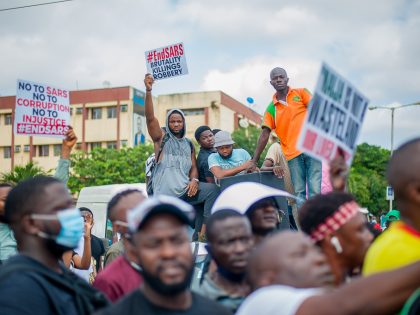
A protester holds a placard reading “No to SARS, No to Corruption, No to Injustice #EndSARS” during a demonstration in Lagos, Nigeria, on 13 October 2020. Source: Kaizenify / Wikimedia Commons
There is a specific kind of Nigerian newspaper headline I have been reading my whole life. It announces that a former governor, or a minister, or a director-general has been arraigned by the Economic and Financial Crimes Commission (EFCC). There are charges. There are counts. The accused person arrives in court in a well-cut agbada, surrounded by lawyers whose fees alone constitute a moderate corruption offence, and they plead not guilty, and the judge grants bail, and the case is adjourned. Then it is adjourned again. Then the administration that appointed the EFCC chairman that filed the charges loses an election, and the new administration appoints a new chairman, and the case against the former governor slows to a pace that makes geological time look urgent.
I am a law graduate. I graduated from the University of Uyo last year. My dissertation was about why this keeps happening, and whether the legal architecture of Nigerian anticorruption enforcement is designed to produce accountability or to produce the performance of accountability. I concluded, after two years of reading statutes and case files and civil society audits, that it is mostly the latter.
The argument is not complicated. Nigeria’s Economic and Financial Crimes Commission was established in 2002 and has operated since then under a chairman appointed by whichever president is in power. That president’s attorney general, a cabinet minister removable by the same president, can take over or discontinue any EFCC prosecution at any stage before judgment, without providing a reason. Five EFCC chairmen have been removed or resigned under circumstances suggesting executive pressure since 2003. The current chairman was appointed by President Bola Tinubu. His predecessor was appointed by President Muhammadu Buhari. The one before that by President Goodluck Jonathan. Each administration has, with minor variation, used the agency to prosecute predecessors and protect allies.
The EFCC announces that it secured over 3,000 convictions between May 2023 and May 2024, a figure confirmed in Freedom House’s 2025 Nigeria country report. This number has been cited internationally, in Freedom House reports and donor assessments, as evidence that Nigeria’s anticorruption effort is producing results. What those 3,000 convictions actually consist of: plea bargains, minor internet fraud cases, and first-instance verdicts that are overturned on appeal. Human Rights Watch found that since the EFCC’s founding, the agency has secured only four convictions against nationally prominent political figures, out of more than 30 arraigned.
Four. Across two decades. In a country where the National Bureau of Statistics has estimated that corruption costs the economy over $18 billion annually.
I want to be honest about what it feels like to grow up inside this. You learn to read the prosecution announcements as political communication rather than law enforcement. When the EFCC arraigns a prominent All Progressives Congress (APC) figure, you note that the Peoples Democratic Party (PDP) is probably gaining influence somewhere. When PDP members suddenly accumulate charges, you check the news for who won what election. The Afrobarometer survey from 2023 found that 76 percent of Nigerians believe the EFCC prosecutes based on political instructions rather than evidence. That is not cynicism. That is pattern recognition.
The formal legal problem is straightforward. The EFCC has no constitutional status. It exists by ordinary statute, which means the National Assembly that created it can amend or repeal it, and the executive whose chairman runs it can shape its priorities through appointment. The Independent Corrupt Practices and Other Related Offences Commission is constitutionally grounded and requires a two-thirds Senate majority to remove its chairman. The EFCC’s wider mandate, larger budget, and higher public visibility make it the more powerful of the two agencies in practice. But that same power sits on weaker institutional ground, since the president alone controls who runs it and how long they stay. Power without independence is what makes an agency useful as a political instrument, and on that measure the EFCC is the more exposed of the two. Nigeria has, in other words, invested heavily in the institution that is easier to capture and less heavily in the institution that is harder to capture.
There is a reform bill in the House of Representatives that would require the president to nominate the EFCC chairman from a shortlist presented by an independent selection committee. It has been read twice and referred to committee. It will, in all probability, die there. The people who benefit from a capturable EFCC are often the same people sitting on the committees meant to reform it. Several members currently serving on anticorruption oversight committees have themselves been named in EFCC petitions or investigations that never proceeded to trial. A body cannot be expected to legislate away the leverage that protects its own members.
What I keep thinking about, sitting with this, is not the politicians. They are behaving rationally given the incentives. What I think about is the intern at a ministry somewhere who knows where a contract was inflated, who knows which official received the transfer, and who is deciding right now whether to report it. And the thing that should make that decision clear, a legal system that actually prosecutes the corrupt regardless of their political connections, is not available to them. The EFCC’s convictions count includes their cousin’s boyfriend who got arrested for Yahoo-Yahoo. It does not include the person who stole from the hospital where their mother couldn’t get treatment.
The substantive law against corruption is not the problem. Nigeria has had clear statutory prohibitions on financial crimes since 2002. What is the problem is the law that built the EFCC, which handed appointment and removal power over the agency’s leadership to the same office the agency is meant to hold accountable. That is not a flaw in implementation. That is a design choice written into the statute itself, and it guarantees that enforcement bends toward whoever currently controls the presidency.
The prosecution that matters never comes. The case that should terrify the corrupt official managing a stolen contract, that case gets adjourned, or quietly discontinued, or never filed. The 3,000 convictions get announced. And somewhere in Abuja, a very well-dressed man in a very good agbada files a motion for an extension of time, and the lawyers bill their hours, and the judge adjourns to a date not yet fixed, and the money stays where it went.