On Safari
This publishing break, we contemplate why we’re all feeling so burnt out.

A North American icon. Photo by Simon Infanger on Unsplash
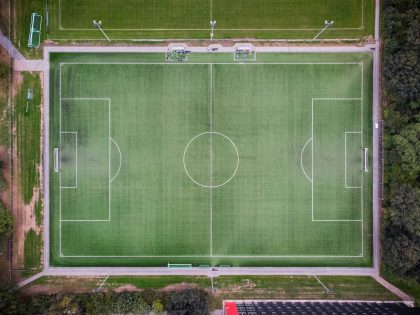
Ever since the World Cup concluded with Spain’s emphatic triumph over universally loathed Argentina (at least it felt this way), it has no longer felt like everyone is looking in the same direction at the same time. For a month and a bit, football’s biggest stage gave us one of the last remaining experiences of shared, global time. Not global justice, not global equality—the tournament is in many ways a monument to their absence—but a crude, synchronized schedule. Games at set hours, short-lived solidarities, the impression, however false, that the world is briefly doing something together, undergoing a collective experience.
Once that all ends, you’re plunged back into a social temporality and news cycle that moves at lightning speed and adjusting back is disorienting. It didn’t help that I had to deal with a debilitating case of cyclosporiasis (in an ill-fated decision, I tried some Taco Bell for the first time the day before my return flight back to South Africa, and getting a food-borne illness felt like an appropriate parting gift from a United States in decline). In the weeks since the World Cup, I found myself in a kind of fog I at first attributed to being exhausted from a busy year coupled with bouts of illness, but which, as I return to relatively decent health, I recognize as a familiar feeling, one that has typified contemporary experience for as long as I can remember.
There’s a book by the Polish sociologist Zygmunt Bauman which I think is underrated, and does better at capturing the texture of our epoch than many other attempts (do we live in late capitalism, surveillance capitalism, the burnout society, post-modernity, etc etc.). It’s called Liquid Modernity, and Bauman’s straightforward argument is that the defining feature of contemporary society is no longer the construction of stable institutions, identities, and social relationships, but their constant dissolution. Where the “solid” phase of modernity sought to build enduring structures—stable careers, lifelong marriages, nation-states, political parties, class identities, and fixed moral frameworks—our present condition is “liquid”: forms no longer retain their shape for long enough to organize human life. The contradictory result of this is that even though in many important respects, individuals have unprecedented freedom (at least compared to any other point in human history), it’s coupled with chronic insecurity and the burden of constantly having to remake ourselves.
One of his most evocative concepts is the notion of pointillist time, which is “more prominent for its inconsistency and lack of cohesion than for its elements of continuity and consistency.” Time under liquid modernity is fragmented and disconnected, and rather than unfolding as a series of events with some relationship to each other, it is rather a series of “eternal instants.” It’s not hard work to see how this characterizes so much of algorithm-dominated society in general, and our media consumption in particular. If it wasn’t hard enough figuring out what producing any meaningful “content” takes in the attention economy, it was dismaying for me to recently learn that even new media like podcasts and video essays are themselves now being repurposed in a “clipping economy” where increasingly, circulation of short clips from longer pieces is becoming the main event rather than previews.
At Africa Is a Country, we are very proud of our World Cup Road Trip series. Three episodes are live—Episode 1 on the Cabo Verdean diaspora in New England, Episode 2 on the affinity between Algeria and Lawrence, Kansas, and Episode 3 on Toronto’s Ghanaian community—with further episodes from the road currently in post-production. Although the website and our weekly newsletters remain our bread and butter, like most outlets, we are experimenting with different ways of reaching audiences, and short-form video has been one of them. The newsletter in particular functions as our most reliable direct channel to readers as social platform referrals grow less dependable. The World Cup, however, gave us a powerful on-ramp: sport brought in readers who might not otherwise arrive at a piece on visa regimes or xenophobia, and the coverage was built to convert that interest into political understanding.
What has been challenging is that discovery is now heavily platform-dependent, and the same work travels very differently depending on where it lands: our road trip episodes have found nearly 10,000 views on Instagram while the identical material moves far more slowly on YouTube. And we’re a small team that only ever has the capacity to make something and release it into the world once, maybe twice. How much labor is involved in reproducing countless clips from one piece, and circulating it on an innumerable number of platforms? Whatever it is, we simply cannot do it.
In fact, we are behind on our production and release schedule, and as is normal to do, we worry about whether the material will be stale by the time we are ready to publish it. To be sure, timeliness is always an objective in journalism, and has been before the age of platform dominance. In fact, what we are dealing with now is tougher to pin down. Bauman’s concept of pointilist time captures, on the one hand, the way discrete events move differently under liquid modernity, and how our sense of when things are happening is transformed. But algorithmic time also organizes the field of perception, i.e, our sense of where things are happening, or more precisely, of what is happening. In other words, the hyper-personalization of what we see means it is increasingly difficult to be certain that we are seeing the same thing, and interpreting the same set of events.
Naming what’s happened to our sense of what needs a different word, and the nearest one I can find is the concept of anamorphosis. Hans Holbein’s 1533 double portrait The Ambassadors is the textbook case. Two French diplomats flank a shelf crowded with globes and instruments, and stretched across the floor between their feet is a long grey smear that reads, from where you’re standing to look at the men, as nothing at all—a flaw in the paint, maybe. Walk up close and look from a sharp angle, low down on the right, and the smear resolves into a human skull, rendered in as much detail as anything else in the frame. Both images are actually there on the same canvas. Neither is a distortion of the other. Stand in one place, and you see two wealthy men and their instruments; stand in the other, and the whole painting turns out to be about death, and you cannot hold both pictures in your eye at once. So, the feed isn’t handing everyone a blurred or partial version of one picture. It’s resolving the same underlying material into fully coherent, mutually exclusive pictures, depending on where—which feed, which platform, which slice of the personalization engine—you happen to be standing at.
Although the World Cup directed our attention to one shared happening, what one’s experience of the World Cup largely depended on was whether you were simultaneously experiencing it online, and if so, primarily through which platform, etc. For example, while Argentina’s seemingly unsportsmanlike conduct and perceptions of favoritism made them wildly unpopular online, that didn’t translate for most regular people I spoke to who still associated it with Maradona and the global South and couldn’t believe anyone in Africa could cheer for Spain. Since at least Qatar 2022, the World Cup has increasingly felt asynchronous on this dimension, consisting of several overlapping tournaments, each with its own villains, injuries, scandals, and moral weather.
Now, of course, every attempt to make sense of the world begins from the fact that each of us encounters it from our own irreducibly subjective position. Human experience is always an exercise in interpretation: the attempt to establish shared meaning across common or divergent experience. What feels distinctive about the present moment, however, is that we are losing not simply a shared sense of time, but a shared world. Politics has always depended on more than disagreement. It has depended on the possibility that we are, in some meaningful sense, disagreeing about the same reality—that our arguments begin from a common object, however differently we interpret it. What has become fragile is the achievement of that common world: not identical beliefs, but enough shared ground to know that we are talking about the same events, inhabiting the same present, looking at the same object from different sides. At least in the group stages, the World Cup felt like it briefly restored a condition that democracy, journalism, and ordinary social life all depend on, namely shared attention. But as the competition narrowed and the algorithm regained its grip, the World Cup itself increasingly dissolved into the endless circulation of content, re-entering the attention economy as just another stream of commodities competing for visibility.
Perhaps the World Cup has simply become too big a spectacle, one exceeding our capacity to engage with it meaningfully at the scale it’s now played at, and perhaps the future will warrant a return to “doing things at human scale.” Staying with football: it’s felt, in recent years, like women’s football has become popular partly for this reason. This isn’t to make light of the real disparities in investment and coverage that still shape the women’s game. But there’s a sense in which it still feels within reach—legible at something closer to human scale, not yet fully run through the same algorithmic churn the men’s tournament now is.
Which brings me, with some embarrassment, to WAFCON. Morocco has been hosting the tournament since late July, and we’re already two days away from the semifinals—the tournament’s own answer to the question of scale above. Smaller broadcast footprint, thinner commercial saturation, a fraction of the men’s tournament’s algorithmic weight. It would have been the perfect subject for the argument I’ve just spent several thousand words making.
We have not covered it properly. Contributing editor Maher Mezahi has been filing dispatches on his podcast and newsletter, but the rest of us have been largely silent, and that’s doesn’t reflect anything except an editorial oversight. I don’t want to paper over it with a joke about being like tired footballers at the end of a long season, true as that joke also happens to be (and if only we had as many resources at our disposal). The honest version is that a small team, mid-fog, still finishing a World Cup series that had already outrun its own schedule, let a second tournament pass it by—which is, if I hold myself to my own argument rather than just making it, exactly what this piece has been describing. Not a failure of will, but what happens when the volume of things worth attending to exceeds what we can hold.
So, I end with an apology, and an announcement. We’re going on our bi-annual publishing break this week, later than planned and more tired than usual, in no small part because of everything above. We’ll be back with something on WAFCON’s back end—the final is on the 16th—and whatever else the world has rearranged the calendar around by the time we’re attempted to rest. For now the fog wins this round. We’re stepping out of it on purpose, rather than being carried along by it, which is about the only kind of victory on offer.