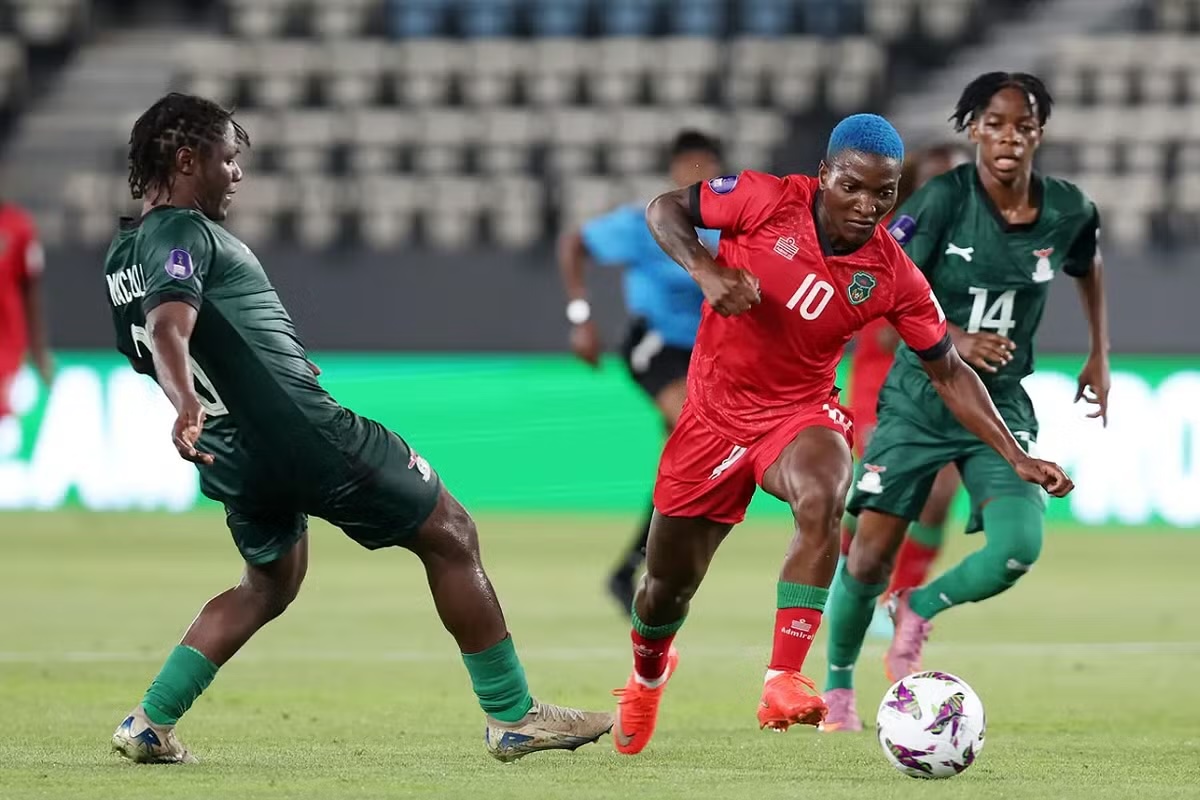
Image via CAF It flew under the radar, but last Wednesday evening may ultimately be remembered as one of the most consequential nights in African football in decades, and for two reasons that turn out to be the same story told twice. On a pleasant summer evening in Rabat, FIFA president Gianni Infantino and his secretary general, Mattias Grafström, attended the 2026 Women’s Africa Cup of Nations match between Malawi and Zambia. The FIFA executives were joined by their African colleagues on the FIFA Council, Royal Moroccan Football Federation president Fouzi Lekjaa, and Egyptian Football Association president Hany Abo Rida. It was striking to see Abo Rida in the stands while his own country’s team, Egypt, played its final group-stage match against Nigeria only a few kilometres away, a small but telling reminder that many of those who govern African football remain more absorbed by political manoeuvring than by the women’s game they were ostensibly there to support. When the broadcast cut to the assembled administrators, they smiled calmly, apparently untroubled by the political storm surrounding Infantino’s FIFA Forward Funds Enterprise proposal. The plan would have handed Trump-linked private equity firms partial ownership of competitions such as the World Cup, neglecting the long-term integrity of the game for corporate interests. Earlier that evening, a meeting had taken place at FIFA’s newly established offices just outside Rabat. Going into it, Infantino appeared to be in a precarious position. Both UEFA and the AFC had issued public statements expressing a lack of confidence in his leadership, and the Europeans had even suggested they were prepared to boycott FIFA competitions until he resigned. So Infantino turned to the support system he has spent a decade cultivating in Africa. Unsurprisingly, and unfortunately, he secured unanimous backing from Africa’s 54 member associations, the second-largest voting bloc in global football. Among colleagues, there is a running joke that CAF no longer exists in any meaningful sense, that it has effectively become “FIFA Africa,” since nearly every major initiative championed by Infantino has been embraced by the continental body without resistance, even when those proposals run counter to African football’s own interests. The African Super League is one example. Conceived as Infantino’s pet project to build a parallel tournament and inject private equity into African football, it made little sense to many observers on the continent and quietly disappeared after a single experimental edition, leaving behind broken promises rather than a legacy. The abandonment of the biennial Africa Cup of Nations is another, a shift driven largely by FIFA’s expanding grip on the international calendar. No one can deny that Infantino has mastered the politics of clientelism. Few administrators have understood so precisely how to convert institutional dependence into personal loyalty. To understand why Africa has stayed loyal to him, it helps to understand his role in reshaping CAF’s architecture in the first place. He was instrumental in forging the coalition that ultimately removed Issa Hayatou from power, and the continent’s current leadership owes much of its political capital to that history. As a result, Infantino appears, for now, to have survived the immediate threat to his presidency, though his protracted dispute with UEFA is likely to drag on for months. This same dynamic, a continental body too indebted to its patron to assert its own interests, is what made Wednesday evening notable for a second, more disquieting reason: the resurgent apathy of African football’s decision-makers toward the women’s game. Despite a field that included four of the world’s outstanding players in Temwa Chawinga, Tabitha Chawinga, Barbra Banda and Racheal Kundananj, the Malawi-Zambia match was played on a visibly pockmarked pitch, an unusual sight in Morocco, which has hosted this tournament twice before on surfaces that were consistently immaculate. If the pitches were neglected, it is hard to believe that happened by accident. Stakeholders suggest Morocco has grown dissatisfied with how it was treated following the 2025 Africa Cup of Nations final and has cooled on hosting continental competitions altogether, a theory that would also explain why the 2026 WAFCON was postponed from its original date in March. The state of the pitches was only one symptom of a broader pattern. Broadcasting agreements were finalized unusually late, television production has been substandard, and accreditation procedures have been plagued by avoidable delays and confusion. After years of steady progress, the Women’s Africa Cup of Nations is losing momentum as Morocco’s enthusiasm fades. Some will read this as an indictment of Morocco. It is better understood as an indictment of the rest of the continent. Morocco has hosted the last three editions of WAFCON precisely because so few other African nations have proven willing, or able, to stage the tournament, and the burden of hosting has fallen repeatedly on one country because no broader institutional commitment to the women’s game exists to share it. Domestic media are now reporting that Lekjaa is considering a run for prime minister. He would enter politics with considerable public support, since many Moroccans associate his stewardship of football with competent governance more broadly, including hopes that he might address the country’s economic challenges. Should he eventually leave football administration, women’s football in Morocco could lose one of its most influential advocates and a significant source of institutional backing. Taken together, these two threads describe the same institutional failure from different angles. African football has reached a genuine crossroads. The turmoil engulfing FIFA has opened a rare window for CAF to reassert itself as a body that places African interests ahead of FIFA’s political priorities, yet the early signs suggest those entrusted with leading the game have little appetite for such reform. FA presidents would rather remain in their comfort zone than do the more challenging work of putting Africa first and developing the game at every level. In this sense, the root of the deference to Infantino is the same that allows the growth of women’s football to slip down the list of priorities. The lack of urgency does not come from supporters or players. It comes from the governing institutions themselves, the very institutions built to protect the sport’s future. The only course left is to keep demanding better governance. African football deserves institutions that serve the continent rather than outside political interests, and African women’s football deserves leaders who match the ambition and excellence its players display every time they step onto the pitch. – Maher Mezahi, contributing editor |