Is football still capable of scandal?
From the Epstein files to a World Cup trailed by rape charges and a hush-money settlement, the public has gotten remarkably good at feeling outrage. What it hasn’t learned is what to do with it.
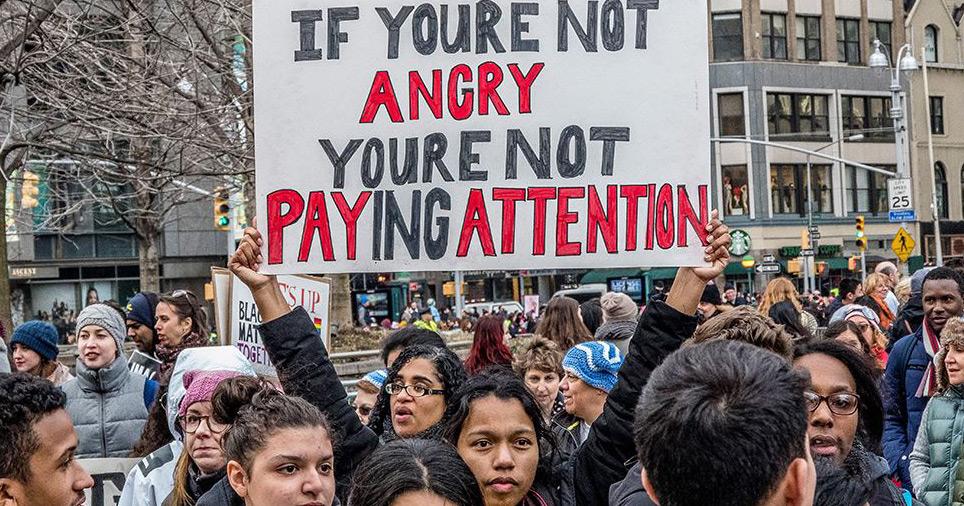
Demonstrators march at the Women’s March in New York City, January 19, 2019. Source: Fred Murphy.
Virginia Giuffre, Annie Farmer, Chauntae Davis, Jesse Michaels, and countless other women and girls were part of an international scandal that captured the public imagination in ways never seen before. And yet their names were barely mentioned. Earlier in the year, there was furious demand for the list of powerful men implicated in the Epstein files from all ends of the political spectrum. And the interest wasn’t just tied to the crimes themselves; it carried the hope that the exposure of the most visible and wealthy men in the world would lead to a reckoning akin to the #MeToo movement. What is implicit in this hope is that if there is accountability at the highest levels, then there would be a trickle-down effect that could assist in confronting the more quotidian and less publicized violence.
What the Epstein files made clear is that there is a distinction between society’s stated moral values and how those values are lived out.
However, that did not transpire. What did happen was the files turned into a spectacle. The anticipation for them, their release, their dissection, the jokes in between, the aftermath. And somewhere along the line, the victims were moved out of sight. Then people moved on. The focus shifted from the files to an ill-advised war against Iran, a green pool in the US capital, and the 2026 FIFA World Cup.
The period between the end of the World Cup and the start of club European football presents an opportunity to reflect on the tournament and all the events and discussions that occurred. One of the conversations that briefly captured the footballing community was the allegations of sexual misconduct against several footballers. Thomas Partey and Achraf Hakimi are facing pending criminal trials, Ryan Mendes remains under active police investigation, while players such as Junya Ito, Kaishu Sano, Andreas Schjelderup, Thiago Almada, and Cristiano Ronaldo have all seen their cases reach their legal conclusions.
These stories did not offer new revelations. But an update on the status of Hakimi’s case, as well as Canada’s refusal to approve Partey’s visa application, summoned the ghosts that have long haunted football.
FIFA, national federations, coaches, teammates, and media deferred to legality, recruiting the criminal justice system as a kind of Big Other, the final arbiter of truth, despite the awareness of its shortcomings and limitations. This is most clearly demonstrated in how the courts are tasked with providing assurances and resolving ethical questions that exceed their mandate of due process. In the interim, innocence was not only presumed; it was asserted.
And while there is a subset of the public that abides by this logic, it does not fully capture the rest of the football ecosystem. Many supporters expressed genuine anger and were vehemently advocating for the removal of these players from their teams. But as soon as the whistle blew, that indignation was muffled. And 90 minutes later, there was discourse around tactics, ref calls, VAR, substitutions, etc.
It raises the question: if there is enough consensus, why isn’t there coordination? What is it about football that allows us to know and yet continue as though we did not?
And the most curious of all, what if outrage is part of the entertainment?
Any answer has to begin with understanding the power of images. Jacques Lacan argues that human beings understand themselves and the world through the symbolic order.
Football is an image-making factory. The fancy footwork, the immaculate touches, the bicycle kicks, and the extra-time winners aren’t just about sublime technique. They become repositories through which spectators organize their ideas, desires, and fears. It is through the moments of magic in which fans come to identify with clubs, countries, and versions of themselves.
In Society of the Spectacle, Guy Debord furthers this point: ours is an age that prefers the sign to the thing itself, the copy to the original, appearance to essence—one in which, as he puts it, “truth is considered profane, and only illusion is sacred.”
So when the reality of rape accusations, FIFA’s corruption, capitalism, imperialism, racism, and labor exploitation threaten to rupture that “sacredness,” audiences respond with real moral outrage, but that rarely converts into sustained pressure. The viewer learns to live with the contradiction without allowing it to reorganize their participation. And this happens not necessarily to protect the players or FIFA per se, but to protect the enjoyment they produce.
That is how the story of Cape Verde became one of the underdog, of extraordinary heroics that transformed them into Africa’s footballing fairytale, and not one of a squad that fielded a player under investigation for rape.
That is how the story of Norway became one of history in the making, of Erling Haaland’s charisma and imaginary Viking boats rowing into the quarterfinals, and not one of a team that harbored a convicted sex offender.
That is how the story of Japan became one of model discipline and cleanliness in the stadium and in the locker room, and not the fact that they have two players accused of sexual assault.
This dynamic is not limited to sexual violence. Football has developed a remarkable capacity to move from one moral crisis to the next and absorb the scandals along the way. During this tournament, the focus shifted from the unfair treatment of the Iranian team to visa denials to the Balogun controversy and countless other flashpoints. The previous tournament revolved around Qatar’s labor exploitation, worker conditions, migrant deaths, and FIFA’s corruption. A similar pattern happens on a club level with incidents of racism, financial irregularities, and controversial sponsorships. Each issue, different in stakes and complexity, is treated the same. They command intense attention until something else happens.
But the issues themselves don’t disappear; they are temporarily suspended from collective consciousness until they get recycled again. Like the Epstein files, the condemnation they provoke becomes part of the spectacle itself. It is very predictable in its life cycle and its outcomes. Ultimately, the problems are not adequately addressed. It’s like a choreographed dance.
And when it comes to sexual crimes, audiences think of themselves as ambidextrous—that they are capable of taking the allegations seriously and enjoying the football, as if the two aren’t in conversation with one another. And unfortunately, spectacles of this nature have a tendency toward erasure. The victims are not only pushed to the background but they are almost rendered invisible. No names, no faces, and no specific stories. They are treated as placeholders and their lives are reduced to legal cases and another talking point.
MeToo was neither perfect nor immune from the dynamics of spectacle. It was introduced to the world through the experiences of famous, rich, white women, which overshadowed the grassroots work that the organization does on the ground. And because of the spectacle, it exists in the public imagination as an era and not a continuous movement that empowers victims to come forward with their stories. However, what distinguished it from a movement like Time’s Up is that it didn’t organize around what punishment perpetrators should receive; it dedicated attention to the agency and care of victims and survivors.
It did not hand over ethical responsibility to the courts, as it understood that courts are not designed to do that in the first place. Instead, moral duty was distributed across the larger social world. Sometimes convictions followed; oftentimes they did not. Some perpetrators lost their reputations while others lost their influence. Yet the movement’s ambitions never depended on those outcomes alone. It also created the conditions in which victims were no longer expected to remain invisible while institutions deliberated the fate of those who had harmed them.
The movement also offered pathways for restoration. After Megan Ganz publicly described the sexual harassment she experienced working for Dan Harmon as a writer for Community, the public discourse gave the two of them an opportunity to engage in dialogue, and Harmon responded with a sincere and rare apology to atone for his actions.
Returning to football, if the sport has ritualized outrage and the institutions can shrug it off, then the solution cannot be found in producing more outrage. Right now, discussions circulate around the idea of whether players should be allowed to play instead of considering why that has become the only point of inquiry.
The other instinctive response is often a boycott. But boycotting isn’t always the most practical or transformative solution. Sometimes it does the reverse of what it intends, and it can offer an easy way out. As mentioned earlier, football is entangled with so many emotional and psychic investments, and therefore boycotting as a political strategy will have the mammoth task of trying to get buy-in before it can even challenge institutions.
Placing steady pressure on FIFA and federations to develop a player policy is a worthy cause. However, it is also one that lends itself to institutional failure. It is a tough ask to demand that organizations properly adjudicate the conduct of their money-makers. It’s limping before it can be put to the test.
None of these interventions should be abandoned; they just cannot be exhaustive. Any solution should consider preventative measures and a different framework of engagement rather than being narrow and reactive. In fact, any intervention will have limitations. Football is deeply embedded within patriarchal structures, and eradicating the violence it produces ultimately requires a complete overhaul of gendered and racial hierarchies. That is not happening today, nor tomorrow, and it is unlikely that it will happen in this lifetime. But it doesn’t mean that reforms are meaningless or can’t produce measurable outcomes.
So the challenge is not to create a football free of contradiction but to interrupt the rituals that allow contradictions to become ordinary. That requires asking better questions.
How can football shift its attention toward victims without reducing them to spectacle?
What would collective action among the fans look like with this in mind?
And finally, what does accountability look like beyond waiting for FIFA or the criminal justice system to act?