No president will save Nigeria
Nigeria’s democracy has become dangerously fixated on capturing the presidency. Reviving regional politics may be the country’s best hope for rebuilding democratic accountability.
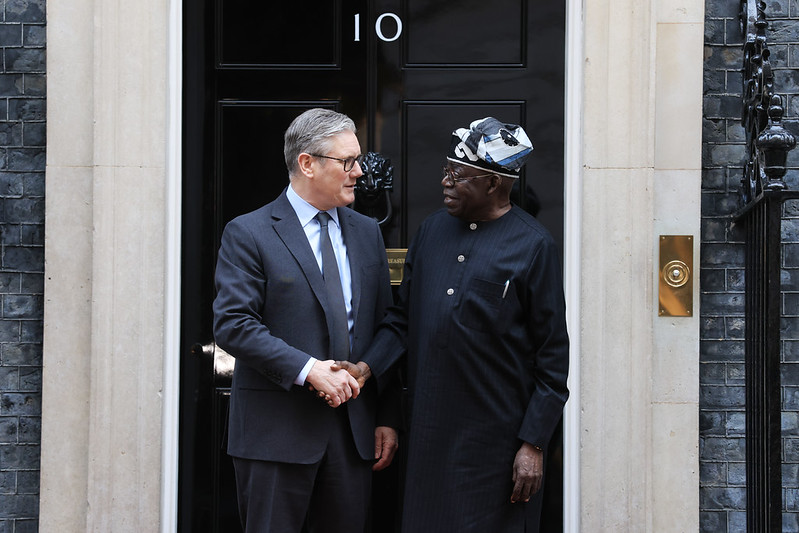
Former UK Prime Minister Keir Starmer welcomes Nigerian President Bola Tinubu to 10 Downing Street during Tinubu’s state visit to London on March 19, 2026. Source: Simon Dawson / No. 10 Downing Street via Flickr.
Nigeria’s political system is becoming more concentrated around the presidency, with weakening institutional and electoral competition since 1999. The 2027 elections may become the first real test of this new order. If current trends continue, it could also become the most dangerous.
The primary issue in this case is actually Nigerians’ imagination of what politics could be or should be. For much of the electorate, politics has come to mean little more than voting for or against executive candidates every four years, whether federal or state, while legislatures and parties have become comparatively weak sites of democratic accountability, as such day-to-day governance remains distant and unaccountable.
This has coincided with a gradual and continuous concentration of power inside one ruling party. As of May 2026, the All Progressives Congress (APC) controls the overwhelming majority of the state governors in Nigeria. Opposition governors continue to defect into the ruling party, often less out of ideological conviction and more for political survival and proximity to federal power. The old multiparty equilibrium of the Fourth Republic is continuously waning.
The country’s recent electoral history reinforces this pattern. Muhammadu Buhari’s 2015 victory was driven by a widespread belief that he represented moral rescue: an incorruptible figure capable of restoring order to a decaying state. This messianic framing elevated a single individual as the solution to systemic failure rather than strengthening the institutions meant to address it. Bola Tinubu’s rise in the 2023 electoral cycle reflected a different logic but produced the same outcome. His “emi lokan” (“it is my turn”) declaration framed the presidency as political entitlement owed after years of elite bargaining within the ruling party.
We are increasingly seeing similar patterns emerge around both Atiku Abubakar and Peter Obi. Around Atiku lingers the language of “his turn,” a belief that decades of political persistence and repeated presidential attempts have earned him the right to finally occupy the presidency. Around Obi has emerged an intensely emotional movement in which supporters often frame him as a moral corrective to the Nigerian state itself. Across personalist divides, presidential politics consistently produce the same presidential imagination: the belief that national redemption lies in one man capturing Abuja.
This expectation persists even though Nigeria already functions politically in a more fragmented way. Voting patterns in recent elections reveal strong regional concentrations of support. Peter Obi maintains significant influence in the South East and parts of the South South. Rabiu Kwankwaso commands a loyal base in the North West, particularly Kano. Atiku Abubakar remains politically relevant in the North East. Political loyalty, voting behavior, and mobilization are deeply shaped by regional dynamics, even when expressed through national elections. Yet these regional political realities are forced into a single presidential contest that rewards total national victory.
The cost of participating in this system reinforces its exclusivity. The ruling APC set the price of its 2027 presidential nomination form at 100 million naira. This figure is significantly higher than the total legal earnings of a Nigerian president over a four-year term. It is also far beyond the reach of ordinary citizens. With record inflation since the assumption of Bola Tinubu’s presidency and the severe collapse of working-class purchasing power, proximity to the federal government appears to many political actors as the only reliable route to financial security and influence.
Yet while politics becomes more expensive at the top, economic conditions continue deteriorating for ordinary Nigerians. The August 2024 #EndBadGovernance protests emerged from widespread anger over worsening living conditions after the removal of fuel subsidies and the floating of the naira. Policies designed to attract foreign investment instead intensified inflation and deepened hardship for millions already struggling to survive. Across the country, many Nigerians increasingly experience the state as an extraction site for the political class, who remain trapped within personality cults.
Within this context, the National Assembly has increasingly lost independence, operating largely in alignment with executive priorities. The APC dominates both federal and most state structures, leading to weakened legislative oversight and defections. The result is a system that is structurally concentrated and not fully democratic.
A more regionally representative political structure could potentially reduce some of these distortions. Regional politics would require less money, shorter campaign distances, deeper familiarity with local realities, and stronger governance credibility among represented populations. Politicians would be forced to maintain proximity to the people they claim to represent rather than disappear into distant federal power structures. Such a shift would not automatically eliminate corruption or political powerhouses, but it could weaken the dangerous overconcentration of political and economic power currently attached to the presidency and federal institutions.
If Bola Tinubu completes eight years in office while the opposition remains fragmented around presidential ambition, Nigeria could drift toward an effectively dominant-party system with little meaningful resistance at the federal level. The cycle would simply repeat itself in another election cycle: opposition figures exhausting themselves pursuing the presidency while gradually losing regional organizational strength.
Obi, Kwankwaso, and Atiku need to focus less obsessively on capturing federal power and more on consolidating genuine regional representation that could collectively form a formidable counterweight to whoever occupies the presidency. There would be a need to abandon the current obsession with presidential messianism for a politics that is more rooted in accountable political blocs with direct responsibility to their constituencies. Politicians would no longer campaign as national saviors promising miraculous transformation from Abuja. They would instead be compelled to negotiate, govern, and deliver within regions where their legitimacy is strongest.
Until political power is decentralized in practice, not just constitutionally, elections will continue to revolve around presidential capture rather than governance. Right now, presidential candidates are often too far removed from the people they claim to represent. Campaigns revolve around personality cults and messianic expectations rather than durable political accountability. The presidency turns every major politician into someone pursuing personal access to total power rather than someone building long-term democratic institutions. The future of Nigerian democracy lies not in endlessly fighting over Abuja but in weakening Abuja itself.
This would require a radical rethinking of Nigerian political culture: stronger regional autonomy, deeper local accountability, and reduced federal concentration. It would also require citizens to stop treating national elections as moments of emotional salvation. No president is coming to rescue Nigeria. As long as federal power remains the ultimate prize, politics will continue rewarding patronage networks, political dynasties, and financial gatekeeping over competence or ideas.