Had he been buried
Binyavanga Wainaina was cremated in a private ceremony in 2019. In his final year, the writer kept returning to a colonial chief’s grave beneath a sacred fig tree in Nairobi — as if contemplating what remains of a life.
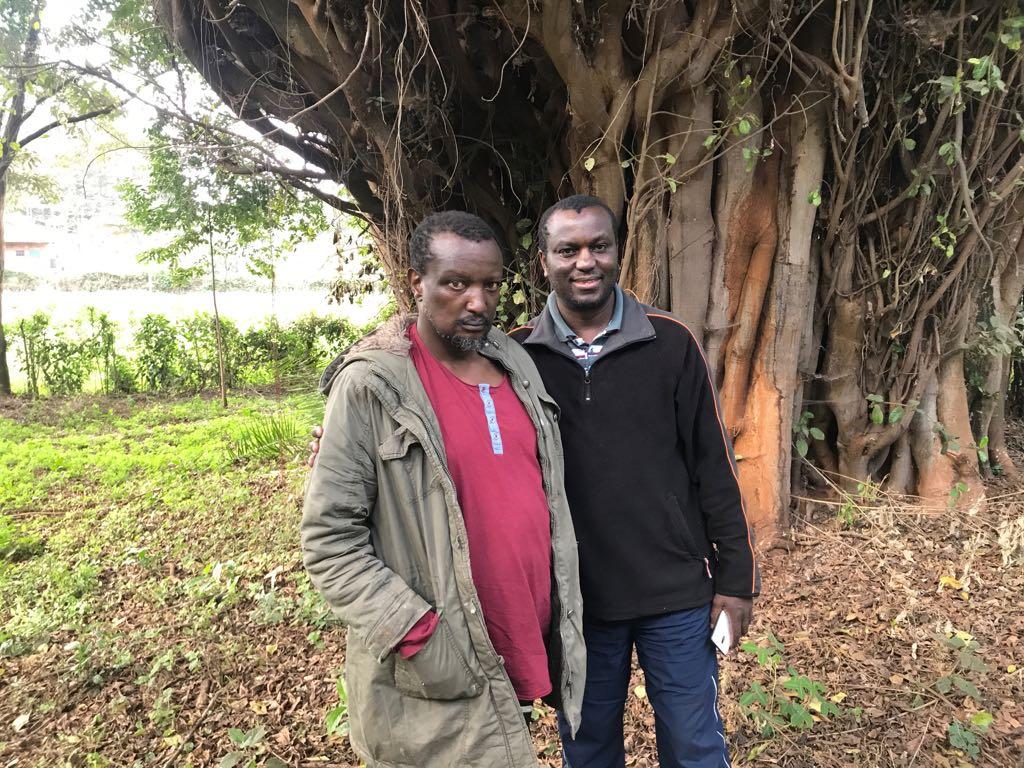
Binyavanga Wainaina and Njuki Githethwa, circa 2018. Source: Njuki Githethwa.
They came seeking solitude in a private family graveyard in our common neighborhood in Riruta, a suburb of Nairobi City, around mid-morning towards the end of September 2018. I was already there. My weakening eyesight could make out only images of two adults.
This is private land. They could be the owners of the land, I thought to myself.
I waved at them rapidly. They both waved back. I walked towards them.
“Oooh! So it’s you!” I exclaimed. These were not the owners of the land and the graveyard after all. It was Binyavanga Wainaina and his helper.
“You two know each other?” his helper asked.
“Of course!” I replied.
Binyavanga had changed a great deal since I had last seen him. The multiple strokes had severely incapacitated him. His speech came out in an agonizing slur. I tried to ease his discomfort by speaking more, compensating for his forced silence.
“Such vast private lands are uncommon in this city,” I observed. “In fact, they are abominable and unjustifiable in a metropolis like Nairobi bursting with deprived humanity.”
He nodded repeatedly in agreement.
There was a huge fig tree on the land. In African spirituality, the fig tree is sacred. Among the Agikuyu people, it is known as Mugumo. Our people once worshipped and offered sacrifices beneath Mugumo trees. We walked closer to it. Its enormous trunk was hollow, forming something like a passageway through the middle. I walked in and out of the trunk the way we used to do in our childhood among the giant podo trees along River Nanyuki. This particular Mugumo was immense, tall, wide, and commanding. Its huge branches spread outward like a canopy over a vast area.
“A Mugumo is never pruned,” one of the owners of that land had once told me casually. “Cutting it is sacrilegious and cursed.”
Such a sacred tree was best left alone, I thought to myself. It was an abode of ancestral spirits. But wait—as children, we had been warned never to walk seven times around a Mugumo. Boys, we were told, would turn into girls, and girls into boys. We did. Nothing happened. It was a myth, an old tale that could not contain the free and wandering spirits of our childhood. I had walked several times around this particular Mugumo in the neighborhood and I remained who I was. I felt only solace and solitude as I escaped into my inner self.
We held animated conversations beside the Mugumo for a long while, hardly noticing the passage of time. We spoke about literature, religion, politics, creative writing, African liberation, Mau Mau, Mwakenya, Kwani?, dreams, life, survival of artists, hope, and much more. Mwakenya was the underground socialist movement of the 1980s in Kenya whose members and supporters were brutally suppressed by the Moi–KANU dictatorship. Kwani? is the literary magazine Binyavanga co-founded in 2003 with his Caine Prize winnings, which became the crucible of a new generation of Kenyan and African writing.
Binyavanga barely spoke, his words still slurred, yet he nodded excitedly and often in agreement. His helper listened attentively. Meanwhile, I spoke endlessly, releasing words like a newly activated word processor.
*
I first met Binyavanga Wainaina in 2002 at a shopping mall in Nairobi during the Nairobi International Book Fair. He had just won the Caine Prize for African Writing. Literary excitement was palpable among the country’s literati. Fresh literary flowers had sprouted, blossoming with beauty and releasing a sweet fragrance, new expressions, new voices; a generation emerging from relative obscurity, as Frantz Fanon had prophesied, either to fulfill its mission or betray it.
Binyavanga was one of the key speakers at the opening ceremony of the book fair. He spoke eloquently about new and vibrant literary horizons and renewed hope in the country. Names such as Nameless, Kalamashaka, Ukoo Flani Mau Mau, some of the hip hop artists then dominating the musical airwaves, rolled effortlessly from his tongue like a staccato burst from a machine gun. In many ways, he himself was a literary machine gun.
“Why are we still trapped in old narratives about the past glory of African literature as if nothing new is happening?” he asked.
Why Are We So Blest? I recalled in the same breath the title of the novel by Ayi Kwei Armah.
Loud applause followed his speech, just as it was echoing across other literary and artistic spaces and sites in the country: Kenya National Theatre, Club Soundd, the GoDown Arts Centre, Sarakasi Dome, Kuona Trust, Kwani LitFest, a lot more.
We met again in 2004 at Jeevanjee Gardens in Nairobi during the Kenya Social Forum. He lingered at the back of the largely activist crowd. I thought he cut a somewhat forlorn figure.
“Another Kenya Is Possible” was the theme of the forum, attuned to the global call of the World Social Forum: “Another World Is Possible.” The local and global processes of the World Social Forum sought to locate and connect people’s struggles for a just world. Politics, we argued, must secure livelihoods. We spoke of climate justice, not merely the language of climate change. We spoke about struggles for food sovereignty, not simply food security. The earth was being decimated by capitalist greed. Soulless corporations, placing profits before people’s welfare, were driving the world towards the brink of extinction. Our world was dying. Progressive forces everywhere needed urgently to coalesce.
Binyavanga at some point later on wrote a post on how hard he had tried to be socialist “as a person of good conscience.” He observed that to many people, “progressive” meant being a socialist. He wanted to be “progressive,” but also believed that the fall of the left globally was real and that the left was fatally flawed. He believed we are in the era of the perfection of capitalism and that capitalism was the best way out for what he considered to be Africa’s century.
I differed with him on his faith in capitalism. I believe capitalism is a mortal disaster for humankind, and that socialism remains the alternative.
But we agreed on the centrality of literature. Literature does not merely fuel struggle; it is itself a vehicle of people’s struggles for freedoms and liberation. That was why we were at the event of the Kenya Social Forum—to locate literature within progressive awakenings, away from the cacophony of tribal politics in the country and the wastelands of art for art’s sake.
We exchanged contacts.
“I will send you the manuscript of my novel,” I promised.
“Sawa!” he said excitedly.
He left shortly afterwards. I remained. The Kenya Social Forum would continue for three more days, and I would stay throughout to help coordinate the event. I was happy to witness sites and spaces of people’s struggles for emancipation taking shape and getting grounded. The arts are the high priests of people’s struggles. Literature is their bishop.
I truly wanted to share with Binyavanga the manuscript of my novel. I never did. My life, like his, was then like a flickering candle in the wind.
We walked to the private family graveyard near the Mugumo tree. Graves of several members of the family that owned the land were located there. Binyavanga stood transfixed before one grave in particular. It belonged to a senior colonial chief who had once ruled this area on behalf of the colonial regime. The tragedy of the chief’s betrayal and treachery had finally come to this: a grave covered by mounds of soil and concrete.
I tried to read his gaze in my mind. The chief’s true legacy, I thought, was one of servitude to colonial masters and betrayal of his own people. I nodded inwardly. Traitors who sold their souls in pursuit of hollow glory, passing comforts, and obscene wealth. The tragedy of colonial betrayal still haunts this country and many other neocolonial states. But death remains the great equalizer for us all.
Binyavanga kept his eyes fixed on the graves for a long while. I wondered whether his mind was wandering as deeply as mine. Our gazes seemed both psychic and spiritual. My thoughts admonished me: So this is what most lives are finally reduced to—skeletons beneath the pride of flesh, memorial plaques bearing dates of birth and death, reminders of the vanity of human existence.
“Vanity of vanities; all is vanity,” says the Preacher in the Bible. “It is like chasing after the wind.”
For most of us, the graveyard is the final destination. Death humbles life. Death should compel us to reflect continually on the meaning and purpose of our existence. In the end, the memory of our lives either fades like passing clouds or endures like seeds that nourish future generations. Such is karma.
The mortal remains of the colonial chief lay in that graveyard discarded and reviled by many. His memory and that of his kind in the betrayal and treachery to the people only helps to fuel people’s struggles for a just society. The generational wealth and privilege inherited from colonial treachery may have survived him, but they too shall one day pass away.
Soon.
I later invited him and his helper to our apartment nearby. He touched the books on the bookshelf as though they were living spirits. In a real sense, books are the abodes of their writers, spirits in themselves, words made flesh and memory. I pulled from the bookshelf several of his works, one after another: Discovering Home; How to Write About Africa; One Day I Will Write About This Place; Beyond River Yei.
His face lit up instantly. His eyes moved, mesmerized, from the books to the bookshelf and back again. I could see his joy, his calmness, his deep sense of comfort. His eyes seemed to say aloud: There lies my literary legacy.
We later walked to his apartment along the main road. We lived in a working-class suburb. Nearby was a sprawling slum.
“I like it here more than anywhere else I have lived,” he told me as we entered his apartment.
The living room was furnished with antique pieces that gave the space both a traditional and modern feel. His MacBook laptop appeared to be the most modern treasure in the room. He strained his eyes while reading and typing; his eyesight was weakening. So was mine. I can no longer see distant objects clearly without glasses. I was not sure whether he owned a pair of reading glasses.
He showed me his bedroom. It was a tidy mess. Books lay everywhere, exciting titles, mostly fiction and creative nonfiction. Some had been gifts from friends.
“Pick any you may want,” he told me.
I was tempted to take A Brief History of Seven Killings by Marlon James. But I did not. I thought I would pick it later. I did not even pick it up when we returned afterwards. Some books carry spirits better left to haunt their authors and owners.
We then headed for a rendezvous at Dagoretti Corner. We partook of lots of nyama choma and mutura, washed down with drinks and laughter wrapped in silence. Nyama choma is grilled meat, and mutura is a Kenyan sausage; both are staples of Nairobi’s social eating. We spoke nothing there of our pet talks on literature, African liberation, African spirituality, and such heavy topics, choosing instead to relish our food and drinks in measured quietness. Outside, along the main road beyond the restaurant, weary laboring masses trudged home from the daily drudgery of sustaining this unequal country and materialist society.
As evening reached its climax and darkness descended, we moved to Dagoz Artists Bar close by for a night of live music. The space was tiny and intimate. The artists performing on the main stage were as much part of the revelry as the audience itself. Anyone with a voice could burst into song, however coarse or unpolished. The main stage was within reach of everyone inside, part of the collective repertoire. Our table, like the others nearby, seemed almost an extension of the stage itself.
We bellowed out the words of our favorite songs alongside the performers, shouting ourselves hoarse in the attempt. The din of drunken voices and clashing sounds was an exercise in glorious discordance. Loud talk and shouting seemed the only acceptable means of communication there; quiet conversations were out of place. The cacophony of voices and sounds beat like a riot of sound, yet somehow it grounded our solitude and tethered our restless artistic spirits to a sense of order.
The music went on even after the session artists had left the stage. We could still hear it from outside as we departed singing along. We drove back with the rhythms and voices still drumming through our minds, soothing us into the calm of the night and into deep sleep.
*
Binyavanga returned another day to the private family graveyard, this time alone. From a distance, I saw him standing transfixed, staring at the grave of the colonial chief. I thought perhaps his spirituality was reawakening in ways he himself could no longer clearly express in his condition. He had once written about his spiritual Sangoma in South Africa who had advised him to return home and honor his rich ancestral lineage.
He called it African spirituality. I understood it, too, as a return to the roots of African civilization—back to narratives of African victories, not merely of conquest and defeat; back to multiple African narratives. Narratives of order, dignity, and peace before slavery and colonialism. Narratives that ask difficult questions: Why were we enslaved? Why were we colonized? Why do we continue allowing ourselves to be recolonized?
No wonder the Mugumo tree occupies such sacred importance in the spirituality of the Agikuyu people. It defies both time and territory. It is said that the Mugumo under which Dedan Kimathi worshipped in the forest while leading the Mau Mau war for independence in Kenya fell soon after his capture by colonial forces. Dedan Kimathi was the field marshal of the Kenya Land and Freedom Army popularly known as Mau Mau. He was captured in 1956 and executed by the British colonial regime in 1957. Indigenous trees are living connections to our spirituality, to our ways of being, to memory and identity.
Wangari Maathai came to mind, embracing a huge tree in her struggle for ecological justice. The graveyard, too, spoke of return, going back to the soil, forever nourishing Mother Earth.
“For dust you are, and to dust you shall return,” the priest at the Catholic church across the main road often intoned from the Bible at the beginning of the Lenten season.
African spirituality converges with the sanctity of the soil, replenishing our lives. Our existence moving endlessly in cycles of birth and death; birth and death again, the eternal rhythms of earthly life. Why trouble yourself? Why worry? I thought Binyavanga’s Sangoma would have rejoiced.
*
I walked back with Binyavanga to his apartment, somehow feeling revitalized. He too seemed renewed, especially in the way we both jovially greeted folks in our neighborhood, most of them only casual acquaintances. His generosity and capacity for love were legendary in many ways. The doors of his heart were wide open to anyone capable of being loved. “Could you be loved,” Bob Marley would sing of such spirits. Binyavanga’s helper could attest to this.
At some point, Binyavanga received funds from his family’s inheritance. I accompanied him to the office of his family’s lawyer in Westlands area in Nairobi to sign documents releasing the inheritance. He had mentioned that the lawyer’s office was near a Mugumo tree in Westlands. I had never imagined that such a sacred fig tree still existed within the city. I do not know whether it is still there today.
Later, I accompanied him and his helper to his bank in the Karen area of Nairobi. I believed he transferred a decent sum of the funds to some of his close friends and a lover. Once Binyavanga’s heart and mind settled on something he wanted, he became stubbornly resistant to caution or advice.
He seemed to have got a decent amount from the inheritance. He inquired about investments in land to settle among his close friends near Nairobi National Park. He dreamed of building there a beautiful villa attuned to his tastes, blending antique elegance with modern architecture. I was of little help in matters of land investment. I could neither advise him nor claim any experience of my own in such matters.
I was not able to accompany him and his helper later that evening for dinner and an outing at a top high-end hotel in the city. They bought lots of exquisite items at the hotel that night. In a rush to please his helper, Binyavanga bought him a pair of expensive leather boots late at night. They discovered the following day that the pair of boots were mismatched. He would often give his helper his ATM card to withdraw cash for him. Many times, I was worried that his generosity might someday be taken advantage of, and that the helper might disappear on him. I suspect that this eventually happened, when his helper switched off his phone and vanished from contact altogether. I have neither seen nor heard from him ever since.
*
We shared several wishes between us. Binyavanga spoke of his desire to learn the Dholuo language.
“That might be too late now,” I said.
“Nooo!” he replied, gesturing emphatically in disagreement with my incredulity. I noticed that his calmness and joy were beginning to fade, and I quickly corrected myself in jest.
“At least for me. I have almost given up the effort of learning another language. Another of my wishes is learning to play the guitar. Another is to swim without a floater.” He giggled.
There were many unfulfilled wishes within us. Binyavanga’s age and mine were already nearing the halfway mark toward the sunset of our lives.
But you have achieved more for African literature in such a short time. You have truly lived your life. I did not say these words aloud. I was speaking to myself. He might have mistaken them for flattery. He was often a pace-setter, bubbling with ideas and projects that others eventually fulfilled. I suppose that is how legacy and heritage are secured.
“Asante!” I told him.
He looked at me intensely, struggling to express himself.
“Thank you too,” he said, his slurred words carrying a deep inner turmoil.
I could feel his frustration at being unable to communicate effectively. It was uncharacteristic of the man who in the recent past had dazzled audiences with eloquent speeches. But I am a believer that better and brighter days are still ahead of us. I downloaded an online guidebook by the Stroke Association: Helping Someone with Communication Problems—Together We Can Conquer Stroke. I promised myself that in the days ahead I would read it carefully and learn how better to communicate with him. I never did. Another of my wishes quietly passed away.
*
I was away on work outside the city for about three weeks. Around the same time, Binyavanga had traveled to Rwanda for the burial of an uncle. When we both returned, we somehow failed to reconnect.
“He has traveled to the coast for a vacation,” his nurse told me.
He remained vibrant on social media throughout the trip. I followed him mostly on Facebook, where he posted photographs of himself and his companion strolling leisurely along the shores of the Indian Ocean, staying at one of the luxurious hotels on the Kenyan coast. The pictures showed his efforts to remain calm, joyful, and at peace with himself, living life as fully as he could despite his failing health.
I imagined the other escapades they might have engaged in at the coast. They would don safety gear before hopping onto a speedboat, floaters fastened reassuringly around them. The boat would surge into the deep sea, rising and plunging against the huge waves as they exclaimed in fear, awe, and excitement. Then a dolphin would suddenly leap out of the water in a graceful somersault. Another would follow, then another, until several dolphins were performing what seemed like a perfectly choreographed spectacle. Aware perhaps of the human gaze upon them, the creatures would intensify their display. Dolphins, it is said, are among the cleverest creatures in the sea. One would leap, then another, and another still, their performance lingering until the speedboats disappeared into the horizon.
They might also have witnessed another spectacle, this time closer to the shore. Snorkeling through the shallow waters, they would see countless small marine creatures crawling and drifting beneath the surface, dazzling in every imaginable color, shape, and pattern. The experience would have been immaculate, a refreshing bliss. We should crown such stories with a cold beer when we meet again, I wished.
But that wish, too, never came to pass. Shortly afterwards, his health deteriorated and he was hospitalized. I visited him at the hospital a few times. Access to him there remained largely a private family affair, limited to a handful of close friends. We did not see much of each other again.
I was later away in Johannesburg for a period of further studies.
“I love Johannesburg,” he had once told me during one of our conversations. “I would like to buy a house there. I love the vibe and spirit of that city, a city for free spirits.”
I often moved around in Johannesburg, or Joburg, as it is fondly called. I met friends he would have loved to meet. I saw and lived in houses and estates that would have suited his tastes. I wandered through art galleries and bookshops he would have lingered in for hours. I attended jazz sessions and absorbed the loves and contradictions of that vibrant city, perhaps much as he would have done himself. I listened to fiery discussions on African liberation politics, subjects he followed with keen interest. In more ways than I could imagine, Binyavanga accompanied my thoughts throughout my stay there.
*
Clues of the sad news first came through a missed call from Isaac, our mutual friend and one of Binyavanga’s closest companions. I called him back, but there was no answer.
I grew disturbed. Why would Isaac call so unusually early?
Shortly afterwards, I read the news. Binyavanga had passed away. He had been frail and ailing, but I had hoped he would prevail, as he had triumphed in so many other battles before. The literary world still looked forward to his boisterous spirit, his gregarious presence, and the boundless imagination that helped spark a literary renaissance in our country, across Africa, and within international literary circles. Death does not equalize such souls. His spirit had already triumphed.
“I have fought the good fight, I have finished the race, I have kept the faith.” The priest at the Catholic church across the main road in our suburb often recited this line from the Bible for souls such as his.
*
From Johannesburg, I followed online the celebration of Binyavanga’s life at the Kenya National Theatre, where family, friends, and hordes of admirers gathered not in grief alone, but in affirmation of the immense spirit he had shared with the world.
“We must free our imaginations,” he had urged in one of his final videos. “Celebrate my life. Do not mourn me,” he had also declared boldly on Facebook.
Binyavanga was cremated in a private ceremony. At the time, I did not fully grasp the significance of that final act, but over the years, I have often found myself wondering: Would he have wanted his mortal remains laid to rest in a graveyard? When he would return to the private family graveyard in our shared neighborhood and stand there for long moments, transfixed by the graves before him, was he contemplating the physical form of legacy and remembrance? Would he have preferred a gravesite where his many admirers, friends, and fans would gather to pay their respects? Perhaps. Perhaps not. His family and those closest to him knew better.
What matters most is that his spirit endures, in memory, in literature, and in the enduring company of remarkable African writers who refuse oblivion. Though his body returned to ashes, his words continue to breathe among us.
Had he been buried, I might have proposed his epitaph, borrowed from the Italian writer Oriana Fallaci:
To write is to die a little less when I die, to leave the children I did not have, to make people think a little more.
*
I recently returned to our shared neighborhood. The private family graveyard is still there. The remains of the colonial chief still lies beneath his slab of concrete, his name and dates fixed into stone, reviled, unvisited, and largely forgotten, while Binyavanga, who has no grave at all. is visited every day by readers across the world who pull his books from their shelves, as I still pull them from mine. His resting place was never a graveyard. It was always language.
The Mugumo still stands, unpruned and sacred, its hollow trunk opening like a doorway between worlds, the living and the ancestral. Some spirits require no grave to mark where they rest. They live in stories, in words, and in the quiet defiance of memory.