Anticolonialism in the age of fragmentation
The violence unfolding in Mali reflects a deeper political impasse: how to sustain popular aspirations for emancipation without collapsing into military authoritarianism.
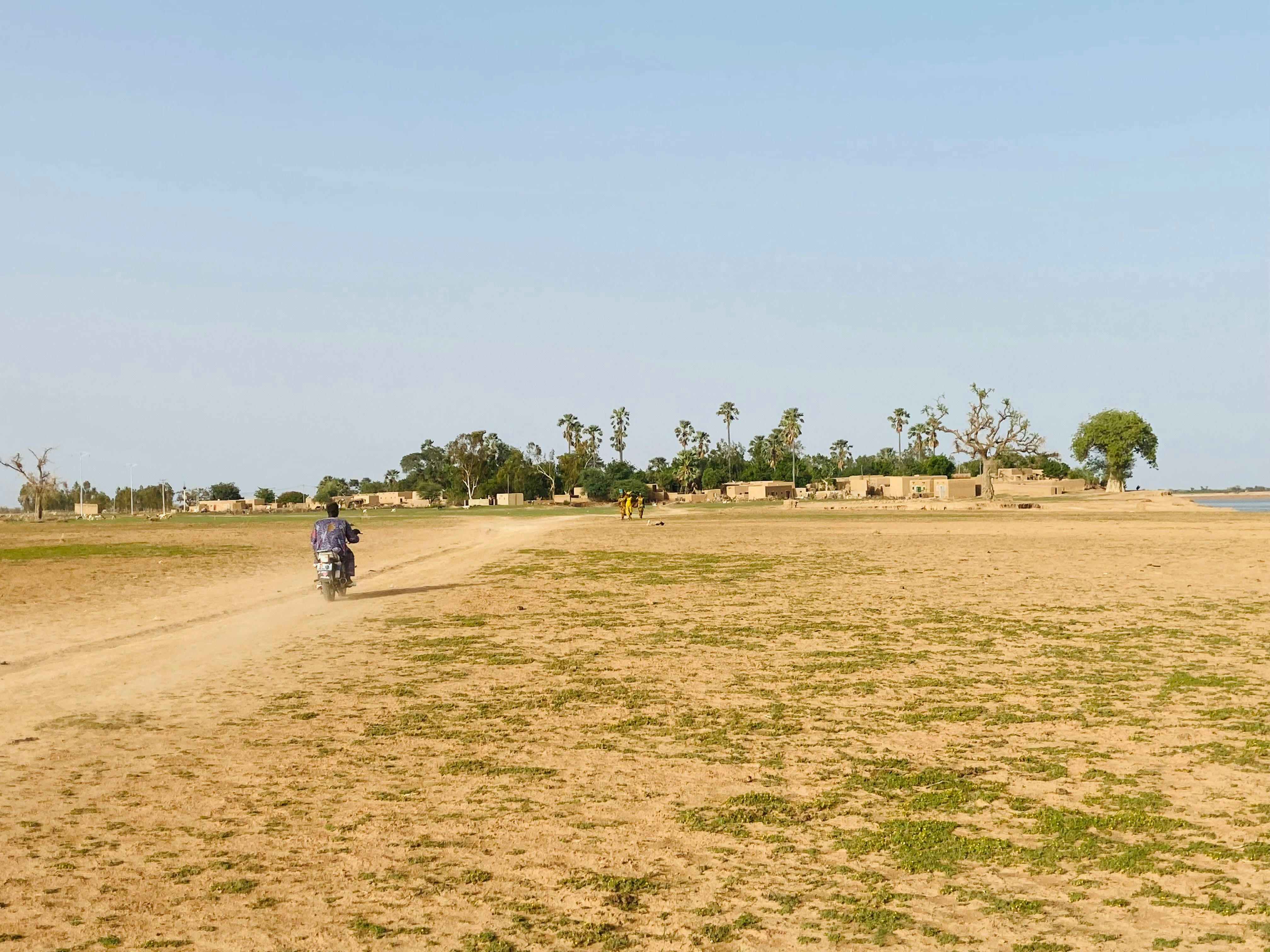
Photo by Kagou Dicko on Unsplash.
Bamako seems to have returned to its own rhythm. Schools have reopened after two days of national mourning, and movement into and out of the city continues. Yet only two weeks ago, on April 25, a suicide vehicle crashed into the residence of the Minister of Defence, Sadio Camara, killing him along with members of his family.
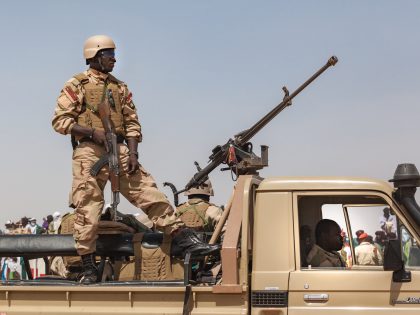
The attack was claimed by the al-Qaeda-affiliated coalition Jama’at Nusrat al-Islam wal-Muslimin (JNIM), which, on the same morning, opened fire near Bamako’s airport, as well as in Sévaré, Mopti, and Gao: from south to north, along the Niger River. That same day, in Kidal, 250km north of Gao, the separatist Azawad Liberation Front (FLA), allied with JNIM, entered the city and claimed its capture. The army, backed by the Russian Africa Corps, managed to avert a possible coup d’état, but the situation remained unclear in the days that followed, particularly in the north.
Videos of armed JNIM members on motorcycles circulating through Kati—home to the country’s main garrison—quickly spread worldwide. After days of silence, on Tuesday April 28, President Assimi Goïta addressed the nation, stressing the gravity of the situation and calling for national unity.
A few hours later, another video circulated online, in which a JNIM spokesperson addressed Bamako’s residents to announce the imposition of a blockade on the city: nothing would be allowed in, and those who left would not be able to return. This is not the first time Malians have endured such pressure, navigating crises ranging from threats of blockade to prolonged fuel shortages. But the threats are now closer; the strain is intensifying, and so is the risk of reaching a breaking point.
Messages of unity and support have multiplied across Malian social media, including within the diaspora. In Paris, the High Council of Malians in France organized a mobilization on May 2, attended by political and civil society figures. At the same time, broader questions are emerging: what are other countries in the region doing in response to these events?
One answer points to recent political ruptures: Mali, Burkina Faso, and Niger expelled MINUSMA forces, withdrew from ECOWAS, and entered into diplomatic confrontation with states such as Côte d’Ivoire, Algeria, and Mauritania. These developments may help explain the caution observed in the immediate aftermath of the attacks.
More recently, however, different positions have begun to emerge. Algeria has signaled support under conditions of dialogue, while Senegal has expressed a more direct commitment to Mali’s fight against armed jihadist groups. This leaves open, however narrowly, a space for shifting alliances and strategic positioning within the region.
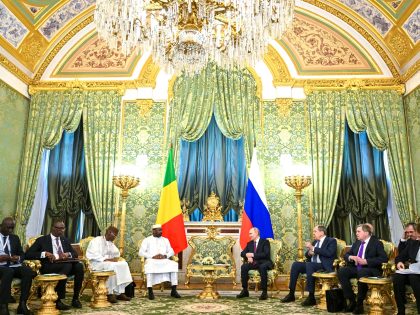
The Malian authorities have yet to respond. They will likely maintain a firm position, particularly regarding Algeria. It is precisely this firmness that has contributed to the circulation of figures such as Assimi Goïta and Burkina Faso’s Ibrahim Traoré as symbols of liberation across the region and beyond, as their stance comes to embody broader demands for sovereignty. While Russian propaganda has helped amplify these images, such political aspirations were already at work.
From the mobilizations that preceded the military takeovers, a vocabulary of decolonization, sovereignty, and pan-Africanism has re-emerged across Mali and the wider region. These terms have become part of everyday political language, expressing widespread demands for autonomy in political, economic, and security decisions. In this sense, the turn toward new alliances, including with Russia, can also be read within longer historical trajectories, particularly the memory of the years of independence.
History, in this context, is not simply a background reference, but an active political force. It shapes how positions are taken, how alliances are imagined, and how conflicts are framed.
The attacks of April 25 bring this dynamic into sharp focus: the involvement of FLA alongside JNIM reveals how separatist claims and jihadist mobilization can become entangled, pointing to a deeper, unresolved political configuration through which the current conflict must be understood.
More than a decade after the 2012 rebellion, what remains unresolved is the position of Tuareg communities within the Malian state—not only as a matter of security, but as a deeply political issue shaped by colonial borders, uneven incorporation into the post-independence state, and recurring cycles of marginalization and revolt.
Referring to a single “Tuareg question” risks obscuring this complexity and, more importantly, reinforcing the idea that a collective identity can be mapped onto a fixed territory. Northern Mali, like the rest of the country, has long functioned less as a space of separation than as one of overlap, where multiple communities live across shared landscapes that cannot be reduced to singular identities or exclusive territorial claims.
Within this landscape, armed groups such as JNIM have been able to anchor themselves in pre-existing political fractures, drawing on unresolved grievances while advancing a fundamentally different project—namely, the imposition of Sharia law across the Malian territory. Their project is not reducible to these grievances, yet it takes root and expands through them, as suggested by their alliance with FLA.
If these underlying issues remain unaddressed, the risk is not only the persistence of armed insurgency, but the deepening of a broader spiral—one in which political grievances are increasingly reframed through ethnic categories. This dynamic is already unfolding. Fulani communities, in particular, have been exposed to forms of collective targeting linked to their perceived association with jihadist groups, while Dogon civilian populations continue to face deadly attacks. The danger is that these cycles of violence become increasingly ethnicized, opening the way to new forms of territorial fragmentation.
This is precisely where the role of the state becomes critical. In Mali, political imaginaries have long insisted on forms of unity that are not based on ethnic exclusivity, captured in recurring slogans such as “unity in diversity.” This vision is a national principle that today aligns with broader political aspirations—decolonization, sovereignty, and pan-Africanism—that have regained force across the region.
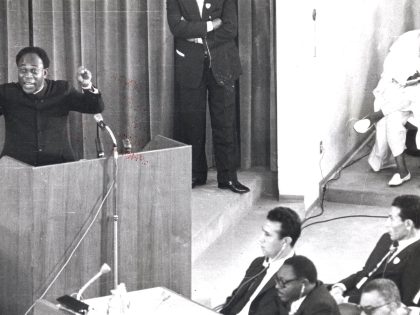
In many ways, these aspirations also echo the political languages of the post-independence period, when projects of emancipation, sovereignty, and African socialism emerged alongside strong state-led forms of political organization. The current military regimes mobilize a similar vocabulary, while also reproducing some of the authoritarian practices that marked several post-independence governments, including censorship, repression, and political control. Looking back, these contradictions may appear easier to identify and judge.
In the present, however, the situation remains politically unresolved. Preserving this non-identitarian political project has become increasingly urgent in the face of expanding violence and growing pressure on the population. At the same time, supporting the Malian authorities’ current position risks reinforcing an increasingly authoritarian turn. This is precisely what makes taking a clear position so difficult: how to engage with political aspirations that resonate far beyond Mali, without reducing them either to military rule or to a simple opposition between support and condemnation.
Politically and strategically, what is required is a form of engagement that rejects both disillusionment and Mali’s isolation. It is true that much of the country’s current isolation results from decisions taken by the military authorities themselves. But reducing the present situation to those decisions alone risks overlooking the broader political terrain in which they emerged and, above all, the population that continues to live through their consequences while continuing to invest in political aspirations that cannot be reduced to the regime itself.
For African intellectuals, political actors, and regional movements, this may be precisely the moment to place Mali back at the center of political debate. Not to legitimize military rule, but to refuse the growing isolation and disillusionment surrounding the country. Doing so means reopening difficult debates around borders, territorial integrity, intercommunal relations, and the legacies of colonial rule.
Reopening these debates through Mali’s current situation will not resolve the crisis overnight. But it may be one of the few ways to prevent Mali from sliding further into fragmentation and exhaustion, while keeping open horizons that resonate far beyond the country itself.