Beyond independence
The post-colonial settlement has left Africa vulnerable to conflict, external pressure, and intellectual dependency. What comes next?
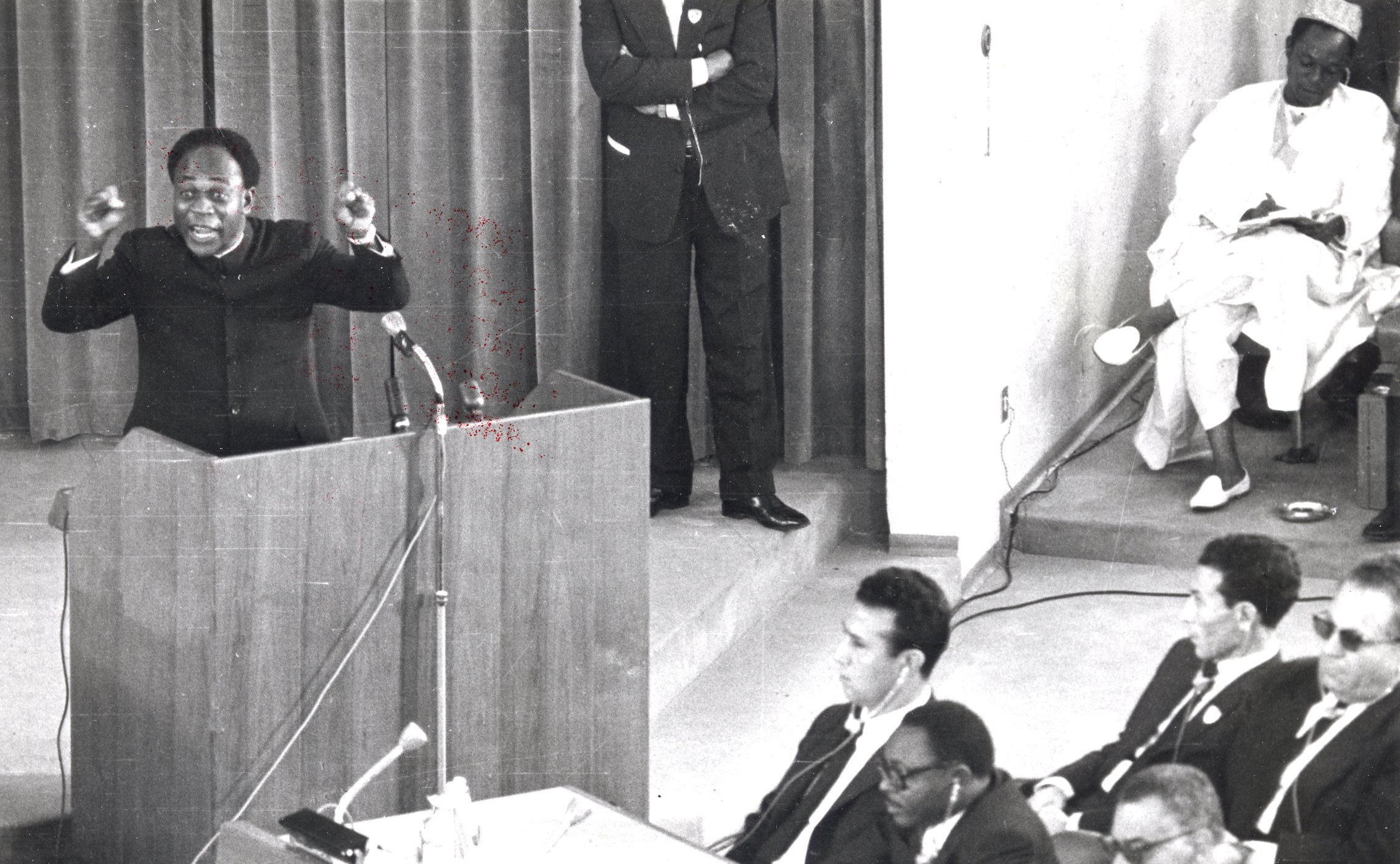
Kwame Nkrumah at the OAU 1963. Image via @GhanaianMuseum on Twitter.
As Africa marks its 65th year of independence, the evolutionary framework chosen at the dawn of this era has failed; now only a revolutionary-pragmatic path can secure the continent’s future. The African Union must reimagine regional integration, prioritize human dignity, and undertake a genuine decolonization of knowledge.
The year 1960 was widely celebrated as the year of Africa’s independence, with seventeen African countries gaining freedom from European rule. Three years later, the Organization of African Unity (OAU), the predecessor of today’s African Union, was founded with 32 member states. The leaders, many of whom were the founding fathers of their newly independent nations, gathered in Addis Ababa with enthusiasm, fervor, and a profound sense of possibility. Yet this enthusiasm was rooted in an optimistic belief in evolution rather than revolution. Compromise and cooperation were prioritized over more transformative alternatives for building a new Africa.
At its first summit in Cairo, the OAU adopted a charter that laid out seven foundational principles to guide the political direction of the postcolonial era. These principles can be summarized as follows: unity and sovereignty, a commitment to decolonization and the anti-apartheid struggle, respect for existing borders, non-Interference in internal affairs, and pan-African cooperation and economic development.
This evolutionary path was championed by the Monrovia Group, leaving an unmistakable imprint on the post-colonial trajectory. In his detailed account of the OAU compromises, Colin Legum documents the debates between the Casablanca and Monrovia blocs leading to the 1963 Addis Ababa Charter. The post-independence evolution of the continent was largely driven by a French-educated elite, notably the conservative leaders Léopold Sédar Senghor and Houphouët-Boigny, who resisted any genuine push for liberation. The outcome bore the clear hallmark of the Monrovia position: it was conciliatory rather than militant, idealistic rather than pragmatic, conservative rather than revolutionary, and—most crucially—it compromised on the single most fundamental issue that should have marked a rupture from the colonial past: the inherited colonial boundaries.
Not all Africans were convinced by these limited forms of independence. The revolutionary camp—politically expressed through the Casablanca Group, wanted a political union and subscribed to the idea that “the state and the party are one and the same.”Members were compelled to compromise rather than persuaded. Nevertheless, its intellectual tradition flourished, captivating the imagination of the masses at home and in the diaspora with visions of healing and rebuilding a new Africa. There was Cheikh Anta Diop, who grounded African unity in a shared cultural, linguistic, and civilizational heritage; there was President Sékou Touré, who insisted on radical political sovereignty and the dignity of the African person; there was Kwame Nkrumah, who exposed the contradictions inherent in the principles of political independence without economic liberation; and Patrice Lumumba embodied the cost of resisting neocolonial entanglements.
If Sékou Touré was the most iconic political embodiment of this orientation, Cheikh Anta Diop was its most dedicated intellectual advocate. In his seminal book The Economic and Cultural Basis for a Federated State, he argued that African unity cannot be a mere political agenda but must instead be a cultural revolution anchored in historical facts and a civilizational renaissance. Seven years before independence, Diop warned his fellow Africans of the danger posed by France: “Of all the European powers that dominate Africa, France is one of the most colonialist—if not the most colonialist.” In under Alarm in the Tropics, Diop warned Africans about the dangers looming in the aftermath of colonialism, emphasizing the need to confront questions of religious and cultural longing and belonging across the Sahel, Libya and Sudan. Like Nkrumah, Diop was right: many post-colonial challenges could have been avoided had Africa embraced a unified, borderless political union.
After sixty-five years of independence, the evolutionary path has proven faulty and disastrous for Africans. In hindsight, it may have been premature to celebrate independence, as mere anti-colonial solidarity was not a sufficient foundation for the moral and institutional architecture of the OAU. None of the main five founding principles, except the commitment to decolonization and the anti-apartheid Struggle, paid dividends to Africa. The continent consistently ranks low on all economic indicators and experienced an estimated 164 intrastate armed conflicts between 1960 and 2017. Conditions are worsening as Africa becomes increasingly entangled in the mercies of foreign dictates from NGOs, the EU, the World Bank, and the IMF. Recent conflict trend analyses reveal that in 2018 alone, Africa experienced 21 civil conflicts—the highest annual number since the colonial era. Even the most revered OAU principle, the rejection of new sovereign states, was disregarded by its own members. Eritrea seceded from Ethiopia in 1993, and South Sudan from Sudan in 2011. In addition, there are the de facto independent regions of Somaliland and the Sahrawi Arab Democratic Republic (administered by the Polisario Front).
The principle of non-interference was a failure of judgment, detached from the lived reality on the ground. As tribes and political groups continued to mutate from their original colonial arrangements, neighboring states repeatedly deployed their armies or proxy forces to pursue regime change next door—such as in the case of Idi Amin in Uganda and Tanzania’s intervention in 1979. Armies also crossed borders to seize territory for mineral extraction, as Rwanda did in the Democratic Republic of Congo, or to extend regional influence, as Algeria has been doing in northern Mali.
The former colonial powers were not exempt from such violations either: France intervened in Côte d’Ivoire to remove President Gbagbo in 2011, and again in Mali in 2013 to shape political outcomes. Moreover, NATO intervened in Libya in 2011 to oust Colonel Gaddafi. It is as if the African Charter was adopted only to be repeatedly violated.
Nowhere is the ineffectiveness of the African Union more visible than in its indifference to the ongoing crises in the Sahel region, where nearly eighty million Africans in Mali, Niger, and Burkina Faso face the daily, relentless violence of terrorism. The AU is paralyzed by its own logic of neoliberal idealism. It remains absent, caught in the contradictory stance of refusing to engage the three governing leaders in the name of not supporting military coups while also refusing to engage the jihadists under the pretext of not talking to terrorists. This represents a clear institutional failure, and inability to address the lived realities of Africans. For instance, it has no representative in the US-brokered framework to address the current crisis in Sudan, while Saudi Arabia, Egypt, and the UAE all do.
An institution is better served by articulating inspirational principles than by promoting charters it cannot enforce. The former strengthens credibility; the latter exposes weakness and undermines legitimacy. This tension helps explain why the African Union has grown increasingly ineffective. The failure of the evolutionary path has also allowed Western narratives to frame Africans as inherently poor administrators and to portray disorder as a natural condition of the continent.
Evidence of this condescension is abundant. In President Richard Nixon’s White House tapes (1969–1971), he refers to African diplomats as “childlike,” “not ready for responsibilities,” and even claims that “the Africans just can’t run things.” Nixon was clearly exploiting Africa’s troubled post-colonial trajectory to recycle long-standing US racial stereotypes about Blacks. The United States was not alone. Two decades later—during Africa’s so-called “lost decade” of the 1980s—French writers Patrick Chabal and Jean-Pascal Daloz further patronized the continent. In their rhetorical provocation, they asked whether Africa “really works,” before condescendingly concluding that disorder in Africa constitutes a functioning order.
It is precisely against this backdrop of external paternalism and internal stagnation that a new direction becomes necessary. A revolutionary-pragmatic path is, in fact, a return to—and modern synthesis of—the Casablanca Group’s ideology as championed by Nkrumah, Touré, and Diop. What would it mean for Africa to declare its independence again? I cannot offer a full blueprint, but I can say unequivocally what such a declaration must entail.
It must be revolutionary and pragmatic in regional integration, mirroring the vision of united African states. It must focus on repairing internal deficits rather than merely responding to Euro-American shortcomings in Africa. Fostering regional integration should reflect the vision of African mobility and migration. Decolonizing African knowledge should be grounded in Africa’s own historical past, rather than allowing it to emerge solely from the narratives of catastrophes produced by Europe’s hegemonic relationship with the continent, such as the transatlantic slave trade, colonialism, and neocolonialism. In practice, this means prioritizing national languages, valuing skills over degrees, and privileging know-how over mere knowledge. The pragmatic path also requires looking outward for comparable, non-neoliberal models.
Looking toward successful and comparable models, not idealistic neoliberal utopias is imperative. Both China and India are comparable to Africa in terms of population and post-colonial ambitions. China has a population of 1.4 billion people; India has roughly 1.47 billion; and Africa has about 1.55 billion. By 2050, one-fourth of the world’s population will be African, surpassing both China and India.
The longstanding emphasis on human dignity in African languages and cultural practices offers a compelling starting point and deserves a central role in this discourse. In the nineteenth century, the Moroccan historian Aḥmad ibn Khālid al-Nāṣirī questioned the European-promoted value of freedom, arguing that it emphasized access and convenience rather than genuine human freedom of action—an orientation he viewed as the antithesis of the divine virtue of justice. This raises a fundamental question: with the failure of the liberal order in Africa, what kind of human virtue should Africans prioritize, one that still preserves the role of freedom? To remain faithful to a revolutionary principle, Africans should choose the Chinese model: the virtue of human dignity should take precedence over the virtue of human liberty, assuming, of course, that true human dignity does not exclude human liberty
To uphold a pragmatic approach to this principle, the dominant discourse on Africa must also address the persistent confusion between what is Arabic and what is Islamic—an issue that has had catastrophic consequences in the Sahel and Sudan. Central to these tensions is the absence, or failure, of the Africanization of Islam. This demand is not unusual: in Europe, Christianity was Europeanized; in Iran, Islam was Persianized; in Turkey, Islam was Turkified. The success of any religious tradition in a given region depends on its capacity for local adaptation. The continual attempts to exempt Africans from this natural process of religious domestication have been a root cause of some of Africa’s most enduring conflicts—Sudan being the clearest example.
In contrast, Sufism in Senegal and the Gambia, for instance, stands out as a successful model of religious adaptation. While it is true that Sufi movements pioneered the domestication of Islam in the Africa, the rise of Political Islam has continually challenged this project of Africanization. Consequently, Political Islam has become a threat to Africa’s quest for a unified spiritual and political horizon.
The revolutionary-pragmatic ideal is best embodied by African musicians. No group of Africans has been more pragmatic about what the continent truly needs than its musicians. Like the griots of yesterday, they remain rooted in tradition while mastering the possibilities of modernity. Whether of the diaspora or at home, they inspire pride and cultural dignity, mourn national suffering, and envision unity that transcends borders and ethnic lines. Diop was right to say that:
When the African get out of his secular routine and begins to compose music in accordance with a defined method, he will easily attain a level of musical expression which, while retaining what it has in common with Jazz in terms of sensitivity, will possess something more dignified, more majestic, more complete, more occult.
I remain loyal to an older conviction: modern Africans might have been better served by the wisdom of their musicians than by the directives of post-colonial politicians. Musicians are often more revolutionary in their convictions and more pragmatic in their craft. From Alpha Blondy in Ivory Coast to Tilahun Gessesse in Ethiopia, and from Miriam Makeba to Bob Marley, the message has remained consistent: love and African unity beyond boundaries and the confines of the nation-state. It is no surprise, then, that politicians committed to an evolutionary, incremental model often found themselves at odds with these musicians.
For example, when President Senghor and his closest confidants, Abdu Diouf and Jean Collin—a French bureaucrat and colonial holdover who effectively ran the country’s daily affairs for years—would tolerate no overt criticism of France, the musician Ouza Diallo offered a dissenting reply in a song: “Wallu, wallu, wallu: toubab yaa ngi nagou sunu alal” (Help, help, help: the white men are draining our wealth). The song was informally banned from Senegalese airwaves, pushing the artist into self-exile in The Gambia, where his sorrowful voice could be heard only through Gambian radio broadcasts. As the ballakh rhythm swells, the trembling voice of the artist continues to recount Africa’s malaise, Europe draining what belongs to Africans: diamonds, gold, petroleum, coffee. And so, Africa cries for Wallu. Wallu, an old Wolof term, is the call one neighbor makes when another is being victimized by someone stronger.
But for Senghor and his loyal partisans, Wallu against France was unthinkable—an echo of the revolutionary path for Africa that he had long resisted. He was a profoundly conservative leader who celebrated African cultures as symbols yet remained resistant to any genuine push for Africa’s departure from French orbit.
The question is not whether Africa can repeat independence, but how it can achieve an independence grounded not only in freedom from external powers but also in the creation of self-determined and united African futures. In a world at a crossroads, Africa must transform its approach to regional governance and continental development. The continent should embrace a revolutionary-pragmatic path: fostering regional integration, prioritizing human dignity, adapting religion to local contexts, and building knowledge systems that address internal deficits rather than merely respond to external critiques. True independence will not be measured solely by the absence of colonial oversight, but by Africa’s ability to shape its own institutions, secure its own peace, and chart a united, self-determined future.