The music is not yours
On the latest AIAC podcast, the gang from the Nigerian Scam explores how Afrobeats got globalized, who captured the value, and why the party may be ending.
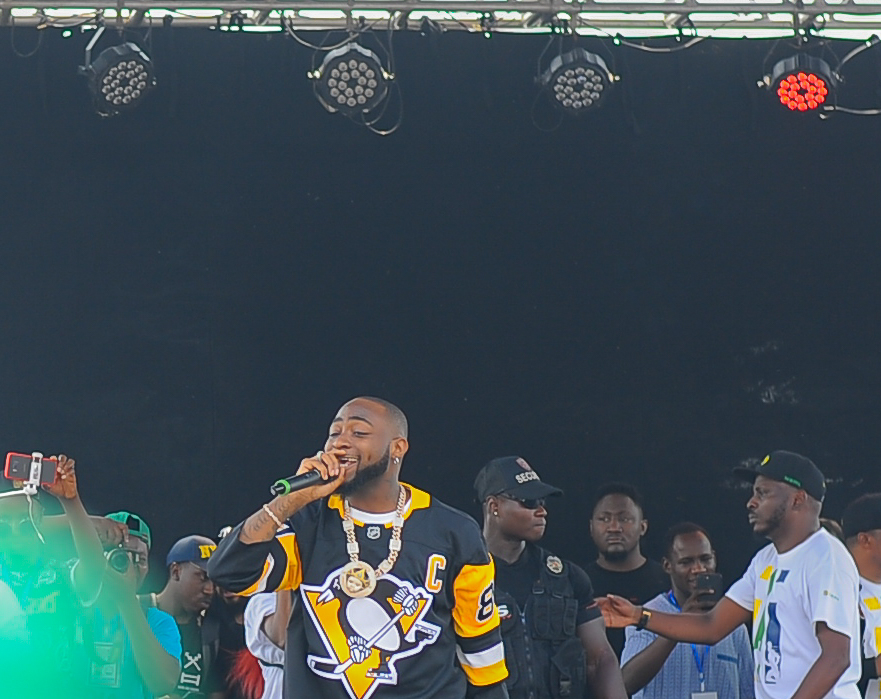
Davido performing at the Lagos City Marathon. Credit Kaizen Studios via Wikimedia Commons CC BY-SA 4.0.
Our most recent recording features the celebrated Nigerian poet, psychiatrist, and music critic Dami Ajayi. The major thread of discussion centers on the evolution of Afrobeats—its origins, global rise, and current uncertainties. Ajayi argues that what is now called “Afrobeats” emerged through a mix of local innovation, diaspora influence, and global market forces, rather than a clean lineage from Fela Kuti’s Afrobeat. He highlights key turning points such as the late 2000s shift in Nigerian listening habits, the 2012 breakout generation of artists, and the role of streaming and international labels. While acknowledging the genre’s global success, he expresses concern about creative stagnation, commercialization, and weak value capture for Nigerian stakeholders, suggesting that the industry may be entering a plateau phase shaped as much by global capital as by local artistic direction. We also briefly reflect on Ajayi’s multidisciplinary career and intellectual journey, situating his work within broader Nigerian cultural production, touching on literature, criticism, and the role of the public intellectual.
- Dami Ajayi
Hi everyone. Lovely to be here. Thank you for the invite, Emeka and Sa’eed. It’s an interesting day for me, actually, because I never have to introduce myself. As you said, I do a few things. I studied medicine and surgery, then I trained in psychiatry in Nigeria, moved to the UK six years ago, and I’ve been working as a psychiatrist since. Whilst in medical school, I discovered that I really wanted to be a writer. I found inspiration in the likes of Chekhov and Femi Osofisan and Niyi Kiwale, who wore both arts easily. And then I became a music critic, because I found that I was interested in reading about music. I mean, I was very much interested in talking about music, but I found there wasn’t so much of that sort of conversation occurring. So I found myself writing as a way to, you know, fill that void—in quotes. Soon enough, people started paying attention to what I was saying. I got a few gigs and got paid to do it. And, as you know, money sweet. Someone pays you to do what you love, to do what you would have done anyway—that’s good passive income. And I found that music, as a form of expression, speaks differently to every generation. My generation—Nigerians who grew up in the ’80s and ’90s—we’re a very unique generation, because we have all of this music, all sorts of influences from our parents, from America, and we were able to fuse all of that into what is ours, or what we call Afrobeats, or what we’re forced to call Afrobeats. I can say that I’ve just followed the journey of Afrobeats from the first time I heard it on radio to date. What else? I’m married, live in London with my wife and six house plants. Family and friends scattered around the world, so I’m interested in what’s going on everywhere—including what’s going on in the Gulf, and of course in Nigeria as well, where the sense of crime is a bit worrying. I’m interested in everything, and I use Twitter a bit too much.
- Emeka Ugwu
Where you have been known to get into some drama. It comes with the terrain. As someone who has followed your work—even though, I must confess, because of time I haven’t followed it as keenly in maybe the last year or two—I know that you have published a chapbook and two books of poetry, if I’m not wrong. But before we get into those works, which always fascinate me, one of them especially because of the title. It’s interesting that in your introduction you spoke almost exclusively as a music critic, as though that was your number one passion. Afrobeats is something we can speak about now without it being the Afrobeat of Fela. Is there anything you can tell us—something like those insights you usually churn out—about what moment defined this seeming transition? Because there still seems to be a bit of friction; people haven’t quite come to grips with the fact that Afrobeat might be one thing and Afrobeats another. Some of that can be gleaned from an article you published on Africa Is a Country recently, where you waded into the friction between Femi Kuti and Wizkid. So where would you say the defining moment was? In terms of the transition from Afrobeat—with Fela as the big influence—to what’s happening on the Nigerian scene these days, and whether what’s happening there has any real meaning beyond the monetary value or the hype.
- Dami Ajayi
You’ve packed a lot of things into that question. As a poet, I always like to be short, but I’ll try to break it down as best I can. There’s always been this—would I say dialogue or conversation or controversy—around Fela’s Afrobeat and Afrobeats with an s. The controversy is that the name Afrobeats became the catch-all phrase to describe contemporary dance music coming out of Nigeria, Ghana, and their diaspora from around 2011. It was a name foisted on everyone. But because of the collectivist nature of how the music industry and most cottage industries emerge in Nigeria, people just have an interest, they’re doing something, and then they begin to gather around it. I don’t think there was a lot of thought given to “What are we going to call this? What name would stick?” Because as much as people talk about creativity in Nigeria, there’s also a lot of individualism in it. You can date that back to the likes of the Travellin’ Theatre, the Thespians like Kokumo and all of them—everybody tried to do their own thing. Even if you take that into the ’70s, which was seen as the golden era of Nigerian music after the civil war, you’d see that most of the big musicians who played live music had their own band, their own record label, their own joints or clubs where they played. So it’s difficult to agree on a name. Usually when the music catches the attention of the West, a name is foisted on it, because you need a name to market things. That’s where I think Afrobeats came from.
Of course, the music began to emerge after Fela passed away, or around that time—no one is really clear on exactly when the sound began. But we know when it became something that could no longer be ignored. For me personally, the time I began to realize I had to start taking this music very seriously was maybe 2007, 2008, when suddenly, on campus, DJs would play an entire set of just Nigerian music and then maybe splash some hip hop in between. Because what used to happen before was that the DJ would play an entire set of hip hop, and when they eventually played Afrobeats—or Eedris Abdulkareem and those—it meant the guy was going to finish his set in the next five to ten minutes. It was almost like a signal to start packing your bags. But around 2007, 2008, that changed. You’d go to a party and you might not even hear one hip hop song. That’s when, for me, it began to be a thing. I’m probably revealing my village now. Obviously we don’t do a lot of archiving, a lot of history-taking or stock-taking. People personalize their own histories. But I think we can agree that the music began to make meaning and catch attention when the Banky W brand started to break, say, around 2004. That’s where you can say, “Okay, this thing now began to emerge as something we had to take seriously.” Add to that the infamous controversy between Eedris Abdulkareem and 50 Cent, or the organizers—no one really knows exactly if things happened the way they’re described, but we know there was an altercation, and it was almost like what you get when people unionize, except it wasn’t a union. It was just one guy, Eedris Abdulkareem, who was clear: “You guys have to take me seriously. You have to give me everything you’re giving this international star.” Previously, they’d just give you a platform and say, “Well, you can come and open for this person—you should be happy we’re even asking.”
- Sa’eed Husaini
That’s a series of interesting answers. And how you’ve woven your biography into it is relevant, because the development of Afrobeats and the narration of Afrobeats—which you’ve been a central part of—have been intertwined, and I think you’re suggesting as much in your answer. I do want to come back to some of the biographical elements of that story. But in talking about periodization, and the ’70s moment, it led me to ponder whether there’s an extent to which this is a bit of a fad—whether we have waves of global attention that go to Nigeria sometimes, then move somewhere else, then come back. And if that might be the case, then is it really that Afrobeats has arrived and is here to stay? Or are we just in a moment that might also pass?
- Dami Ajayi
You’re right. The world is talking about the AI bubble at the moment, and a lot of it is, you know, warranted. You can extend that analogy to music, and to pop music in particular. The global pop scene is always looking for what is hot, what is new. The record labels are always looking for what can sell, what novelty factor they can use. The ’70s boom in Nigeria was a consequence of Nigeria’s economic abundance. I didn’t live through it—I wasn’t born—but you hear everyone talk about how things were. My father went to university in the ’70s, and when he talks about the life they were living, you know, you had a concierge in your hall, you had good food in the cafeteria, you were paid. And there are record label executives who say they were doing millions of records in Nigeria at the time. You just listen to the music from that era and there was something unusual going on. The juju musicians were so expansive. It had an orchestral feel. You had Sunny Adé with maybe six or seven guitars, interlocking rhythms, a medley going on for 22, 23 minutes. These guys had all-night parties where they’d do an afternoon party, stop, go and rest, then come back at ten and play from ten to seven in the morning. That era was Nigeria’s own golden age, because there was money. They had just fought a war, so there was a kind of subduing—everyone processing the horrors the war had brought—and then all this money on top of it.
In the ’80s, Bob Marley had passed away, his music was very successful, and Island Records was actively looking for someone to step into his shoes. The myth—and you can’t fact-check these things, but they’ve been repeated so many times they’ve become their own mythology—is that they were looking for Fela, couldn’t get him because Fela was Fela, and then they went for Sunny Adé. Sunny Adé was open to it. He was signed to Mango and did three albums through the ’80s. He toured America, toured Europe, played Glastonbury, played in Japan. But after about four years, they dropped him because the return on investment wasn’t significant enough. And it wasn’t just Sunny who had that juju break—Shina Peters and Segun Adewale were also taken on around the same time that Paul Simon was doing his thing with South African music, and then Graceland came out shortly afterwards. Graceland won Album of the Year at the Grammys. There was genuine attention on Africa. But obviously that faded. In the ’90s, there wasn’t so much going on for Africa on the global scene, except maybe Majek Fashek, who was not that big a success—there was a lack of consistency, partly, sadly, owing to his health. Of course, Dr. Alban was big on the European circuit. So there’s always been one person popping. But not in a while had we had what happened in the last six or seven years, and a lot of that you can attribute to globalization and technology. It could be sustained for a while—maybe the best we’ve ever had it. But I don’t think these things last forever. There’s always something new to catch people’s attention. And as much as we like to think Afrobeats is the next sliced bread, it isn’t the most sophisticated music ever. It isn’t. And I think that novelty has started to wear off.
I think the musicians themselves, instead of doubling down and leaning into musical traditions that could make it a more formidable sound, have gotten into this attitude of just saying whatever they want and getting the paycheck. That was part of what I was trying to say in that essay—that you have Wizkid and Asake giving you a four-song EP which is really underwhelming. Underwhelming to the point where you’re like, “Okay, maybe we’re done here.” Maybe it’s like that DJ set where you play the African music—you’ve come to the end of the show.
- Sa’eed Husaini
Maybe it’s time to go home. Before we do, it would be helpful to zoom in a bit on this wave—if that’s what we want to call it—of attention, especially since global attention is part of what defines it. You said Nigerian attention to the fact that Nigerians are listening to their own music more, but there’s something about someone else valuing it that has also increased its value at home, at least that’s one way to look at it. So I’m curious about what for you were the important touchpoints—what marked that this was happening and gaining momentum, and then where the momentum started slowing.
- Dami Ajayi
I’ve always felt that the generation of musicians who all released debut albums around 2012 have an outsized personality—it’s almost like thinking of the military Class of ’66, but for Afrobeats. You have Burna Boy, Olamide, Davido, Wizkid—how can I forget Wizkid—and in being appropriately inclusive, Tiwa Savage as well. And the moment they crossed into getting international label deals, that was the turning point. It was a bit staggered, but once they all got there, things shifted. It wasn’t all immediately successful—Wizkid’s Sounds from the Other Side, which was his attempt to consolidate what had happened with Drake, wasn’t that great. But we had “One Dance,” which was a massive song with Drake. And the moment international musicians started getting into Afrobeats, trying out the styles—the Justin Biebers, the Ed Sheerans—that’s really when things began to go crazy. Of course, you have to give special mention to Wande Coal’s “Oliver Twist,” which conquered the United Kingdom.
- Sa’eed Husaini
I wanted to briefly ask about the crew that came slightly before that—the 2Face, the Plantashun Boiz kind of generation. Would you consider them pioneers? Or were they more like John the Baptist, preparing the way?
- Dami Ajayi
I think what the 2012 generation were able to do was galvanize. That’s the key word. It was all hitting back to back to back to back, and that created a certain kind of attention. What the earlier guys did—and you can’t sleep on it—was a lot of hard work. A lot of them went to America, they were paying for features, building contacts. They knew that was the direction to take and they pursued it. Look at someone like Olamide, who of the five we spoke about was the most reluctant to go international initially. But even he kept trying, and what he did was build—he expanded his own skill set. And he was able to deliver someone like Asake, whose rise to meteoric status looks almost like a form of magic, honestly. So people pay it forward. You learn from your predecessors, take what they’ve given you, and push it further. But I think what this generation had was the ability to galvanize, and a few other things were happening at the same time. There was also the brain drain—a lot of people pushing into the diaspora, like myself. So these artists had ambassadors all over the world, people listening to their music and influencing others. That builds cultural capital. Because in the diaspora, for a long time, Africans—I still hear these stories—would rather people thought they were from the Caribbean. But Afrobeats suddenly became something they could all identify with, a source of pride, ancestral pride. So all of that was happening simultaneously. Usually it’s not just one thing happening—it’s three, four, five, six things happening at once. And then of course streaming, streaming, streaming. Streaming made it easier to cross barriers, because the statistics can’t lie. You see where the listeners are coming from, and then you pursue it.
- Emeka Ugwu
I know exactly where I was when I found out that you can’t sleep on Afrobeats anymore. It was with “Oliver Twist.” This was in London, sometime around 2010, in a club that you could have described as more of an all-white club. And I can still feel the way I felt when that moment happened—towards the end of the night, everybody was seated, I didn’t even know the intro to the song. But I realized that people around me—white girls, white guys, a bunch of people—were already jumping. This is maybe 3 a.m. So I take that. I also take the point you made that a lot of how Afrobeats has evolved is not disconnected from the large diasporan population that Nigeria has—and Ghana—and maybe even Africa in general, because you find people from all parts of Africa vibing to this Nigerian thing. But to keep it short so you can answer: What do you think the emerging or future trends of Afrobeats might be? And maybe this will sound a bit cheeky—do you think Afrobeats is or even could be displaced by amapiano?
- Dami Ajayi
I wrote a piece for Afrocritik for their reports recently, and I addressed some of these questions, because everyone in the music industry is a bit on edge. Not since Asake has there been a big breakout star, and it’s been a while since then. No one has really set the world alight since. And the music itself is not performing as well globally—the quality has somehow been woeful in the last two, three years. That gives everyone pause, because in terms of the money that has been pumped into the industry, you have the big players here with big checks and big accounts. Everyone who comes to the party expects a return on their investment. And if the numbers are not going up, what do you usually do? If a corporation finds they don’t have money anymore, they sack everybody and give them redundancy.
What has happened over the years is that what we call Afrobeats—really, popular Nigerian music—finds a new trend to sit on. What has happened since around 2019, pre-Covid, is that we began to experiment with South Africa and amapiano, and a lot of our producers, who are really the engine room of Afrobeats—the guys who do the heavy lifting—sat in that space and carved out something that was not quite Afrobeats, not quite amapiano. Some people have suggested calling it Afro-piano, or whatever, to express what was going on at the time. That sound was popular and did quite well. But since then, I don’t think we’ve had any new sound that has emerged and caught everyone’s attention. The creativity feels stuck. Even the latest Wizkid and Asake EP is that amapiano sound. So the question is: Are we going to find the next sound? Everyone is waiting to see. There’s a sense of stuckness in the genre.
And it’s a make-or-break moment. But if you look at genres generally, it’s very rare for any genre to sustain this long in public spaces. I was saying to my wife—and she was quite surprised—that if you look at Caribbean influences in American music, the Kevin Lyttles and the Sean Pauls of that era, what they did was import those artists, use their music, try to get them into the market. And then you had someone like Rihanna, who came in with the old Caribbean thing, and then suddenly had an album where she was marketed properly as an American pop star and went on to do big things. I think that’s probably what’s going to happen with someone like Tyla as well, who is getting bigger—she may be Africa’s response to Rihanna in that very specific sense. My view is that capitalism will always exploit in its own way. It takes what it needs, takes your secret formula, uses it for themselves, enriches themselves, and leaves you high and dry. So if in all your optimism you did not envisage that a day would come where you’d come to work and they’d say, “Well, we’re so sorry, nothing doing”—then you are the fool. I think that’s really where everyone is now. They’ve all taken these big advances, they’ve enjoyed themselves with it, and the next paycheck may not be coming, and everyone is in a bit of a state of panic.
- Emeka Ugwu
I like where you arrive with that. This issue of talking back to Afrobeats in relation to Fela and his quote-unquote message—because if Afrobeats is stuck in a time warp, I don’t know, given the connection it has to Fela, whether it’s for those of us who look for message, who look for meaning in sounds and lyrics. Maybe that’s why I’m drawn to Afrobeats but not as invested in it as you are. I’d like to think some of the reason is that I don’t understand what these people are saying, they’re not saying anything. Sometimes I’m drawn to Burna Boy because for imagery he occasionally gets close to it, but it’s obvious he doesn’t fully know what’s at stake. So I don’t throw my whole heart in when he gets into trouble every once in a while.
How off is it for people like us to want to make those kinds of comparisons? And might we get back to a time where the music connects to what’s happening in society and in literature—as opposed to what you’re describing, where capitalism and the way the music industry has become structured means people can just come and say a lot of nonsense and get away with it because the production sounds great?
- Dami Ajayi
A lot of it is probably generational as well. Because the real indicator for knowing that you’ve become an old man is to say, “Oh, this music is not like the music of the other day.” Once you hit that Rubicon—and I think you’ve just crossed it, Mr. Emeka. But jokes apart, I think if you look at the sort of expression across the board—look at the contemporaries of the Afrobeats musicians in other genres, in other places—you wouldn’t find much of a difference. We are in a place where there’s slop everywhere. People no longer use music for messaging, perhaps because of how chaotic life has become, how much information we’re fed on a day-to-day basis. The information overload means people want to use music to relax, to feel something different, to escape. We don’t talk enough about how these conditionings change and shape music for us.
And then there’s the fact that the kind of society Nigeria has become—if you do not give yourself the education you deserve, you find that the values have eroded. There was a time when, if your father was a bad man, your family would have to leave the area because people would look at you funny. But now, if you’re a Yahoo boy or involved in any sort of fraud, your parents welcome you and drive the car you bought them. We’ve gotten to a point where that has all eroded. So what messaging do you then want to give? What values do you want to express in your music?
And I’ve always stood by the fact that the success of even the claim—that there’s a relationship between Fela and the new guys—is the success of a mythology that was given to us. Nobody could draw a proper, true line between Fela and what these guys are doing. We were given these things. And if you go back in history, it’s really the Kuti family themselves who would always say, “Well, this thing you’re saying, we don’t quite agree with it.” But okay, cool. So there’s a grudging acceptance, and it’s now become the myth of choice. I don’t think there’s any real connection. What there is, is a sense of Fela as the patron saint of Nigerian music—in the way that maybe Fela himself saw Ambrose Campbell as the father of modern Nigerian music. There’s that sense of Fela as this outsized patron. And it doesn’t hurt that he was bohemian and excellent. The younger musicians are able to identify with certain aspects of Fela’s life. Like the guy who, a long time ago, went to an audition and wore trousers. So people are able to tap into parts of Fela that resonate with them. Someone like Burna Boy, for instance, styles himself like Fela, takes some of his messaging. But you and I know that Burna Boy will never lead a protest. He will buy a billboard and send a tweet saying, “Have you seen my billboard?” He’s an influencer. So what I’m essentially saying is that the connection between Fela and the new generation is simplistic—and it’s useful precisely as a simplification when you’re marketing something to people outside Nigeria. It’s like when someone at work asks you where you traveled, and you say Africa, and then you explain, “Oh, this is how we do it in Africa.” It’s an oversimplification for external audiences. As a marketing ploy, it works. But you and I know Afrobeats is not a monolith. There’s so much going on inside.
That said, I do think that if you listen to some of the guys who make the Afro-Adura music in particular, there’s something they’re doing with language. They’re taking language from the streets and from Pentecostalism, talking about struggles, about urban poverty, depicting stories and anecdotes with a lot of craft. It’s almost like what Nas achieves in his early music—depicting the society as it is, and society looks at itself and laughs back. A good place to start would be Odumodublvck, Qdot, Shallipopi, and even the late MohBad. And to an extent, Naira Marley, though his music leans a bit too hard on shock value.
- Sa’eed Husaini
That’s quite interesting. One of the threads you’ve woven into the narrative that I want to pull on is the industry element, and I want to come back to recommendations before we close. But stepping back to draw out the trajectory of the wider industry: One way to summarize what you’re saying is that this is definitely not the ’70s anymore—not just in terms of demand, as in the audience has changed and people aren’t looking for anti-imperialism or bohemian anticapitalist sentiments in their Afrobeats; they want to chill. But there’s also the economics. What I’m still not clear on is the division of labor in the global music industry, and whether Nigeria’s role has shifted at all. Because the picture you described from the ’70s sounds like one where Nigeria was both producer and consumer—there wasn’t, not to be too grandiose, the classic dependency-theory supply chain where we produce raw materials that are refined externally and sold back to us. But it sounds like this current wave has mirrored that dynamic more closely—talents discovered in Lagos, exported, refined, and brought back under foreign labels. Is that too harsh a framing, and does it over-romanticize the ’70s?
- Dami Ajayi
Let me start with the ’70s. From what I’ve read and heard about the scene then, a lot of the record labels were owned by suits in London and New York, but they had offices in Nigeria—offices that were almost autonomous in their operation. You had recording engineers, band men, band executives based there; they had their own walk-ins. Of course, aspects of the music—the processing, making up the masters—I think a lot of those things were done over in England. But they were bringing the music back to the continent, to Nigeria, where people had money to buy it. Let’s not forget that in that period, owning a vinyl player was a status symbol. It was a hierarchy of possessions for a young man—that was the first thing, then a bicycle, then a car. But what then happened was the military passed their indigenization decrees, and a lot of those companies had to restructure. Nigeria was trying to keep the money in. And then the corporations were very keen and quick to leave when things got really bad in the ’80s. By about 1996, none of those guys were in Nigeria anymore—I think Sony CBS was one of the last to leave. When they left, there was a vacuum. That’s why if you look at the ’90s, you can’t really find much music from there, because it wasn’t being produced to international standards. A lot of the people who were making music were just indies.
But in the 2000s—the late 2000s and into the 2010s—those same sorts of organizations came back. They’re back in Lagos. They have their subsidiaries, their A&R people, because it’s hot again, and they’re looking for talents to showcase to the world. For them it’s a game of numbers—sign as many talents as you can and see if enough of them can deliver a profit. The end game is economics; it’s a boardroom. But if you want to deal in the emotions of it, the emotions tell you categorically that a lot of the gains Afrobeats has made in the last five or six years, the money doesn’t trickle down to Nigeria. Because the A&Rs now are guys who are probably Nigerian, but they went to university with people like Emeka—they can speak the right accent, say the right things, and get it.
What tends to happen with the record labels now is more decentralized. They give you money, a budget for everything you need—go, make your music, and then deliver your raw files to us. We’ll process it. So the musician goes and camps out in an Airbnb with his boys. And the A&R—the artists and repertoire person—is essentially your handler. They’re the one saying, “This sound is not there yet, maybe we should feature this person.” A lot of people who get those jobs understand where the music is going. But the problem is who is getting those jobs. For instance, a lot of the early Fireboy work—and the Asake songs—was actually A&R’d by Olamide himself. He said himself that it was his idea to do a song with Lagbaja. And that song, when you look at Fireboy’s catalog, stands out completely. These are songs that will age well. So the money is not trickling down anymore because a new set of bosses has come to town. The old guys have become podcasters—telling stories about the old days, which is what I think someone like Paul Play should not be doing. Instead of sitting behind those conversations and being the actual A&R for the music we’re listening to now, they’re the ones telling the stories of who slapped who in the studio. And then the segment comes where you’re in your 50s and 60s and your body is breaking down, there’s no money for hospital or food, and you ask yourself, “Was it really worth it?” So that’s the existential angst everyone has now. The guy who took the big advance is looking at his career, at 40,000 listeners on Spotify, wondering what comes next. The people who make the real decisions are sitting in air-conditioned boardrooms, sipping their coffees and saying, cut it out—no emotion, it’s just business and numbers.
- Sa’eed Husaini
So then it doesn’t differ so dramatically from any other African raw material in how its price and market value is determined. You’re describing licensed buying agents who buy cocoa when there’s a surplus.
- Dami Ajayi
That’s exactly what it is. And then you add streaming on top, which is now like another business on top of the business. Before, you’d sell the music yourself and the record label takes the money. Now there’s a streaming company taking most of it as well. So yeah, I’m just interested in what would happen after streaming. I’ve actually started buying my vinyls back, because at least when they take everything off the internet, I can listen to some music. Because what you listen to on your phone, online—you don’t really own it. It’s paid for on your behalf.
- Sa’eed Husaini
It’s not really yours. And it’s increasingly AI nonsense anyway—maybe you’ll start writing reviews for machine-generated music one of these days. On a slightly lighter note, I’m wondering how, or to what extent, you feel that the music industry and the literary scene track together or diverge. There’s probably not the same kind of flamboyance in terms of cars people drive, but there might be some similarities. In a way, Nigeria seemed to be having a moment in the 2000s where Nollywood was increasingly recognized, big names emerged in Nigerian literature on the global scene, and Afrobeats was also emerging. Nigerian cultural production in general seemed to be globalizing. I wondered if from that vantage point there are ways in which those two worlds are related or have had similar dynamics shape them.
- Dami Ajayi
I think the root cause of all the problems in African literature is that the biggest patrons of African literature are not Africans. That’s the first thing. And then there are competing interests, competing talent, and the deck is stacked against the African or Nigerian writer. In time, you’d always have one or two or three or four writers who are in the limelight. Those who stay in the limelight, or go into what you might call pop glory, always have to diversify. You have to cut media, be controversial, be beautiful, speak very well—do all the other things that are not quite legible as the writing itself. And if you really want to be a writer, you may have to embrace obscurity if you’re not willing to do all of those things. Because you have to market yourself, you have to take all the opportunities. And in my view, there are very few of those opportunities available for writers of African descent in the West—they take one or two, there’s usually one or two slots, and once those are saturated, that’s it.
Take the Black Lives Matter period. There was a flip in publishing where you had more writers from ethnic minorities getting published as a direct consequence of what was going on politically. But you and I know the political space has flipped now, and if you look closely, you see that flip reflected in publishing too. Growing up, I used to think talent was enough, that you just had to write well and have good ideas and lean into tradition. But I find that the world goes in the direction of the politics around it, and all of those responses are more legitimate in determining who becomes what. And you have to be willing to accept that your best writing may be read only by your friends and your lovers.
- Sa’eed Husaini
Not entirely dissimilar to your best podcasting reaching a modest audience. But to that point—and this is the final question I want to pose before Emeka comes back in—what is the role of the critic, especially a critic who sits between the worlds of literature and music? Who is your audience, and what do you feel is your responsibility to that audience? What are the underlying motivations or philosophies that undergird your approach to criticism?
- Dami Ajayi
I started writing music criticism for myself in the first instance. When I was doing my work, some people came and said, “Dami, how about you write for us and we’ll pay you?” I took the money. And when they stopped paying me, I continued to do my work. Because my work is my work. I feel weird about music, and writing about it helps me feel better about it. So I’m my most important audience in that sense. And I feel that the real role of the writer is to speak to their times. There’s no human experience that is truly different—what makes it different is how it’s expressed in words, in film, in whatever form. In doing your expression, you’re still trying to connect with people. I’ve written so much about music that sometimes I come across a piece I’ve written and think, “When did you write this one?” So yes, prolific—but I find it serves its own purpose. When a work is sent out into the world, it goes, not unlike the bird that is set free. If it falls in nice places and people like it, wonderful. And I’m fortunate that at least I’ve been read. The fact that you’d even have me on this podcast—that’s a big deal to me. I still see myself as that little child who just cares about music and wants to talk about it. And people now want to listen. My bars are low, so to speak—if you have low expectations, you’ll be happy. I’m just going to do the work I think I was put here to do.
What I’ve also observed about music journalism is that there isn’t much in the way of career progression. After some time, the next step is either joining the suits—going A&R, rising up the ranks, running a record label—or working with the talent as a PR person. Or you become a politician, or write a book, or become an influencer. Any career pathway that kills your ability to sit at the laptop and pour your thoughts out, to do the actual writing—I find that problematic. I knew this early. That’s why I stayed in school, finished my degree, became a psychiatrist. So I can do what I want to do without wondering, “Do I have to get paid for this? Do I have to pay rent?” I can do all those things without thinking about money first when it comes to my writing. I’m a very privileged person, and I accept that. But I wanted to do my work, and I’ve found a way.
- Emeka Ugwu
Dami is being modest. And I say this—maybe because we’re friends—but let me wear my literary critic hat for a moment. If I have any criticism of the older generation of writers—the Soyinkas, the Achebes, perhaps even the Nwigwes, that cohort, and even some who came after them—I think what they didn’t quite do, even in the ’70s, was pay much attention to the music that was being created at the time. We didn’t get music critics of the sort that Dami is, or at least not in the same public register. I don’t know who I would go and read if I wanted to think seriously about the music of the ’70s. You find some of it in academic papers, maybe in passing in a Saro-Wiwa or a Lola Shoneyin, but basically, it was almost as if those writers thought they were above the music of their time. What the likes of Dami did was break that myth. In that cohort of writers you find people who stuck to music as music critics, and people who stuck to film. How they’ve evolved from there—well, that’s partly why I haven’t caught up much on the literary side lately.
What I think they’ve managed to do is cultivate a following as the industries—film, music, all the entertainment compartments—developed. And I think I can say this for film especially, though I wouldn’t be surprised if Dami has had the same experience: people who write criticism of a particular film or single, and then the producer or artist—someone with some street credibility—says publicly, if I catch you outside, you are in trouble for what you wrote. Or, in this age of fan bases, Wizkid FC comes for your timeline. That kind of controversy makes me think there’s a world in which a music critic can build something real. Maybe it’s not quite been built yet. Maybe people like Dami would build it. He has newsletters coming into my inbox every week, and I know people are actively listening to what he has to say. This might be a case—and I hope not—of coming ahead of your time. But I think there’ll be time enough for Dami to respond to that.
Now, a closing question. In much of our conversation today, we haven’t focused much on your work as a psychiatrist. When I first read your poetry—and by the way, Dami has a collection called A Woman’s Body Is a Country—my thought was that you were writing sensual poetry. Upon reflection, I realized there are aspects of you as the psychiatrist that come into you writing as a poet. Earlier in this conversation you mentioned that as a poet, one of your biggest assets is brevity. Is this something you’re consciously aware of that you also bring into writing music reviews, or into how you respond to the arts around you? And how much of this involves your politics—some of which you’ve begun to articulate, in terms of the privileges you’ve tried to build around yourself to insulate you from the roadblocks of the industry?
- Dami Ajayi
What you’re trying to ask, I think, is: How do my many parts work together? Yes. And the most important thing to me as a poet is mischief. If you read my poetry and you understand it, you’ll understand that mischief is at the heart of what I’m doing. I was having a conversation with a professor of literature once, and I told him I consider Eshu my patron god in writing.
The mischief drives a lot of the poetry. And the thing is, everyone who comes and says, “Oh, this guy’s poetry is shallow”—you’ve missed it. On one layer it is. But if you take time and go over it again, you find layers beneath. For instance, the book A Woman’s Body Is a Country—about five years after it was published, someone wrote a review looking at the social and political aspects of it, and said, “This is the most political book I’ve read in a long time.” And I thought, “Yes, you get it.” Because the book is really about Nigeria. It’s about patriotism in a very specific sense. But of course I was using and utilizing metaphors available to me as a young person in Nigeria who cares about music and dance and all those things. I needed to co-opt metaphors that were accessible to me at the time. So there is that sense of politics in the work. And I think even in this conversation today I’ve been quite political, clearly, in a lot of the ideas I’ve shared.
The mischief doesn’t travel very well into my work as a psychiatrist, because the skill you need to be a good psychiatrist in the NHS—in particular—is not mischief. You need empathy. You need to be sensitive to people’s feelings. You need to be kind, professional, and you need to know your onions in the service of helping the patient. But rigor—you need that to be a good poet as well. And listening, you need to listen. So I’m just trying to see which skills travel between these different parts of me.
For me as a music writer, the real reason I do what I do is simply that I care very much about music. Even when I speak to my parents, they’ve always said, “We knew you had an unusual relationship with music since you were a child, since you were a baby.” I’ve just sort of found a way to cope with that unusual relationship, and writing has been that vehicle. The people who most identify with my work have the same problem I have. They can’t get the music out of their head, so they have to find people like them who will keep talking about it.
And on the poetry: Poets should be sensual, because we’re working with language in a very specific way. If you as a poet don’t have that uncanny relationship with language, maybe you should become an accountant. My wife’s an accountant, by the way. And Jesus was a carpenter. I also didn’t want to write the kind of poems that Niyi Osundare wrote, or that Christopher Okigbo wrote, or even Tanure Ojaide. I wanted to write something uniquely mine—so that you read a line from my poem and you get a sense of my style. That’s a Dami Ajayi line, you know, in the way that when I come across a Soyinka poem I know it’s Soyinka. For me it was about finding my own voice.
- Sa’eed Husaini
Indeed. And I’m a hobbyist carpenter, but I can’t count much, and I’m certainly not a poet. But I will say that, to quote you quoting a friend: Finding meaning in Afrobeats is as efficient as fetching water from a well with a basket. Despite that, I think you’ve managed to quench some of our thirst for knowledge. You can see why I’m not a poet. What I’m trying to say is this has been a fantastic conversation, and we’ve kept you for a while, so we should probably let you go—with the hope that we’ll be able to catch you again for another discussion down the line. Thank you for joining us today.
- Dami Ajayi
It’s been great being here. Thank you very much. I had a good time with you guys. Hopefully soon we should be able to break bread and drink beer in person. That would be nice.

Unfortunately, it’s your boys again. We have as a guest in the house a poet and a music critic—at least, those are one or two of the hats he wears. His name is Dami Ajayi. Full disclosure, Dami is my guy; we go way back. One of the things that we’ve tried to do is to get people like Dami on the show. We’ll be discussing everything from poetry to Afrobeats. As is the staple on the show, I’ll leave Dami to introduce himself and tell us more about those other hats that I haven’t mentioned.