Whose language is the nation’s?
Senegal’s bilingual education reforms challenge the dominance of French — but foreign aid dependence and internal linguistic politics complicate the path to decolonizing the classroom.
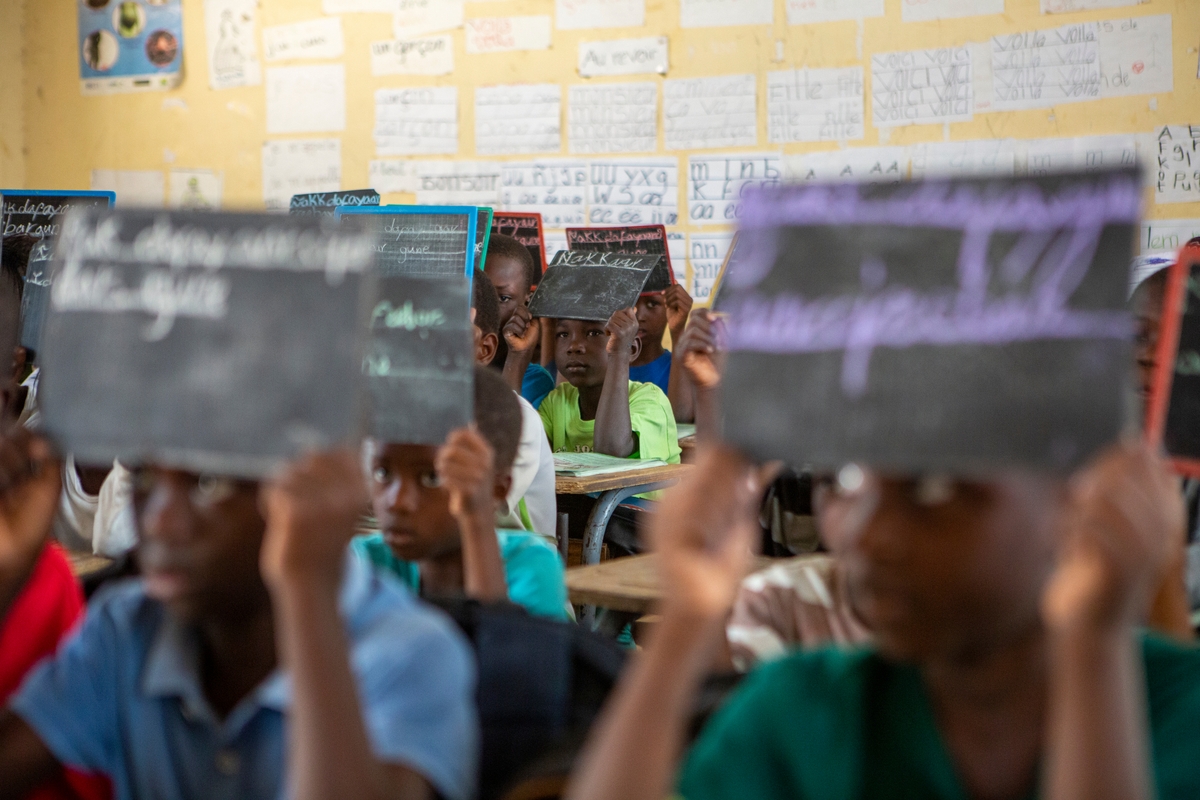
Early Education in Senegal. Original public domain image from Flickr
Since its independence in 1960, Senegal has retained a public education system modeled after the French system. While the Ministry of Education and numerous NGOs have introduced curricular reforms adapting to the national context, and have piloted bilingual programs since 1971, French is still the only permitted language of instruction in most public school classrooms. This language policy continues to pose enormous challenges to students and teachers, as outside of the urban elite, most children enter the first grade knowing only a few words of French. At least one-third will not finish primary school.
Bilingual programs introducing instruction in local languages like Wolof, Sereer, and Pulaar alongside instruction in French in the early grades have consistently demonstrated remarkable improvements in student competency in all subjects, including French. And yet skepticism persists. How will learning to read and write in the language they speak at home help our children? Many parents still ask. Do vernacular languages have the capacity to mediate scientific concepts? Teachers ask. And, isn’t immersion the most effective way to select and train the next French-speaking elite? These are just some of the questions that I heard expressed over the course of my research. Each hinges on assumptions about what the objectives of public education are and who education is for, entangled with raciolinguistic ideologies, ideas about language conaturalized historically along with ideas about race. Established in Senegal by the French mission civilisatrice, this bundle of linguistic ideology and value, based on notions of racial hierarchy, persists in the attachment students acquire in school to correct grammatical expression in French, betrayed, for example, in the educated person’s automatic vicarious embarrassment or desire to laugh at the sound of a French mistake.
The transition to bilingualism has been slow in part because of this ideological assemblage anchored in ongoing French education, but there is also the material question, brought to the fore this year with the cancellation of USAID funding. When every new pedagogical manual comes stamped with the logo of an aid organization, it is no secret that all public education reforms are ultimately tied to the interests of foreign partners, which Senegalese officials have no choice but to accept. USAID has been a leading supporter of bilingualism, including the development of a national bilingual model (Le Modèle Harmonisé d’Éducation Bilingue au Sénégal, or MOHEBS) in place since 2019. Elementary students follow the existing curriculum in both French and one of six national languages: Wolof, Pulaar, Sereer, Joola, Mandinka, or Soninke. When the Trump administration froze USAID funding and told overseas employees to pack their bags in February of this year, it gradually became apparent that the millions promised for Senegal’s emerging bilingual elementary curriculum were not going to materialize.
The interruption of USAID funding presents an opportunity to reexamine the coloniality, structural inequalities, and dependencies perpetuated by foreign aid, and this is exactly what the Senegalese at all levels of the education system are doing today. Has the supposed lack of political will among Senegal’s leaders to break from the French model, in reality, been a matter of dependence on external funding? While teachers, used to the precarity of reforms tied to project-specific funding of foreign assistance (which at some point expires), fear this may be the beginning of the end, officials at Senegal’s Direction de l’Enseignement Élémentaire (DEE) and Direction de l’Alphabetisation et Langues Nationales (DALN) are not discouraged. Bilingual education has by now become “a state affair,” they declare, and is at this point “irreversible.” To hear these words spoken so definitively from inside the Ministry, when I visited recently, was to hear the only kind of determination that can move the weight of history.
Immersed in French education and its ideological regime, for some, the idea of writing in Wolof, Seereer, Pulaar, or another national language on a blackboard inspires laughter, for others wonder, and for others, deep satisfaction. When I asked a school director how he felt about the bilingual transition, he shook his head with an amused smile, imagining the number of mistakes he would make in a Wolof dictation, whereas if it were in French he would easily perform the task without a single error. A younger friend learning to write in Wolof through a mobile application described the experience as restoring some part of himself, rediscovering things he felt he already knew. When he realized that the way he had spelled his own name—indeed, his family’s name—throughout his life had distorted its “proper pronunciation,” there was a touch of anger as well.
The retraction of USAID funding for all sectors comes at a political moment in which declarations of national sovereignty are an ongoing refrain of political speeches and public discourse in Senegal. Since being elected in 2024, President Bassirou Diomaye Faye, Prime Minister Ousmane Sonko, and their party PASTEF have pursued a politics of rupture with Françafrique. They have rejected the French military, moved to renegotiate fishery agreements with the EU, negotiated a new offshore drilling contract, and declared their support for bilingual education, as well as the introduction of English instruction at the elementary level. Amid these moves, however, the new administration faces ongoing restrictions on the liquidity of its coffers. Senegal’s debt is now estimated at 132% of GDP, and as current leaders resist another debt restructuring program with the IMF, they have had to turn to regional financial sources to cover their costs.
This constraint bears upon the ongoing struggle to formalize bilingual education on a national level. MOHEBS is now fully established in the regions of Mataam, Diourbel, Fatick, Kaffrine, Tambacounda, Kaolack, Louga, St. Louis, Ziguinchor, Kolda, Sediou, and Thies, but is still in the pilot stage in the Dakar region, home to more than 20% of the population. In one school selected for the pilot in Sebikotane, an urbanizing town in the Dakar periphery, teachers successfully taught the Wolof-French curriculum in the first and second grades, but the training they anticipated being called for in March of 2025 was canceled.
Teachers of different ethnic backgrounds in Sebikotane were already speaking a fair amount of Wolof in the classroom, so the bilingual training essentially authorized them to continue what they had already been doing, but with didactic support. Since their initial training, teachers have adjusted to using Wolof terms for concepts that they would previously refer to with borrowed French words like blackboard (aluwa), circle (wërgël), and syllable (dogu baat). The transition is easier for the few teachers who grew up immersed in the Wolof language in a village setting, while the majority who spoke other languages at home—Saafi-Saafi, Sereer-Sine, Pulaar, Joola, Sonkine, Mandinka, and others—face more of a learning curve.
Without the upcoming training in Wolof grammar and mathematical terminology, the school director in Sebikotane worries about how the second-grade teachers will be able to continue teaching the Wolof curriculum when their students move on to third grade next year. In the meantime, however, he tells his teachers to keep teaching in Wolof. “We know it is good for us,” he says, because “when you speak Wolof to a child, he understands quickly.” A first-grade teacher reports that her students can read at a level that she previously wouldn’t have seen until the 4th grade. This simple, effective tool, held back for so long, practiced in secret, and now unleashed, will not be easily given up. “Now that we have put in all this effort, it would really be a shame to let this slip away. Our government must fly with its own wings,” she says.
While the retraction of USAID funding is one easy explanation for these canceled trainings, some still wonder if the Ministry hasn’t already encountered roadblocks in the Dakar region. Although Wolof is the most widely spoken national language in this “melting-pot” region, there are communities speaking minority languages (often concentrated in particular villages or neighborhoods) who resist the dominance of Wolof. This is the case of the Saafi-Saafi community in Sebikotane, where some fear the long-term loss of their language.
Still, Ministry officials are not deterred. Resistance reflects a misunderstanding that requires careful “awareness raising,” says inspector Dame Seck; MOHEBS is not about promoting a particular language, but rather is about boosting literacy acquisition and easing learning in later grades, which remains in French. MOHEBS is, in fact, an example of “subtractive” bilingualism—in which local languages are integrated in support of the acquisition of a global (and for some, still colonial) language.
Subtractive bilingualism allows the future language politics of the Senegalese state to remain ambiguous. Is the plan to stop here and keep French as the official language of Senegal, or is it to eventually replace French with a different official language? Certainly, this will have to be Wolof, some say, since Wolof is spoken by 90 percent of the population, and the saying goes that “a country can’t develop without its own language.” Certainly, it can’t be Wolof, others say, for in a country where at least 25 indigenous languages are spoken, that would merely replace one kind of domination with another. If the transition to bilingualism is to be accepted without regrets—particularly in multiethnic communities where Wolof is the language of instruction—these are critical questions that the Ministry’s “awareness raising” efforts will have to engage in dialogue with educators, parents, and students.
I suggest that just as current rhetoric de-emphasizes promoting any particular language or the ethnicity that it represents, this tactic could be continued as Wolof is increasingly used in other realms, emphasizing instead the language’s capacity to mediate inclusive development and democracy. Ultimately, it will require pedagogical support for not just the most readily available linguistic emblem of decoloniality, but for multilingualism.
“We wouldn’t say that the end of USAID hasn’t impacted us,” reports Inspector Sow at the DEE. He estimates that the date by which all students across Senegal will take their Certificat de Fin d’Études Élémentaires (CFEE) exam in both French and one national language (originally projected for 2028) will be delayed by one to three years. For now, the implementation of MOHEBS will continue with ongoing support from the World Bank, UNICEF, the Gates Foundation, and the Senegalese state. “Teaching in our own languages is a matter of national sovereignty,” says Sow’s colleague, Moussa Sall. Somehow, in the long run, financial sovereignty will have to follow.