After the subcontracting state
The withdrawal from the port city of Berbera by regional powers distracted by war, marks the end of an external system that managed the Horn of Africa — and the beginning of a deeper structural collapse.
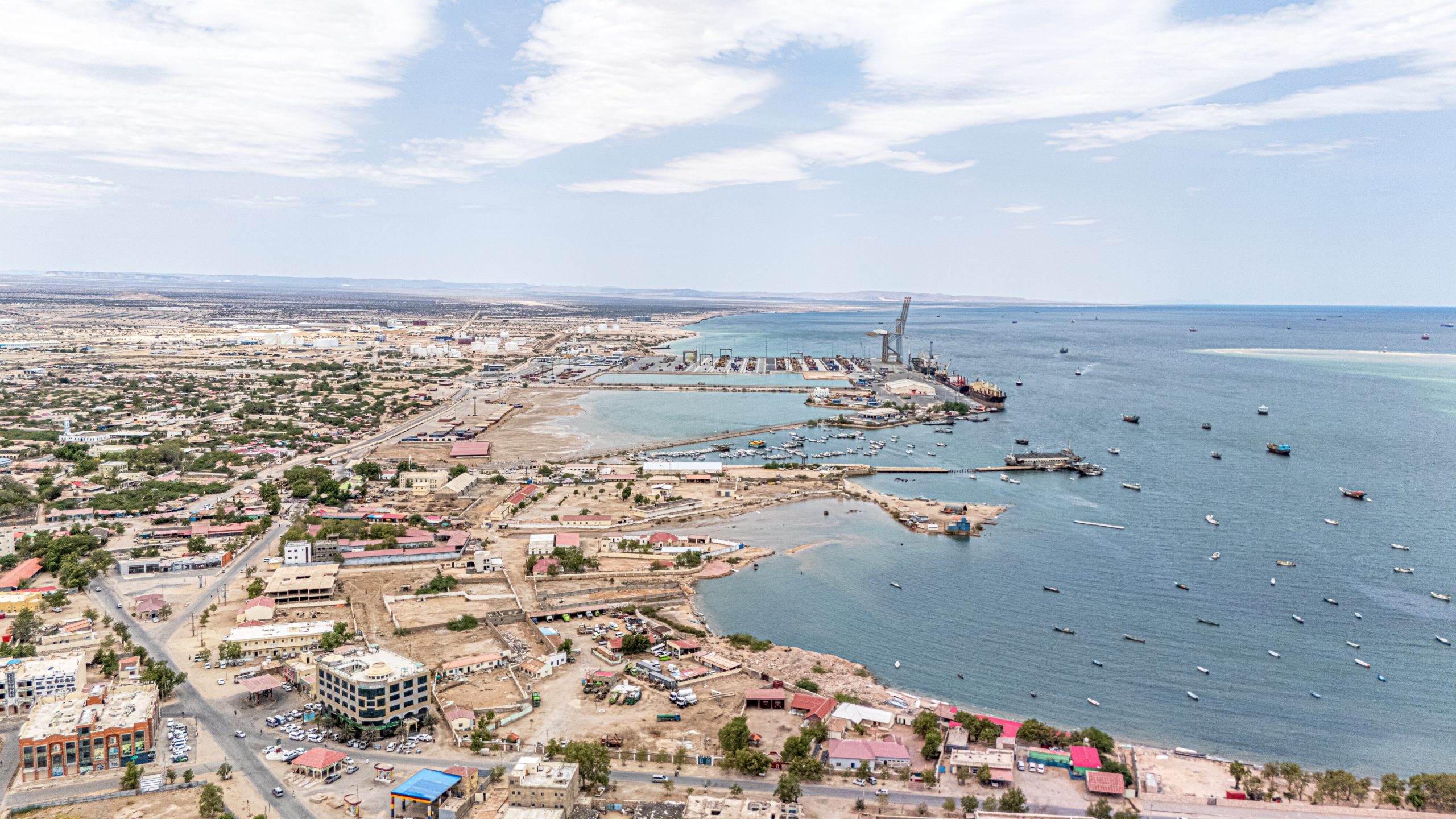
Berbera, Somaliland. Image credit Abdulkadir Hirabe via Shutterstock © 2024.
There is a port on the Gulf of Aden that empires keep finding indispensable. Berbera, on the coast of what is today Somaliland, has served for three centuries as a barometer of great-power ambition in the Horn of Africa—a region where the strategic calculations of distant capitals become legible in the physical infrastructure of docks, runways, and fuel depots.
What has changed across those centuries is not Berbera’s importance. What has changed is who is operating it, toward what end, and what political fiction they are using to justify their presence. During the Cold War, the Soviet Union understood the port’s value without ceremony. When Major General Siad Barre seized power in Mogadishu in October 1969 and supercharged the pan-Somali irredentist project—the Soomaaliweyn vision of a Greater Somalia uniting the Ogaden region of Ethiopia, northeastern Kenya, and Djibouti—Moscow offered military hardware in exchange for access to Berbera’s port and airfields. The calculation was transparent: Berbera gave the USSR the capacity to monitor and interdict maritime traffic transiting the Suez Canal and the Persian Gulf. The Horn was not a humanitarian concern for either superpower. It was a chessboard, and Berbera was the square that controlled the board.
The Ogaden War of 1977–1978 brought the Soviet-Somali arrangement to an abrupt end. Barre’s invasion of the Ogaden—launched to fulfill the pan-Somali project left unresolved by the 1964 ceasefire—prompted Moscow to switch sides, backing Ethiopia’s Mengistu Haile Mariam instead. Barre expelled Soviet advisors in November 1977, abrogated the friendship treaty, and watched as his Greater Somalia project was buried in the barren sands of the Ogaden Desert. Zbigniew Brzezinski, Carter’s national security advisor, noted acidly that SALT—the first binding nuclear agreement between Washington and Moscow—lay buried there too. The Horn had swallowed up not just Barre’s ambitions but also a pillar of superpower diplomacy. It was the first proof of what the region would demonstrate repeatedly: that the Horn absorbs great power projects and returns their wreckage.
What the Cold War established, the 21st century has extended and complicated. The Soviet Union no longer operates in Berbera. DP World, majority-owned by the Abu Dhabi government, signed a 30-year concession in 2016 worth US$442 million to develop the port. Where Barre used Berbera as a bargaining chip to wage a war of national unification, the United Arab Emirates uses the same port to pursue the opposite: creating a wedge between Somalia and Somaliland, anchoring a UAE–Israel–Ethiopia axis across the Red Sea littoral, and building the commercial and security infrastructure that gives Abu Dhabi deniable leverage over one of the world’s most consequential waterways. If Greater Somalia’s unity was buried in the sands of Ogaden, the path to its permanent fracture runs through the turquoise waters of Berbera.
On December 26, 2025, Israel became the first UN member state to formally recognize Somaliland’s independence—framing the decision, in Netanyahu’s words, in the spirit of the Abraham Accords. The move was not primarily about Somaliland. It was about Berbera. Israel’s recognition secured a strategic foothold 300–400 kilometers from Yemen: forward intelligence and potential military positioning against Houthi threats and Iranian influence in the Red Sea. It completed the political layer of what the Atlantic Council identified as the “Berbera Axis”—UAE capital, Ethiopian appetite for maritime access, and Israeli diplomatic cover, all converging on a single deep-water port. Somalia canceled every UAE port security and defense agreement in response. Saudi Arabia, Turkey, and Egypt condemned the recognition. The fracture lines were drawn. Then, on February 28, 2026, the United States and Israel struck Iran, and everything that had been slowly deteriorating began to collapse at once.
The joint US–Israeli strikes on Iran—Operation Epic Fury—did not introduce great power rivalry into the Horn of Africa. The rivalry was already metastasizing. What the strikes ended was something more specific and more consequential: the last credible fiction that the post-Cold War political economy underwriting humanitarian progress in the Horn could be reconstructed.
To understand what was lost, you have to understand what it actually was, because it was not what it claimed to be. The Western humanitarian scaffolding that kept the Horn from total collapse after the Cold War was not, at its core, an expression of obligation or conscience, although those narratives were useful. It was a subcontracting arrangement. The West needed a Horn of Africa that was stable enough not to generate refugee crises that landed on European front pages, not to become a jihadist sanctuary requiring direct military intervention, not to produce televised famines that demanded political accountability. It found, in certain moments and certain leaders, local partners willing to provide that stability, in exchange for developmental concessions extracted with considerable strategic discipline.
The clearest expression of the subcontracting model was Meles Zenawi. Meles was not an angel—his government’s repression of the Oromo, the Somali region, and eventually the architecture that would produce the Tigray catastrophe, are not footnotes. But he understood the subcontract with a precision that none of his successors has matched. He positioned himself explicitly as the West’s indispensable partner in the Horn—the bulwark against Al-Shabaab, the anchor of regional stability, the interlocutor that Washington, Brussels, and London needed at the table.
And in exchange, he extracted: PEPFAR funding, agricultural extension investment, Productive Safety Net Program financing, AGOA access, and World Bank program lending. He converted external scaffolding into internal state capacity with a deliberateness that his donors frequently found uncomfortable and his people found insufficient, but that produced measurable results. Under Meles, Ethiopia came closer to food self-sufficiency than at any time in its modern history. Famines that would have happened did not. That is not nothing. That is, in fact, the most precise measure of what is now being destroyed.
When Meles died in 2012, the subcontracting model began its slow collapse, but nobody named it. Hailemariam Desalegn maintained the form without the strategic content. Abiy Ahmed dissolved the contract altogether, not from incompetence but from a fundamentally different theory of Ethiopian power. Abiy’s project is civilizational and domestic—Medemer philosophy, Orthodox Christian nationalism, an Oromia political base, and a Nobel Prize as personal brand. He has no interest in being the West’s subcontractor. He wants to be Ethiopia’s prophet-king. The result was a government that continued receiving the aid flows Meles had structurally negotiated into the system, without the developmental conditionality Meles had extracted in exchange. The scaffolding became a subsidy. And subsidies without a strategic counterpart produce exactly what followed: a government capable of prosecuting a war in Tigray while receiving humanitarian assistance, with no mechanism—political, financial, or diplomatic—to demand coherence.
What February 28 ended was not the scaffolding itself—USAID had already begun its demolition, and the Gulf’s internal fractures were already widening before the first strike. What it ended was the last credible argument that the three conditions that made the subcontracting model work could be reconstructed in any politically foreseeable timeframe: Western financing, Gulf stability, and a Horn state with the capacity and ambition to convert external support into internal sufficiency. All three are now simultaneously gone. The Iran war did not cause that, it foreclosed the possibility of pretending otherwise.
The language of crisis—polycrisis, cascade, emergency—consistently understates what is structurally underway in the Horn. These terms describe conditions. They do not describe the process by which load-bearing capacity is being actively removed from a system that was already running on the residue of a model that had ceased to function. The more precise frame is hollowing out: the external institutional structure remains visible (the UNHCR maintains a presence, the WFP retains its Djibouti logistics hub, the African Union holds its mandate), while the internal systems that made any of them functional are being extracted simultaneously, and in several cases irreversibly.
The first extraction is financial. With a single administrative decision, the USAID withdrawal has removed 42 percent of global humanitarian financing from the architecture, and 86 percent of USAID programs have been terminated. Ethiopia loses over US$1 billion annually—its single largest external financing source and successor to the Meles-era investment flows that built the agricultural extension system now being abandoned. Over 80 percent of food kitchens feeding Sudanese war refugees closed within weeks. The Global Fund cut US$1.43 billion. No coalition is mobilizing to replace any of it. Germany cut ODA by €4.8 billion. France cut over US$1 billion. The UK diverted US$900 million to domestic asylum costs. The US was not a donor among donors in this system. It was the load-bearing wall removed while the building was still occupied.
The second extraction is logistical. Djibouti handles 95 percent of Ethiopia’s imports and pre-positions food aid for Somalia, Sudan, Yemen, and Ethiopia simultaneously—a WFP logistics hub with a capacity of 65,000 metric tons that functions as the humanitarian circulatory system for the entire region. That single chokepoint sits at the entrance to a Red Sea already 75 percent emptier of container ships than before Houthi attacks resumed in July 2025. Iran’s Hormuz closure has compounded that disruption with a particularly cruel twist: roughly one third of global fertilizer trade transits the Strait, including large volumes of nitrogen exports. Urea prices have risen from US$475 to US$680 per metric ton since the conflict began.
In a region where Ethiopia had already absorbed a 200 percent fertilizer price spike after Ukraine, and the WFP projected a 21 percent decline in cereal production from input shocks alone, this is not an additional burden on a resilient system. It is the elimination of the remaining margin in a system that Meles spent a decade building, and Abiy spent a decade neglecting.
The third extraction is political—and it is the one that forecloses recovery. The Iran conflict is simultaneously withdrawing both Gulf rivals from any stabilizing role in the Horn. The Critical Threats Project at AEI has documented how the war is reducing both the UAE and Saudi capacity and willingness to sustain proxy engagement in the Horn. That reduction produces a governance vacancy.
Rapid Support Force’s (RSF) retrenchment from UAE patronage does not mean the RSF weakens—a proxy cut off from external funding becomes fully self-financed through gold extraction and civilian taxation, becoming more violent and less controllable than before. The same government decision that withdraws UAE support simultaneously withdraws the conditionality that accompanied it. There is no longer any external lever to pull. And the AU peace and security architecture—whose missions run on EU funding and whose mediation processes require Gulf interlocutors—was never designed to function without both. When they are withdrawn simultaneously, what is revealed is not AU weakness. What’s revealed is that African institutional sovereignty in the security domain has, in large part, been a performance underwritten by external actors who have now left the theater.
Remittances—the system that individual families depend on when institutions fail—are the fourth and most intimate extraction. Somalia receives US$2 billion annually, more than its government budget. Ethiopia receives US$5 billion. Seventy-eight percent of Ethiopian remittances flow through informal hawala networks. If the war continues, the 750,000 undocumented Ethiopians working in Saudi Arabia would be cast in national security language and expelled, or they would leave of their own volition. Gulf wartime financial controls sever hawala corridors in days, not months. Proxy retrenchment and remittance disruption are the same government decision expressed through different ministries. A Sudanese family can simultaneously lose the territorial stability that kept them in their home and the monthly transfer from a cousin in Riyadh, Doha, or Dubai that was buying their food. These are not separate shocks. They are the same shock in two registers, and there is no Meles-equivalent state to catch what falls.
The standard humanitarian response cycle—identify the crisis, mobilize funding, restore the baseline, repeat—assumes a system with recovery capacity. What is currently in place in the Horn of Africa is a system in which the preconditions for recovery are being eliminated before any ceasefire in Iran is signed, and in which the state-level counterparts that could convert any future recovery investment into durable gains do not currently exist.
Sudan’s GDP contracted 42 percent between 2022 and 2025. The Gezira Scheme, historically responsible for half of Sudan’s wheat production, has been systematically plundered by the RSF. State revenues collapsed 80 percent. Both the Sudan Armed Forces (SAF) and RSF are now fully self-financing through predation. Sudan’s humanitarian response plan is 28 percent funded. This is not a state requiring reconstruction. The institutional and economic preconditions for reconstruction—functioning revenue systems, a productive agricultural base, a legitimate monopoly on force—have been destroyed. What remains is a war economy with no external constituency for its termination and no internal actor with either the capacity or the incentive to end it.
Fifty-three percent of children screened in North Darfur are acutely malnourished. Acute malnutrition in the first 1,000 days of life produces irreversible cognitive impairment, a 30-year productivity deficit encoded in neurology before any peace agreement is signed. The cohort currently experiencing acute malnutrition in Sudan and Ethiopia will enter labor markets between 2035 and 2045, carrying structural limitations that no subsequent investment can undo. That damage is being locked in right now, while diplomatic attention is fixed on Tehran. It is the most precise measure of what the end of the subcontracting model costs: not the institutions that are closing, but the human potential that is being permanently foreclosed in the gap between the model’s collapse and whatever comes after it.
Al-Shabaab’s recruitment base is expanding faster than any counter-operation can contain, because the group offers what Mogadishu cannot: wages, services, and governance. Aid collapse, remittance severance, fertilizer failure, and youth unemployment do not produce a terrorism problem. They produce a political economy of extremism that fills the vacuum left behind when the subcontracting model fails and no alternative has been built to replace it. Somalia’s own Speaker of Parliament has said it directly: those turned into fighters are the youth, those migrating illegally are the youth. The ACLED-documented coordination between the Houthis and Al-Shabaab—weapons transfers and materiel exchanges confirmed by UN investigators—means this is not a domestic Somali security problem. It is a regional supply chain for armed non-state actors, running through the same waters Berbera was built to control.
The obvious response to the West’s exit is to ask whether China steps in. The Horn International Institute for Strategic Studies and others have noted Beijing’s expanding footprint: the Djibouti military base, the Addis—Djibouti railway, the BRI debt instruments in Ethiopia and Kenya, the port interests across the Red Sea littoral. China is, by any measure, the most strategically astute external actor in the region. It has the means, the patience, and the long-range vision that Washington has abandoned.
But China is not going to assume the West’s role. Not because it is not ready, but because it has made a precise strategic calculation that the role is not worth assuming on the West’s terms. Beijing watched the Meles subcontracting model from the outside and drew the correct analytical lesson: the model works only when the local counterpart has genuine state capacity and developmental discipline. China structured its Belt and Road Initiative engagement in Ethiopia around the state capacity of the Meles-era government. It assumed a functioning developmental state as its counterpart. When that state fractured under Abiy, China did not step into the vacancy. It recalibrated toward asset protection by securing infrastructure investments, managing debt exposure, and avoiding political turbulence. Beijing takes the ports and the railways. It leaves the refugee camps and the famine responses to whoever remains willing to fund them.
That calculation will hold until one of two things happens: either a Horn state emerges with the developmental capacity and strategic discipline to offer Beijing the kind of subcontracting relationship that Meles offered the West—a partner worth investing in, capable of converting external support into internal stability—or the region’s instability begins directly threatening Chinese assets at a scale that demands engagement. Neither condition currently exists. Which means the vacuum is not temporary. It is structural, and it will deepen before any new order emerges to fill it.
If the subcontracting model is over, the ask cannot be to find a new contractor. Replenishment—more donors, more funding, more coordination—rebuilds the same external scaffolding on the same contingent foundations, subject to the same political disruptions that just destroyed it. The Iran war has made that fragility undeniable. What is required instead is something harder to fund and harder to explain: the deliberate preservation of the technical and institutional substrate that a future developmental state will need to inherit.
That means protecting the agricultural extension services, the food security early-warning systems, the hawala corridor infrastructure, the fertilizer import financing mechanisms. Not because they are functioning well under current conditions, but because they are the institutional memory that the next leader with Meles’s combination of strategic discipline and developmental ambition will need to find intact. The Productive Safety Net Program took years to build. The fertilizer adoption infrastructure that brought Ethiopia toward food self-sufficiency took a decade of consistent investment. These are not systems that can be rebuilt from scratch after a collapse. They have to be kept alive through the interregnum.
Concretely: a Horn food security compact—modeled on the Maputo Declaration’s 10 percent agricultural budget commitment but with enforceable conditionality—is necessary. One that makes Ethiopia, Somalia, Kenya, and whatever Sudanese authority survives, co-guarantors of humanitarian access and agricultural supply chain protection, not charity administered from Washington. The region needs sovereignty over the supply chain, financed by whatever multilateral architecture survives the USAID exit, backed by regional powers that cannot afford the alternative.
The Strait of Hormuz closure—through which 27 percent of the world’s maritime crude oil and up to 30 percent of global fertilizer exports transit—is not a temporary disruption. The IMF estimates that every 10 percent increase in oil prices raises global inflation by 0.4 percentage points. For a region where over 45 percent of smallholder farmers had already cut fertilizer purchases before the conflict began, and 24.6 million Sudanese were in acute food insecurity before the first strike, the inflationary math is not a macroeconomic abstraction. It is a death calculation being run in real time in the absence of the state capacity that once existed to interrupt it.
Berbera has outlasted every power that found it indispensable. It outlasted the Soviet Union. It outlasted Barre’s Greater Somalia. It will outlast the current configuration of the UAE’s commercial ambition and Israel’s strategic repositioning. The port endures because its geography endures—it sits at the interface of Europe, Africa, and Asia, at the entrance to waters through which the global economy breathes.
What the port cannot provide, and what no external power has ever provided as a substitute, is the developmental state behind it. Meles understood that Berbera’s strategic value to external powers was leverage—leverage he used, imperfectly and often brutally, to build something. His successors have not understood this. The external powers that replaced him have not required it. The result is a port surrounded by a region being hollowed out: the institutional shell intact, the load-bearing capacity gone, and no successor model yet visible on the horizon.
The Iran war did not create that vacancy. It foreclosed the last argument that the vacancy was temporary. What ended on February 28, 2026, was not a scaffolding. What ended was the pretense that the scaffolding could be rebuilt on the same foundations, by the same actors, for the same purposes. The question now is not how to restore what existed. It is whether the technical and institutional substrate can be kept alive long enough for something new—and genuinely rooted—to grow through it.