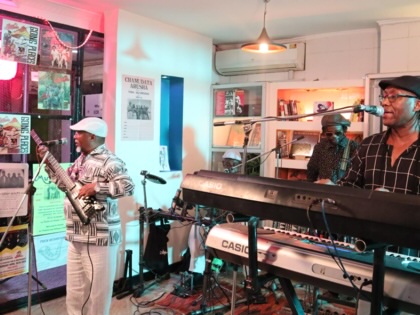
Visiting Ngara
A redevelopment project in Nairobi’s Ngara district promises revival — but raises deeper questions about capital, memory, and who has the right to shape the city.
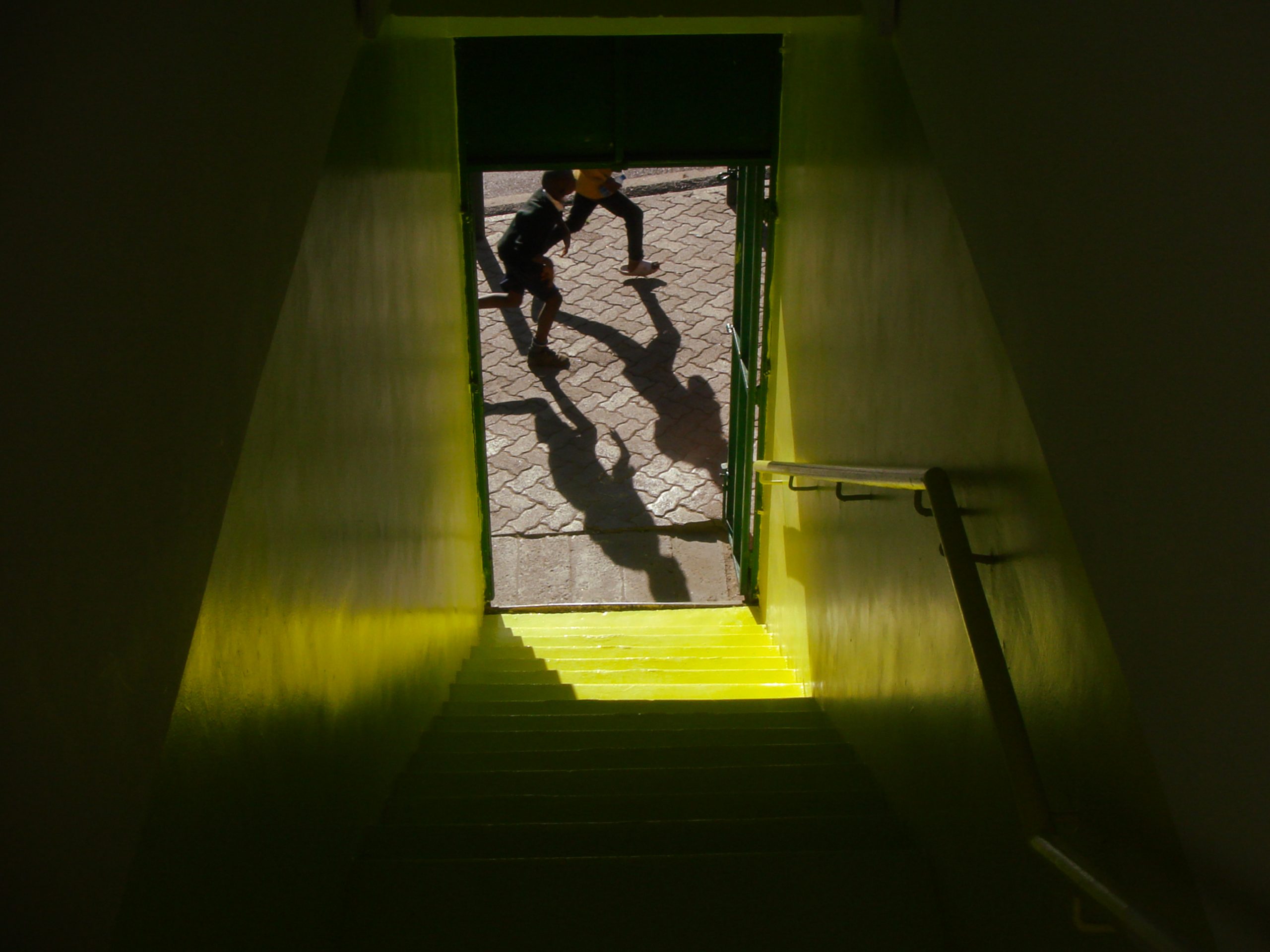
Kenya. Nairobi. March 21, 2025. Children running on the sidewalk by The Living Rooms bar entrance,
As the Friday sun, sated of the workweek, sets over Nairobi, Ngara still turns on its axis like a sun of its own. The liver man at Equity Roundabout fans coals beneath a small mountain of sliced offal and scallions steaming under a pink plastic tub. Boda riders shoot the shit beside their cooling motorcycles, next to a jaba base advertising the “Digital” strain of mũgũka, ready-to-chew leaves bundled within a clear plastic drawer. Now and then the sky cracks with the boom of a souped-up car on a test run, after which it returns to mechanics on Musindi Lane, where children on wheels race past a bar barely older than the Republic of Kenya. What is a city but masses pulsing in the illusion of a heartbeat?
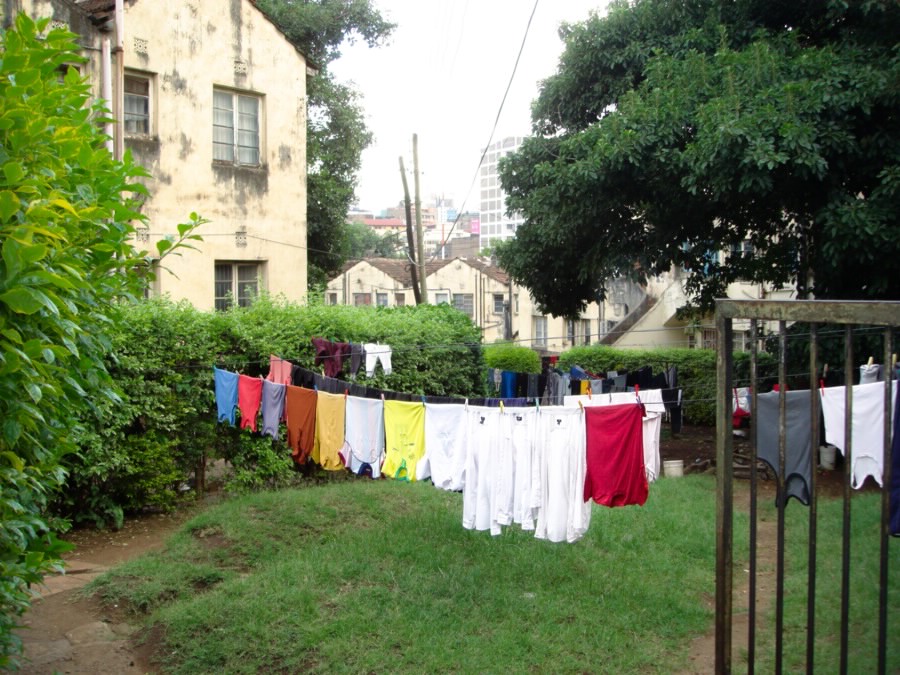
Here, within the old Central Business District, lies Nairobi’s innermost tree rings. Ngara documents how a colonial railway “tin-town” grew into a global metropolis of 5.5 million in little more than a century. Along the Desai Road promenade of mature blue jacaranda trees lies the Railways pension scheme housing project, now overtaken by neon bougainvillea and sugarcane stalks as tall as trees. A pixelated call to prayer from a mosque ripples the still air, drawing out black abayas and white kanzus onto Park Road like dewdrops; these newcomers of the Boma Yangu housing estate drift past old Indian houses that became working-class brothels and then student dormitories, all living artifacts of evolution.
In my introduction to Ngara, I saw none of this. I am an American writer in Nairobi and, though I had lived here for ten years, like most other white-collar foreigners, I had in fact never visited Ngara. In March 2024, while I was in Mombasa, I learned of an urban-renewal project unfolding in Ngara through the photos and videos of many of my friends who attended its launch party which they posted on social media. From verandas two, three floors in the air, their phone cameras gazed upon an open courtyard humming with spinning vinyls and shaking cocktails. The promotional video displays an array of party guests: cool, creative, foreign, rich, or some permutation thereof. One shot, only fractions of a second, caught my eye. Beyond the foregrounded party guests and the wall and window that separated this venue from the street was the background of Ngara outside: a paramilitary police officer in camouflage, leaned up on a car, swinging his baton in repose as a passerby, without breaking the brisk stride of a pedestrian commuter, glances towards us. The project’s name was a call to people like me: Visit Ngara.
Visit Ngara is the pilot project of Urban Africa Partners, the investment and development company incorporated in Kenya as NBST. Founded in 2020 by Funsho Allu, Brooks Washington, and Fukunda Mbaru—financiers, entrepreneurs, or real estate developers who had all worked at some point at investment capital firms—NBST aimed at the outset to buy, renovate, and rent out 14 consecutive properties along Ngara Road, ultimately pedestrianizing the road and turning it into a commercial arts and cultural district like Battersea in London or Industry City in Brooklyn. Currently, NBST has fully acquired six properties. In addition to the “14 buildings in core precinct,” its 2024 Quarter 1 pitch deck for tenants provisionally mentions “36 buildings in pipeline.” These buildings host offices, boutique stores, a wine speakeasy, as well as multiuse spaces that have already hosted art exhibitions, fashion shows, birthday parties, album launches, film screenings, and an NFT Kenya event. At the end of one block is the bookstore Soma Nami and, above it, an events venue, bar, and coworking space called the Living Rooms.
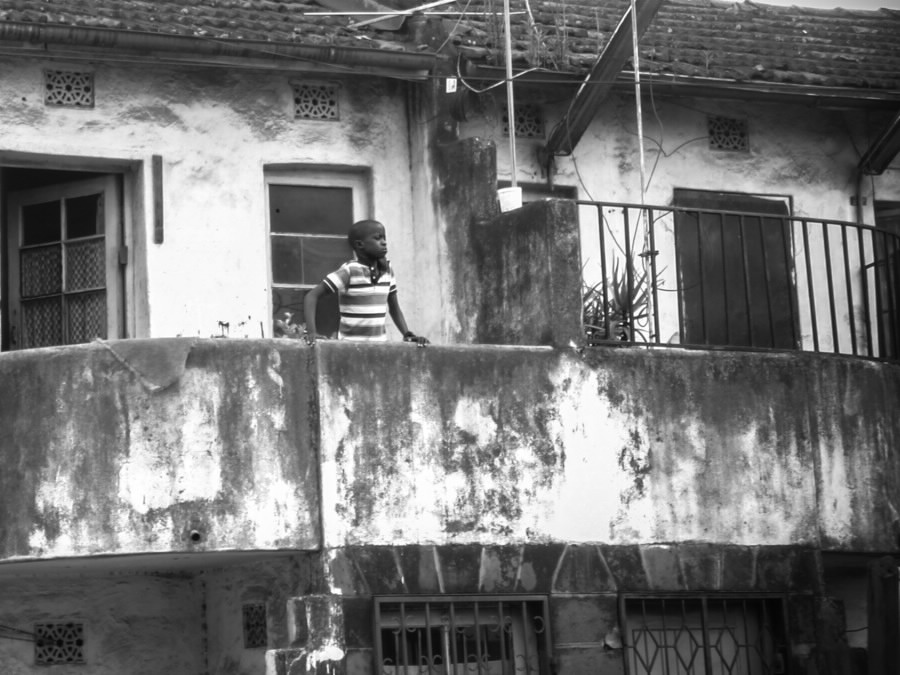
The invite-only launch of the Living Rooms was my introduction to Ngara, as it was for many others in the room. We had been welcomed there to celebrate our friend, the store’s proprietor, in her big milestone—and yet, were it not for this event, we would not be in Ngara. We had taken Ubers there. We had been scanned (some patted down) by the man outside the unmarked door and, after scaling up narrow stairs, found ourselves in a space with concrete flooring, raw wooden beams, plywood surfaces, among snake plants, Edison filament bulbs, and a pink neon tube light. We could buy a drink, dance, or shop for bespoke jewelry and clothes. We were told that this space had once been a dentist’s office, which I relayed to an acquaintance as we chatted near a window. From across the narrow street I could see into a blue bedroom, where a man had entered to place something on a bed draped with mosquito gauze. He disappeared, leaving the gelid fluorescent light on. The exterior wall of his apartment’s building was painted with a pesticide advertisement that promised to “KILL ALL DUDUS DEAD.” My acquaintance and I agreed that the space we were in was quite beautiful, but eventually, as if it must be acknowledged, she said, “I can’t help wondering if we are gentrifying Ngara.” Three other people that night confessed the same.
In other cities, gentrification is often easy to spot with colors. In many US cities in the ’50s and ’60s, white flight into the suburbs divested resources from urban areas, relegating black and brown people to inner cities governed less by services than by police; later, the low property values of these neighborhoods’ housing stock made them prime targets for private developers and middle-class homebuyers and landlords, who gradually “returned” and “cleaned up” the city, all while pricing out existing inhabitants. But Nairobi is not a US city. Ngara was historically an Asian district, for one, set aside by the colonial British administration for Indian workers who worked as railroad coolies and, permitted to stay in Kenya thereafter, occupied an intermediary position between settler and native—and so perhaps more nuance would help me understand if gentrification was indeed what was happening in Ngara. This is what I told Wairimu Mwaura, NBST’s head of community, when I found her at the party. When I asked her if I might be able to interview the company’s founders, she responded bounteously, graciously, with a bright voice and crisp laugh, and I felt that there might be a more open-ended answer to that question which loomed above that party.
The party came to a hard stop. Around 10 p.m., Mwaura announced once, twice, a final time, that everyone had to leave. We were in Ngara, after all, and we knew what that meant. Or at least that we shouldn’t want to know. Beneath the warm-white streetlights NBST had installed, a few stray commuters swept past beneath the verandas of the old Indian buildings, and boda riders at a nearby stage waited atop their motorcycles. To them, we may have looked like moths drawn in from far away, all fluttering about one unmarked door, only to disappear back into our cabs and scatter again once darkness fell.
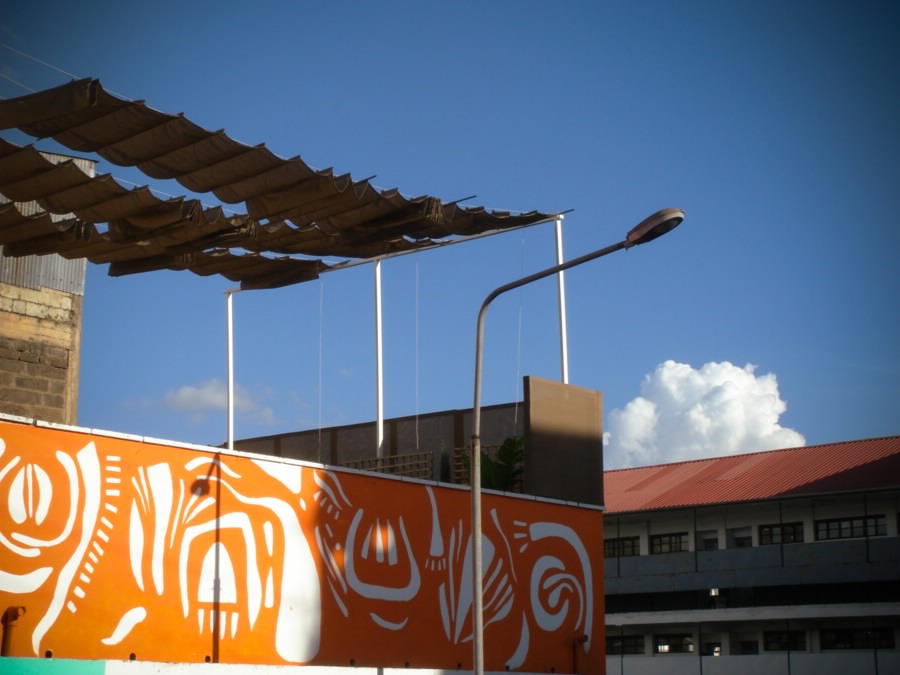
Wairimu Mwaura suggested we meet at Westminster House in the CBD and, a couple of weeks after the party, after I sent questions in advance and she prepared answers, we sat facing one another in a long hall beneath the weak, cool light cast from narrow windows of old load-bearing walls. Built in 1928 as lodging for colonial administrators, Westminster House was later used as a banking hall and now a branch of the upscale resto-café chain ArtCaffè. “I love that something can exist and you can have the old and the new—and have something beautiful,” Mwaura says. “ArtCaffè is full corporate in the middle of town, but they have paid an ode to the old and what was historically here.” This, she remarks, is a good way to understand what NBST wants to do in Ngara.
NBST aims to turn a “recently forgotten area” into a hub “to house all the best of Nairobi’s creative, entrepreneurial, and innovation communities,” says its pitch deck, drawing its vision from cultural districts in other cities its founders have traversed. (NBST’s founders declined to be interviewed.) “What’s normal for New York should be normal for Nairobi,” stated the company’s website in 2024 (though it has now been taken down), gesturing towards a cosmopolitan melting pot of creation and consumption: “Walk down our streets and you’ll find bars, restaurants, art galleries, co-work spaces and theaters. Global names support and work with local talent. Investment flows, opportunity grows, and businesses prosper.”
Ngara Road was the perfect site for such a vision. Anchored on one end by the compelling architecture of Sarakasi Dome and located along public transportation routes and close to town center, this strip has largely been shielded from soaring rents by its structures’ outdated piping, irregular water supply, inefficient electricity wiring, limited parking, and reputation for petty crime. But perhaps most uniquely, Ngara Road hosts a contiguous line of unique architecture: Indian-style mixed-use houses, with ground-floor storefronts and two or three stories of residential space above, some with courtyards, able to host families of multiple generations. Stripped down, the structures spoke for themselves with little intervention and could be easily re-partitioned. “We found that these buildings are really underutilized,” Mwaura says. Why build something new when you can renovate the old, “honor the historical architecture that already exists”—preserve the rangoli stickers on the floor that once invited in gods for puja, the red flooring with veins that run where kitchen and bathroom walls were once anchored, the pockmarked, raw concrete columns in the basements, the good bones?
Last year, Shah House, one of NBST’s buildings that has already gone live, hosted a retrospective exhibition of the Kenyan fashion designer Katungulu Mwendwa. In her welcome speech, Mwendwa revealed that this very building, once an Indian fabric store, was where she shopped as a young artist. “You can’t make that up,” Mwaura recounts. “[Mwendwa] said, ‘I used to buy fabrics here, man, this is where I started.’ If anything, it assured me that we’re honoring the history here.” The fabric store, once “dark and dingy,” now beams with sunlight through tall window panels that appear as glowing moving pictures, framing the banana leaves swaying outside. It is undeniably beautiful.
Mwaura had witnessed some of NBST’s earlier renovation work, where dilapidated infrastructure made clear why these structures were, in her words, “50 percent underutilized.” NBST modernizes the electrical wiring, collects rainwater, constructs new large windows to let in natural light, and even installs toilets from Arumloo, a local company that uses three to four times less water per flush. But primary to NBST’s commitment to sustainability is their “brownfield” approach: rehabilitating what exists and changing as little as possible—letting original surfaces breathe, or removing a floor-to-ceiling railing in a corridor so that suddenly, simply, a space opens up. “When you keep those elements and when you just put a lick of paint on the walls,” Mwaura says, “you feel that the space is so transformed, though you didn’t do too much.” NBST’s live buildings have received Level 2 EDGE Certification—a building sustainability code developed by the International Finance Corporation, a World Bank Group member—and NBST is targeting EDGE’s highest “Zero-Carbon” classification, which requires significant water and on-site energy reductions and can be topped up marginally with the purchase of carbon offsets. “Africa’s overall CO2 emissions are set to rise by 48% by 2040,” Urban Africa’s website states, during which “building emissions will nearly triple.”
This future demand for structures is Visit Ngara’s raison d’être, according to its developers: “We invest in assets in central, non-prime, underserved urban areas in cities we think will benefit from Africa’s demographic dividend, urbanisation and economic growth”—elements, it says, which are crucial for Africa to “close the gap with the more developed world.” Visit Ngara is their first project of this sort. If successful, it can bring Nairobi on par with other metropolises, NBST writes on its website: “Our founders live and work in Nairobi but have deep international connections and travel a lot. Why, they wondered, can I find the places I want in London but not in my hometown? And why is there nowhere to focus all the buzzing, bubbling energy that you feel in African cities?” This old neighborhood is ripe for entry into the future, says the pitch deck: “Along with Kilimani and Westlands, Ngara will be another node for the digital economy, creative companies, the knowledge economy, and everything in between.”
It is an ambitious project. Of course, demography in Nairobi has always shifted with capital—with Somalis entering Parklands, with Chinese, Ethiopian, and Nigerian immigrants pooling in Kilimani—and luxury homes are inching northward from affluent areas like Kitisuru into once sleepy towns. But Visit Ngara may be the first intervention of its kind here: a single-developer, district-level buyout of individually owned houses, refurbished for creative entrepreneurs. NBST itself touts a unique approach: “The communities and neighborhoods NBST creates are built to last. We are not short-term investors looking to make a quick return. Once we’ve built, we stay put.”
The elephant in the room is what “staying put” means for those who were already there. NBST denies that displacing locals is in any way part of their plan. I asked if anyone was evicted to make way for NBST’s newcomer tenants. “No. Absolutely not,” Mwaura firmly stated, adding that some of the former tenants in the house that now hosts the Living Rooms even told her that the building had been poorly maintained anyways and often experienced water problems. The pitch deck states that “many of the upper floors are vacant.” Veronica Omondi, NBST’s Chief of Staff, told me in a later interview, “Sure, we’re modernizing spaces, but we don’t want to kick out the people who have already been using the spaces before. I’ve lived and grown up in Nairobi, and I’ve been here a couple of times. I don’t want my friends who used to come here to get their clothes tailored to only come here for events. We want it to feel like, ‘Sure it’s Ngara, the Ngara we’ve always known, but there’s a bit more to it.’”
Ngara carries a bittersweet nostalgia for many Kenyans who remember a version now lost to the past. Steve Aggrey, the founder of a Kenyan conscious travel company, had spent years working around Mount Kenya but, upon moving back to Nairobi in 2023, found himself driving down Ngara Road in search of a memory. He was with a friend and wanted to share with her a piece of his childhood: one specific Indian Kenyan confectionery, the one his mother used to take him and his brother when they were young, to bribe them with savory, toasty chevda for their compliance. His mother worked in fashion and would spend hours on Ngara Road with swatches of fabric and sons in tow, browsing one Indian fabric store after the other. Three decades later, Aggrey recognized some of those same stores but couldn’t remember where the chevda store was. He parallel parked, they stepped into a spice store, and asked the two Indian shopkeepers if there used to be a sweets shop somewhere right about here.
“It was the one next door,” the woman told Aggrey, “but they closed a while back.” She said the family had kept the original Ngara store open for sentimental purposes, even as their new branch provided the real cash flow. A few of their friends had sold off their family-owned buildings too, she added. Shame, Aggrey thought as he scanned the empty, dim shelves. The other shopkeeper, probably her husband, glowered from the back of the store, as if to say, Don’t talk too much.
Aggrey continued making small talk, reminiscing about coming to Ngara with his mother. In the ’90s and early aughts, as an informal settlement swelled in the swamp around the Nairobi River along Ngara Road, and muggings became commonplace, Aggrey’s mother stopped coming. Many Indian families moved out. As in many other cities around that time, wealth flowed out of the CBD, agglomerating in suburbs and hollowing out the “inner city.”
Hearing Aggrey speak, the husband warmed up, came to the counter, and told him that their former landlord sold the building and the new landlord raised the rent—but wouldn’t meet with them to discuss a more favorable arrangement. “We’re paying in US dollars now, and it doesn’t make sense,” he told Aggrey. Although Aggrey sensed he was “at wit’s end,” his wife repeated, “God will help us.” Still, it was clear what was at stake. “People think all Asians are wealthy, but some of us are living hand-to-mouth,” she said. “We can’t survive on what we make here. If we have to move, where do we move? This is all we know.” In solidarity, Aggrey bought just about a year’s worth of spices.
Half a year later, Aggrey and I met on Ngara Road so he could show me the spice store. We found the very spice store owner who the previous year had hoped “God will help us” and her gray-haired mother standing outside their old storefront. It was now shuttered. That day they just happened to be there waiting for a ride. Their cash flow had finally choked, churning a vicious cycle of inferior stock and fewer customers, the store owner told us, casting a bitter, vague gaze at the street as if it were her witness. They never got an audience with the new landlord. When asked if they might share their names or say more, both women shook their heads: “We don’t want any trouble.” Seeing the vehicle they’d been waiting for, they were briskly off.
Their former spice store was indeed part of a building NBST had acquired, Omondi later confirmed, adding, however, that it was “already vacant” when they bought it. “If your building is fully occupied, we don’t want that,” Omondi explains. “We have to then ask you to vacate everyone, which is not really fair.” NBST tries to acquire properties without tenants inside, she says. The former landlord, in order to sell his property to NBST, had to first sort out a “legal case” with his tenants—something well beyond the bounds of NBST’s control but which, they were assured, ended “amicably.”
This might be resolved by asking the building owner to confirm himself that his tenants were indeed vacated amicably; NBST, however, declined to identify him. While Omondi firmly denies that NBST has ever collected rent in USD, not least because of the legal risk that would bring, the spice store owners would have been out of the picture already by the time NBST bought it. Do these two accounts contradict one another, or do they tell the same story? Perhaps the real story, capable of yielding much more than a crisp “yes” or “no” and thus much more than balmy moral exculpation for the guilty partygoer, is about something much greater than NBST, and yet something that Ngara, and the city around it, are the perfect archive to help us understand: a story of how capital changes how we view what is “dead” or “alive” at all.
Kenya was a settler colony, a “white man’s country”—and Nairobi was the white man’s city. The Imperial British East Africa Company, granted the juridical right to annex land vested in the Crown, expropriated massive tracts of land for both a railroad and the scheme it hoped would help pay for it: attracting European settlers with the promise of arable land and a familiar alpine climate. What made Nairobi a good watering hole, a “place of cool waters” as the Maasai called it, made it bad for settlement: a malarial swamp of decomposed volcanic magma that got waterlogged when wet and cracked up when dry. But to the railroad capitalists—327 miles of meter-gauge track behind them to the east and ahead to their west the soaring escarpments of the Rift Valley—it was perfect. The last stretch of flat land perfect for laying shunting yards and warehouses, Nairobi collected laborers, administrators, settlers, and whatever economy bled out from the sides of the permanent way.
Though the starting cast of the frontier depot was diverse—Indian railroad workers, Swahili porters from the coast, Nubian and Somali military and security personnel, and of course other indigenous Africans from across the colonial East Africa Protectorate—it was never unclear for whom Nairobi existed. Within a few years of reaching Nairobi, the railroad already ushered in a stream of aristocratic tourists into East Africa. White “Nairobians” enjoyed milk and butter from Lord Delamere’s Njoro dairy farm, hunted wild animals whose names they were still learning, and sipped premium coffee cultivated by the White Fathers of the Roman Catholic St. Austin’s Mission. Nairobi became both an entry point and gathering point for an array of settlers: There were the debonair government officials who played tennis and golf, there were the genteel sportsmen who hunted big game as they prospected for investment opportunities, and there were, of course, the predominantly British and South African speculators who kept bars in business, “dressed in riding clothes, big helmet hats, and top boots and dashed about the country on ponies,” as American photographer Frank G. Carpenter wrote in Cairo to Kisumu.
Unlike their compatriots back in cold, stuffy, square, overcrowded European cities, “Nairobians” lived with a backdrop equal parts gritty and sumptuous. Former US President Theodore Roosevelt, who helped popularize the luxury safari among Americans, complimented Nairobi’s quaint beauty, with sweet bungalows “bowered in trees, with vines shading the verandas, and pretty flower-gardens round about,” as he wrote in his 1910 book African Game Trails. “Not only do I firmly believe in the future of East Africa for settlement as a white man’s country,” he continued, “but I feel that it is an ideal playground alike for sportsmen and for travelers who wish to live in health and comfort, and yet to see what is beautiful and unusual.” Today, such luxuries are still touted as draws of living in Nairobi (hunting replaced by safaris), and Kenya remains for many foreigners a backdrop for self-actualization, means of leisure, and fertile ground for investment.
Though settlers owned Nairobi, they of course did not build it. The apartheid template of the city would rest on the question of where to put the laborers who did. The justifying logic was one of sanitation. Successive plagues had broken out around the Indian Bazaar, despite the fact that it had been burned down three times before 1907 in attempts to decontaminate it. The state pursued the recommendations of Scottish professor of tropical disease W. J. Simpson, who, in a 1914 report, recommended strictly separate racial zones: one for Europeans, one for “all but the highest class” Indians, and one for “the primitive African.” For the colonial urban planner, contagion was intrinsic to race: “To overcrowd is an inherent tendency in the character of the Asiatic,” wrote Nairobi Health Officer B. W. Cherwitt in 1916, a tendency responsible for “the spread of plague, smallpox, and the poor physique, debilitated condition and unwholesome appearance of so many Asiatics.” Simpson’s subcommittee suggested an “Asian residential area” on the north bank of the bilharzia-infested Nairobi River, where a Somali village of about 120 houses stood. In June 1917, this village was demolished to make way for what is now Ngara. The old Indian houses on Ngara Road that NBST is rehabilitating today still bear the datestones that document Ngara’s inauguration as an Asian settlement. The Somali village, like many of Nairobi’s layers of change, has been lost to memory.
A city is not the average of its skyscrapers and slums, but rather—in urbanist Henri LeFebvre’s words, the oeuvre of its citizens—a work of art that its people make and remake. In his canonical 1968 text Le Droit à la Ville, LeFebvre describes “the right to the city,” a right that opposes property rights, as the right of people “who build and sustain urban life”—construction workers, truck and taxi drivers, domestic workers, trash collectors, medical workers, janitors, miners, teachers, farmers, restaurant workers—to shape a city after their heart’s desire. Geographer David Harvey expands upon LeFebvre’s ideas: “The question of what kind of city we want cannot be divorced from the question of what kind of people we want to be, what kinds of social relations we seek, what relations to nature we cherish, what style of daily life we desire, what kinds of technologies we deem appropriate, what aesthetic values we hold. The right to the city is, therefore, far more than a right of individual access to the sources that the city embodies: it is a right to change ourselves by changing the city more after our heart’s desire.” We might call this democracy.
The right to the city was claimed militantly just as Nairobi was about to become a city. In 1949, the Municipal Council of Nairobi petitioned the king to request Nairobi be elevated in status from “town” to “city.” If this city charter was granted, it would coincide with the 50th anniversary of “local governance” in Nairobi, presenting an opportunity for grand Charter Day celebrations to inaugurate a new city to the world—an idea that excited white settlers. However, the dissonance between the sparkling prosperity of Nairobi and the abject poverty in the rural native reserves was not lost on the workers who “built and sustained urban life.” The East African Trade Unions Congress, a union of African and Asian workers led by Fred Kubai and Makhan Singh, gathered thousands of workers in halls throughout Nairobi. They protested forced labor and poor working conditions and announced a boycott of the Charter Day celebrations which, as Kubai said in a speech, was a “mere propaganda trick” to give the appearance of progress in Kenya. “We see no change in our status. Housing for the worker is still expensive, wages were low and even so basic a need as water was not available to him in adequate quantity,” Kubai said. “How could the worker under such conditions honestly join in the celebrations?”
Like the flower of a parasitic plant, the Green City in the Sun grew more beautiful the more labor and land was squeezed from Africans. As historians Bethwell and Madara Ogot wrote of the interwar years in their History of Nairobi, “Nairobi was an island of wealth, attempting to defend its shores against intruders, mostly Africans. But within Nairobi itself, there was another widening gap between the rich and the poor resulting in the existence of two ‘Nairobis.’” To this day, refined opulence in Nairobi produces an equal and opposite ugly deprivation.
Two months after Kubai gave that speech, he, Singh, and other labor leaders were arrested under dubious charges, rushed through sham trials, and detained. This triggered the 1950 Nairobi General Strike, during which African and Asian workers ground the colonial economy to a halt. For two weeks, unemployed youths scouted the city as flying pickets, loudspeaker vans blasted messages of defiance, all while a crowd gathered by a bonfire in Kaloleni Valley that burned day and night. The strike grew to bakery and hotel workers, city council workers, schoolteachers, railyard workers, oil company workers, maize production control workers, and airport workers. Public works, power and lighting, hospitality—everything shut down. The fight for the right to the city melded naturally into a fight for self-determination. Those two weeks, Nairobi belonged to those who made it, not those who owned it.
Today, the defining landmark of Ngara is the Sarakasi Dome, a brick-red theater encased in a rib cage of swooping black buttresses and pulsing mural art, set about a long spiral staircase. It was the Dome itself, with the architectural ambition of another era, a structure that embodied history itself, that caught the eye of one of NBST’s founders, Veronica Omondi says. (She did not name which one.) He had attended an event at Sarakasi and, ambling about on Ngara Road afterwards, saw a perfect canvas. Though hardly the first to reimagine Ngara as a space for artists, he and his partners were the first to mobilize enough capital to single-handedly add a new layer to the ice core of Ngara. The tabula rasa such magnitudes of capital can carve out is a curatorial dream. In its initial pitch deck, NBST shares a rendering in a bird’s-eye, isometric projection: a reimagined Ngara Road, provisional but ambitious, a green, pedestrianized strip of road with logos of potential participating brands floating about blank buildings. A potential investor or tenant might start sketching out in their mind a bespoke fashion boutique in what was a stagnant spice and rations store, recording studios and performance spaces in what were cheap furniture stores, a padel court where trucks used to sleep.
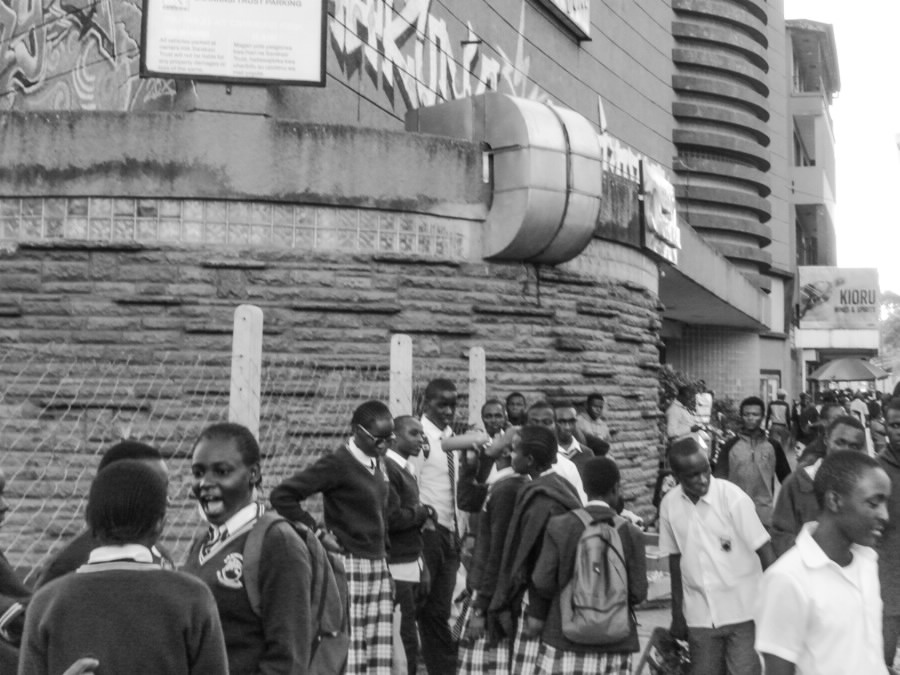
On the other hand, the messy work of being neighbors, which cannot be mediated by capital, is what earns a newcomer local respect. Sarakasi itself was founded and funded by foreigners, and yet never raised the questions of invasion that NBST faces. For many in this part of town, the Sarakasi Dome has been a site of memories: home to not only acrobats but aspiring rappers at open-mic nights, a safe space for LGBTQ events outside of affluent suburbs, a host of big Somali parties glinting with diraacs, a stage etched in the minds of students who watch setbook plays to distill dense Kiswahili literature before exams. The Dome became part of Ngara even as Ngara evolved around it. This was no smooth process. When the roundabout—once an illegal dumpsite where street kids slept by fires—was “cleaned up” by municipal authorities, Sarakasi partnered with organizations feeding street kids nearby, ran some programs of their own, paid street kids to do odd jobs like sweeping, with the standing invitation to train in acrobatics. They neutered and spayed street animals, allowed fruit vendors to use their trash disposal, and negotiated with hawkers who crowded the entryway. “You have to engage. You cannot just come and do your thing and pretend that people aren’t there,” says Marion Op het Veld, the co-founder of the Sarakasi Trust. “I mean, we cannot come here as Sarakasi and say, ‘This is how it has to happen.’ No, that is not our style.”
Op het Veld had come to Kenya decades ago as a young volunteer—very green and bright-eyed, she admits, looking back three decades later—and in her early days, she had frequented Ngara’s famed Indian fabric shops. She eventually got involved facilitating Kenyan acrobats’ training, bringing them to international stages and organizing them to prevent competition within and exploitation from outside. This initiative ultimately became the Sarakasi Trust and, as their training and performance programs developed, they needed more space. Op het Veld remembered the large, gray conch-shaped dome of the old Indian Shan Cinema she’d seen while shopping in Ngara.
In 2006, when Op het Veld scouted out the cinema, it was “a shell,” she says. “Street families had lived in there, the chairs had all been ripped out, fires had been lit inside, plumbing, electricity, nothing was working,” she told me as we sat in the foyer of the Sarakasi Dome. “It was full of human waste, like flying toilets thrown onto the roof.” They later discovered a guard living somewhere inside. The trust bought the space for KES 32 million—and spent nearly the same amount cleaning and renovating it. Built in 1952, the Shan Cinema was designed by an unknown Indian architect and remained in operation through the ’80s, screening Bollywood movies for the Indians who lived in Ngara. From what Op het Veld learned from scant documents and Indian Kenyans who returned to the Dome in nostalgia, she gathered that the cinema was used as surety for a business deal that went sour, after which it was repossessed by the bank and fell into decay. When Sarakasi first acquired the Shan Cinema, Ngara—and indeed much of Nairobi—was a picture of abjection. The adjacent parking lot was a “mini mini slum,” Op het Veld recalls. One day, she looked out her office window to see a man lying on the ground behind a makeshift tea kiosk. She called for help and rushed down, but was told by the tea seller that the man, a regular customer of hers who suffered from tuberculosis, had already died.
During structural adjustment in the ’80s and ’90s, IMF- and World Bank–led deregulation plunged Kenyan farmers into the global commodities market with sink-or-swim policies. Those who sank streamed into Nairobi, even as city people were laid off in waves of retrenchment. From 1963 to 1999, the population of Nairobi ballooned sixfold. Even as austerity deepened their poverty, Kenyan taxpayers footed the bill for their own capital’s decline: Between 1962 to 2002, corrupt politicians created over 200,000 illegal land titles, handing them out as political favors, according to the 2004 Ndung’u Land Commission, and often these false titles were sold right back to the state at exorbitant prices. The National Social Security Fund, for example, spent KES 30 billion (USD 400 million) of taxpayer money buying illegally acquired properties. Nairobi’s public land and green areas were carved up. Like the Shan Cinema, Nairobi hollowed out into a dark shell of its former self.
When families that once populated Ngara’s middle-class estates fled the CBD in the ’90s, a new population entered like the quiet succession of plants after a forest fire. In the early 2000s, universities that before charged no tuition but accepted a limited number of students began accepting “self-sponsored students” and made “parallel courses,” opening higher education to anyone in the country who could gain admission and pay tuition, says Kepha Maina, a fashion designer who has lived in Ngara for almost two decades. Savvy entrepreneurs rented out and partitioned old buildings in Ngara, turning the district into a hub for students, blue-collar workers, and “people starting out.”
Kepha Maina was one of those “people starting out.” Born and raised in Embu, he came to Nairobi to study economics at the University of Nairobi. After graduating, Kepha gravitated to Ngara, where many of his college friends stayed, and hasn’t moved since. He made his name as a fashion designer, creating costumes for internationally acclaimed Kenyan films and artists, as well as garments under his eponymous label. “I’ve made everything you can think of for everyone you can think of,” he says. His home studio in Ngara is an old building whose rent hasn’t been raised in eight years. Kepha and I met on the rooftop of Khweza Guesthouse, whose main clientele seem to be tourists who found it using only a map and aggregated booking site. From this perch, Kepha first gave me a tour of gestures but, needless to say, we had to take a walk.
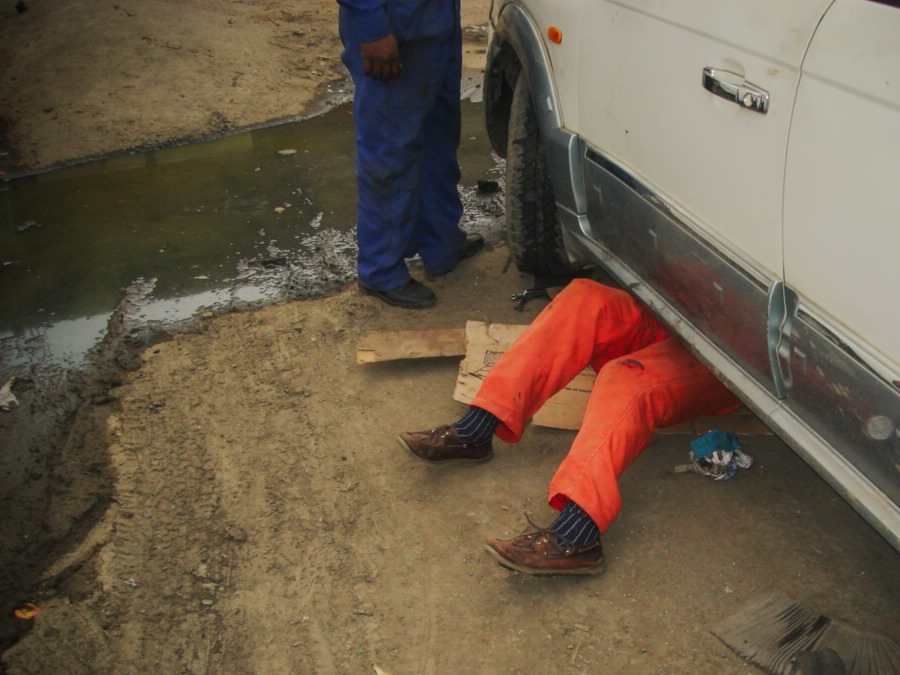
We began at the defunct bus terminal that the Nairobi Metropolitan Service had built on Desai Road for a project that fell through. The covered waiting benches, labeled with routes never plied, are now a concrete park, public space carved out of municipal ruins. “You’ll find people sitting around just watching life go by,” Kepha said. “Friday and Saturday, there are still people up to midnight. They’ll take their drinks and sit on the benches and kula their banter.” We continued to the railways pension housing scheme where, in the weaving lacunae between bungalows littered with silvery tools, mechanics in coveralls slid in and out from under car bellies. This scheme, protected by the legal inertia of obligations to pensioners, would not disappear so fast, Kepha said. “There are these spaces that will sort of resist change. There’s a bit of hope in that, like it won’t just be overrun,” he said, adding too that the families of the New Ngara Estate on Ring Road banded together some years ago to resist the demolition of their homes.
But while Ngara has a distinct working-class character, it houses many middle-class estates, where white-collar workers with families and cars live. In the 2010s, the government, still the biggest landowner in Ngara, built new large-scale public housing which, as with other public housing projects, often resulted in those allotted properties subleased out at a profit—but rent still capped by Ngara’s raw edges. However, this didn’t change Ngara, Kepha said. Rather than reshaping the street in the image of its own consumer desires, the residents of the Civil Servants Estate infused new life into the street with concrete parks. “It was seamless,” Kepha said. “They made this street.”
Ngara is, as NBST says, “historic.” It has been around for almost as long as Nairobi has, as the datestones of buildings and the old shapes of their bodies testify. But the historic nature of Ngara is equally, if not more importantly, documented in its demographic diversity. Ngara is an in-between space, a seam in the city where white collar slides seamlessly across blue collar, where no space is taken for granted, a place indifferent to its own dynamic antiquity.
We ended our tour long after dark, back on Ngara Road, where the white lights of two adjacent butchers appeared like twin open refrigerator doors. This street is home to myriad small businesses that need a lot of space and can afford Ngara rates. We saw mechanics, wheel-alignment businesses, secondhand-goods stores, furniture makers and, as austerity has thickened recently, abattoirs. One kilogram of chicken liver for KES 100 , plus a flatiron, knife, oil, and onions, can make a street-food livelihood. Every day before sunrise, women carrying kiondos queue along the sidewalk for the freshest chickens, just a five-minute walk from the Living Rooms.
Among the exemplary case studies Visit Ngara’s founders cite on the Urban Africa website is Laguna México in the working-class district of Doctores in Mexico City, shortlisted by Architecture Review for its 2023 New into Old awards. Once a textile and lace factory established by a German family in the 1920s called La Laguna, the site is also remembered fondly by Doctores residents as a crucial shelter after the 1985 earthquake when, as the only building with running water, it served as a refuge and service point. But global economic winds foreclosed an industrial future for this factory, and so the family looked to other uses. Like Visit Ngara, La Laguna was transformed into a multiuse space, with architecture studios, a gallery, felt and textile workshop, bookshop, school, and offices. After another devastating earthquake in 2017, the developers offered attractive rates to affected companies and pushed for La Laguna to become a “factory of factories,” a collection of trade workshops that would not only pay homage to its history but keep it alive through present, hyperlocal supply chains. Like the Sarakasi Trust, Productora behaved less like architects and more “like gardeners,” as Juan Carlos Cano wrote in the Architecture Review profile of Laguna México, “looking closely at how their actions grow, which ones take root and must be cultivated, which ones fail and must be replaced by a different species.”
The “species” that NBST focuses on, as Omondi explains, are “fashion, food, film, art, tech, and social entrepreneurs.” So far, nearly all of Visit Ngara’s enterprises are African-owned, and within the Coricom House, all three are women-owned. In Omondi’s words, NBST pegs its own success to not only creating synergies between businesses but providing linkages for “cool things happening across Africa,” for example, a Nigerian DJ performing in a space apart from the same-old venues of Westlands. When asked if Visit Ngara might one day venture into residential spaces too, Omondi said it’s possible: “We’re working to the benefit of these groups—entrepreneurs, innovators, etc.—and they often have to change their business model. So, for us to be successful, we have to change with them. At the moment, retail and office spaces are what we see as a big need, so that’s what we’re doing—but we’re not completely closing ourselves off from the possibility of doing more, if that’s what they need.”
But whereas Laguna México grew from one family’s attempts to keep a space and its neighbors alive in a new economy, the tenants that NBST is bringing in are the new economy. Even when the government offered incentives to develop the areas, La Laguna’s owners rejected a more lucrative strategy to preserve productive integrity of the former factory and neighborhood. NBST’s focus is more downstream: inclusivity. “We understand we’re not operating in a silo. We’re in a neighborhood that has always been here and will always be here,” Omondi echoes. “Sure, there’s an element of ‘You’re bringing in new people who go to Westlands, Kilimani, etc. But an important part of our community engagement is we have different stakeholders, and part of those are the people who already use the spaces.” NBST’s community-engagement work has included a one-hour Christmas caroling session at Sarakasi, featuring Ghetto Classics, an organization that teaches music to children in informal settlements, as well as an International Women’s Day session hosted by the Kenyan Green Building Society, to which NBST invited two dozen students from Ngara Girls High School.
In 1873, Heinrich Schliemann—a German entrepreneur who, once he had made quite a bit of money, fancied himself an archeologist—began excavating in what is now Hisarlık, Türkiye, with little more than a copy of Homer’s Iliad to guide him towards the fabled city of Troy. Searching for the stuff of myth, Schliemann had his workers dig through the historical towards the legendary, all the while discarding layers of rubble. He discovered gold and silver artifacts and—exhilarated to hold in his contemporary hands the very Treasure of Priam, the last king of Troy—smuggled them out of Anatolia. Unfortunately, Schliemann was wrong. These were not artifacts of Troy but of an unknown civilization 1,250 years prior. They had dug blindly. The “actual” Troy—or at least what could have been dated to the time of the Trojan War—was somewhere in that pile of rubble, irreversibly destroyed. Real estate developers, hawking smooth CGI futures at odds with existing streets, likewise blast through urban life to curate a commercial art and cultural district, making underexploited spaces legible to global capital and smoothing them into units consumable by a certain class—in other words, killing what they claimed to renew. Like Schliemann’s, their confidence is an impatient and narrow one that, with crosshairs in view, digs at will, sure that what it values is valuable.
NBST is not the first group of people to imagine Ngara a node of culture in the city. Marjorie Oludhe Macgoye—whose novels picked up the frequencies of Nairobi’s streets, its character and characters, throughout Kenyan history—spent her final years in Ngara. Binyavanga Wainaina once highlighted the organic creative energy of places like Ngara or River Road—a creativity legible to many artists but not always to professional curators. “[Ngara] is an in-between space. You have access to everything and everyone. Everyone is transiting through the same space,” says Kepha Maina. “I don’t think, if I wasn’t living here, I would have that perspective of even what is ailing the art industry in Kenya.” What ails artists in Kenya, he believes, is a misrecognition of what can be considered “art”—a misrecognition rooted in the cultural amnesia wrought by Kenya’s settler colonialism but perpetuated by Kenyans looking at themselves from the outside. “Nairobi is known for art,” he says, “but not what we think.” Kepha sees artists’ eyes and hands in matatu art (some spray-painted just a short walk from Sarakasi Dome), in the object design of trolleys za sosi—the ubiquitous, handmade white carts with water-bottle-steam vents, a motif of street life—in the panel art of kibandas and barbershops, and in the ambient sonic, optic collage of it all. What makes Ngara a potential arts and cultural district is more than its architecture. Everyone agrees Ngara makes a perfect bridge. The question is, does the bridge lead to Huruma or London?
In “(Re)Configuring the City,” cultural scholar Joyce Nyairo analyzes the 1999 song “4 in 1” by Ndarlin P, part of the compilation album Kenyan the Second Chapter produced by Tedd Josiah. The song “4 in 1” unfurls a map with a distinctly Nairobian subjectivity. Narrated from a matatu’s-eye view, zooming through inner-city estates that sank into informality like Ngara, the song plies the Umoja, Kayole, and Komarock routes—“where the dominant architectural scheme speaks of jua kali—informality, bold self-help initiatives, and an utter lack of official or institutional support,” writes Nyairo—telling a story with the polyglot ease typical of Nairobians. Ndarlin P’s map, Nyairo argues, shows a city of colonial ruins that, through “creative ingenuity,” has been “domesticated” by the messy informality of life persisting: of a city being used, not owned. Needless to say, Nairobi’s artists are not ignorant of the hypocrisies of their own home. The mocking, mimicking voice Ndarlin P puts on to refer to an upscale residential area isn’t just a critique of urban inequality; it seems to say, Nyairo writes, “that Nairobi only pretends to be a modern enclave whereas in fact its character is derived more from the ethnic ingenuity that has collapsed all plans of a green city and made illegal densification and informal settlements the order of the city’s development.”
In other words, the “life” of Nairobi is inseparable from how the city’s majority, like those watching the world go by from their concrete park seats, have had to make the city work for them and, in doing so, create the oeuvre that is Nairobi. Those who see in the city primarily a financial engine misidentify this making-do as “death” or “waste” begging for renewal. Like Schliemann digging through Troy to get to “Troy,” it does not occur to the developer walking down Ngara Road and reimagining it as Industry City, Brooklyn, that not only does art need not be imported into Ngara, but that this project’s success—delivering returns on investment through no other way, functionally, than elevating property values—is predicated on fatal epistemic hubris.
Standing in the Living Rooms that night, I had marveled at how the old had been made new again. Perhaps many who attended the launch party felt that same satisfaction of witnessing a decaying space given life without waste. But the more time I spent in Ngara, the more that marvel curdled. If Ngara Road was already dead, what of all this life I saw, threatened through direct consequence by rising property values? What of the quintessence of Nairobi: eking out life in a cruel city built for capital and still living, even if living is braided tightly with struggle, as so delicately archived in the Ngara everyday? Strange to call Ngara a “historic Indian quarter,” as NBST’s website does, when Aggrey and I had stumbled upon a living Kenyan Indian woman who stood in front of her shuttered store, bitter and resigned. If anything, her family’s spice business, the roller shutters repainted a demure olive green and pulled down shut for months, was now more historic than ever—dead indeed. Now, the trickier converse. If Ngara wasn’t dead, what is there to revitalize? If it’s not revitalization that is happening, perhaps there’s another word we should use.
I still didn’t know very much about NBST. I knew that they bought buildings that were already vacant, but I also knew that, with perhaps a couple of exceptions, no buildings were just vacant. NBST claimed it wanted to leave existing businesses standing, but the map in their pitch deck showed blocks of color, properties marked for future acquisition. When I asked Wairimu Mwaura about the people behind NBST in my first interview with her at the ArtCaffè in town, she told me, “My understanding is it’s family and friends who just came together.” I didn’t understand the need to conceal the names of founders which were publicly available on the website, but Kenya Business Registry records did confirm that the founders of NBST are indeed Funsho Allu, Brooks Washington, and Fukunda Mbaru.
Who are the investors behind Visit Ngara? In my second interview with both Mwaura and Omondi, I asked this. All that Mwaura and Omondi were permitted to divulge is that the project has been funded with private capital from the founders’ personal networks. “It’s friends and family of that group of friends,” said Omondi. “They have twenty years of experience each, and with that experience comes a very good network of people who can support you.”
The magnitude of capital capable of acquiring more than a dozen contiguous buildings in the CBD, even if it is a “recently forgotten” area like Ngara, would not deliver returns through rent alone, and certainly not the affordable rates that NBST’s pioneering tenants enjoy—but rather through raising property values of the surrounding area. This process, while it may benefit existing landlords, is diametrically opposed to the interests of current tenants. Constructing residential units, as Omondi suggested NBST is open to—and the very thing La Laguna in Mexico City avoided at all costs—will only expedite this.
A strange contrast thus emerges: Much is said about the light touch used to rehabilitate these buildings, yet so little apparently can be said about the heavy touch necessary to turn occupied properties vacant. With a couple of exceptions, we know little about the people who once spent time between the walls of Visit Ngara’s properties, and even less about whether they wanted to go. That day Aggrey and I found the Indian shopkeeper outside her former store, she said that the remaining storefronts on that street charged rents they couldn’t afford. “We don’t know where to go,” she said. For as little as we have heard from any tenants who have left against their will, we know even less about the landlords who, perhaps even of their own volition, without any contact with NBST, are incentivized to ride the wave buoyed by a new economy. NBST will not evict anyone themselves; but, as many already intuitively know, they don’t have to.
In this sense, it doesn’t really matter what NBST’s intentions are. In this sense, gentrification in Nairobi is actually the same as it is anywhere else. It’s capital looking for means to accumulate, looking for its next fix. Though the focus is often on the party- and restaurant-goers—their race, class, ethnicity, or just their vibe—it is the investors, the developers, and the landlords who both drive this process and also enjoy the privilege of invisibility. The colorfully diverse, or even predominantly African, beneficiaries and participants of a project changes nothing about the force motivating this project, one of the oldest stories of Nairobi: speculation.
Some speculation in Nairobi is ugly and illegal. In 2018, the private Chinese real estate developer Erdemann Property Ltd. began constructing River Estate, a compound of nine 34-floor towers sited precariously close to the Nairobi River that would introduce 3,098 residential units to the neighborhood. To feed concrete to this massive site, Erdemann even built its own cement factory next to Ngara Girls High School, which sits behind NBST’s properties. (In its pitch deck, NBST cites the future residents of River Estate as part of its range of “impact.”) The county government shut down the factory late last year only after students reported respiratory problems.
But some speculation comes in the guise of development. In 2024, expat lifestyle website InterNations ranked Nairobi as the “13th best city for expatriates.” Survey respondents cited “personal finances”—the cost of living for people with the purchasing power of such an article’s intended audience—as a major pro. But while life in Nairobi is affordable for readers of “Expat City Ranking 2024,” the city’s real estate market, inflated by the laundered billions of Kenyan elites and international capitalists and distorted by the housing subsidies of international organizations like the UN, mires Nairobi’s majority population in a “low-quality, high-cost trap.” Nowhere is this starker than informal settlements. A slumlord who “builds” a corrugated metal shanty with no floor, running water, toilet, security, or electricity for $200 can recoup their investment in just a few months. These ghettos, apart from attracting charities and NGOs like fruit flies, perform both their original colonial function as cheap labor reserves and a postcolonial function as rent plantations for the Kenyan rentier bourgeoisie. Chronic housing crises, like other “developing country” problems, are outsourced to NGOs like UN-Habitat (itself headquartered in the leafy hills of Gigiri on land annexed in 1972 from the public Karura Forest) or the government, whose corruption-laden public housing schemes rarely benefit intended beneficiaries, while everyone else—not just the ultrarich but also a growing middle class and diaspora reliant on real estate as a secure form of investment—agrees to never seriously consider rent control, property expropriation, or rental income tax. Meanwhile, international organizations wooed by the Kenyan government provide a ready and willing stream of often untaxed foreign employees who can easily afford the verdant crème de la crème of Nairobi real estate; the UN pays as much as $4,000 per month in rent on behalf of its higher-ranking employees.
Whether for rich or poor, it is speculation that drives the city’s evolution. Each notch of the ice core, every shift in the built environment, begins with a juicy “rent gap”: a demolishable slum, a strip of riparian land, a patch of green space, one more potential UN Blue Zone–certified villa. In a 2017 study on housing price spikes in Kenya, Stephen Githae Njaramba found that, between 2000 and 2015, the price of apartments, bungalows, and maisonettes—staples of middle-income housing—skyrocketed by more than 300 percent even after adjusting for inflation. No longer, if ever at all, does Nairobi’s urban land value (a line that, forebodingly, only goes up) correlate to productive activity; what is important is that the urban built environment remains safe for capital investment.
Kenya’s weak property taxation, a developer’s wet dream, sustains this. Whereas South Africa, which also inherited colonial British land rates, has since pegged property taxes to the capital value of property, “Kenya is the only country in the world that currently uses pure site value taxation”—a system that, when it was created in 1928, was meant to discourage holding vacant land when Nairobi was mostly vacant land, according to Lucy Nyabwengi and Owiti K’Akumu of the University of Nairobi’s Department of Architecture and Building Science. Although the Nairobi County government squanders in debt, it derives only 15 percent of its revenue from property taxation, according to Nyabwengi and K’Akumu, compared to cities in Australia which derive 37.3 percent of their revenue from property taxation or Canada, where it is 53.3 percent. A city—if an engine for multiplying stolen taxes, diaspora finance, global hedge funds, and foreigners eager to invest—is a terrible thing to waste. It is this, and none of Nairobi’s many well-intentioned but ignored city plans, that de facto “designs” the city, making the refined parts refined and the ugly parts ugly.
All these phenomena—a rent-drunk city, a slum city, a divided city—can be connected not just to Nairobi’s colonial design but to structural adjustment policies touted by many of the same institutions that today claim to be on the forefront of revitalizing poor cities. In Planet of the Slums, Mike Davis writes, “The 1980s—when the IMF and the World Bank used the leverage of debt to restructure the economies of most of the Third World—are the years when slums became an implacable future not just for poor rural migrants, but also for millions of traditional urbanites displaced or immigrated by the violence of adjustment.” This is why, Davis explains, the 2003 UN Report The Challenge of Slums called structural adjustment programs “deliberately anti-urban in nature”; mass collapse in formal employment and subsequent informalization can be seen as a “direct function of liberalization.” Thanks to the unfettering of global capital, Kenya deindustrialized before it industrialized: Factories shut down, national assets were privatized en masse, cheap imports flooded markets, and land was carved up by multinationals. The Kenyan economy shifted away from production towards a service economy that hangs precariously on consumption patterns and, often, foreign investment.
So faraway is the notion of the right to the city nowadays that, so long as an enterprise points towards the lodestar of consumption and its twin, “creating jobs,” it is justifiable. Nairobi, rather than an engine of production, grew as an engine of finance, and—just as unionized workers critiqued ahead of Nairobi’s first Charter Day—the urban built environment was used less as a home for those who make it and more a medium for capital accumulation.
Still, mobilizing capital remains the orthodoxy for how to improve cities in the Global South. The landmark 2010 World Bank report “Systems of Cities: Harnessing Urbanization for Growth and Poverty Alleviation” suggests myriad interventions for cities struggling with poverty, including redeveloping underutilized postindustrial spaces as cities of the Global South transition into a postindustrial economy. Visit Ngara, a mixed-use redevelopment project executed by a single developer for profit, would likely be a positive case study. Whether it is called “development” or “upgrading,” urban-renewal projects globally have notoriously supplanted locals’ right to shape their neighborhoods with the right to a return on investment or the right to extract rent. Ngara’s secondhand-electronics stores, wheel-alignment businesses, and rations stores are sitting on untapped gold—“thrice-ignored capital reserves,” in urbanist Michael Goldman’s words: “dead infrastructural capital sitting on dead land capital, overseen by dead managerial capital.” For capitalists, then, Ngara is dead. And, thus, perhaps they are not suited to shape this city after their heart’s desire. Who is, then?
In the early hours of April 24, 2024, torrential rain overwhelmed Nairobi’s congested, suffocated rivers. In the Mathare River Valley, where shanties line flood zones, entire neighborhoods were submerged up to their corrugated-metal roofs. Hundreds lost their belongings; 32 people lost their lives. When the sun rose, residents of the Mathare informal settlement daisy-chained belongings out of neighbors’ homes, standing waist deep in brown water while six kilometers away President William S. Ruto launched the $74 million Bunge Tower built for legislators. The government offered little aid to victims, but it did try to prevent this from happening again by demolishing homes near the river with only hours’ notice, while many were already at work. Families were compensated $77 for the trouble. In Mukuru, two children were crushed to death and, in Mathare, a bed-ridden teenager, whose mother had left to buy medicine, was also killed.
Mathare is just as historic as Ngara. Most of colonial Nairobi’s earliest buildings, including the Indian buildings along Ngara Road rehabilitated by NBST, were constructed with stone mined from Mathare’s quarries just a few kilometers northeast. African laborers rented the quarry from Indians and settled in the river valley. In the 1950s, when anticolonial resistance reached its fever pitch, the Kenya Land and Freedom Army, an armed insurgency later called Mau Mau, used Mathare as its urban base, moving money and weapons, recruiting and oathing, and even holding court and executing loyalist Home Guards there. It is for this reason that in 1951 the British colonial administration used earthmovers to demolish Mathare wholesale—and for this same reason that the road which courses through Mathare parallel to the river is today called Mau Mau Road.
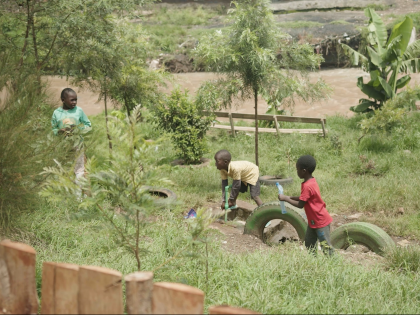
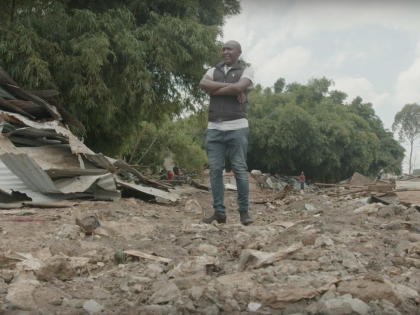
On December 10, 2024, International Human Rights Day, just off Mau Mau Road, a couple of earthmovers remained on the banks of the Mathare River. Though most of the riverside homes had long been destroyed, the straggling earthmovers pecked at debris on a bald patch of land, while the air buzzed with the ambient chirp of children deep into a long school break. Nearby, an adjacent patch of land teemed with pumpkins and tree seedlings, decorated with glittering fences of recycled plastic bottles. A group of Mathare residents gathered here, beneath tents populated with a grid of cream-colored plastic chairs. They were here to launch a community park, built by volunteers organized by the Mathare Social Justice Centre (MSJC), a local alliance of organizers that began by documenting cases of extrajudicial executions by police in Mathare. It would be known as the Dr. Wangarĩ Maathai Park, named for the Kenyan winner of the Nobel Peace Prize who defended forests and public green spaces.
In the wake of the river demolitions, a group of Mathare residents decided that, rather than leave the land empty or, worse, cede it to slumlords to immediately rebuild and re-rent on the same terrain, they could turn it into a public park. They wrote to local authorities for permission and planted memorial trees to honor the young protestors who had been killed by police during the anti-austerity demonstrations of June and July 2024. As volunteers labored to carve out the park, police arrested them under bogus charges—“trespassing,” “incitement,” “possession of bomb.” In November, police raided the park and uprooted the memorial trees.
At the launch, a group of police officers, armed with tear-gas grenade launchers and rifles, tried to stop it. Gacheke wa Gachihi, MSJC’s coordinator, took the microphone. “We saw those who were evicted,” he said. “We occupy: we plant food and trees and create this work so that we understand every day is struggle. To make this space a site of struggle. To live without subjugation, just as Wangarĩ Maathai fought.” As he spoke, a couple of teenagers wheeled in stacks of more plastic chairs past the police.
The creation of the Dr. Wangarĩ Maathai Park in Mathare is a rare refutation of Nairobi’s logic of urban planning. Mathare residents imagined a yet-to-exist version of their neighborhood, then reclaimed and occupied land, a lucrative resource, for its use value (recreation, sustenance, memorial) rather than its exchange value (rent). This is an articulation of their “right to the city,” an act of democratic imagination that does not confuse luxury with progress. Yet when Mathare people attempt to change the city after their own heart’s desire, rather than being applauded for sustainability and inclusivity, they are criminalized. Their park is not “beautiful” in ways that could win them design or architecture awards, but it elegantly illuminates a truth about urban development: that Nairobi’s opulent beauty, when viewed from the valleys that house those who build and sustain it, valleys that must be policed differently to the lush, green neighborhoods to maintain this imbalance, is hardly beautiful at all.
Why Mathare is governed differently from Westlands—no piped water, unreliable electricity, regular executions by police, and roads paved primarily for kettling—is the story of Nairobi. Since the “two Nairobis” that Bethwell and Madara Ogot described coagulating in the interwar years, informal settlements that contain the cheap labor that fuels Nairobi are treated not merely as an afterthought but as an eyesore. Hardly different to the settlers eager to showcase their modern, developed Nairobi on Charter Day, many today are more content with a city that looks the metropolis it wishes to be, even if from a few choice angles, than an open-ended oeuvre crafted democratically by those who build and sustain it. A crown jewel is easier to sell than a beating heart.
It might seem silly that anyone could believe that the clean arcs of expressways or the Babylonian sparkle of luxury hotels could possibly offset the reality that the metabolism of this city disposes trash in the same place it relegates its cheap labor. Yet this “mere propaganda trick,” to echo trade unionist Fred Kubai, has motivated middle and upper classes to create cities within a city. Nairobi Street Kitchen, for example, a large restaurant and bar in Westlands designed to be the simulacrum of a night market—replete with food trucks, restaurants, and cafés, but domesticated from the public, is safe enough even for King Charles and his security detail to stop by during his 2023 visit for some “Kenyan street food.” Within fenced, gated, privatized bubbles, mini utopias provide the opportunity to consume urban life without being in the urban. Likewise, Visit Ngara is creating a cultural district in a lab. While in archetypal gentrification, capital follows culture, with broke artists moving to working-class neighborhoods and then capital, smelling a rent gap, swooping in, in Ngara, it is, cynically, the reverse. Here, capital first rearranges urban space to centralize rent extraction and then inoculates it with select artists to project an aesthetic of there having been artists here already.
During the week that I stayed in Ngara while writing this, I ate almost every day at Ndiira Café, usually beef stew matoke. Ndiira is the most bustling food joint on that stretch of Ngara Road, and it runs on working-man hours: 5 a.m. to midnight. On the walls sit collages that do not take themselves seriously, like an archival photo of Jomo Kenyatta meeting Haile Selassie with a speech bubble saying “Asante,” while below them is an arrangement of stock-photo fruits, sodas, and a glass of white drink labeled “Milk.” The menu spills off into taped-up A4 sheets of paper announcing new items and extras: “2 FRIED EGGS 70/=,” “PILAU AVAILABLE 150/=,” “KINDLY SPEND 50/= PER GAME.” A man stirs his tea eternally until an andazi appears before him. Another scribbles on a piece of paper. People scroll on charging phones.
At Ndiira, I was just another patron in this in-between space on a seam of Nairobi. The food was fine. No one paid me any heed. I wasn’t Visiting Ngara, after all; I and everyone else in that café were just in it. Nothing I’ve argued rests on romanticizing Ngara as it is now, nor insisting on freezing it. Ngara has archived nothing less than a century of change. The problem was never that people of different kinds slide across one another in a city.
The problem is believing that no transformation to the built environment can be called wrong if it is a response to market demand and was consecrated with an amicable and legal handshake of willing buyer and willing seller. The problem is Nairobi putting on an accent once again to pretend it is, in Joyce Nyairo’s words, “a modern enclave.” The problem is confusing a city of citizens with a city of individual consumers with consumers’ rights. My right to eat a croissant while my parked car remains safe. My right to rent a podcast recording studio for even cheaper than in Kilimani. My right to have a whiskey sour not just anywhere in Nairobi but in Ngara—and, in doing so, make Ngara new.
As Friday night settles comfortably over Ngara, temporary matatu stages appear around the Equity Roundabout at one end of Ngara Road. Vehicles rest behind hawkers who line up kiddie shoes on a neat grid, and in this space of intersections the Sheng “wozza wozza” stretches into the pause of a familiar handshake. Twenty-four-hour soup kibandas, serving eternal bone broth stewing a cow head, anticipate their market base of drunkards, a constituency that blooms as the night renders. In a city where people make homes out of scars, one might need to look a little harder to see what needs renewing and what is already very much alive.