Atayese
Honored in Yorubaland as “one who repairs the world,” Jesse Jackson’s life bridged civil rights, pan-Africanism, empire, and contradiction — leaving behind a legacy as expansive as it was imperfect.
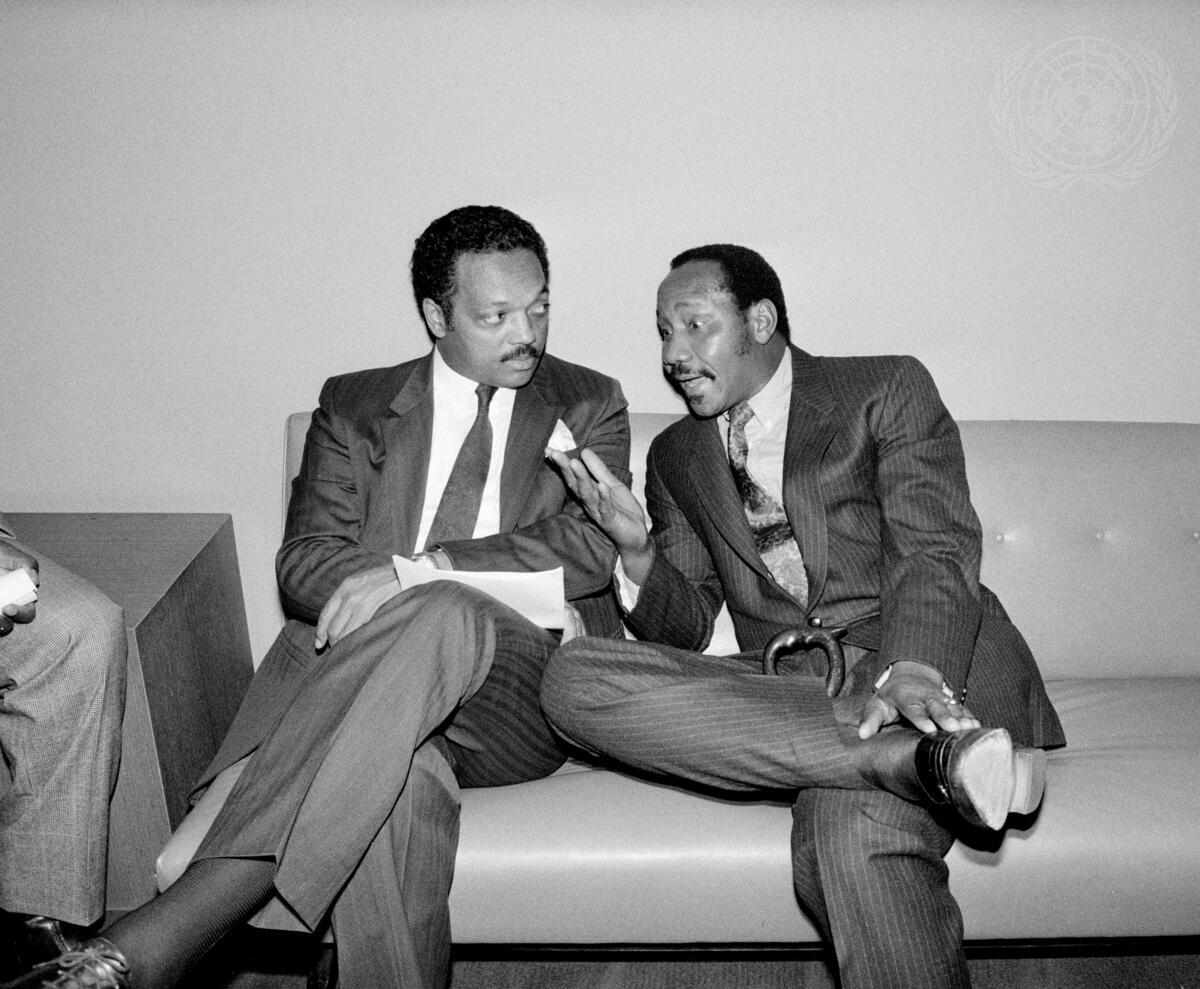
Rev. Jesse Jackson (left) meets with Joseph N. Garba, Permanent Representative of Nigeria and Chairman of
When the then Oyo monarch Oba Lamidi Adeyemi III conferred a chieftaincy title on Reverend Jesse Jackson in 1989, Jackson was already a globally recognized figure. As an acolyte of Martin Luther King Jr. and a two-time presidential candidate in the United States, it was fitting, though not surprising, that he would be honored by a monarch in southwestern Nigeria. This was the era of pan-Africanism, and Reverend Jackson, having made numerous trips to the continent in the ’70s and ’80s, was well-known in diplomatic and political circles.
In Yorubaland, honorary titles are typically reserved for distinguished individuals. While these titles often carry significant social weight—sometimes being conferred haphazardly or even to launder an undeserving recipient’s image, the honor bestowed upon Reverend Jackson was deliberate and appropriate. Conferring the title of Atayese underscored the importance of names to the Yoruba people and the foresight of the king.
Atayese, in literal terms, means “one who repairs the world.” Decades earlier, Malcolm X had been rechristened Omowale (the child returns home) in nearby Ibadan. Despite global progress, it was clear that the Black world was in a state of disrepair. The gains of the Civil Rights Movement had been eroded by the Reagan economy and COINTELPRO; the promises of independence had faded in many African countries, and South Africa remained under apartheid. From his days as a high school class president to his death as a world-famous activist and minister, Jesse Jackson’s life was dedicated to repairing breaches and connecting people.
When his death was announced in the early hours of February 17, the entire world paid tribute. That evening, I was at the University of Wisconsin–Milwaukee to hear scholar-activist Angela Davis speak. When the event host asked her about Reverend Jackson, she recalled him fondly, sharing a memory of his visit to her while she was incarcerated. When the jail authorities asked about their relationship, Davis recounted that he introduced himself as her spiritual advisor. This anecdote typifies the profound impact he had on people. Hundreds of individuals on social media are sharing photos taken with him during his numerous travels, all underscoring a clear truth: He was everywhere.
From former hostages to politicians and activists, Reverend Jackson was ubiquitous, assisting people and intervening in conflicts. He reached out to everyone who needed support, irrespective of race, class, nationality, gender, or sexual orientation. He was famous for reciting Reverend William Holmes Borders’s poem “I Am Somebody” at events, insisting that we are all God’s children. The insistence on being somebody might seem trite but in a country that was built on the dispossession of Indigenous people and the enslavement of Africans, it was important to keep insisting on the humanity of everyone.
This ubiquity and affability, however, also proved to be a flaw. Many people felt alienated when they saw him engage with individuals they considered enemies. Yet this was not a failing of the man himself; it simply showed how capacious his heart was.
Reverend Jackson’s life was also marked by notable contradictions. During his 1984 presidential run, he referred to New York as “Hymietown,” which enraged the Jewish community. He apologized repeatedly, and in an attempt to mend relations, he overcompensated by attending the World Jewish Congress in 1992, where he praised Zionism outright. This was a huge surprise coming from the man who is arguably the first to bring the issue of Palestinian rights into an American presidential campaign. On another occasion, he was caught on camera blasting then Senator Barack Obama in what he thought was a private conversation. Yet when Obama won the presidential election, the video of Jackson weeping at Grant Park remains a poignant symbol of how much progress African Americans have made. Such was the paradox of Reverend Jackson.
Despite these contradictions, he possessed a keen understanding of how the US empire operated. His successful and highly acclaimed leadership of Operation Breadbasket is a reflection of his view of economic freedom as being central to progress.
He also compared International Monetary Fund policies in Africa to the slave trade. He upbraided the IMF and called them “slave masters.” Only an internationalist like Reverend Jackson could have drawn such a parallel between slavery and oppressive modern-day economic policies. Reverend Jackson will be remembered differently by different people, but one thing remains clear: He was a true repairer of breaches, and his like we may never see again.