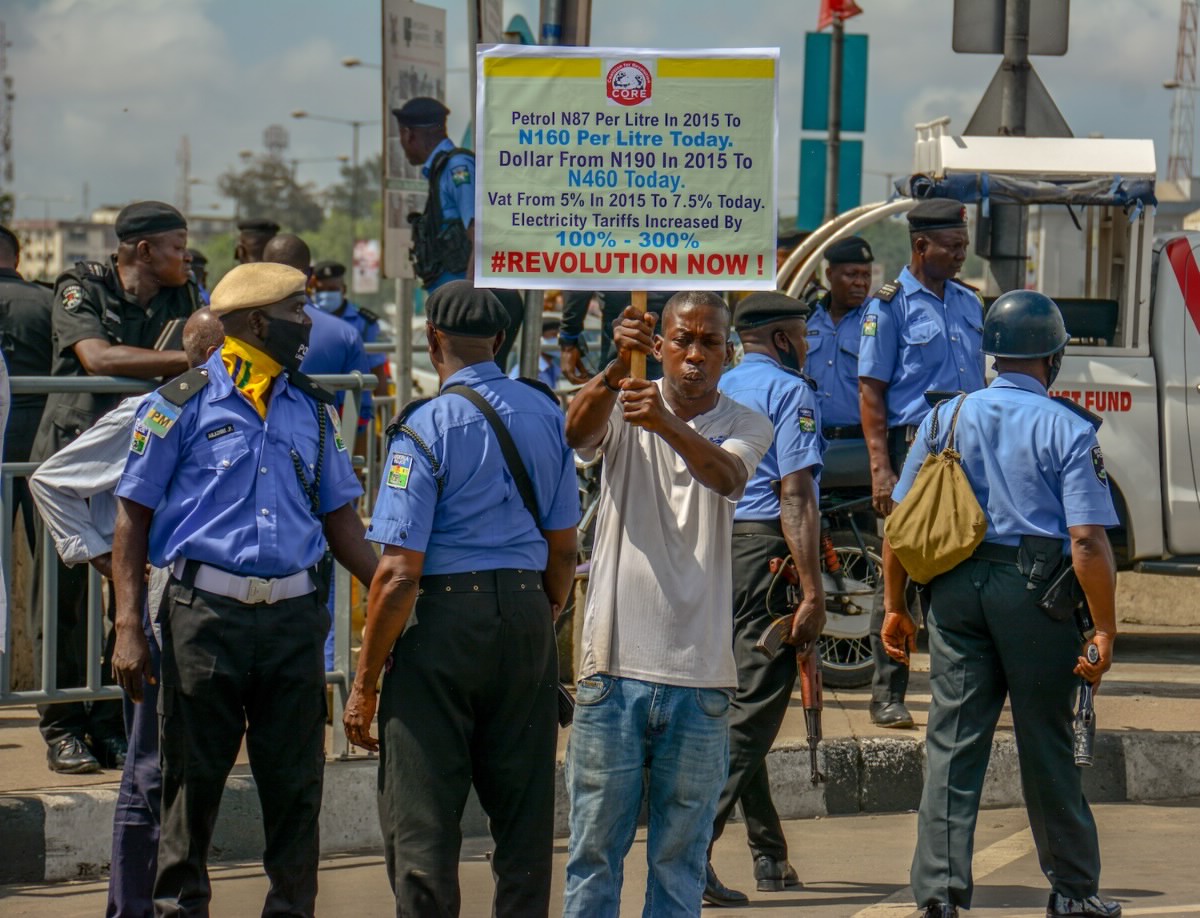
Lagos, 2020. Image credit Oluwafemi Dawodu / Shutterstock.com Today, South Africans mark Freedom Day and Sierra Leoneans their independence—both good occasions to take stock of what postcolonial freedom has actually been made to mean. Nigerian President Bola Tinubu offered one answer a few weeks ago when he stood before a crowd in Bayelsa State and told his countrymen to be grateful. Fuel prices were high, yes, the pain of subsidy removal real and ongoing—but Nigerians should take comfort, he suggested, because people in Kenya and elsewhere had it worse. Liberation, it turns out, has come to mean: at least we are not them. Two weeks later, Kenyan President William Ruto had responded sharply, mocking Nigeria’s infrastructure and, in a remark that lit up social media, taking a swipe at Nigerians’ spoken English. The two leaders traded barbs across thousands of kilometres, to the delight and outrage of their respective online publics. Commentators asked whether this constituted a diplomatic crisis. It does not. What it constitutes is something more revealing: a window into the political condition of a continent where economic stagnation has made elite self-justification a governing art form. The context for the exchange matters. Both Nigeria and Kenya are navigating some of the most intense cost-of-living pressures in years. Fuel subsidy removal, currency depreciation, food inflation, and contracting public services have combined across much of sub-Saharan Africa to produce a moment of genuine popular frustration (the protest mobilizations over the last decade and a half that are the focus of our 2025 special issue illustrate this). These are not abstract macroeconomic difficulties. They register in the price of maize flour, the cost of cooking gas, the school fees that cannot be paid, and the hospital that cannot be reached. In this moment, Tinubu chose not to defend his economic program on its own merits, but to reach sideways, to another country’s misery, and offer it as consolation. The logic was unspoken but legible: we may be struggling, but at least we are not them. This is a recognizable move. It might be called pathetic exceptionalism, reflecting the politics of managing discontent not by improving material conditions but by locating a more unfortunate neighbor and pointing. It reminds me of when South Africa’s mineral resources minister, Gwede Mantashe, during the worst years of the country’s energy crisis, offered something similar, suggesting that at least South Africans were warned when power cuts were imminent, unlike elsewhere on the continent (by the way, our first feature-length documentary on the ecological crisis and energy inequality that features Mantashe as a character, has its North America premiere next month in NY). The appeal of such framings is obvious. They require no policy, no investment, no institutional reform. They require only the existence of someone worse off and a microphone. What they reveal, beneath the surface provocation, is governments that have exhausted the narrative of improvement and retreated to the narrative of comparison. This is not a diplomatic posture. It is a crisis management technique, and a poor one. Ken Opalo once wrote illuminatingly about what he calls a deficit of developmental ambition among African elites—a tendency toward what he describes, with some precision, as “destination anywhere” policymaking. The core of his argument is that the ends we pursue shape the means we choose, and that in the absence of a shared, explicit vision of structural transformation, policy becomes a kind of aimless management, a series of reforms that are ends in themselves rather than steps toward a materially improved society. The MDGs, the SDGs, the endless conference frameworks and conditionality matrices—these become, in Opalo’s reading, substitutes for ambition rather than expressions of it. Governments do development rather than transforming societies. They navigate the terrain of donor expectations, technocratic benchmarks, and political survival while the fundamental condition of their populations changes only slowly, if at all. The Tinubu remark fits perfectly within this frame. It is the utterance of a leader who has no compelling developmental story to tell, and who therefore borrows his neighbors’ problems to paper over his own. What makes this moment particularly interesting is the contrast it invites with a very different kind of political performance, that of the Sahelian junta leaders who have, in the past several years, become improbable icons of anti-establishment politics across the continent. Ibrahim Traoré of Burkina Faso, with his military fatigues and his scorching rhetoric about Western imperialism and comprador elites, has accumulated a social media following that extends far beyond his landlocked country. Assimi Goïta of Mali and Abdourahamane Tchiani of Niger have attracted similar, if more qualified, admiration. These leaders are widely seen, especially by younger Africans, as something refreshing: they say what the civilian elites are too cautious to say, they name the structures of dependency that have constrained the continent, they perform a sovereignty that feels, at least aesthetically, like a rebuke to decades of managed subservience. The appeal is understandable. At a moment when mainstream political leadership has been reduced to Tinubu’s lateral comparisons and Ruto’s defensive nationalism, there is genuine emotional satisfaction in watching a leader throw France out, refuse the IMF’s terms, invoke Thomas Sankara, and speak, however theatrically, of a different future. One can understand, without endorsing, the appeal of the strongman who appears to have conviction. In a landscape dominated by unimaginative neoliberal “pragmatism,” the man who claims principle feels radical. But the evidence from the Sahel itself should give us pause. Mali under Goïta offers perhaps the clearest case study in the limits of sovereignty-first politics. The junta’s rhetoric has been nationalist and anti-imperialist in the most unambiguous terms. France’s Barkhane forces were expelled. MINUSMA was shown the door. The Algiers Accord was buried. Russia’s Africa Corps arrived. And yet none of this has produced material improvement in the lives of ordinary Malians. Jihadist groups now control more territory than they did before the coups. Living conditions remain dire, with growth concentrated in urban centers while rural areas are neglected. A new class of enriched colonels has emerged, with horses in stables and new houses springing up like mushrooms, while poverty has deepened. In May 2025, Goïta dissolved all political parties, citing public order. The sovereignty rhetoric has become, in practice, the justification for authoritarianism, and the authoritarianism has produced neither security nor development––and in many cases new forms of dependency. This brings us to a genuine tension in contemporary pan-Africanist thought. Responding to Bettina Engels’s assessment of Traoré’s record in Jacobin, Momodou Taal—whose work we admire and who has been twice-profiled on this publication—tweeted that Western Marxism would never truly fathom third-world struggles, and that in the Global South, class struggle must ultimately be subordinated to a national project of sovereignty and development. It is a position worth taking seriously, not least because it captures something real about the limits of certain imported analytical frameworks. But I think, with respect, that it gets the relationship backwards. Frantz Fanon (among many others), who was neither Western nor soft on imperialism, understood the trap contained within it. The national bourgeoisie—or in this case, the national military—that inherits the structures of the colonial state without transforming them will not liberate the people. It will reproduce the conditions of their subordination under a different flag. The nationalism that does not pass into social and economic transformation is not a liberation; it is a change of personnel. It is worth insisting that this is not just an argument for the restoration of the old civilian order, which was itself exhausted and extractive. Nor is it an argument for Western tutelage or for the donor frameworks that Opalo rightly criticises as low-ambition substitutionism. The point is rather that there is no shortcut through the figure of the strongman, however rhetorically compelling, to the kind of structural transformation that the continent needs. The junta leaders are, as Faisal Ali has noted, practitioners of what might be called praetorian plebeianism: they position themselves as the incorruptible guardians of the people against the corrupt civilian class, while gradually and inevitably building a new extractive class of their own. What African politics needs—and what its history, at its best moments, has actually produced—is not a better strongman or a more rhetorically satisfying elite, but organized popular power with the patience to outlast the state’s capacity to ignore it. This means trade unions that are genuinely rooted in working-class life, political formations that contest elections not as vehicles for individual ambition but as expressions of collective programs; social movements that hold governments to account not only through the oppositional sidelines but through the slow accumulation of institutional force. None of this is glamorous. None of it produces the kind of viral moment that a junta leader’s speech against imperialism produces. And with most things, it is easier said than done. The space for popular political agency is contracting globally, and in much of the continent, it was never allowed to fully open in the first place. But, in the long run, it is the only form of power that has ever compelled states to serve the people who live within them rather than the elites who sit atop them. Africa’s people are not waiting for leaders who can identify, in spectacular fashion, what is wrong. They have long known what is wrong. What they are owed is the organized political infrastructure to do something about it. – William Shoki, editor |