After the Jamahiriya
Fifteen years after NATO’s intervention in Libya, economic collapse and foreign subjugation have fueled renewed support for Gaddafi-era stability.
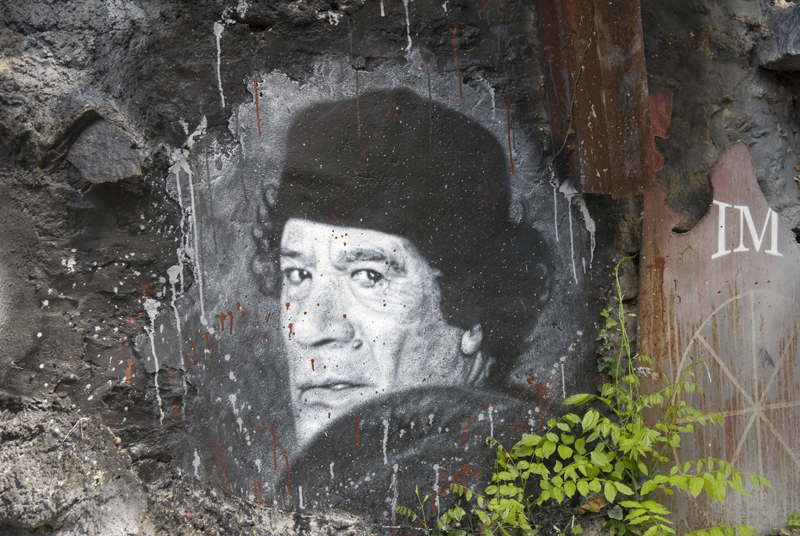
Painted portrait of Muammar al-Gaddafi on a wall at the Abode of Chaos, France. Photo by Thierry Ehrmann via Flickr CC BY 2.0.
Since the 2011 NATO war on Libya, the once prosperous North African country has been marked by grinding poverty, institutional dysfunction, and the constant threat of civil war. Many Libyans long for a return to state functionality. This yearning often manifests as nostalgia for the Jamahiriya period, when Libya was helmed by Colonel Muammar Gaddafi, who led the Al-Fatah Revolution of 1969 and oversaw the construction of a sovereign state along the lines of his Third Universal Theory, a unique form of Islamic socialism and anti-imperialism explicated in Gaddafi’s Green Book.
Today, Libya is partitioned between the Tripoli-based Government of National Unity (GNU), recognized by the United Nations and led by Abdulhamid Dabaiba, and the House of Representatives, effectively a military government under the command of Field Marshal Khalifa Haftar. Both governments rely on foreign backing: the GNU on Türkiye, Qatar, and the US, and the House of Representatives on Egypt and the United Arab Emirates, among others.
Support for Gaddafi and his theories did not die when the man himself was killed by NATO-backed Misratan rebels on October 20, 2011. The Jamahiriya’s legacy looms large over Libya today, and Gaddafi nostalgia remains a significant force in the country’s politics. It is primarily as a mass movement from below, with various political instantiations such as the Popular National Movement (PNM) and the Popular Front for the Liberation of Libya (PFLL), the latter of which was led by the late Saif al-Islam Gaddafi until his assassination earlier this year.
For many in Libya, the Jamahiriya remains a reference point of lost sovereignty and stability. Such views are reinforced with every new revelation about Libya’s subjugation to outside forces. One of the latest insights into this subjugation came when the US Department of Justice released documents revealing that, during NATO’s intervention in Libya, Jeffrey Epstein worked with former British and Israeli intelligence officers in an effort to access billions in Libyan state assets frozen in Western countries.
In a sign of Libya’s ongoing dysfunction, many former anti-Gaddafi rebels have been converted to the “Green Resistance,” as the constellation of loyalist councils, tribal alliances, and clandestine networks is often called. When Libyan academic Dr Mustafa Fetouri journeyed to the Nafusa Mountains in January 2026 to meet Saif al-Islam—a trip eloquently described in a recent New Lines Magazine article—he found that one of Saif’s bodyguards was a former rebel from Zintan who described himself as belonging to the “mugharrar bihim,” meaning “duped.” In 2016, a Zimbabwean newspaper interviewed former anti-Gaddafi fighters about the situation in Libya; they expressed nostalgia for the government they helped overthrow. One former anti-government fighter remarked, “Before 2011, I hated Gaddafi more than anyone. But now, life is much, much harder, and I have become his biggest fan.” While writing my book, Targeting Libya, a Libyan man from Benghazi informed me that “most” former rebels in the city regret their role in toppling the Jamahiriya.
Among the working and middle classes in Libya, there remains a vast base of support for the Green Resistance. Organizationally, however, the Resistance is fragmented, lacking a unified command structure. This is representative of internal divisions, but it is also a survival tactic; after all, it is harder for the post-2011 authorities to stamp out Gaddafi loyalism when the Green Resistance remains diffuse.
While the excesses of the Gaddafi period are well-known, its positive aspects, which serve as the basis for the present nostalgia, tend to be elided, especially in Western media coverage. Such a lopsided analysis does a disservice to Westerners and Libyans both. It severs one’s connection to realities on the ground, and filters descriptions of events through a preconditioned hostility to the Jamahiriya period. Any full, reasoned analysis of Libya’s political system today, and the Green Resistance that influences political discourse both within and outside government institutions, must account for Libyans’ own feelings about the 42-year political experiment that still occupies the nation’s collective memory.
Between 1969 and 2011, Libya was transformed from a desperately poor country into the most prosperous nation in Africa, with human development indicators more comparable to Southern Europe than the rest of the African continent. The state reclaimed natural resources, most importantly oil, from foreign control and used revenues to fund a system of universal healthcare and education. Women’s rights were expanded, and widespread literacy was achieved. In 1976, Colonel Gaddafi personally bulldozed the last shanty in Libya to celebrate the construction of more than 100,000 new homes (during this period, the only Western countries with higher rates of construction were Sweden and Denmark). A political system arose, rooted in Green Book theory, that granted Libyans a greater degree of political participation than they’d experienced under the Senussi monarchy of King Idris (1951-1969), the postwar domination by Allied powers (1945-1951), the Italian colonization (1911-1943), and the preceding Ottoman era.
Green nostalgia fundamentally represents a longing for public order, economic stability, and functional institutions—all of which were destroyed by NATO bombs in 2011. As Mustafa Fetouri described in an interview with the author:
The working and middle classes [of Libya] have borne the brunt of the post-2011 economic collapse, insecurity, and institutional fragmentation. For many, this nostalgia is not necessarily a yearning for a specific political ideology of the past, but rather a longing for the ‘state of order’ and the basic life dignity that has since evaporated.
However, it is surely not lost on Libyans that such order and dignity were secured in the context of resource nationalization and strong anti-imperialist policies.
In Libya today, the two leading political formations of the Green movement are the PFLL and the PNM. The groups have similarities and differences. The PFLL, in Fetouri’s words, “functions more as a socio-political movement than a traditional party.” It has no formal organization nor an established hierarchy, although authority indisputably rested in the hands of Saif al-Islam, Muammar Gaddafi’s son, who was assassinated on February 3, 2026.
Operationally, the PFLL functions “through a network of influential key players who often remain behind the scenes for security reasons.” Hostile to both Libyan governments, the PFLL was nonetheless influential enough to warrant inclusion in the United Nations Support Mission in Libya’s “structured dialogue” involving the country’s various factions.
Summarizing the PFLL, Fetouri explained:
The Front acts as an umbrella for the ‘Greens.’ Its relationship with Saif al-Islam was one of profound ideological alignment rather than a rigid bureaucratic command structure. Within Libya, the Front draws its strength from a deep-seated base of supporters, particularly among tribes and communities that feel marginalized by the post-2011 political order.
Before his assassination, Saif al-Islam was the most popular political figure in Libya. During the final decade of his father's rule, Saif was a champion of economic liberalization. After NATO's 2011 war on Libya, he was imprisoned by rebels in Zintan for several years. Following his release in 2017, he once again became a national political figure, defending his father's legacy while criticizing both the UN-recognized government in Tripoli and the House of Representatives. As such, he was isolated by both Libyan governments. As Anas El Gomati writes: “[Saif] remained outside the system, tolerated, contained, and watched, a reminder of an alternative line of inheritance that could never be fully neutralised. He had lived under the persistent threat of assassination since 2017.”
The Gaddafi scion ran for president during the December 2021 election; however, the election was ultimately cancelled and postponed several times. Some in the Libyan government asserted that the election was cancelled at the behest of Washington to prevent the popular Saif from winning power; the US government dismissed these suspicions as “conspiracy theories.”
Saif al-Islam planned to run in the April 2026 presidential election, which has been delayed since December 2018; unofficial polls showed him receiving a high level of popular support. Interestingly, his assassination occurred one week after a meeting in Paris between US officials and high-level representatives from Libya’s two governments, and on the heels of the Donald Trump administration's efforts to ramp up its exploitation of Libyan oil; naturally, this has fueled speculation about the motives of Saif al-Islam’s assassins.
With Saif dead, the PFLL’s future is uncertain. “The absence of Saif al-Islam leaves the movement at a critical crossroads,” Fetouri stated. “It must now navigate the challenge of transitioning from a personality-driven entity to a more institutionalized resistance or political bloc if it hopes to survive the loss of its central figure.”
The Popular National Movement (PNM) is led by Dr Mustafa al-Zaidi, a prominent plastic surgeon, who called for the overthrow of the Tripoli-based Dabaiba government in 2022. Unlike the PFLL, the PNM has forged inroads with Haftar’s government in eastern Libya, where the PNM also publishes its newspaper.
The PNM is more structured than the PFLL. Despite its limited resources—it relies primarily on contributions from supporters—the PNM managed to hold two consecutive annual conferences on Libyan soil, both in Benghazi. “This indicates a level of grassroots mobilization and internal management that sets it apart from more clandestine or personality-driven factions,” noted Dr Fetouri. “While the [PFLL] often functions through symbolic and clandestine networks, the PNM acts as the more ‘institutionalized’ and ‘diplomatic’ face of the movement, seeking to re-integrate the loyalist base into the formal political process.” This integration has involved pragmatic, transactional interactions with Libyan authorities, primarily in the east.
Beyond his dealings with the PNM, Haftar has regularly played the “Green card,” flaunting his connections to Gaddafi-era officials in hopes of benefitting from the popular Gaddafi nostalgia—quite ironic given the fact that Haftar himself defected from Libya in the 1980s and lived for years in Virginia. Nevertheless, Haftar has integrated numerous Gaddafi-era military officers and administrative figures into his command, and he has received support from prominent Gaddafi-era figures like Abu Zaid Dorda and Moussa Ibrahim.
Fifteen years after the destruction of the Jamahiriya, Libyan authorities must still contend with Gaddafi’s legacy. Government repression of the Green Resistance has forced members into hiding and secrecy, while some, like Haftar, attempt to co-opt Gaddafi’s legacy for their own political purposes while remaining hostile to Gaddafi-era ideology.
In a grim illustration of post-2011 repression, Libyan authorities forbid supporters of Saif al-Islam from burying their leader in Sirte, the hometown and tribal seat of Muammar Gaddafi. Public remembrance of the one-time presidential hopeful was suppressed. As Anas El Gomati describes: “Condolence receptions were blocked. Public mourning was prevented. Saif spent a decade being told where he could live, who he could see, and when he could speak. His killers decided where he could die. His rivals decided where he could be buried. No one has been arrested. No one will be.”
Despite the public restrictions, thousands of Saif’s supporters converged on the city of Bani Walid for his funeral. Dr Fetouri was in attendance. He described tens of thousands of Libyans gathered in a “massive, silent referendum.” While Bani Walid has long been a center of Gaddafi loyalism in Libya, Fetouri stressed that “this is no longer a fringe or isolated group; it has manifested into a broad social base that views the pre-2011 era as a benchmark for stability in contrast to the current protracted crisis.”
The longer Libya’s crisis continues, the longer it is subjugated to foreign powers, the more widespread Gaddafi nostalgia will become. This is hardly surprising. Promised freedom and Western-style democracy, Libyans instead received bombs, civil war, and rampant corruption.
It is highly unlikely that a Green phoenix will rise from Libya’s ashes and restore stability and sovereignty to the country. At the very least, however, Gaddafi nostalgia will remain a popular force that all factions in Libya must contend with—through repression, cooptation, or a combination of the two.