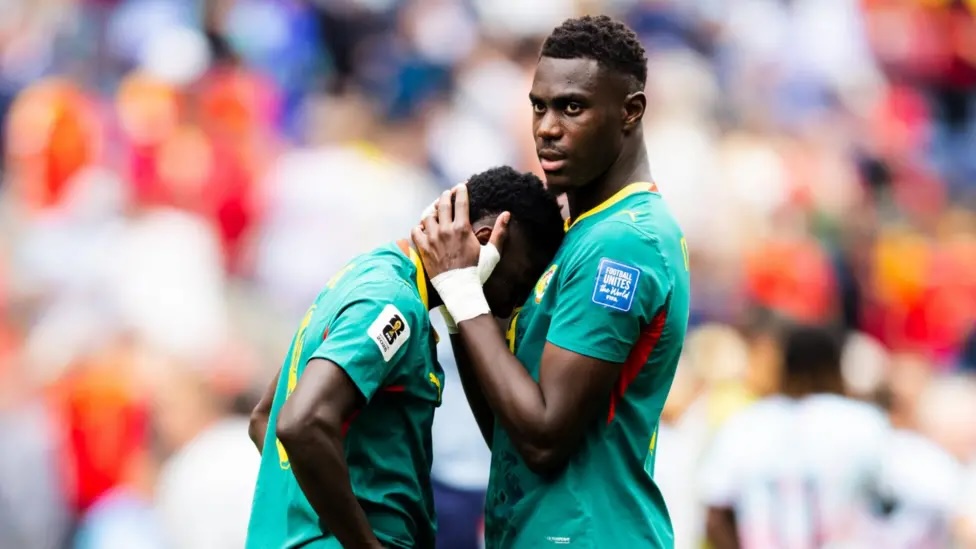
Getty Images This time last week, the entire continent was justifiably celebrating the advancement of nine of ten teams to the knockout stages of the World Cup. Soon thereafter, we began asking ourselves just how many of the nine would progress deep into the tournament? Conservative estimates suggested roughly half of those teams might reach the round of 16, with a few advancing further to the quarterfinals. As of this writing, six of the nine teams have played and five have been eliminated. At this point, we would be fortunate to see a total of three African teams reach the round of 16. Only Morocco has advanced, and done so convincingly. So what happened? Perhaps we should have first acknowledged that part of this pan-African success in the expanded 48-team World Cup stems from the format itself, in which 8 of 12 third-place teams progress past the group stage. Of the nine African teams that reached the round of 16, none finished top of their group. Five finished as runners-up, and four secured one of the best third-place slots. Still, there is merit in that achievement. A 90 percent qualification rate represents higher proportional representation in the knockout phase than any other continent managed. That accomplishment carries additional weight given the international skepticism toward a 48-team World Cup and the fear that additional African berths would dilute the competition’s quality. Anyone attentive to African football understood that Africa possesses ten to fifteen genuinely competitive teams, and expanding the continent’s allotment from five to ten slots would not effect the tournament’s competitiveness. There is a strong likelihood that nations which failed to qualify, such as Cameroon, Nigeria, Mali, or Burkina Faso, could similarly unsettle European or Asian sides, and might still do so in future tournaments. Africa cultivated this "middle class" of competitive teams over the past fifteen years through several channels. Morocco and Algeria challenged FIFA’s eligibility regulations, making it considerably easier for members of the African diaspora to represent their countries of origin. This shift has profoundly benefited teams such as DR Congo, Cape Verde, Senegal, Morocco, and Algeria, whose rosters are now largely composed of foreign-born players. Beyond leveraging diaspora talent, several African nations have invested in elite football infrastructure to ensure players are not undermined by inadequate systems during international duty. Morocco, Algeria, Egypt, South Africa, and Senegal now boast renowned stadiums, academies, and technical centers. Finally, the rise of a new generation of young African coaches, most of them former international players, at the helm of national teams has elevated the baseline standard of coaching to an international level. Coaching deficiencies are no longer a credible explanation for African teams suffering humiliating defeats on the world stage. Even so, as the round of 32 draws to a close, the results are not what fans of African football would have desired. Frustratingly, Senegal, Cote D’Ivoire, South Africa, and DR Congo were all eliminated by late goals after appearing to control large parts of their matches. This raises an essential and broader question. If Africa fields ten to fifteen genuinely good national teams, how many of them are truly great? And how do we move beyond this middle class to expand the number of African teams considered not merely good, but World Cup contenders? It is one thing to organize a disciplined low block that frustrates opponents into a fortuitous result. That is precisely what Cape Verde accomplished against Spain and Ghana against England. Such performances have merit, demanding tactical preparation and mental fortitude. Yet the next step for African teams is to confront the world’s elite in the middle of the park, trying not merely to secure a draw but to defeat the top six sides outright while outplaying them. There’s no secret recipe to attaining such results. The most instructive examples are often those closest at hand, so African nations can look to Morocco as a model for how to construct a formidable side that genuinely contends to win a World Cup. It takes a nation united in buying into the merits of massive long-term sporting investment (often despite glaring needs elsewhere), a clean ecosystem or governance, and—perhaps most importantly—hiring the right people for the right jobs. Such a transformation probably cannot be achieved by 2030. It will require a process spanning a decade or two. Still, for those countries looking to lay those foundations, they must be laid now. – Maher Mezahi, contributing editor |