The king of soccer
In 1957, three months after Ghanaian independence, the world’s most celebrated footballer came to Accra to teach. What Stanley Matthews left behind changed Ghanaian football forever.
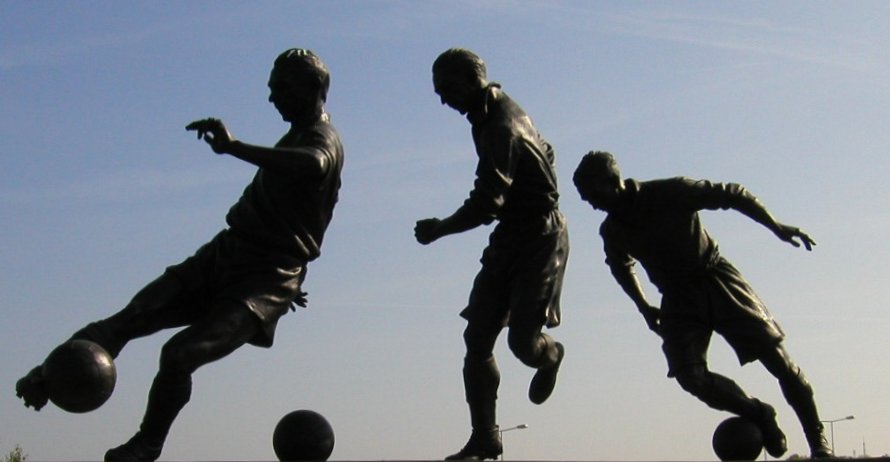
The statue of English footballer Stanley Matthews outside the Britannia Stadium in Stoke-on-Trent. Photo: John Lord/Flickr.
It was June 25, 1957, just over three months after Ghana had gained independence from the British Empire. One of the empire’s crown jewels, Sir Stanley Matthews CBE, was ascending the gangway of his BOAC (British Overseas Airways Corporation) flight at the Accra Airport when he suddenly stopped, turned, and waved with his right hand. He was diligently dressed in a suave suit, and his overcoat hung on his left arm—a sense of sartorial sophistication. He was wrapping up what he had called “the most memorable overseas tour of my life.” And it was an emotional one.
“Come back again, Stan!” chanted the loud crowd at the airport. He smiled. Hours before boarding the flight, he had told reporters that he had been “deeply touched” by the hospitality of Ghanaians.
Sir Stanley’s visit to Ghana was one of the most influential events not only in the history of sports in Ghana, but in the history of Ghana in general. Here was the world’s best footballer of that era—he had won the inaugural Ballon d’Or a year earlier—choosing to visit a three-month-old country to share his talent through teaching.
At the time, he had a successful 25-year playing career under his belt and was regarded as football’s pioneering global superstar. By all intents and purposes, he was arguably the most high-profile personality across any discipline to have ever visited Ghana at that point. The reigning “Monarch of Association Football”—as a newspaper ad called him—had visited a nascent nation at the heart of the West African coast. It was as special as it was fascinating, and would pave the way for later pilgrimages by global giants of the game such as Lev Yashin, Alfredo Di Stéfano, and Pelé in the ensuing years.
Sir Stanley had arrived on May 21, and, as the Daily Graphic, Ghana’s biggest newspaper, noted, he had a “terrific impact on the sport in this country” right from when his feet touched Ghanaian soil, his reverence reverberating raucously around the country. “No visiting sportsman has ever received the sort of reception accorded Matthews,” the paper reported.
He was given a “stately” six-mile drive from the Accra Airport to the Accra Community Center, where a reception was held in his honor. A few hours later, he was enstooled—installed in a traditional chieftaincy ceremony—as a Soccer Hene (King of Soccer) by Nii Tetteh Kpeshie, the Sempe Mantse (a traditional chief and patron of Hearts of Oak, the club that funded the legend’s trip to Ghana). Looking glad, he was clad in full traditional regalia—colorful kente over a white jumper—holding an ivory sword, with his famous feet resting on a pair of footballs. The stool he sat on would, 60 years later, be auctioned for £850.
The main brain behind Sir Stanley’s invitation to Ghana, though, was the man they called the “grey-haired soccer philosopher”: Henry Plange “HP” Nyemetei, the president of Hearts of Oak. HP Nyemetei and his Hearts crew put in a lot of heart, breaking their backs and challenging lack and luck to pluck up their courage. As the Daily Graphic noted, “a lot of sleepless nights, empty stomachs and tiring treks” went into planning the visit, which was, indeed, “a great, bold experiment.” Nyemetei said it was Hearts of Oak’s “privilege to introduce the new state of Ghana to one of the greatest sportsmen of all time.”
Sir Stanley was mobbed by fans everywhere he went, celebrated with appellations, showered with praise, and serenaded with music. He was proof that the kingdom of football knew no boundaries, just people and passion. He met all the people who mattered in Ghana: Governor-General Sir Arku Korsah; Prime Minister Kwame Nkrumah; the Asantehene Otumfuor Agyemang Prempeh II (the king of the Ashanti people); the Okyehene Ofori Atta II (the king of the Akyem Abuakwa traditional area); the UK High Commissioner to Ghana Sir Ian Maclennan; and many more. The gatherings to honor him had many iterations: shindigs, soirees, sherry parties, and so on.
He played five exhibition matches across the country, featuring for Hearts of Oak against sides such as archrivals Asante Kotoko, Sekondi Hasaacas, and Cornerstones. Across these games, on relatively undulating and dusty pitches, his gentle yet genuine genius shone, even as a 42-year-old, conjuring ethereal moves such as “stylishly sedating” balls, as CK Gyamfi recalls in his autobiography The Black Star.
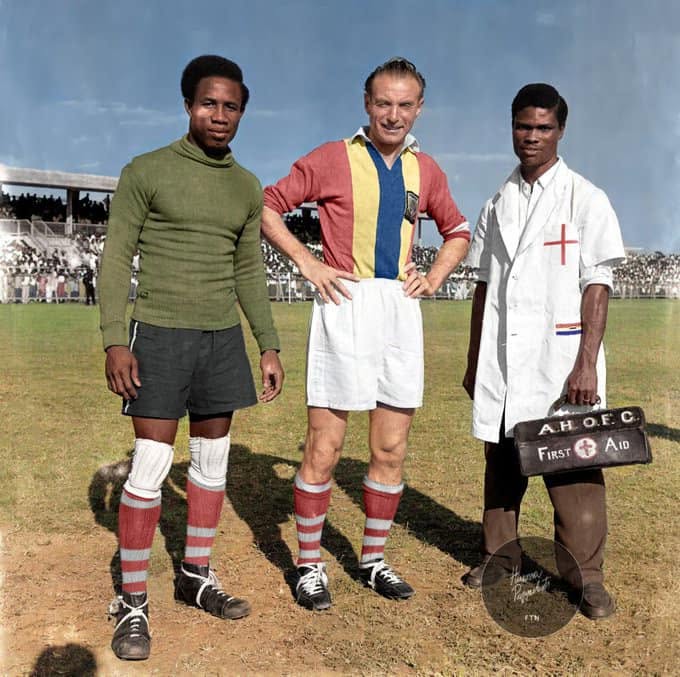
He “blazed” through defenses “like a wildfire set in a summer desert,” according to legendary sports writer Kofi Badu. For Badu, whenever the “magic of Matthews came to life”, it was “peerless and impeccable.” “What a man he is!” he simply ended one of his match reports. Not even the tropical humidity of Ghana could stop him—he had come in from cold Denmark—because he exerted himself, exhibiting fierce fitness that flabbergasted fans. Indeed, Sir Stanley measured up to all his monikers: the King of Wingers, the Wizard of the Dribble, the Soccer Saint, the King of Soccer—as 80,000 fans savored every bit of his mastery across Accra, Kumasi, and Sekondi.
The matches he played in offered players—both teammates and opponents—a rare opportunity to tap into greatness from close range, but it was the training sessions he organized in schools and parks that were more crucial. Sir Stanley took his time to organize workshops for grassroots footballers and school children about the rudiments of modern soccer, or what Ghanaians of that era obsessively called “scientific soccer.” He covered the craft and the culture; and professed the physical and the psychological. He spread knowledge in such a caring and contagious manner. No wonder CK Gyamfi noted that he was like “a walking encyclopedia of football.”
He was given full media privileges, too. Apart from a brilliant broadcast on Radio Ghana, Sir Stanley wrote a full center-spread column in the Daily Graphic detailing his observations of football in Ghana, commending positives and suggesting improvements. He emphasized what he said was his main “secret”: “The importance of 100 percent physical fitness.” “Some are lacking it, and as a consequence, the stamina to last the whole 90 minutes of the game is wanting. Skill and ability and enthusiasm count for nought if you are not in sound physical condition to put them into operation. So keep fit—proper!” He also entreated Ghanaian footballers to be bold and “call more for the ball”, as that “sense of anticipation is the knack that wins games.” And he advised Ghanaian footballers to normalize rolling passes low along the turf, to avoid unnecessarily hoofing the ball high.
Sir Stanley’s visit not only positioned a young Ghana in influential geopolitical circles, it also shook its football foundations internally, contributing significantly to the revolution that toppled the administration of long-time Ghanaian football chief Richard Akwei just months later. Ghanaian football fans developed an urgent craving for such progressive policies in the wake of his departure. Kofi Badu had observed in a column that Hearts’ “brave” attempt to pull off the Sir Stanley visit was an indictment on Akwei’s Ghana Amateur Football Association (GAFA). “They (Hearts) have shown that foresight which is lacking in our GAFA,” Badu wrote.
Ohene Djan, the 33-year-old who led the successful revolt against Akwei in September, and who would soon become a football colossus in his own right, stepped into power and borrowed the Sir Stanley visit blueprint from his friend and fellow Convention People’s Party (CPP) member HP Nyemetei: the ambitious invitation of top personalities and clubs into the country to “rub shoulders” with local footballers and other stakeholders.
As GAFA chairman, Djan hired three foreign coaches—George Ainsley, Andreas Sjoberg, and Josef Ember—for the national team, the first time since 1903 that Ghana had hired professional coaches. He brought in celebrated English referee Alf Bond to train Ghanaian referees into FIFA referees. There were many such Sir Stanley-esque schemes, and they worked to perfection, propelling Ghana’s football to continental power and global prominence.
Sir Stanley had predicted in his column that Ghana “in the not-too-distant future can become a force in international soccer. . . . I can confidently prophesy a great future for Ghana football.”
It took a few years, but by 1965, Ghana had become Africa’s first superstar football nation: three-time West African champions, ceremonial East African champions, two-time African champions, the first African nation to tour Eastern Europe, and the first Black African nation to qualify for the Olympic Games football tournament. More markedly, the Black Stars sent shock waves across the world of football by drawing three-all with the greatest club in the world, Real Madrid, in August 1962. They even beat Sir Stanley’s former club, Blackpool, five goals to one in May 1960.
And it all started with Sir Stanley, and the standard of studiousness he stirred among the sea of soccer stars he sighted in the state of Ghana.