The globalization of African football
Can a continent dominate global football while losing control of its own game?
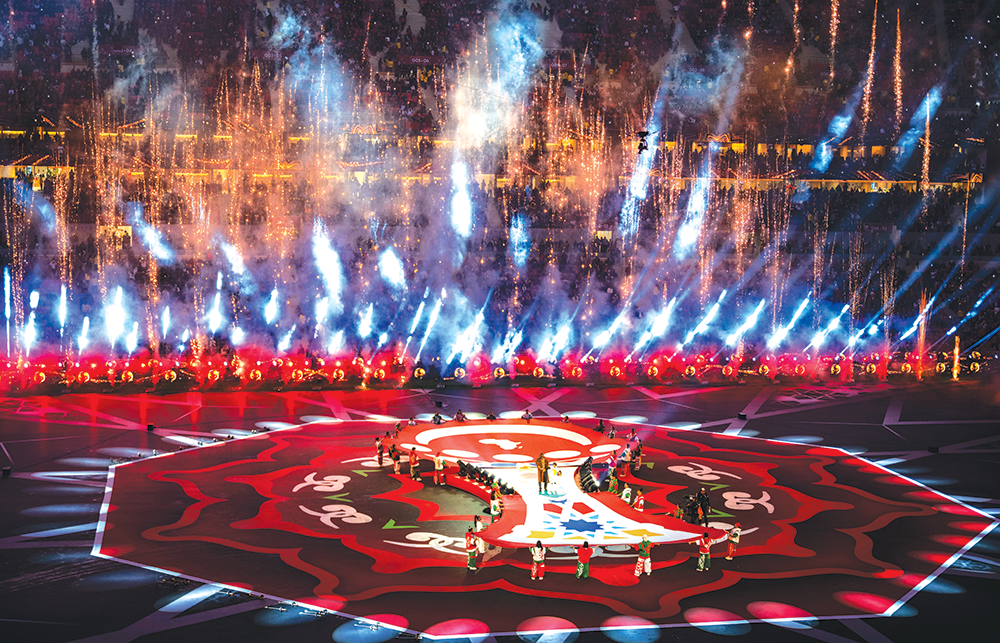
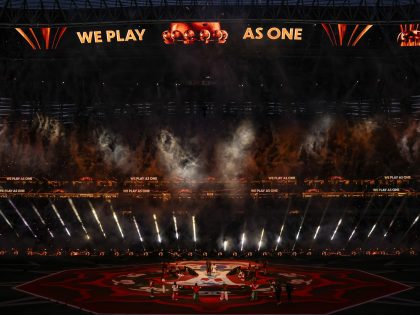
The closing ceremony of the 2025 Africa Cup of Nations in January 2026 at the Prince Moulay Abdellah Stadium in Rabat, Morocco. (Wikimedia Commons)
Football in Africa is more than a sport. It is a scene of dreams, stories of post-colonial expectation, and an image reflecting the continent’s frictional integration into the global capitalist system. From its colonial introduction through the independence era to the age of football as “big business,” the game has been continuously adapted by Africans. Yet while the world celebrates stars like Mohamed Salah, Sadio Mané, and Didier Drogba, a closer look reveals a landscape marked by neoliberal economics, talent drain, and a growing gap between European-based diaspora and struggling local leagues. Ahead of the 2026 FIFA World Cup, this essay traces African football’s journey from colonial adoption through political awakening and World Cup heartbreaks and victories, to its current era of commodification, governance struggles, and a growing divergence between the financially successful Africa Cup of Nations (AFCON) and the continent’s struggling domestic leagues.
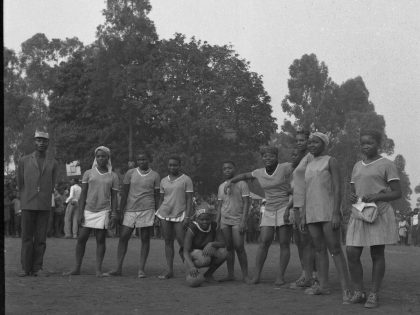
The introduction of football to Africa was neither benign nor neutral. In the late 19th and early 20th centuries, European colonial administrators, missionaries, and settlers brought the game to ports and outposts from Algiers to Cape Town, from Lagos to Dar es Salaam. Initially reserved for Europeans, football was intended as a civilizing tool to inculcate discipline. Africans were relegated to ball boys or second-class spectators.
Yet, in a classic act of resistance, the colonized turned the master’s tool against him. By the 1930s and 1940s, indigenous communities in Ghana, Nigeria, Egypt, and Senegal formed their own clubs, turning pitches into arenas of anti-colonial expression. Matches between African and colonist teams became proxy battles for dignity. The Orlando Pirates of South Africa (founded in 1937) were not just a sports club but an organization of cultural resistance. Football became a democratic space where colonial subjects could momentarily challenge racial hierarchy. By the time independence movements gained momentum in the 1950s, football was already an effective symbol of a unified, ambitious, and combative Africa.
Independence brought political freedom and national sports associations, but for African football, the road to global recognition was paved with boycott, political activism, and power struggles.
The Confederation of African Football (CAF), founded in 1957 by Sudan, Ethiopia, Egypt, and South Africa, quickly made anti-apartheid a core principle. South Africa’s white-only association refused to field multi-racial teams. Led by Sudanese official Abdel Halim Mohammed, CAF pushed for expulsion. In 1961, FIFA gave South Africa an ultimatum: integrate or leave. After refusal, South Africa was suspended in 1964 and expelled in 1976. This moral victory established CAF as an anti-apartheid political force, proving that football could serve justice and liberation.
Despite political gains, World Cup allocations remained grossly inequitable. Until 1966, Africa, Asia, and Oceania shared a single pre-qualifying spot. Led by Ghana’s Kwame Nkrumah and his minister of sport, Ohene Gyan, CAF boycotted the 1966 qualifiers entirely. In 1970, Africa finally received one guaranteed spot. Morocco became the first African nation to qualify directly, but representation remained a token.
Mobutu Sese Seko’s Zaire (now the Democratic Republic of the Congo) qualified for the 1974 World Cup, becoming the first sub-Saharan African nation to reach the finals. Preparation was a disaster of political vanity: unpaid bonuses, psychological terror, and no real training. Zaire lost 2–0 to Scotland, 9–0 to Yugoslavia, and 3–0 to Brazil. The “Zaire disaster” fed a narrative of African naivety, but it was not a failure of talent; it was a failure of governance. Four years later, Tunisia secured Africa’s first World Cup victory (3–1 over Mexico), signaling progress.
The redemption arc began in Spain in 1982. Algeria stunned reigning European champions West Germany, winning 2–1, only to be eliminated by a collusive result between West Germany and Austria—the “Gijón disgrace.” The injustice felt by Africans was rooted in colonial memory and asymmetrical global power. Algeria and Cameroon proved African teams could tactically outplay Europeans. Cameroon’s 1990 run, led by 38-year-old Roger Milla, saw it defeat the defending champion, Argentina, and reach the quarterfinals. Milla’s corner-flag dance shattered the stereotype of the technically gifted but tactically naive African side.
Meanwhile, FIFA’s introduction of youth World Cups (U-20 in 1977, U-17 in 1987) put young Africans in the global spotlight. African teams have won the U-20 World Cup twice (Ghana, 2009; Morocco, 2025) and the U-17 World Cup eight times. These platforms accelerated European recruitment of African talent.
Cameroon’s 1990 heroics, combined with the achievements of African U-20 and U-17 teams, did more than delight African fans; they helped establish African football’s respectability at a moment when the global game was being fundamentally transformed. That remaking was driven by satellite broadcasting, media deregulation, and liberalized player transfers across Europe—culminating in the 1995 Bosman ruling. Together, these forces pulled African football deeper into the global market—but on unequal terms. The same dynamics that showcased African talent also contributed to weakening the continent’s own football economy.
The 1990s marked a turning point. African football ceased to be primarily a political statement and became a competitive sport—and, increasingly, a commodity. CAF, once a pan-Africanist body, began operating as a transnational confederation, monetizing the AFCON, its flagship competition. Under presidents Issa Hayatou (1988–2017) and later Patrice Motsepe, sponsorship deals soared. Since 2016, TotalEnergies has been the title sponsor of CAF’s ten main competitions, including the AFCON. The Africa Cup of Nations expanded from eight to 24 teams in 2019 and will reach 28 teams in 2027. This increase leads to more games and, consequently, more broadcasting rights, sponsorship, and advertising revenue.
In 2000, CAF signed a $50 million deal with German firm Sportfive to broadcast four AFCON tournaments. European broadcasters historically paid low fees due to limited demand. Yet the exponential rise of African stars in the English Premier League and other top European leagues—Didier Drogba, Samuel Eto’o, Sadio Mané, Mohamed Salah, Achraf Hakimi—has boosted AFCON’s global visibility. Morocco’s 2022 World Cup semifinal further reinforced the competitiveness of African football on the world stage. New ott platforms now reach niche audiences that traditional broadcasters ignore. CAF reports that the 2025 AFCON in Morocco achieved commercial success, generating a 90% increase in competition revenue and attracting 23 sponsors. CAF also reports that, since the 2023 AFCON in Côte d’Ivoire, the competition has seen a 50% increase in international broadcast partners and a 61% increase in audiences across European, Asian, and South American markets.
The AFCON’s commercial success stands in stark contrast to the struggles of most local leagues. Fans in Accra, Abidjan, Lagos, and Nairobi would rather watch Liverpool, Arsenal, or Real Madrid than attend a local derby. DStv, Canal+, and beIN Sports deliver highly produced European football season after season—outgunning local broadcasters on both production value and rights. Except in North Africa and South Africa, stadium attendance is extremely low. Outside the North African leagues and a few clubs with wealthy patrons or sustained government subsidies, most local clubs survive on meager gate receipts, with no media rights income or sponsorship—even as numerous well-trained young players emerge from academies.
The struggles of local leagues persists despite—and in some ways because of—the emergence of private football academies, which, for the best ones, offered higher-quality youth training and led to more consistent African team performance at the World Cup. After Cameroon’s 1990 heroics and Senegal’s 2002 quarterfinal run (including a 1–0 upset of defending champions France), private academies multiplied across the continent. From Right to Dream in Ghana to asec Mimosas in Côte d’Ivoire (which produced the golden generation of the 2000s), and Generation Foot and Diambars in Senegal, academies became essential pipelines feeding European clubs. Their economic model is built on transfer fees paid by European clubs, plus FIFA solidarity payments—fixed percentages distributed to clubs that trained a player between the ages of 12 and 23.
Today, the majority of players on Africa’s most successful national teams—except South Africa and Egypt—play outside the continent. Increasingly, they are dual citizens, European-born, raised, and trained in Europe, highlighting an additional challenge. In a fascinating reversal, the 2010s saw a “reverse muscle drain.” Second- and third-generation African immigrants born in France (Riyad Mahrez, Algeria), England (Victor Moses, Nigeria), or the Netherlands (Hakim Ziyech, Morocco) began representing their ancestral nations. Morocco’s 2022 World Cup semifinal run was powered by a team mostly born and trained in Europe. While this improves competitiveness, it deepens the gap between these players—products of European academies—and local ones. The reverse drain, a quick fix for improved performance, helps the national team win without strong local football development systems but contributes little to local leagues or grassroots development.
On the surface, AFCON is a roaring success. Beneath the spectacle lies a structural challenge. The 2023 edition in Côte d’Ivoire generated record viewership, with 2.5 billion cumulative digital views. Diaspora fans in Paris, New Jersey, and London created a global carnival. FIFA has championed this as a model of “football development.” CAF’s deal with FIFA to host the expanded 32-team Club World Cup in Africa is presented as validation. The spectacle is undeniably colorful, dramatic, and commercially viable.
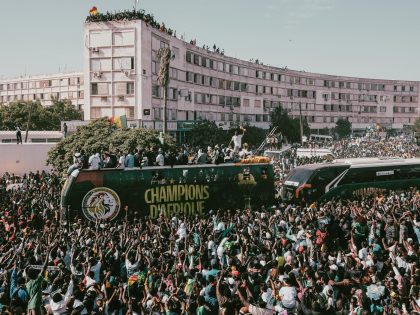
In 2022, Senegal won AFCON with a squad of 26 players, only one of whom played in the Senegalese league. Local league matches in the country are played in near-empty stadiums, with fans preferring European football on TV or streams. Local players are paid late, if at all.
Meanwhile, CAF’s “Our AFCON, Our Pride” slogan celebrates a tournament that has become a curated export product—a performance of African excellence that overshadows the deteriorating infrastructure in many countries. These nations often cannot host their national team’s matches at home, let alone produce that same excellence locally.
The story of African football is one of structural irony. Born in colonial resistance, sharpened through the anti-apartheid struggle and the fight for World Cup representation, and matured through World Cup heroics, it has finally achieved global recognition. Yet that recognition has come at a fundamental price. The commodity logic of global football has reduced many local leagues to ghost events and turned millions of African children’s dreams into speculative assets for agents and academies.
The success of Morocco’s and Senegal’s academies and diaspora proves African talent is world class, but it also shows that players must leave Africa to make a good living and become stars. When European-born dual citizens choose to represent their ancestral nations, they bring joy to Africans everywhere—a genuine pan-African achievement. But it also exposes a complex and uncomfortable reality: The continent’s domestic football infrastructure and governance are decaying even as its exported stars shine weekly through the world sports media complex.
If the game is to truly serve the continent, the goal cannot be merely to export talent, produce a commercial AFCON every two years—soon every four—or win prestigious matches at the World Cup. The goal must be to build the local ecosystem: to ensure a child in Kano or Kinshasa can grow up to be a professional in their own country, earn a dignified wage, play in a full stadium, and watch their league in prime time. Until then, the global visibility of African stars will remain just that—a reflection of individual brilliance extracted from a system that cannot yet sustain it. World Cup successes bring real continental pride. But can the achievements of a handful of stars and national teams truly speak to the lives of 1.5 billion Africans, let alone offer a path forward for the hundreds of millions of young players polishing their skills on any open patch of ground they can find?