Brazil’s racket society
As Bolsonarismo outlives Bolsonaro, what does Brazil reveal about where politics everywhere is heading?
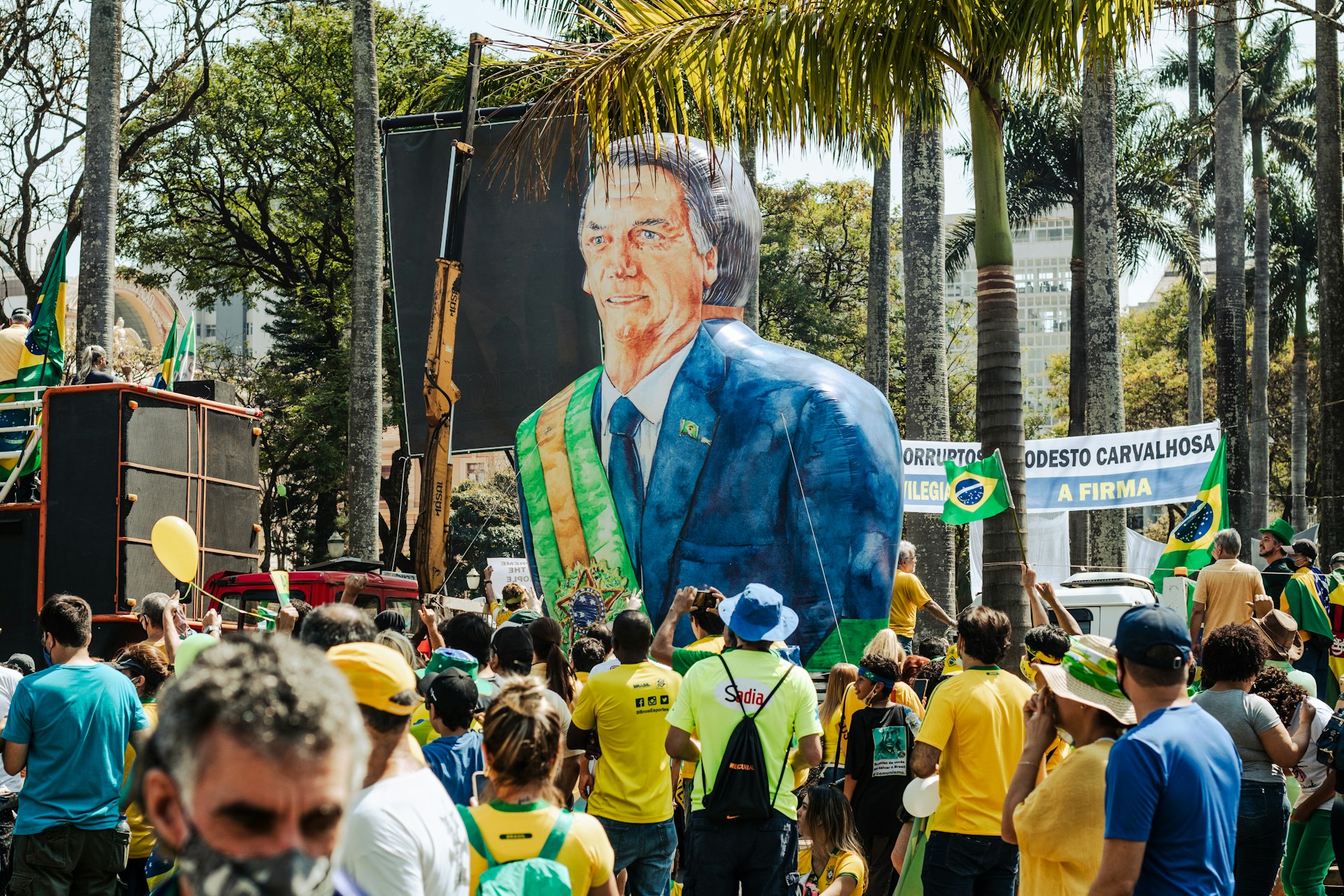
Photo by Matheus Câmara da Silva on Unsplash.
- Interview by
- William Shoki
Brazil’s presidential election is headed for a runoff. In the first round on October 4, far-right Senator Flávio Bolsonaro, the eldest son of former president Jair Bolsonaro, edged out President Luiz Inácio Lula da Silva 47 percent to 45 percent. The right also consolidated its hold on Congress, with Bolsonaro’s Liberal Party now the largest bloc in the Senate. The result came despite Flávio’s thin record, his documented ties to Rio de Janeiro’s militias, and his father’s 27-year sentence for plotting a coup after losing the 2022 election.
As Latin America’s largest economy and its most populous democracy, Brazil has long served as a bellwether for the region, and increasingly for the world. Analysts of neoliberalism have used “Brazilianization” to describe a future of informal work, fortified elites, and hollowed-out states that they see arriving in the global North. The outcome of the runoff will help decide whether Brazil holds out against a regional turn toward Trump-aligned strongmen, a wave that has already swept Argentina, Ecuador, and, most recently, Colombia.
The stakes are high. Lula’s third term delivered growth, rising wages, and record-low unemployment, but it was hemmed in by a hostile Congress, and household debt and the cost of living kept climbing. Meanwhile, the Trump administration has intervened with unusual openness. It has imposed punitive tariffs and sanctioned a Supreme Court justice, and it has designated Brazil’s two largest criminal factions as terrorist organizations. As Benjamin Fogel wrote in Jacobin before the vote, “something deeper and more paradigmatic is going on” than ordinary frustration with an incumbent.
In this conversation, editor William Shoki speaks with Fogel, a historian of Brazil and contributing editor at Jacobin and an alumnus of Africa Is a Country, to unpack the first-round results, the coalition of interests behind Flávio, and the political economy that makes it cohere. They discuss why Brazilian capital has made its peace with predation, why anti-corruption politics so often breeds cynicism, how “security slop” became the right’s signature policy, and what Brazil and South Africa reveal about everyone else’s future.
William Shoki
For readers who haven’t followed Brazil since Lula came to power for his third term in 2022, what happened on October 4?
Benjamin Fogel
To give a little background: Lula won the election in 2022, but at the same time, what people were calling the most right-wing Congress ever was elected. So if Bolsonaro was defeated at the polls, Bolsonarismo—and we can get into what that is later—was still very much alive.
That election was contested. Apart from all sorts of maneuvers before the vote—trying to discredit it through disinformation channels, trying to buy votes, voter intimidation, and obstruction by the Federal Highway Police on the day—there was an attempted coup, which led into the events of January 8, 2023. That bore some resemblance to January 6, in that you had a bunch of fanatical Bolsonaro supporters storm Congress and trash the place. But Brazil, unlike the United States, has a history of military coups, and it was touch and go whether the military would back it. There were other aspects to this, such as a plot to assassinate Lula, his vice president, and the Supreme Court justice who was overseeing the elections.
So it was defeated, and some people had thought this would discredit the right. It certainly weakened them for a while. But having a right-wing Congress made it really difficult for the Lula government to govern. In terms of the macroeconomic agenda, there were some successes. We’re not talking about anything dramatic, but the economy was growing at three or four percent, and the minimum wage increased. Overall, people were slightly better off than when Lula started, but there wasn’t a massive shift in wealth, and there were other factors we should get into later.
Bolsonarismo persisted. Then last year, Bolsonaro was successfully prosecuted for the failed coup, along with a bunch of his allies—the first time anybody has ever been successfully prosecuted for one. He was in prison and then placed under house arrest for health reasons—as people like to say, he’s permanently ill. What that meant is that the throne of the Brazilian right was up for grabs, and there were a number of pretenders. These included the governor of São Paulo, Tarcísio de Freitas, who’s just been reelected by a huge majority, and even Michelle Bolsonaro, Bolsonaro’s current wife, who is quite a bit younger than him. She has a big following among evangelicals, particularly women, and has just been elected senator for the Federal District, which is Brasília.
There was some dispute within the family. She had beef with the three sons from Bolsonaro’s first marriage, who are all politicians: Flávio, aka Zero Um; Carlos, aka Zero Dois; and Eduardo, aka Zero Três. Those are the nicknames their father gave them. But basically, the father decided—even though he couldn’t communicate with them directly, there were ways of communicating with Flávio—that Flávio was going to be the candidate. Flávio is the oldest, and a longtime senator from Rio. We should get into his background later. But once he announced he was going to be the candidate of the right, all the other people competing for Bolsonaro’s support fell by the wayside.
The other factor here, which we’ll have to expand on, is US support and US intervention in favor of Flávio. So that sets the stage.
For a lot of people, it’s really hard to take Flávio’s candidacy seriously. He doesn’t have any particular personal qualities as a public speaker or charisma. He has a very shady history and links to organized crime. In an article for Jacobin, I compared him to Jackie Aprile Jr. from The Sopranos. So he was underestimated, and I think this led to a degree of complacency on the left about his campaign.
At the same time, this is the first election Brazil has had without another center-left candidate outside the Workers’ Party (PT). There were some small radical-left candidates, but all the other candidates were right-wing, some even more right-wing than Flávio, who styled himself as more moderate than his father. In effect, it was just right-wing parties.
So what happened was that Flávio came out two points ahead: 47 to 45 percent over Lula. The polling wasn’t that far off. People have acted like it was a surprise, but I’d been hearing from some of the pollsters and people in the know that this was quite likely, and it was within some of the polls’ margins of error. Lula underperformed in quite a few strategic places. The center-right parties did not get as many votes as some expected. And moreover, there was a bit of a blowout in the Senate. The Liberal Party (PL), Bolsonaro’s party—a sort of machine party that has cannibalized a lot of the old parties—now has the biggest bloc in the Senate. At the same time, it wasn’t a blowout for the left: the number of left-wing deputies in Congress increased by, I think, two or three seats. But the right is now more consolidated, has a big platform, and has the Senate.
William Shoki
If Flávio isn’t a particularly inspiring political figure, and is in fact relatively flat, how did he become the figurehead of the right? There was a competitive field, and all the other contenders stood aside to give him a clear path. Obviously he has the heft of the Bolsonaro name, but as Rodrigo Nunes put it in his recent interview with Equator, Bolsonarismo is increasingly separate from Bolsonaro himself. So what’s the story behind Flávio’s rapid ascent, despite his clear lack of political acumen?
Benjamin Fogel
Rodrigo Nunes’s analysis is incredibly important, and his new book on the global right is an essential read for anyone who wants to get a grip on what’s happening, not only in Brazil but everywhere. When we say Bolsonarismo doesn’t need Bolsonaro, we mean two things. First, it’s a brand—a family brand. Every member of the Bolsonaro family got elected: Bolsonaro’s brother, his wife, his two other sons from his first marriage, and his youngest son from his current marriage. The only one who didn’t is his younger daughter, and she’s too young. So this family clan is really an operation, with the Liberal Party behind it, and that exists because there are a number of convergent social forces behind Bolsonarismo.
But specifically, Flávio is a stand-in for his father. His father is in prison, so he’s unable to run. To the extent there is a policy platform—and there really isn’t much of one—Flávio is running on behalf of his father, to free his father, and because of the brand, that has appeal.
Second, there are the social forces behind Bolsonarismo. I’ll give a brief summary, and then we can get into the specifics. First, the evangelical churches and the so-called Bible lobby. Brazil is set to become an evangelical-majority country in the next 10 years, and the demographics of evangelical Christianity skew quite a bit younger than Catholic voters, for instance. So unlike in a lot of right-wing movements, young people are more likely to vote for it. We’re not talking about a vast majority, but a tendency.
Second, the political common sense in Brazil, to the extent there is one. Miguel Lago, another very interesting scholar of the Brazilian right, has called it a political revolution. You could say, in a Gramscian sense, that common sense is now right-wing, and that has a structural economic basis. What that shift means is that the Bolsonaro brand, with the Liberal Party, has cannibalized the Centrão, the “big center”—the old parties we call fisiológicos, which exist to trade votes for rents. So the center-right has been wiped out, and the physiological parties have been taken over.
Then there are new sectors of capital—particularly agricultural capital, some elements of financial capital, and the online betting lobby. Online betting has been a social cancer in Brazil. Lula banned it before the elections, but there’s a lot of money there. These forces of capital are behind Flávio, as is the United States. There’s also the security lobby, what we call the bullet lobby, which includes members of the security forces and people campaigning against crime—and Flávio himself and his associates have very extensive associations with organized crime, which is another matter we can talk about. And there’s the agricultural lobby, the so-called beef lobby. These forces are behind him, and they’re also where the demographics and the popular culture in Brazil are going.
And then there’s the United States, which has openly intervened. Flávio’s brother Eduardo exiled himself to Texas, was removed from Congress for absence, and has been actively lobbying for sanctions against Brazil. When Bolsonaro was imprisoned, 50 percent tariffs were placed on Brazil. But Brazil doesn’t do a lot of trade with the US and is actually quite resilient in its ability to resist US pressure, so it sort of backfired.
All of these have coalesced. The best description of Flávio—and I’m paraphrasing the Brazilian public intellectual Celso Rocha de Barros—is that he’s a stand-in for other interests: his dad; Marco Rubio and Donald Trump; the Rio mafia; the banking fraudster Daniel Vorcaro, who has been a big, big part of the Bolsonaros’ campaign; the evangelical churches; and things like the gambling lobby.
The best description of this election came from Brian Winter of Americas Quarterly, who’s a kind of business-lobby journalist. He called it “apathetic polarization”: people weren’t particularly mobilized; they were just voting against the other guy. So as the main candidate, Flávio had a chance to get through. People were also voting against the incumbent, blaming them for whatever the problem was. And then there’s what we call antipetismo, the widespread, deep-seated sentiment against the PT that has been part of the conservative revolution that began after the 2013 protests in Brazil.
William Shoki
In some ways, who Flávio is doesn’t really matter, right? Based on your description, he’s an avatar for all these different interests.
Benjamin Fogel
I think it actually does matter. It’s not so much his charisma, though his family name matters. It’s that his particular trajectory, in terms of his associates, is the trajectory of where political power in Brazil is going.
William Shoki
So then, part of why Flávio, and Bolsonarismo more generally, are representative is in how the interests of capital converge with the movement? What is the composition of Brazilian capital at the moment that makes that so? Thinking about patronage populism in South Africa, with radical economic transformation (RET) under Jacob Zuma, and how his family itself became a political brand. Capital opposed it, because RET undermined its ability to accumulate. Organized business responded with a kind of low-intensity investment strike that helped birth the Government of National Unity, effectively a coalition between the center-left African National Congress (ANC) and the center-right Democratic Alliance (DA). So it’s puzzling, as an outsider, why numerous factions of Brazilian capital are siding with a movement that has all these destabilizing, deinstitutionalizing intentions—one that would undermine the formal conditions of capital accumulation in favor of a much more nebulous, mafia-ized political economy, the kind Flávio is very fluent in. Brazil is a large country, one of the most industrialized in Latin America, a regional power. How does that all come together?
Benjamin Fogel
It’s a very large question, and I’m going to give a short and a long answer. But first, on Zuma: RET was an insurgent faction of capital connected to state contracts. That was the whole point of it.
William Shoki
Right, that’s what I’m saying too.
Benjamin Fogel
These were people from outside a certain, more elite wing of the ANC, who had been locked out of the big deals that people like Cyril Ramaphosa had access to. Brazil is very different. And it should be noted that capital was less than enthusiastically behind Flávio. In 2018, capital was very unified against the PT and very strongly behind Bolsonaro. By 2022, after economic chaos under Bolsonaro and the complete catastrophe of the pandemic, it was split. There were divisions between, let’s say, the old financial bourgeoisie, the more export-oriented industrial or manufacturing factions of capital, and the rest. The two sections of Brazilian capital that backed Bolsonaro most strongly in the last election were agribusiness and retail. The reason for retail is that shutting things down during COVID wasn’t good for business—these are big department-store owners.
In this election, there hasn’t been enthusiastic backing from capital for Flávio. In fact, that’s one of the reasons people had assumed Lula had a pretty easy route to victory: it wasn’t as though the main forces of Brazilian capital were actively mobilizing behind Flávio.
But the pithy answer is that the nature of capital accumulation worldwide is predatory, extractive, and rent-seeking. People have used the term “racket society,” which comes from the Frankfurt School. The scam is the norm now. We’re talking about everything from the AI bubble to the openly imperialist way Trump goes to the UN General Assembly: to the victor belong the spoils; we’re taking their oil. The illusions of things like the green transition, or even the Millennium Development Goals—all these convenient fictions—are gone. It’s extractive now.
So in this case, there’s an easy answer. One is that there’s a belief it will be like 2018, when Paulo Guedes was finance minister—Faria Lima’s man, Faria Lima being Brazil’s Wall Street. Guedes was a very antisocial ex–Chicago Boy, in that he was part of the Chicago Boys trying the neoliberal experiment in Pinochet’s Chile, except he was such a prick that he ended up going home. There’s an expectation that they’ll have that again.
There’s another issue I think hasn’t been talked about enough. A lot of the Brazilian elite have significant financial and property assets in the United States, and that’s on their minds when you have a government as hostile to Brazil as Trump’s. It’s not that Brazil does a lot of trade with the US; it’s that the elite park their money there. They have apartments and houses in Miami. They want to keep their money in American banks.
Then there are the extractive elements. Everyone has this fantasy—and I think it is a fantasy—that the hidden wealth of the Amazon just needs to be taken out of the soil. That was something Bolsonaro himself articulated, and he actually had significantly more capacity to articulate a coherent politics than his son, who barely speaks and does aura-farming dances. You have mining interests, and illegal mining is an increasingly big sector. The illegal gold trade is a big way of laundering money, and there’s a lot of that in the Amazon. These are very propulsive interests. You have agribusiness, which wants that land. There was a big transformation in Brazil’s political economy in that agribusiness is such a big sector here, and it’s not just beef—it’s also soy. And where does most of that go? It goes to China. Brazil also has a big petroleum industry, but it’s under national control through Petrobras, the national oil company, which was founded in the 1950s, and I imagine there are some fantasies about privatizing that.
But Brazil has also gone through a big deindustrialization process. In 1980, it was a more industrialized society than South Korea. Manufacturing was almost 50 percent of its exports. That was promoted not only by import-substitution industrialization policies and state intervention in the economy, but by a competitive international arrangement. As Brazil democratized and re-entered the global economy on different terms in the late 1980s and 1990s, it did so under conditions of a debt crisis and hyperinflation, and it resorted to a degree of austerity and neoliberal measures. That had a significant effect in destroying elements of Brazilian industry, particularly in the late 1990s. There was a lot of privatization and a loss of manufacturing’s share of GDP, while agriculture and raw materials grew—the classic way people talk about dependency theory, extracting things from the periphery and taking them to the core. I’m not a subscriber to dependency theory. And Brazil still makes advanced products: it has one of the biggest jet manufacturers in the world, and there are tons of BYD factories here now from Chinese investment.
More recently, under Lula’s second term, and more so under his successor Dilma Rousseff, there was an attempt to use the surplus—Brazil had wiped out its foreign debt and had a lot of dollars—to form a national bourgeoisie again. Many have written about the character of the Brazilian national bourgeoisie: that it’s not loyal to its state, that it views itself as part of Europe or North America as much as part of Brazil. But basically, the Lava Jato (“Car Wash”) corruption investigations—a huge topic—took out the construction industry, which was a really big sector. Odebrecht was operating all over Africa and Latin America, competing with American firms, and remember that the US Department of Justice backed the Lava Jato investigations. That entire sector, which was a pro-Lula sector, was taken out by that investigation, which further shifted power toward these more extractive interests.
Then you have the financialization and “app-ification” of the Brazilian economy. It’s even more app-ified than South Africa. Every time I come back to Brazil, there seem to be twice as many guys waiting around for orders on Brazil’s versions of Uber Eats, Deliveroo, or DoorDash. There’s a huge new fintech sector, which included Banco Master, the biggest banking fraud in Brazilian history, which has been one of the big stories of this election. Then you have online betting, which is ever-present. You have this scam sector. That’s also one of the experiences of living in Brazil, and in South Africa to an extent: someone is trying to scam you every day. We have normalized, as a society, expecting a call to be somebody trying to scam you, getting all these texts, having a loved one’s WhatsApp hacked and suddenly asking for money. This is an everyday experience. These are the operating interests—this new rapacious, unveiled model, uninterested in development, which is a reflection not only of where capital accumulation in the world is going, but is encapsulated in Brazil. And this is a growth sector.
William Shoki
And it’s embodied in Flávio as a political figure, given his ties to the Rio militias, to Banco Master, to the betting lobby, and, as you noted in your recent Jacobin article, to the case of Marielle Franco, the Rio socialist city councilor murdered in 2018. That raises another puzzle. Corruption has been a long-standing fixation of the right, which reduced the PT to corruption through Lava Jato. And yet the right is so thoroughly implicated in corruption, and it doesn’t seem politically costly for them. Why?
Benjamin Fogel
I would push back on that. It was costly for the center-right, which got absolutely annihilated by the corruption scandals, more so than the PT in the mid-2010s. It’s the same way the center-right has been discredited by the rise of the new right, or the far right, all over the world.
I’m a scholar of corruption—I wrote a dissertation on the history of anti-corruption politics in Brazil. There’s always a hypocrisy about corruption, and there are different forms of it. In my view, the characteristic Brazilian form of patronage corruption is rouba mas faz: he robs, but he gets things done. Corruption is tolerated provided things are delivered. In South Africa, we have a form of corruption—I think the biggest example is Johannesburg—that’s parasitic and doesn’t even try to fix things. It just picks the bones of what’s there.
That aside, anti-corruption politics tends to take a moralizing form, where corruption stands in for everything you don’t like. If you don’t earn enough money, if you’re jealous of somebody on Instagram who’s going to Miami, if you wish you had a better body, if you’re in a bad relationship, if you don’t like the traffic, if your apartment’s too small—all of these things get projected onto the figure of corruption, personified, in Brazil’s case, in the PT. So at one level, anti-corruption politics serves as a metanarrative. It’s an acceptable way of saying things, including outright racism—people being upset that there are more black people at the airports is a famous example. It’s an acceptable way of saying this is what’s wrong, this is unfair. When you say corruption, you’re saying the world as it should be is unfair because sinister forces are manipulating society. In that sense, it’s a metanarrative.
The other point is about the force that has historically mobilized on the streets around anti-corruption in Brazil, which has generally not been the left, and which is also the most solidified base of Bolsonarismo: let’s call it the lower-upper-middle class. These are people who have education—private education—and some money, but who are not truly wealthy. They’re not truly part of the old elite. They lack the cultural and social capital of the elite, or even of a more sophisticated progressive middle class. They’re not poor, but they have a deep fear of moving down in society. Under developmentalist programs, like those of the 1950s in Brazil, or Lula’s redistributive programs, what we saw was a closing of the gap between them and the working and lower classes in access to consumption and consumer goods—things like holidays, travel, and TVs, which were markers of status. And that status anxiety is a mobilizing force. At the same time, the rich got richer, as they tend to do. And there’s an aspiration: we are the frustrated rich; we want to be the entrepreneur. That logic is also part of the individualized, precarious society that app-ification and the gig economy have created.
So corruption specifically wasn’t what mobilized people. Even if there were real corruption scandals, it was a stand-in for a lot of other issues, and they were projected onto the PT. This has been a historic pattern: you can see it in the failed coup against Getúlio Vargas in 1954, in Jânio Quadros’s candidacy for president in 1960, and in the anti-corruption protests that preceded the 1964 military coup.
Moreover, the left is particularly vulnerable on corruption. First, you have to get your hands dirty in power, especially in a society deliberately structured the way Brazil was in its transition. You have to deal with rent-seeking interests to get things passed. Second, the left has sold you something: a better, more just future that it’s going to bring you. So there’s an element of disappointment. The right is saying we live in a Hobbesian war of all against all—which is really what the new right is saying about society—so it doesn’t have to meet the same moral standards.
There was an interesting article in The Conversation by an ethnographer about how people described the PT, often as a cheating husband. This is a classic anthropological and social-theory trope, and it’s personified by Daniel Vorcaro more than anyone else, the banker responsible for this big fraud. He was hosting orgies with hundreds of women, seemingly setting up the whole Brazilian elite with the pleasurable company of young women of various persuasions, holding private parties featuring the likes of Swedish House Mafia and Flo Rida in an underground club in São Paulo, and chatting across the world. He somehow answered every single message on WhatsApp, which is really a superpower, especially in Brazil, which is even more WhatsApp-driven than South Africa. Basically: if you’re the elite, we’re jealous of your sexual success. You’re the boss; you can cheat outside your marriage; you’ve earned it. But if we expect a more moral, humble subject, we feel betrayed.
So it also produces a politics of declining expectations as things go wrong. There’s real scandal fatigue. We have this in South Africa. Every day you read about a new municipal water-truck mafia scam. You get an update from the Madlanga Commission, the inquiry into criminality and political interference in the criminal justice system, about some cop or politician moving drugs or calling in hits. There’s only so much you can take before you say, “Fuck it. There’s no social contract here. Everyone’s out for themselves. I’m going to turn to my own private interest and what I think is good for me.” So a society of declining expectations and defensive postures is what anti-corruption politics and continuous corruption scandals produce.
At times, it can be a mobilizing force that progressive forces can use. I would argue that some on the left were completely wrong to characterize the Zuma Must Fall moment as just being about capital. Remember, that’s probably the last time we saw the unions mobilize en masse. They came out in the streets, and there was a genuine popular element to it. And then we had the disappointments of Cyril Ramaphosa and declining expectations, and that leads elsewhere.
So that, in short, is the pitfall of anti-corruption. That doesn’t mean progressives or the left should abandon anti-corruption. Corruption has been a political mobilizer and issue since people started writing political theory—go back to Aristotle, go back to Machiavelli. But it means that without a program of redistribution, anti-corruption politics leads to the pitfalls of declining expectations.
Part of what’s happened is the disappointment people have felt with Lula’s third government. Sometimes it’s due to external shocks. There’s a Biden element: things are more expensive in the stores, and you’re being told the macroeconomic indicators are fine. And then you have these constant scandals involving the Supreme Court and virtually the whole political class. It doesn’t matter if they’re mostly right-wing, or that there’s been deliberate framing by bad-faith actors, including American-backed social media and US-allied actors, to make it a left-wing issue. What you end up with is an election fought on the terms that the PT is also the establishment, that there isn’t much difference between them and the other guys. What they’re saying is, “We’re less corrupt than the right, even if we’re a little bit corrupt.” That’s not really what you want to be conducting an electoral campaign on. And unfortunately, even if the campaign was doing more than that, this has been the perception among some voters.
William Shoki
Expanding on that perception: one of the major preoccupations of voters in Brazil, and arguably everywhere in the global South, including South Africa, is security and the rise of organized crime—and not just organized crime, but the emergence of this racket society you’ve been describing, in which every aspect of the social fabric has been penetrated by criminal interests and every social relation has been transformed into some kind of extortion. Elsewhere in Latin America, tough-on-crime rhetoric has catapulted strongmen to victory. El Salvador and Bukele are the paradigmatic case, but there’s also Ecuador, Peru and Colombia. What’s surprising is that Flávio is also propagating tough-on-crime rhetoric, and yet he has ties to the mafia, to organized crime, to banking fraudsters. And in this conversation, the left is largely absent. Can you help us make sense of that?
Benjamin Fogel
Let’s start with the reality: security and crime are a big issue. And let’s start with the basic premise that the average victim of crime is a worker on their way to work, or, increasingly, someone being scammed through their cell phone. Organized crime is a huge factor. In South Africa, we’re only now revealing the deep penetration and interlocking interests of all these forms of crime, from drug trafficking to cash-in-transit heists to tender fraud.
But in Brazil, there’s always been a “the only good bandit is a dead bandit” type of politics. This is an old thing. You can trace it back to slavery, to the fear of the enslaved, and then to the criminalization and repression of the popular classes. And remember, racialization in Brazil is very different from the American or even the South African style. There are degrees of racialization; it doesn’t mean you’re black—you could be brown as well. There’s a much bigger diversity. But racialization means the idea of the criminal is not the white Rio mafia politician who’s got shooters on call, has millions of dollars, and is involved in all sorts of rackets that plunder society and lead to its degeneration. It’s a black kid in his teens holding an assault rifle in a favela somewhere on the periphery of Rio or another Brazilian city. That’s the perception of the criminal.
Then there are the big criminal organizations, the two criminal factions. This links to the broader geopolitics of the “Donroe Doctrine,” Trump’s version of the Monroe Doctrine—the idea of using the war on drugs, which has been used repeatedly. This is cyclical; none of it is new. They’ve been declared narcoterrorists, which is a way to destabilize Brazil. These two big factions are the Comando Vermelho, the Red Command, which is based in Rio but has interests across the country, and the Primeiro Comando da Capital (PCC), which is from São Paulo but also operates across the country and in neighboring states, and even has significant trafficking operations through South Africa, particularly the port of Durban, and through Mozambique. But they’re not active in the US. Those aren’t their routes.
While violent crime is down in Brazil, it’s partly because of the consolidation of these organizations. Unlike South Africa, where probably most murders are not linked to organized crime, in Brazil, probably most murders are. There was a battle between these two organizations, which had previously had a truce, over new routes in the north and northeast, and in 2017, just before Bolsonaro, that led to a big increase in the murder rate. One of Bolsonaro’s big promises was that human rights, these NGOs, these lawyers, are an impediment to the security of the good citizen—the cidadão de bem, as they say in Brazil. And even people in the periphery who are black, and who look like the imagined bad citizen, imagine themselves as the good citizen: a white, respectable, educated Brazilian. That’s the imagination. That was a big association in 2018.
There’s also been a constant narrative, pushed from the beginning, that the left is in league with organized crime. Lula has been accused of being linked to the PCC, despite the PCC having significant links to people on the right in São Paulo. They run a lot of São Paulo, which has been governed by the right forever now. They have an accord, and they run half the transport system in São Paulo.
In Rio, the Comando Vermelho has professionalized, and there are people with drug-trafficking links around Flávio. Then you have the militias, which are paramilitary extortion forces embedded in politics—off-duty or ex-cops and firemen, again “respectable,” who said, “We’re going to provide security to keep out the bandits, the bad black youths in their sandals.” But then they got into extortion rackets and all sorts of mafia activities, and now there’s even more of a confluence between them and drug trafficking.
So this is real, and the concerns about organized crime are real. The dynamic of declaring war on organized crime has been raging in Brazil forever. This is the country where the police kill the most people on the books. In Rio alone, they kill over 1,000 people a year on the books, sometimes over 2,000, and God knows what’s off the books, because bodies disappear in those swamps out there or get dropped in the ocean. And the police often act as criminal rackets too.
Then there’s Bukele and his supposed success in El Salvador, which is a tiny country. It wasn’t so much the megaprison and the declaration of a state of emergency; it was also having a behind-the-scenes pact with the criminal gangs there, which are completely different from the Brazilian factions in their history and how they work. So I’ve called this “security slop.” It’s performative—the most asinine, empty type of stuff, the strongman saying we just need to be hard in the war on drugs. We’re in the third generation of politicians who have done versions of this. In the 1970s, there was Nixon’s war on drugs. Then in the 1980s, the cocaine trade takes off. In the 1990s and 2000s, there was the Mérida Initiative and Mexico’s war on drugs. This has been tried, tried, and failed.
So the security slop is megaprisons. Megaprisons have been one of the few policies Flávio is committed to—he’s promised to build five. Abelardo de la Espriella, “El Tigre,” the new president of Colombia, is a lawyer who used to defend narco-paramilitaries for money, in Miami. He promised to build 10. Colombia has, what, 45 or 50 million people; Brazil has nearly 220 million. So, ambitious. They’ve also promised Milei-style massive cuts to the state sector, which I don’t think is happening in Brazil.
There’s also the element that this is how the United States is justifying its interventions in Latin America. And at the same time, take Juan Orlando Hernández, the ex-president of Honduras, who was convicted for, I think, moving 450 tons of cocaine with El Chapo. He had this great line about stuffing the cocaine up the gringos’ noses. He was convicted in an American court and then pardoned through a backroom deal with Trump, and he’s back in Honduras. Daniel Noboa, the president of Ecuador, is from the richest family in Ecuador. His family owns the biggest banana-shipping company in the world, and that’s how the cocaine gets to Europe—in the bananas. There are Balkan mafia guys on the record talking about having the cocaine in those shipments. And as I mentioned, El Tigre comes from a long association with narco-paramilitaries. His next-door neighbor was Salvatore Mancuso, the head of the United Self-Defense Forces of Colombia (AUC), a big paramilitary organization of death squads that was big in the drug trade in the 1990s and 2000s. Mancuso was convicted of drug trafficking, along with a few thousand killings. And El Tigre has a rum brand called Ron Defensor, whose biggest investors are the family of an AUC commander called “Comandante Barbie”—not to be confused with “La Barbie,” the infamous American-born Mexican narco.
So this is hardly unprecedented. But I want you to understand that it’s a slop policy. It’s “if we just kill enough people, it’ll be all right.” It’s not serious: we’ll build megaprisons. And frankly, in this age of AI-generated slop and influencers, that’s enough. Another policy: Flávio wants to chemically castrate rapists, and his running mate was under investigation for raping a 13-year-old girl until the case was shelved by a Supreme Court justice.
But as I was saying about corruption, shouting about the right’s hypocrisy and pointing it out is not an effective response. It’s an impotent response. Moreover, the left has struggled here. It has often made compromises with the police or with hardline candidates on this, or been seen as really soft. I won’t be able to articulate solutions. But the point is that there’s a structural way in which the drug trade has been used not only by the United States to take out its enemies, but also to fund and consolidate right-wing causes. At the end of the day, the origins of the mafia are in a parastate force meant to discipline people who get out of line.
William Shoki
Turning to slop politics as a new political style or genre—all the dynamics you’re describing: the hyper-individualization of political participation, the outsized influence of the online, the gamification of ordinary life. Is what we’re really grappling with a new political subjectivity? One could say the old ways of politics, which largely envisioned offline participation, just don’t work. Politics now moves through digital channels and spreads through networked nodes rather than vertical structures. The beneficiaries are, of course, the right, because they’re not trying to implement a transformative program or abide by any political or moral standards, so a field marked by entrepreneurialism and grifting benefits them disproportionately. The left is completely lost in this terrain, because so much of it is antithetical to what it wants to achieve.
Benjamin Fogel
There are various dimensions. One is that online activity is not unmediated. As we’ve discussed—with the political-economy shifts, the move toward the gig economy, and the constant corruption scandals that discredit the mainstream media—there’s an illusion that you’re speaking directly, that you have direct access to somebody. But that’s mediated through the algorithm, and we know the fingers are on the scale. One of the many American interventions in this election was Meta down-boosting, shadow-banning, and even banning PT accounts during the election while promoting right-wing content. And of course we know what Elon’s X has done.
The influencer economy is part of the gig economy. Ask young people what they want to be—and this is hardly confined to the global South—and lots of them will say, “I want to be an influencer.” What is an influencer? It’s showing that I’m authentic, that I have direct access to you, that I’m going to show you some product, or this special health supplement that’s going to get you super jacked. There’s no place more online, and no place where the influencer economy is more competitive, than Brazil. And it’s also a good way to get elected. Where the old corrupt political machine used to be the mediating factor, because that’s how you got people out to vote, now you can get elected as an influencer.
Let me give you a profile of the average influencer who gets elected in Brazil. This type has been around since the YouTube days, before TikTok and Instagram got big: basically a cop who killed a bunch of people and then blogged about it. “I’m Deputado Corporal Whoever, or Sergeant Whoever. I kill people, vote for me. I’m tough on crime.” That’s now an average type of person who gets elected, and there are all sorts of examples. Then there are the more political entrepreneurs, who are trying to make money. In this new right, there’s no contradiction between grifting, hustling, and the grindset mentality—taking advantage of what they call coaching culture, teaching people how to make money, which is already scamming them—and being a right-wing ideologue.
I think the most-voted federal deputy in São Paulo ran a candidacy mostly about trans people and bathrooms. Funnily enough, one of the new-right figures, Renan Santos, who was part of the Movimento Brasil Livre (MBL)—one of the very far-right, libertarian-backed movements that were part of the 2015 moment—is also one of the best critics of this right now. His big slogan on crime is “capture, kill.” But he understands. His line is basically: whatever you think about trans people and bathrooms, this isn’t even 0.1 percent of Brazil’s problems. This is slop. Nobody can tell me what Flávio actually stands for, and you’re voting for him.
The influencer economy favors the right, but that doesn’t mean the left can’t use it. In fact, some of the candidates who emerged in this election on the left have been effective communicators on the new platforms. Jones Manoel, for instance, who is very proudly an old-school communist, is one of the most-voted federal deputies in the Northeast. Then there’s Elias Jabbour, a developmentalist economist, who got elected in Rio, which is a pretty right-wing place.
For the left, there’s a way you can get enough votes from more middle-class areas on a platform that draws from different social and justice movements, and the best candidates representing them. You can get elected on that, and the left’s caucus has grown. But it’s not reaching new voters. And what I found with the Lula campaign was a lot of nostalgia and sentiment—jingles about the great days of mobilization, memories of the social movements. But these are not memories shared by younger people, which is a problem. Second, it doesn’t provide a space for rage, and you’re staying within your comfort zone.
The politics of affect might get you elected, and some very good candidates got elected, including quite a few directly from the two biggest social movements in Brazil, the MST and the MTST—the Landless Workers’ Movement and the Homeless Workers’ Movement. And I’m not saying you can just recreate figures like Zohran Mamdani and rely on them. But Jones and Jabbour—love them or hate them, and many would disagree with their views—do something very well: they put themselves in unfriendly spaces. Jabbour will go on the banking-bros podcast and argue his points. Jones will say, “I defend the Soviet Union and I support this vision,” and he’ll put himself on unfriendly platforms, in the liberal media. So instead of playing it safe, they’ve found a form of communication in a very individualized environment that’s hostile to organizing. And this is not organizing. We’re talking about elections; this is not building structural power. But it is a lesson: you’ve got to put yourself outside your comfort zone.
You can get hundreds of thousands of people in the streets for Lula—there were probably 500,000 at his last rally before the elections. That’s a real base. But it’s you holding a defensive line, and that defensive line is fraying.
And then there’s this other factor that has to be stated again. The United States may not have directly manipulated the election, in the sense of hacking the results, and in cases of American intervention it’s hard to know what is effective and what isn’t, because it’s covert—that’s the nature of covert ops. But at the very least, there’s what I’ve called, drawing on Rodrigo Nunes, the investment in social disintegration: these technologies of social media, fintech, online gambling, all this stuff that’s really destructive for society, which then finds expression in things like the prosperity gospel in mobilizing people. At the very least, that’s a form of intervention mediated through the United States’ technological and cultural power, and it has shaped the environment here and elsewhere.
William Shoki
The US influence complicates my final question, but let me ask it anyway. There’s renewed theoretical interest in discourses of peripheralization—in crude summary, the idea that the core of the capitalist world system increasingly takes on features of the periphery: informalization, public insecurity, rampant inequality, elite fortification. Over the last five years especially, the two classical cases have been Brazilianization and South Africanization. They have theoretical uses, and rhetorical ones—especially South Africanization, which circulates among right-wing ideologues that present South Africa as a cautionary tale of what happens when power transfers from white settlers to a black majority. You’re a South African Brazilianist who has spent a lot of time in both countries. There’s that line, misattributed to J. G. Ballard, I think, about the periphery being where the future reveals itself. Do Brazil and South Africa reveal something about the future of the world? And, more immediately, what do you think will happen in the second round on October 25?
Benjamin Fogel
I’m going to very unsubtly not give predictions. Eighteen days is an eternity in Brazilian politics. But Lula will have to mobilize to win, because Flávio’s structural advantage is that the other parties that ran were right-wing, and quite clearly can’t stand the Workers’ Party. So Lula is going to have to get non-voters and those who voted null. Brazil has compulsory voting, but this election saw record abstention, the highest since 1998. So there’s space to move that, but it’s going to take a different type of campaign.
Now, the first question, and then I’ll get to something more practical. I’ve written an article in the New Statesman, for instance, about how, in the right-wing imaginary, the idea of white genocide in Rhodesia and especially South Africa—this absolute nonsense—serves as the dystopian example of where multiculturalism and liberalism lead. So it serves that rhetorical imaginary.
In Brazil, the Brazilianization thesis comes from critical theory. It started off as talk about precarity and development economics, but Paulo Arantes—who is untranslated; at our organization, Alameda, we’re working on theorizing peripheralization—offered a peripheralization thesis based on Brazil’s contradiction: it’s both highly modern and highly industrialized, and a peripheral place shaped by slavery and the production of surplus peoples. You see that in gated communities versus slums.
And look at this elite that’s given up on a developmental project, because I think that’s the crucial thing. Flávio does not have a developmental project. Trump does not have a developmental project. It’s self-enrichment: everyone’s going to be an entrepreneur. And part of the problem on the left is: where is the developmental project? You can talk about nationalization and all of this, but it sounds hollow, because you have to build structural power for that. You have to offer a developmental project, and you have to do more than say we’ve got to do some good social policies and redistribution.
If we think of the social fragmentation that the climate crisis, war, and all these technologies are producing, it’s producing insecurity. You have to speak to security and offer more than the right is offering, which has some grounding in lived experience: all you can do is protect people like you and your own, look after your own interests, and fuck over people you don’t like. You have to work there. That means, in South Africa, in Brazil, and elsewhere, we need to talk about how to deal with organized crime in working-class communities. You can’t just say the police are evil, murder people, and are also crooks. It doesn’t work. It doesn’t stop you from being extorted by some local gang while you’re sitting in Khayelitsha. It doesn’t stop these big criminal syndicates from making big, big money. In South Africa, more so than Brazil, the biggest growth sector has got to be organized crime. I think the Madlanga Commission is revealing it: the same people trafficking drugs are running massive extortion schemes and getting tenders. So first, security, and talking about restoring state capacity to solve people’s problems.
Obviously, I’m just an analyst; I can’t provide the real politics behind it. And I’m even speaking in an individualized way, because you don’t have a collective. I’m not a member of a party. What’s the party for me to join? I don’t know. I can’t vote in the Brazilian elections. But collectively, getting outside the comfort zone has to mean fighting on people’s concerns, not just dismissing them.
And this is going to be my parting words: perhaps we can take some joy in the downfall of Andrew Tate, who looks like he’s completely done for, facing charges in the UK. He was one of the big proponents of the hustle and the grindset. What the right, the influencers, and all these guys are saying is that the system—the Matrix, as he called it—is weighted against you. But instead of saying, “I’m going to destroy the Matrix,” they say, “I’m going to show you how to take advantage of it. I’m going to make you part of the scam.” That’s really the vision the right is selling: yes, everything is a scam, but you can get in on Trump coin and make yourself rich too; you can sell those dietary supplements. But you always end up holding the bag, with your bank account emptied. That’s where the sports betting came in, which is why Lula’s ban on it was a very good policy: people end up broke and taken advantage of.
So think about that, and get outside the comfort zones. That’s what the peripheralization thing means: if it comes up north, you’re going to be in zones of discomfort and insecurity, not just islands of wealth.