Reading List: Faraaz Mahomed
How do the struggles of one generation echo, decades later, in another’s?
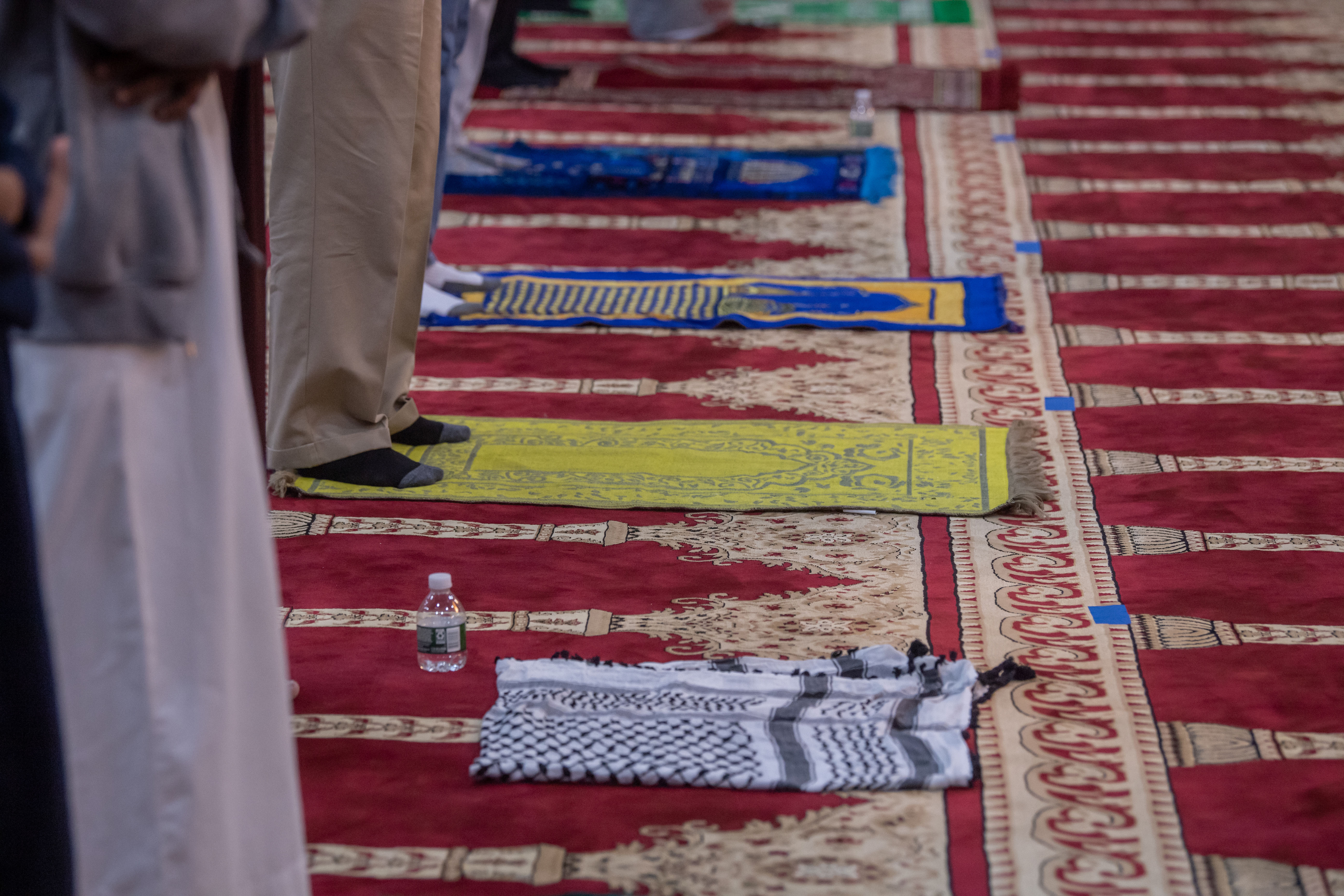
Worshiper at the Masjid Ar-Rahman mosque in New York, 2021. Image © Ron Adar via Shutterstock.
My novel, Mother/Land, focuses on a law professor, Salim, a South African in New York, who finds out that he is the product of an affair between his mother—Sawligha—and an apartheid politician. The story engages with the recent past as well as the apartheid years, telling parallel histories about the Fees Must Fall movement in South Africa, Black Lives Matter in the US, forced removals under the Group Areas Act, and the experience of a Muslim immigrant in New York with a gay Afrikaans brother whose life he might save.
Salim has a sunken world-weariness, which is perhaps rooted in his intellectualization and his provenance. There is no shortage of such protagonists wandering the streets of New York, whether in Herzog, Open City, or Netherland. Interestingly, two of these are also immigrant narratives, although the latter might not characterize itself as such. My own experience as a South African of Muslim origin living in New York certainly shaped the story, but I read We Need New Names with great interest, and I found some of the complexities of Salim and his family in it.
The theme of inheritance is one of the most prominent in Mother/Land. Sawligha and Salim’s relationship is central, and this dialogue in the matrilineal relationship (and to some extent the patrilineal too) had me reaching for On Earth We’re Briefly Gorgeous by Ocean Vuong and The Return by Hisham Matar. These are beautifully gifted writers, not only in their prose, but also in the intimacy with which they write. Looking for intimacy, and for the ‘lostness’ that Salim conjures, I often turned to In a Strange Room—a brilliant and relentlessly personal text.
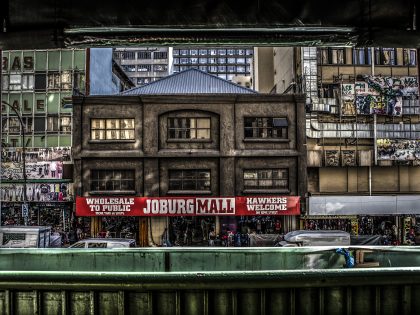
Sawligha’s arc takes place during the days of the removals. Richard Rive’s Buckingham Palace stood out as a reference text about District Six, but I think my own family history in Vrededorp/Fietas/Fordsburg/Pageview (a cluster neighbourhood in Johannesburg) was a good starting point too. To understand the topography and to build a reliable history of what was left of the district, I relied on Sean Field’s Lost Communities, Living Memories and on South African History Online (a great resource!). The story of Sawligha’s affair with an apartheid politician is pure fiction, but I’d decided that Carl Lamprecht, Sawligha’s lover and Salim’s father, would be a contemporary of DF Malan. I did not read up much on him (merely picking up facts from Wikipedia), but there are small details that have helped to tell the history, and indeed portray Carl as a multidimensional character.
To capture the perfect naïve goodness of Salim, and to engineer (as my editor Fourie likes to say) a version of a person who intellectualizes too much and yet finds himself ultimately wanting, I found something quite akin in The Idiot. The tragedy of it and the beauty of it are very much the stuff of my daydreams—and the bittersweetness of Dostoevsky is something I find really captivating, and has actually helped me write the voice of by far the wisest character in the novel—eight-year-old Aa’isha.
I struggled with Aa’isha, Salim’s daughter, who sees the intricacies of the world and endeavors to understand them, all the while feeling like the contradictions and the lies that adults tell themselves are utterly nonsensical. It was a creative growth path for me personally, and I spent an inordinate amount of time reading everything from The Curious Incident of the Dog in the Night-Time to The Girl with the Louding Voice to try (and very possibly fail) to get the words, the logic, the temperament, and the reality of Aa’isha right.
As a psychologist, I went back to Piaget and Erikson, but the truth is that I am under no illusions that the voice is marked by a precociousness that I couldn’t quite erase (and that, by the final edit, I had decided was just the right amount of weird, unreliable humanness). I think that’s part of the beauty of writing children, though—because they do turn out to be the most astute of characters, even when their vocabularies don’t quite match their insight.
Reading Zuleika Dobson helped with the metaphysical aspects of my storytelling (Sawligha is, after all, a ghost), but I enjoyed telling the paranormal aspects with a recognition of their ambivalent relationship to reality. Olga Tokarczuk’s House of Day, House of Night is mystifying, and Ben Okri’s Famished Road trilogy contains beautiful stories about the ability to travel between worlds. I am indebted to these, and so many other writers for the gifts of their work.