More commerce than chaos
In Johannesburg’s Jeppe precinct, what looks like disorder is in fact a dense, transnational system of trade, labor, and survival at the heart of the global economy.
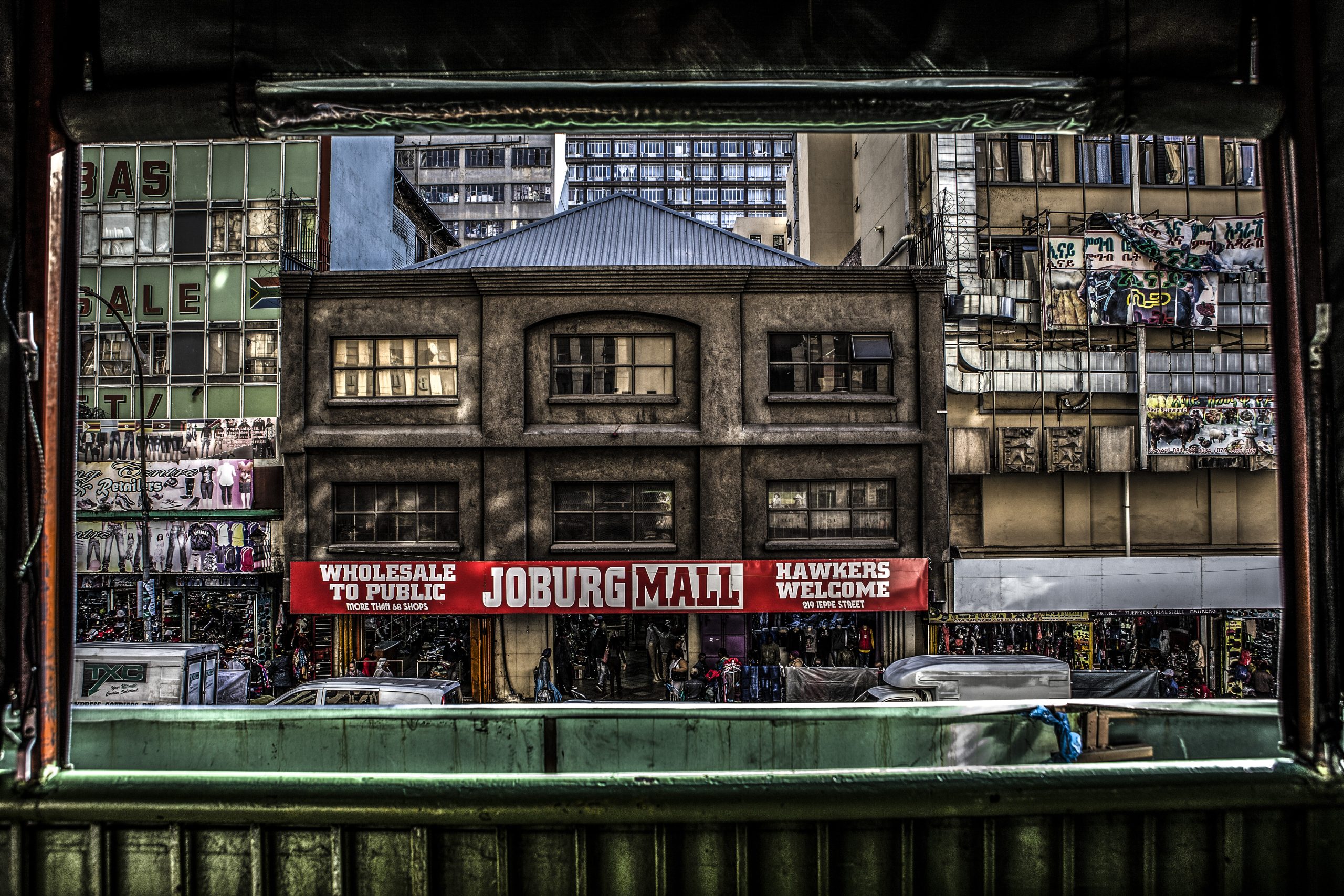
The Joburg Mall building on 219 Rahima Moosa Street. Image courtesy of Mark Lewis.
Tanya Zack’s recent gem—The Chaos Precinct: Johannesburg as Port City—is focused on the Jeppe precinct, the so-called “Ethiopian Quarter,” located in the heart of Johannesburg’s central business district. The book lends an ethnographic take on the cross-border trading activities the precinct’s largely migrant population has operated since the end of apartheid. Working against those who see the migrant-led enclave as anecdotal, invisible, and ungovernable, Zack offers to reconceptualize Jeppe as an entrepôt, a major transnational port—without sea access—in South Africa’s largest conurbation, responsible for the movement of goods and money in industrial proportions.
Long in the making, the book was a difficult and perilous task for Zack, who, to her own admission, had to navigate the emotion of unpacking her personal ties and doing justice to all the lives that make the book, that make Jeppe, while retaining a colder, analytical gaze throughout. I personally shed a tear over my discovery of some of her characters’ life stories—Yosef, Sem, Berta, Sultan Tiku, and many more; I felt like I was right there with them, sharing all their doubts, self-hatred, courage, wit, and simple joys. The book takes the reader through a journey of the unexplored corners of globalization, drawing on a rich and sophisticated account of how to rethink and remake a city in a postcolonial and post-apartheid environment.
It’s been a privilege to learn about yet another city within the African continent, one that I have only occasionally visited over the years, and in the end, knew very little about. Here, I want to share three inspirations that relate to the focus of my own work, but more specifically, on why I think this is an important book for anyone remotely interested in finding humanity in this world.
My first inspiration in reading this book has been to use it as a tool for thinking about structural, physical, and psychological violence. The lifeworld of the Chaos Precinct echoes that of many other urban spaces—from the bustling activities in the informal settlements of Kinshasa and the transborder commercial ventures of Butembo in eastern DRC, to the hawkers and shopkeepers hustling and toiling in Abidjan—that have, much like Jeppe, been categorized as anarchic, chaotic, ungovernable. But nested in the social fabric of Jeppe lies the desire to thrive, and an imperative to survive in a world economy that increasingly serves the interest of a privileged few, while feeding on the underpaid and often criminalized work of a majority of refugees, asylum seekers, and undocumented workers.
At the low-end of globalization, sit the masses of underprivileged—the poor, the working class, the migrants represented here in the figure of the shopkeeper, owners, assistant, street vendors, taxi drivers—who, the book aptly demonstrates, occupy the ambivalent position of both wanting to become part of the global economy, and rejecting its very premises often based on labour exploitation, broken minds and disjointed homes. For example, Yosef’s loathing of his bosses, and of the money-oriented, sometimes illegal activities he must engage in, and other migrants’ longings for home, or a sense of home in a hostile city, speak to this. The fact that “everything is about money” drives xenophobia and disdain for the poor, making class prejudice transcendental to racial and gender prejudice.
The cruelty of police raids and harassment in Jeppe, the faultlines of the legal system, and the rigid hierarchies of community and economic practices by government bodies—people made illegal, the informal economy made illegal, and the practical, organic uses of infrastructure made illegal—illuminate the workings of state-violence, whose institutions are put to the service of a self-serving global elite. This captures the incessant police raids targeting the distribution of counterfeit goods, even as this market does not pose any serious threat to the authentic brand items meant for much higher-end consumers. State intervention in this age of late capitalism now focuses increasingly on categorizing people, securitizing wealth, and disciplining bodies—a feature of state power that takes on particularly brutal forms in what Achille Mbembe calls the postcolony. This provides further global lessons about the role of state action and neoliberalism in perpetuating the conditions for oppression and structural violence across the world.
Zack’s account also goes against many conventional views about Africa as a continent having integrated into the world economy too late and too little. It is made clear, thanks to the notion that Jeppe is a vast entrepot, that this is not the case. Many urban formations across the continent are complex networks of social, economic, and material practices that reach deep and far in supporting and shaping our global economy’s logistical, consumption, financial, and labour needs. Places like Jeppe are not lagging in economic development; if anything, they are situated right in the middle of the nervous system of globalization—from Ethiopia, Kenya, Malawi, and Mozambique, stretching all the way to China—and may offer a glimpse into our shared futures, if state structures and capitalist forces are left to work together unabated. The lethal combination of a politics of neglect and a politics of erasure, encapsulated in the book, impacts the communities of Jeppe, as the possibilities for leveraging “local energy” and nurturing “new mutuality” to achieve more inclusive development are ignored.
My second inspiration has been to reflect on the notion of chaos. The book stands with a host of scholarly works that endeavor to rethink politics across the Global South, against unhelpful binaries and semantics that describe African societies as pathologized sites of violence. Even though Jeppe is partially built on improvisation and provisional arrangements, the communities, social practices, and economic value that compose the area are anything but chaotic. “The apparent chaos of this precinct, Zack explains, conceals the logics of its system of codified rules and regulations. Its own innovative methods and efficiencies. And its reshaping of value.”
But chaos there is. And it may not be where we think it is.
First, there is chaos in government responses to the rise and renewal of Jeppe. One that embraces police violence, harassment, neglect, and erasure. Sporadic, overly militarized, and disproportionate use of force is deployed as a performative shorthand for state action that is cheaper, faster, and more readily visible than opting for the slower workings of democratic practice, consultation, research, and policy that can elevate and promote Jeppe as the important global economic centre that it is. If there is chaos in Jeppe, it originates more from law enforcement and municipal services supposedly aiming to impose “order” than from the regular tumult of daily urban life.
And then, there is chaos in the mind.
The migrant communities that populate the book struggle with the psychological pain of leading dislocated lives; lives that they attach to everywhere, but that really belong nowhere. They suffer the mental exhaustion of longing for home, finding a way out, and the urgent need to secure livelihoods. Their past is fragmented, their present is a haze, and their future is uncertain. The endless quest for dignity so vividly recounted in the book is a reminder of Frantz Fanon’s work on the psychological damage people carry with them for having been robbed of their identity, for never being whole.
Finally, my third inspiration has been to revel in the wonders of human interactions, the hope that may or may not emerge from said interactions, and the gentle gaze and caring practices many ordinary men and women lay on the city that holds them, the buildings that shelter them, the communities that sustain them—even in the face of injustice and violence. The stories of the residents and workers of Jeppe reminded me of AbdouMaliq Simone’s call to move beyond formal accounts of order and legality, to look at what a city can hold: “No matter how improvised,” he said, “lives need to be held, supported. They need a somewhere in which to take place, and places need to be assessed in terms of what they are able to hold.”
This book, in both format and substance, is an homage to life, an ode to what Michel de Certeau referred to as the “ordinary man”, the “untold wanderer” of Jeppe, the “anonymous hero.” In other words, those who populate the “murmur of society” are too often ignored, occasionally despised, and manipulated. It is a powerful antidote against those of us in academia, in government, and other positions of decision-making, who build and rely on prejudice or simply truncated knowledge about how violence takes hold, how poverty spreads, and lives are lost.
In her concluding remarks, Zack writes: “Jeppe makes a powerful claim to be taken seriously.” The people of Jeppe, like so many others in all corners of the planet, make, to quote James Ferguson, “a haunting claim for equal rights of membership in a spectacularly unequal global society [ . . . ]; a moral claim to something like global citizenship” and an appeal to “a graciousness and solidarity” that are to this day, still “chillingly absent.”