Refusing non-existence
Despite renewed efforts to criminalize and erase queerness, LGBTQ Africans continue to challenge the myth that their lives and identities are somehow un-African.
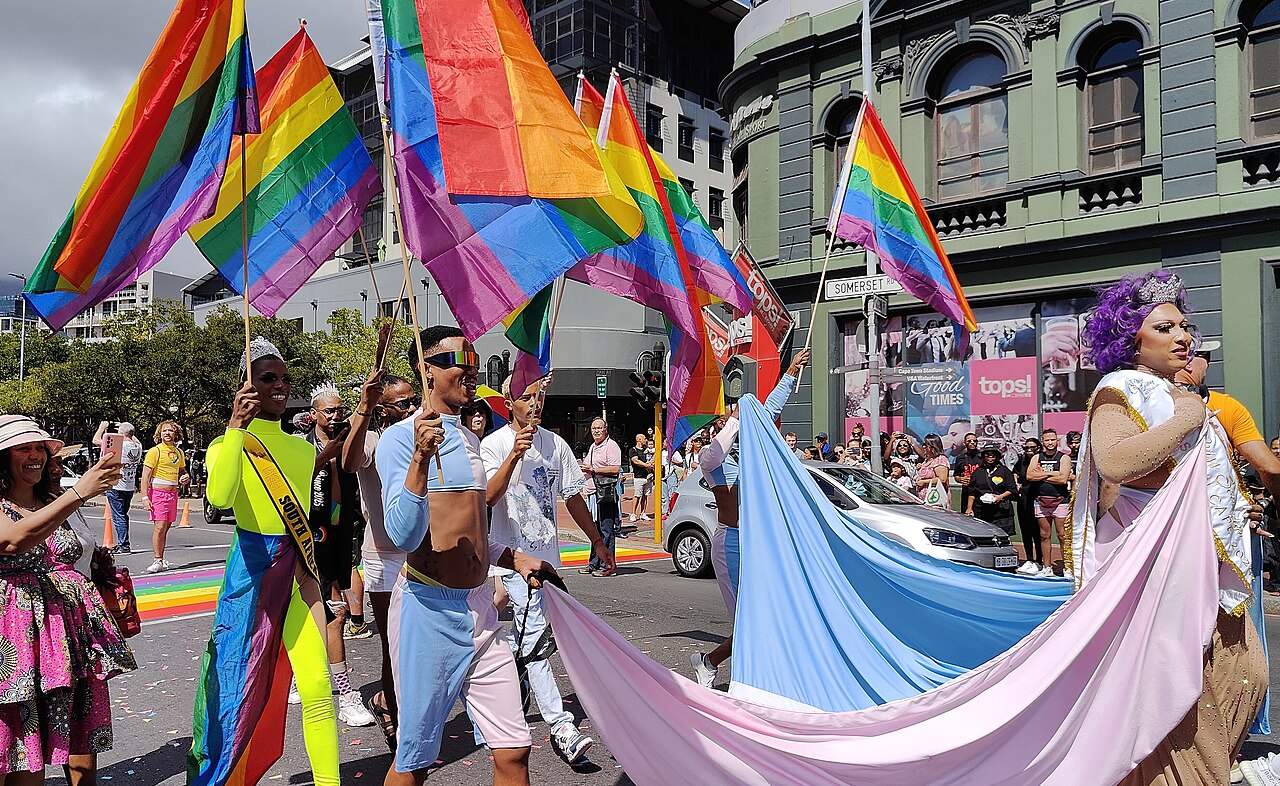
Participants carry rainbow flags and fabric banners during the Cape Town Pride march on 1 March 2025. Photo: Husskeyy/Wikimedia Commons
As an African feminist pushing against how systems of oppression endeavor to constrain and diminish, I am concerned with the functions of violence. Violence in its myriad forms serves to inscribe who is deemed human and who is not, who is considered deserving of dignity and who must be stripped of it. It is a language of demarcating society’s status quo and the bounds of acceptable identities and behaviors. When understood this way, violence against queer African bodies is particularly insidious as it is designed to brutally mold queer people into heteronormativity—in life and sometimes in death.
African queers are often confronted by the claim that their existences are un-African; a detestable product of Western influence. And so African leaders and others expend considerable energy in attempting to do away with queerness through various tools of violence: rhetorical, legal, political, physical, religious, and sexual. At the same time that queer Africans are subjected to violence and live with the unrelenting spectre of it, they must also find ways to resist. It is a liminal existence, but one that demonstrates that queer Africans are permanently fixed within the continent’s bounds despite concerted efforts to effect their erasure.
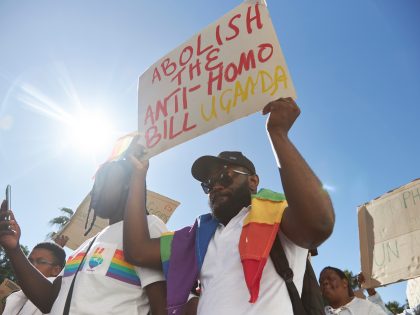
In the legal arena, African leaders and states untiringly expand the intended project of queer erasure through violent laws. In March, Senegal’s President signed into law a bill that doubles prison terms for same-sex relations and criminalizes pro-queer advocacy. Recently, Ghana’s parliament resurrected and subsequently passed the Human Sexual Rights and Family Values Bill, which intensifies the existing laws, including through criminalizing queer identity and advocacy. It awaits signing by President John Mahama. Despite legal efforts to undo it, the harsh 2023 Anti-Homosexuality Act remains in force in Uganda. Through this law, people who engage in same-sex activities face the risk of life imprisonment and the death penalty for “aggravated homosexuality.” Under President Ibrahim Traoré’s bold and Pan-Africanist rule, Burkina Faso criminalized homosexuality in 2025.
The legal reforms are emboldened and accompanied by the fiery speeches of African leaders who return faithfully to the mantra that queerness is un-African. Defending Senegal’s new anti-LGBTQ law, President Ousmane Sonko recently stated: “There is a kind of tyranny. There are eight billion human beings in the world, but there is a small nucleus called the West which, because it has resources and controls the media, wants to impose it [homosexuality] on the rest of the world.” When Traoré’s government criminalized homosexuality, Edasso Rodrigue Bayala, the Minister of Justice and Human Rights, explained that this development was “a historic reform” reflecting “respect for cultural values and the will to build a Burkinabé family.” At the end of 2023, Burundian President Évariste Ndayishimiye commented that queer Burundians should be stoned, should go and live in Western countries because they choose “satan.”
The African leaders are perhaps unconscious of the fact that they are building on and concretizing a particular brand of homophobia calcified through colonial rule when same-sex relations were criminalized. They perhaps do not know that they are leaning into and cementing the idea of a homogenous Africa, which again feeds into an earlier Western project of seeing Africa through simplified lenses. Moreover, they ignore the fact that modern-day anti-rights forces consist of networks between African politicians, religious leaders, Christian fundamentalist groups from the US, Europe, and elsewhere.
But this is the function of violence. It is an imprecise instrument that effects repression to sustain power structures. Anti-queerness especially reinforces patriarchy. This is why, even in countries such as South Africa, where constitutional rights present the illusion of freedom for sexual orientation and gender identity minorities, there are special horrors reserved for Black queer women. They are raped, mutilated and murdered for daring to step outside of the patriarchal mould. Sometimes this violence is committed by friends or sanctioned by family members.
In juxtaposition to legitimized violence, queer Africans enact multifaceted forms of political resistance that cast queerness into registers of African humanity. In Uganda, Clare Byarugaba founded the first local chapter of Parents and Families of LGBTIQ children (P-FLAG). Though she constantly lives in a state of vigilance and risk as one of the few openly queer activists in the country, she maintains that “I fight because I want those who come after me to have a softer landing, to know a different Uganda.” In Bostwana, a case initiated by 24-year-old Letsweletse Motshidiemang and supported by Lesbians, Gays and Bisexuals of Botswana (LEGABIBO), succeeded in decriminalizing homosexuality in 2019 by demonstrating to the court the very dire impacts of criminalization. In February this year, an array of queer people proudly paraded through Cape Town city to celebrate Pride, but also to call attention to hate crimes and inequality experienced by Black queer people.
Activist scholarship forms another critical part of queer resistance. We see this through Stella Nyanzi’s ethnographic research contextualizing how Ugandans proudly claim being both African and same-sex loving by affirming their locally-cultivated identities and names, heeding ancestral callings, and recalling documented pre-colonial same-sex practices in the Buganda kingdom. This research is a vital counter-argument to claims that African queerness did not exist before colonialism and that the marker of African-ness is the heterosexual and patriarchal family unit.
I cite these examples not to make a happy check-list of queer African activism, but to demonstrate the slow, exhausting, and often unseen work of refusing violence that is taken as normal and viable. This unsettling of the status quo is a critical means of reclaiming African identities from within, debunking the distracting and illegitimate claims of Western origins and influence, and forging marginalized African solidarities. There is no neat conclusion, but only an incremental shuffling forward in resistance to imposed “non-existence.”