Who is an Arab?
In the United States, Arabs are rendered white or nonwhite depending on the political needs of empire, war, and racial control.
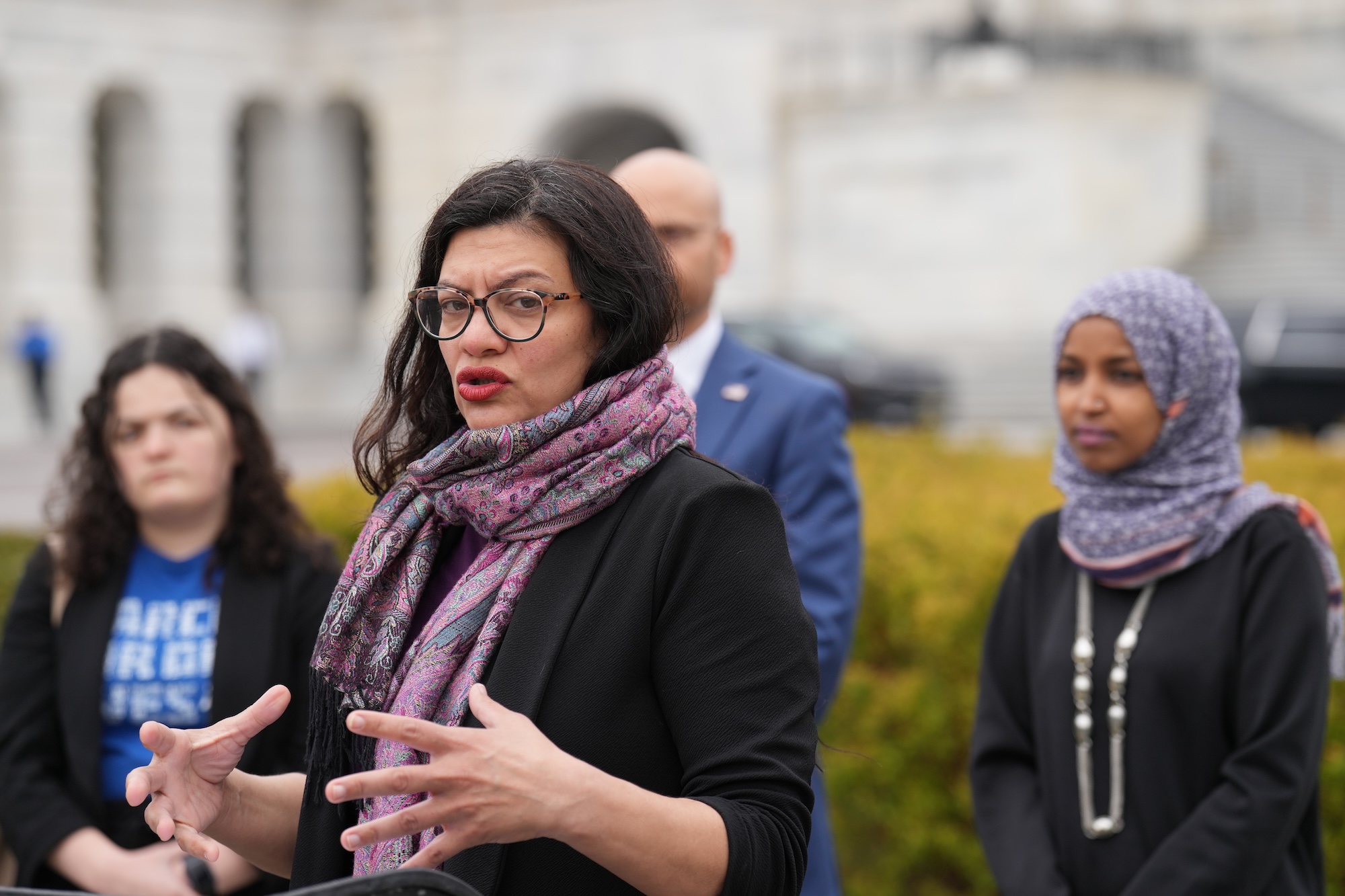
Rep. Rashida Talib (D-MI) speaks at a press conference in support of an anti-Islamophobia amendment before Congress. Image credit Phil Pasquini via Shutterstock.
What is an Arab? In the US, where race is a particularly potent myth with real consequences, they have long been categorized as white—until Biden-era proposals for a new Middle East and North Africa (MENA) category emerged for the 2030 census, only to be potentially delayed by the Trump administration.
During his 2024 campaign, Trump himself seemingly benefited from appealing to Arabs as a distinct and unified racial group, one that grew increasingly disgruntled with the Democrats throughout the campaign period due to the party’s financial, material, and ideological support for Israel’s genocidal campaign in Gaza. While some Arab Americans abstained from voting altogether, many shifted their support to the Republican Party. This is a clear reversal of the dynamics of the Bush presidency, which saw many abandoning the Republicans after their ruthless war on terror killed Arabs abroad and discriminated against them at home in the US.
Because of the lack of detailed research on Arab Americans that decisively distinguishes them as a racial or ethnic group as a result of this policy, data on their electoral impact is difficult to come by. However, many turn to the figures in Michigan to quantify their support; Trump won the pivotal swing state by a little over 80,000 votes, more than two-thirds of which came from Arab-majority cities Dearborn, Dearborn Heights, and Hamtramck. The narrative that Arab Americans were something of a decisive factor in helping Trump win the election swirled in legacy media and even more ferociously on social platforms, where many Black Americans expressed feelings of abandonment after supporting pro-Palestinian advocacy efforts on the ground and online. TikTok’s attempts to mobilize Black Americans to engage in something of an anti-boycott gained hundreds of thousands of likes and comments, with particularly disgruntled individuals filming themselves pejoratively consuming Starbucks and McDonald’s products.
Despite their apparent support for the Republicans, the coalition formerly known as Arabs for Trump now identifies as Arabs for Peace after Trump and Netanyahu jointly presented the so-called “Gaza Riviera” proposal at a press conference in February 2025. This suggests that the thrust of Arab-American approval hinged not on support of Trump’s broader agenda, but a poorly informed belief that he would follow through on the false promises he delivered to end the genocide during a campaign rally in Novi, Michigan in late 2024. Online discourse between these two groups became rife with jilted feelings, with Black Americans voicing concerns that Arab Americans were exercising a kind of selfishness by being single-issue voters without considering how a Trump presidency could disproportionately subjugate Black Americans. So, when Trump backpedaled on his Gaza-related promises to Arab Americans, there was little sympathy to be found from other marginalized groups.
Indeed, one of the most successful mechanisms in disrupting solidarity between these two key demographics in the US is the legally enshrined racial identity of Arabs and North Africans as white. Many lamented that by voting for Trump, Arab Americans acted to protect their whiteness. Though discourse has intensified on the matter in recent years, the racial character of Arabs across Southwest Asia and North Africa has long been a contentious matter in the US, both legislatively and culturally. Famously, the legal battles of George Dow circa the early 20th century have become emblematic of the pursuit of functional and legal whiteness among Arab Americans. Dow’s petition, like the curious case of Arabs for Trump, prompts inquiry: who does it hurt to navigate the ever-changing racial caste system of the US by seeking privilege? Though once enforced through the law, this dynamic is now largely acted out through more discreet mechanisms—namely, cultural norms and social practices that keep the legacy of race-based oppression alive despite increasingly unstable anti-discrimination legislation in Trump’s America.
Between Arab and White, Sara Gualtieri’s 2009 book, describes her own Syrian community’s journey navigating racialized naturalization laws in early 20th-century America. Indeed, there were questions about their origins in Asia, which were equally confounding and ultimately found unfitting due to their differences from the so-called “yellow race.” As Gualtieri describes, the fight for whiteness was inextricably connected to the fight for Americanness, but even where they succeeded in achieving legal status as white people for the sake of naturalization, their social and thus socioeconomic experiences as new Americans remained racialized.
In wondering what makes an Arab beyond the particular lands of the Arabian peninsula, in the diasporic context, more discreet and marginal sub-groups are erased as broader racial categories come to the fore, defined by simplistic, colonially-established regional associations rather than longstanding historical ones. There is the obvious association with the Arabic language. However, the region commonly described as the Middle East, whose people are most often referred to rather generally as Arabs, is made up of many countries with over 60 different languages spoken. Additionally, Arabic is the primary language of record in many countries outside of what is considered the Middle East.
The next obvious unifier is religion. Despite the religious complexity of the region, it tends to be flattened through xenophobic essentialism that overidentifies it with Islam. American historian Joel Carmichael, the son of founders of the American Zionist movement and an active Zionist and scholar himself, wrote at length about Arab identity in his The Shaping of the Arabs: A Study in Ethnic Identity (1967), in which he chalks up Arab identity as a process of religious unification between disparate, nomadic, and primitive Bedouin tribes after the time of the Prophet Mohamed. His version of history is shared by a great number of ideologically aligned scholars who find the region to be underwritten by loosely articulated boundaries and groupings passed from empire to empire, possessing little claim over their lands, conducive to modern conceptions of nationhood. Carmichael, without explicitly naming it, begins his book by introducing the concept of the Islamic ummah, drawing on the religious idea that believers should primarily see themselves as part of a unified community. He uses this framework to challenge and weaken the significance of older communal identities and state structures that underpin the countries that later emerged in the Middle East.
Indeed, the Arab League of 1945 and other expressions of Pan-Arabism (and their success over Pan-Africanism) indicate some form of transregional self-articulation, but it is important to keep in mind the contexts of subjugation through which these identities emerged. As noted by Marc Lynch in an earlier AIAC article, racial formations in the French Maghreb and British Middle East, apparently distinct from those of the surrounding African and Asian countries, were imagined and forged by competing colonial agendas in the region. Pan-Arabism, then, emerging predominantly as an anti-colonial movement, reflects not any real technical Arab heritage across the involved nations, but a desire for strategic regional unification on the basis of coherence forged by shared linguistic, religious, and cultural qualities.
It is important to acknowledge that much of the Arab world is within Africa, possessing ethnic and cultural distinctions from the rest of the Middle East, and regional affiliations with other states on the African continent. Various interest groups, however, promulgate anti-scientific and anti-historical race-replacement theories that allege the erasure of indigenous groups throughout various North African countries—particularly the ever-contentious Egypt—with the intent to undermine their indigeneity through racial essentialism. This strategy is reminiscent, perhaps even an outpost, of the Arabization of Palestinians by Zionists, who will only refer to the indigenous peoples of the land unspecifically as Arabs. Of course, the distinction between northern Africa and the rest is needlessly constructed by race, a fact that is increasingly contested by North Africans themselves in the wake of a growing decolonial consciousness. Hisham Aïdi, Marc Lynch, and Zachariah Mampilly note that the artificial separation of Middle Eastern and African Studies is itself deeply racial, often severing analysis and continuing to manufacture the notion of Arab-as-race. They point to the rise of emphasis on indigenous identities like Amazigh as a metric for growing African consciousness in the region that tethers the northernmost nations to the continent, rather than strictly to the Middle East.
Nevertheless, in the US, so-called Arabs, wherever they may hail from, so long as they are not Black, are legally white. For anti-Arab Americans, the Arab umbrella widens further; indeed, in the wake of September 11, anyone loosely appearing to be one may be a victim of racial violence intended for Arabs, including Sikhs. For this reason, one might argue that the Arab has functionally become a racial category. With the title Arab totally detached from its original referent, the term operates, like other racial categories, as pure Baudrillardian simulacra. As Baudrillard argues:
It is the map that precedes the territory—precession of simulacra—that engenders the territory. . . . but it is no longer a question of either maps or territories. Something has disappeared: the sovereign difference, between one and the other.
Race itself functions just this way. Detached from its referent, essentializing and flat, a desert of meaning that becomes confused for the real terrain of lived experience along cultural, religious, ethnic, or national lines.
This subversion of reality is a weapon that sustains itself and is readily available to various interest groups. Zionists like Carmichael benefit from arguing the Arabness of Palestinians, because it grants permission to cast them away into other Arab countries, where they would apparently be among their racially indistinguishable kinfolk—close enough to home—just as George Bush benefited from flattening the Arabness of the 9/11 attackers, because it gave him an excuse to be geographically inexact in his foreign policy response so long as the missiles landed in the Middle East. Israel’s attack on Gaza has been framed, like the aggressions that preceded it, by an approach that erases Palestinian and its various religious, ethnic, and other textures, and prescribes Arab.
Although many Arab migrants embraced the pursuit of whiteness described by Gualtieri, Arab Americans have nevertheless maintained historical and ideological ties with communities situated at the opposite end of the American racial order. Malcolm X famously stated after his time in Egypt that he “was among brothers” and “felt the spirit of brotherhood,” experiences that later transformed his racial outlook. Indeed, Black Americans often shed their slave names for Arabic ones, embracing Islam as an avenue for self-determination and a vehicle for racial revolution. Although religious sects and institutions remained highly segregated as new expressions of Islam emerged to address the unique conditions of Black American life, a potentially status-quo-threatening kinship developed between Black Americans and Arab Americans along religious lines, even as many Muslims from Southwest Asia and North Africa viewed groups such as the Nation of Islam as excessively heterodox. Highlighting this legacy is essential not to overlook legitimate concerns regarding anti-Black sentiment as an element of Arab racial formation, but to understand how such sentiments function primarily to reinforce imperial power rather than materially improve the socioeconomic position of Arab Americans.
Counter to figures like Elijah Mohammed, Muhammad Ali, Amiri Baraka, and others who sought to develop Black America as a diasporic outpost of Africa and the Middle East, more heavily canonized and state-sanctioned individuals like W.E.B. Du Bois and Martin Luther King Jr. publicly suggested that their solidarity should lie with Israel, not with Arabs. Black nationalist Edward Wilmot Blyden, who would later immigrate to Liberia, was amazed by “that marvellous movement called Zionism,” identifying a kinship between Black Americans and Jews, “closely allied both by Divine declaration and by a history almost identical of sorrow and oppression.” Marcus Garvey similarly maintained, “When the Jews said, ‘We shall have Palestine!’ the same sentiment came to us when we said, ‘We shall have Africa.’” In the 20th century, it seemed that rallying support among Black Americans for Zionism was (and remains) heavily dependent on religious affiliations. Despite the religious complexity of the Middle East, Islam has remained the central axis of solidarity between Black Americans and Arabs.
On the one hand, the racial essentialism underpinning the Arab other in the post-9/11 cultural landscape enables a uniquely diffuse cruelty in both domestic and foreign policy. On the other hand, the legal classification of Arabs as white erodes political visibility while promoting a racial narrative that undermines solidarity with other marginalized groups, particularly Black Americans. What the emergence of Arabs for Trump ultimately reveals is the strategic flexibility of Arab racial formation within the US: Arabs can be rendered nonwhite when surveillance, exclusion, and war are required, yet absorbed into whiteness when cross-racial solidarity threatens the geopolitical interests of colonial states invested in the Middle East, particularly the US and Israel.