Being right at the wrong time
Prominent cleric Sheikh Ahmad Gumi’s calls for negotiation reflect practices already in use, but in Nigeria’s polarized digital space, nuance is punished.
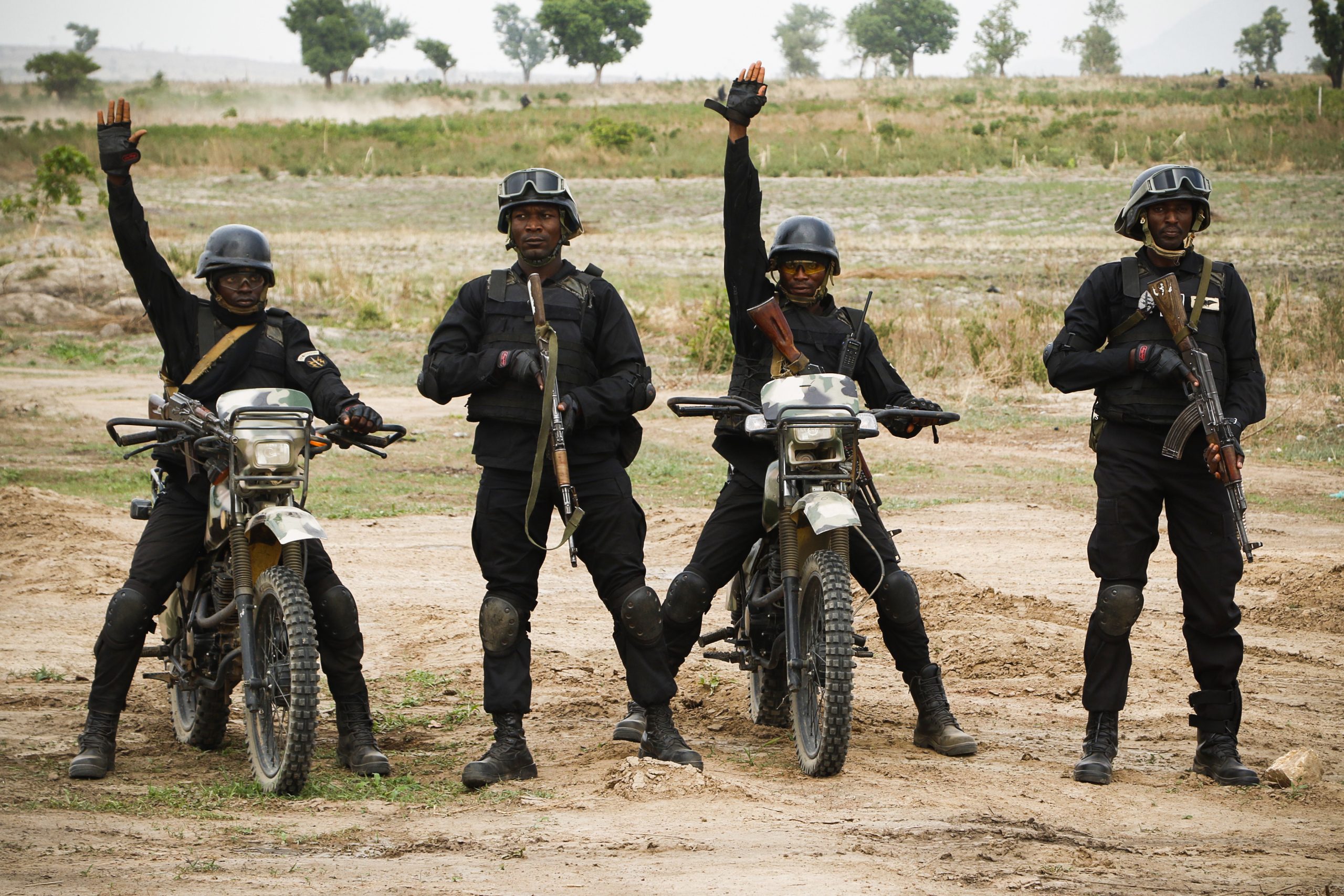
Nigerian soldiers introduce themselves after completing a “Silent Kill” demonstration at the African Land Force Summit,
For years, a Nigerian Muslim cleric Sheikh Ahmad Gumi, in interviews and on social media, has repeatedly urged the government to prioritize dialogue and negotiation over an “exclusively kinetic” approach—which prioritizes armed ground operations and aerial bombardments aimed at “neutralizing” insurgents even if at the cost of “civilian casualties” and the environment.
Sheikh Ahmad Abubakar Gumi, born in Kano State in 1960, is an Islamic scholar, medical doctor and retired captain in the Nigerian Army Medical Corps. He is the eldest son of the influential jurist Abubakar Mahmud Gumi, who served as Grand Khadi—the chief judge of a Sharia Court of Appeal. After secondary education at Sardauna Memorial College, he read medicine at Ahmadu Bello University, served as a military doctor and later studied Islamic jurisprudence and Qur’anic exegesis at Umm al‑Qura University in Mecca. On returning home, he succeeded his father as Mufti and Mufassir at the Sultan Bello Mosque in Kaduna. In Islamic terms, a Mufti is a legal expert who issues formal opinions on religious questions, while a Mufassir is a scholar of tafsir—one who offers a deep interpretation of the Qur’an. Sheikh Gumi began to enter the national and international spotlight in 2010 when he was detained in Saudi Arabia amid allegations that he had connections to Umar Farouk Abdulmutallab, the Nigerian accused of attempting to bomb a Detroit-bound aircraft on December 25, 2009. However, the peak of his popularity was in 2021 when he ventured into bandit hideouts in Zamfara and Niger States to mediate kidnappings, attend publicized meetings with notorious bandit kingpins such as Dogo Gide, and advocate for amnesty for them.
In recent times, he has advanced this point by vigorously criticizing America’s bombing of Nigeria, noting that such an approach could not succeed in Afghanistan and that even Israel could not prevail against a determined insurgency in Gaza. Beyond talks, in 2021, he facilitated a meeting in Kaduna involving more than 600 armed bandits, who agreed to lay down their weapons in exchange for security guarantees. His position, however, has drawn fierce backlash. Many critics, particularly from Nigeria’s Middle Belt and southern regions, denounced him as a terrorist apologist, arguing that calls for negotiation showed insensitivity to victims. His blunt language has further fueled outrage. During a December 2025 BBC interview, Gumi described child abductions as a “lesser evil” than killing soldiers, a provocative phrasing intended to argue that killing is irreparable while kidnapped hostages are often eventually released. In context, he was suggesting that engaging kidnappers could, however imperfectly, reduce overall bloodshed.
Meanwhile, what Gumi is saying is neither novel nor especially radical. The Nigerian state already operates a classified sulhu program through which it negotiates with insurgent groups and offers incentives to encourage defections, even while publicly denying such engagement. At the same time, communities in states such as Zamfara, Kaduna, Niger, and parts of Katsina have entered informal peace agreements with bandit groups to reduce attacks, making dialogue a reality rather than a dangerous innovation.
If Gumi’s argument reflects practices already in use, why the uproar? The answer lies in Nigeria’s fraught identity politics and media culture. Gumi is a northern Muslim cleric, a profile that makes many southern Christians immediately suspicious of his motives. In such a charged environment, who speaks often matters more than what is said. Any remark by a northern Muslim or analyst that promotes negotiation, especially if it adds a condemnation of the US bombing in Nigeria or even questions US motives for being on the ground in Nigeria, is immediately flagged as that of a terrorist sympathizer. Analysis is quickly filtered through ethno-religious anxieties of north vs. south and Christians vs. Muslims. Nigeria’s online space thrives on binary framing that leaves little room for nuance. You either align with the loudest voices or you are branded wrong. Gumi, despite being a retired Nigerian Army captain who likely understands the limits of a purely kinetic strategy, is seldom assessed based on his professional experience. Instead, he appears to be paying the price for being the wrong messenger, speaking from the wrong position at a politically sensitive moment. To make Gumi widely disliked, critics circulate not only real videos of him but doctored videos that push his statements to offensive extremes, provoking public backlash. Yet dismissing uncomfortable ideas has not resolved the crisis.
The rollback of non-kinetic options appears to be a global trend. Global military spending hit a record $2,718 billion in 2024, up 9.4 percent year-on-year—the fastest rise since the Cold War. Meanwhile, Global donor investment in peacebuilding and prevention fell by 12 percent ($343 million) from its 2018 peak to 2023 and broader conflict assistance dropped by 17 percent ($871 million). In Ukraine, in Gaza, and in the widening confrontation between the United States, Israel and its allied countries, and Iran, military escalation now takes precedence over dialogue and negotiation. Institutions that once performed the slow, unglamorous labor of mediation and development, from the United Nations to the United States Agency for International Development, are weakened, defunded, or politically undermined. However long they last, wars end in negotiation. The grinding stalemate in Ukraine only reinforces this point. If dialogue is the inevitable destination, why declare it illegitimate at the outset? Africa’s own political traditions, whether in the language of palaver, sulhu, or community reconciliation, have long recognized that durable peace requires talking to enemies, not only defeating them.
At a moment when global powers seem captivated by the theater of force, Africa can once more teach the world the ways of peacebuilding it has long held. It has become a ritual saying that the global rules-based world order is collapsing. It often sounds abstract, even structural, but in practical terms, it refers to the erosion of idealistic norms in favor of realist calculations, particularly the growing preference for kinetic over non-kinetic strategies in global affairs. This preference is not confined to high-level global politics or world leaders; it is also evident in the marginalization of nuance at the domestic level, particularly when non-kinetic approaches are proposed. Across Nigeria, many states are prioritizing the creation of armed state police units or vigilante groups, while previously popular state peace commissions, which had begun to gain traction, now appear to be in retreat.
After more than a decade and a half of trial and error, including the recent US bombings in Nigeria that appear to have escalated the challenge rather than resolved it, it is evident that military force and counterterrorism designations alone cannot uproot guerrilla-style attacks, nor are they a silver bullet. However, knowing this truth is one thing, but openly saying it on Nigerian social media can be dangerous. Either you say the kinetic strategy is right or you are pilloried as a sympathizer or a terrorist. No one wants to hear the militants’ side of the story, but if we are serious about resolving the challenge of banditry in Nigeria, we must listen to them, and the sooner the better. Only a few, like Sheikh Gumi, have had the guts to speak this reality and own it.