Could expanding protected land undermine biodiversity?
Paradoxically, conservation efforts in Liberia and Senegal are threatening native ecology.
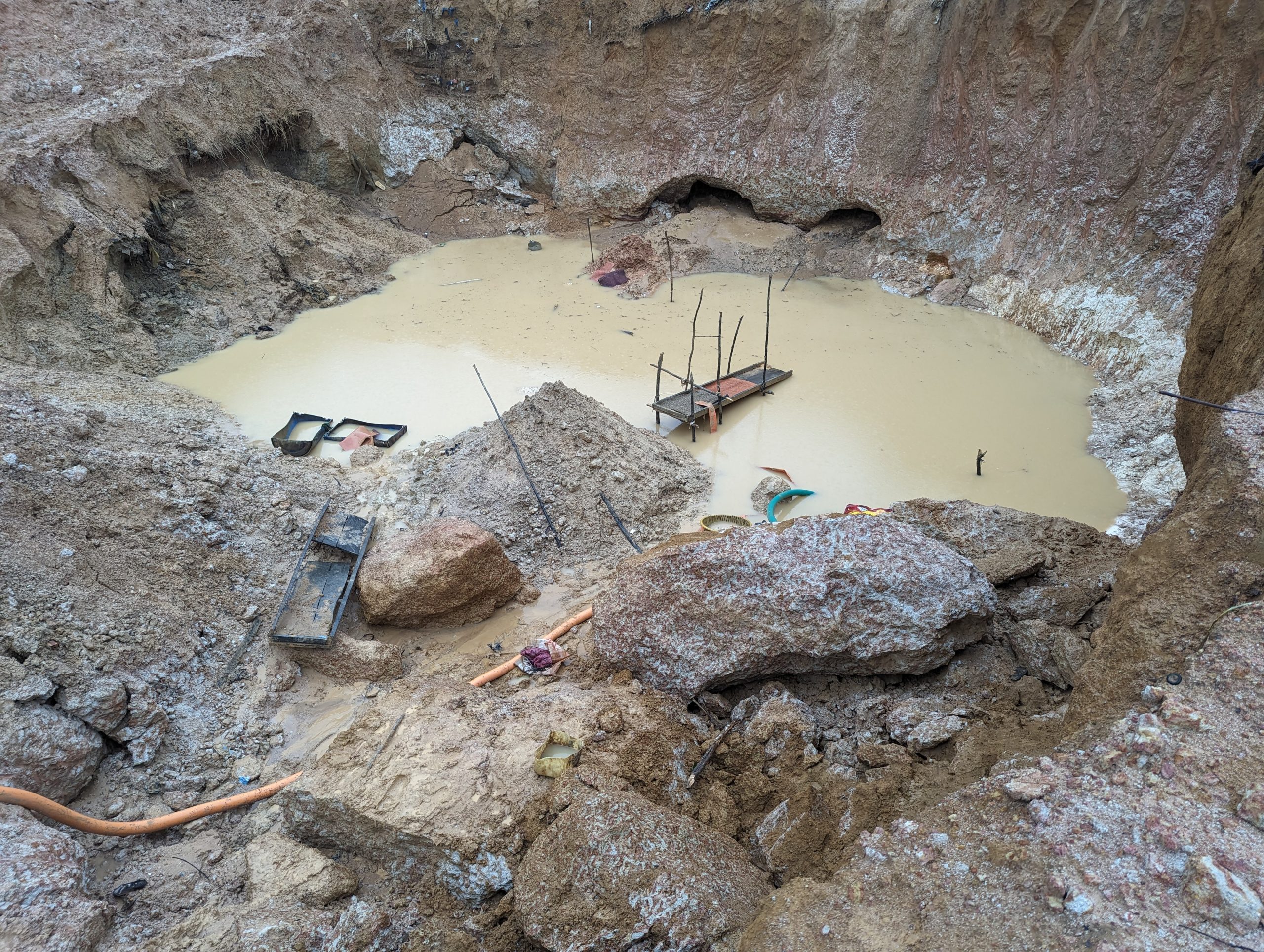
Artisanal mining site near Sapo National Park, showing a pit where earth-moving equipment removed the topsoil. Credit
A decade ago, nearly two-thirds of the African continent’s natural world heritage sites—recognized by the United Nations as globally important for their biodiversity, ecological significance, and natural beauty—were identified as promising prospects for mining, oil, and gas exploration. In 2022, 196 countries committed to the Kunming-Montreal Global Biodiversity Framework, pledging to protect 30% of land and sea by 2030 to curb biodiversity loss. On the surface, mining and conservation seem at odds: one is premised on the destruction of the earth, the other on its preservation in an unaltered state.
But as the essays in this series reveal, mining and conservation increasingly work together to dispossess local communities of land and livelihoods, while reframing exclusion as development and environmental protection. Two global trends—soaring demand for gold, bauxite, and iron ore, and the rapid expansion of protected areas—are converging in West Africa to produce overlapping resource frontiers. Extractive infrastructures open remote areas to research and ecotourism. They are also ideologically aligned, sharing a neoliberal emphasis on market value and “optimal” resource use, treating nature as a commodity. Mining companies have become key funders of conservation, supporting parks, offset markets, and environmental programs, promoting their operations as “green” to shareholders and consumers.
The highest costs fall on local communities. They bear the greatest burden of land dispossession, restricted resource access, and mining degradation. And they will be the ones who remain, sustaining these landscapes long after this wave of capital abandons and moves on.
A powerful global alliance of conservation actors is pushing for the Kunming-Montreal Global Biodiversity Framework’s 30×30 goal: by 2030, at least 30% of global land, inland water, and marine areas should have protected conservation status. The aim is noble in the face of the failure of global efforts to mitigate climate change and broad-scale ecological destruction. Yet expanding protected land has a dark underbelly, particularly in Africa, where per capita protected land often exceeds that in most developed economies.
National histories of conservation shape local engagement. Our ongoing work in Liberia and in Senegal documents rural communities increasingly transgressing historic national park boundaries. This trend is driven by two factors: the expansion of existing park borders and the encroachment of corporate and artisanal mining near conservation areas. Parallel processes in countries with radically divergent postcolonial histories offer a cautionary tale for global biodiversity efforts and suggest the need to rethink the future of conservation.
Unlike other African nations, where colonial governments established protected areas before independence, conservation arrived late in Liberia. Despite being the oldest African republic, Liberia passed its first forest law in 1953. It took three more decades to establish Sapo National Park, the country’s first and largest protected area. Created in 1983, Sapo is one of the “jewels” of West Africa’s remaining forest, estimated to cover 69% of Liberia’s land.
The park followed an international model of fortress conservation: people were strictly prohibited from accessing protected land. From the late 1950s, the state had established national forests primarily for commercial logging, excluding farming and hunting. While rural communities acknowledged state ownership of “political forests,” enforcement was lax, and residents continued to access these spaces. The government promised Sapo would generate local economic benefits, providing cash compensation to farmers displaced by the park, and supporting agroforestry and community gardening initiatives.
Early perceptions were relatively positive—that is, until the First Liberian Civil War reached the park in 1990, disrupting state management. Fleeing violence and hardship, people sought refuge in the park. They revitalized old farms, hunted, collected forest products, and occasionally mined for alluvial gold. As the conflict eased, more people dug for gold at old mine sites inside and near the park boundary.
In 2003, at the urging of conservation actors, the state expanded Sapo’s boundaries to address wartime degradation. Local communities felt betrayed: their access to the forest as a source of livelihood was further restricted, while promised ecotourism and development failed to materialize, primarily due to the civil conflict. Local residents increasingly turned to artisanal mining inside Sapo. As a young miner said, “The benefits we get from mining are here in our hands, but we keep waiting for these tourists who never come,” asking, “Do you know when they will come?” For the local communities bordering Sapo, granting miners access to the park through their land was a risk worth taking.
The expansion of Sapo’s borders and the growth of artisanal mining in the park are intertwined political and ecological developments. The 2003 extension act cited concerns about the “integrity” of the park, yet contestation over boundaries has degraded that integrity, and conservation proposals to militarize the park to restrict human mobility overlook the social and economic relationships formed around artisanal mining, whose camps create opportunities for traders, farmers, and porters. Today, Sapo covers 1804 km2, up from 1308 km2, dotted with mining camps that drive hunting and watershed pollution. Was the expansion worth the mistrust and increased illegal activities?
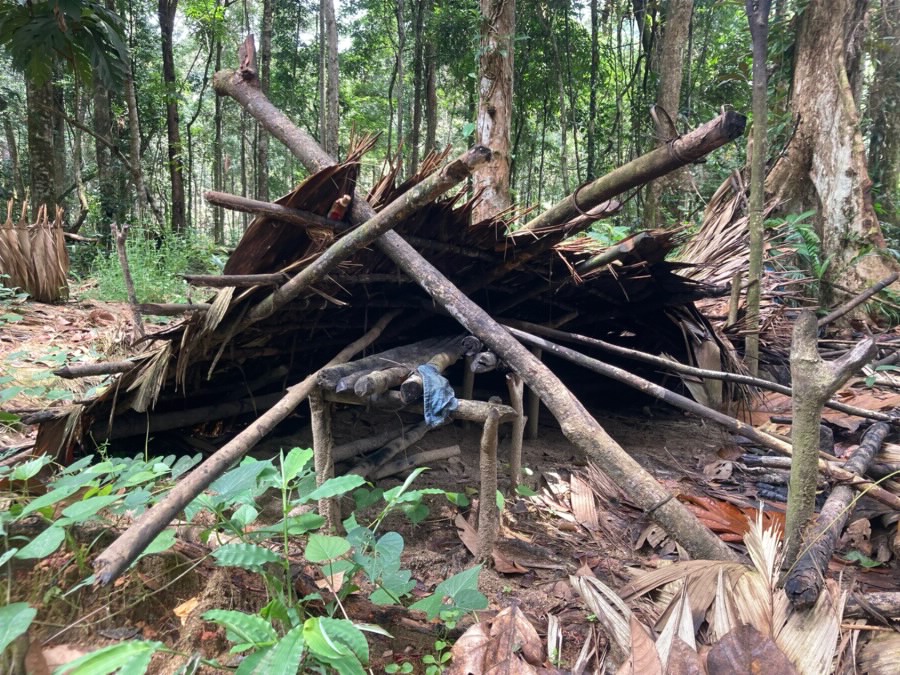
In Senegal, a cartographic dispute illustrates similar tensions. In July 2010, park agents arrested three geologists prospecting for gold for Torogold, a British firm, alleging they had illegally entered Senegal’s largest protected area, Parc National du Niokolo Koba (Niokolo Koba). While the geologists sat in a jail cell, Senegalese officials deliberated over where the park border lay. For more than 20 years, park agents relied on a cylindrical poured concrete border marker with peeling white paint to demarcate the park’s border. GPS coordinates, however, located the border five miles to the east of the physical marker. After claiming they relied on the GPS data, the Senegalese government ultimately sided with the geologists. It released them from jail, a decision that many residents concluded was an intentional move of the park border for the mine.
Cartographic confusion over the park border had a fateful afterlife. Shortly after their arrest, the geological team announced the discovery of the Petowal lode, a sizable gold deposit near the village of Mako. Conservation organizations warned of the threats the mine posed to Niokolo Koba’s wildlife—including West African lions, leopards, and chimpanzees. Despite its UN World Heritage status since 1981, the park was placed on a list of endangered sites in 2007, just as Senegal’s mining boom accelerated. Yet the Senegalese government granted Torogold a concession to mine Petowal, outraging the park’s border communities, who had been violently excluded from entering the park for decades near the very border marker the state now claimed had been “misplaced.”
The grievances of rural communities are inherent to the park’s political history. Niokolo Koba began in 1925 as a colonial game preserve, converted into a fully protected natural preserve in 1950. Léopold Sédar Senghor, Senegal’s first post-colonial president, celebrated it as the cornerstone of Senegal’s participation in the growing international conservation movement. Management of the park, like that of Sapo, embraced fortress conservation principles; throughout the 1960s and 1970s, Senghor expanded Niokolo Koba’s borders and ordered military evictions of villages, whose residents were resettled along the unpaved national highway. Park guards were authorized to “shoot-to-kill” trespassers in service of “conservation,” and raided nearby villages for bush meat or palm wine collected from within the park.
As the decades progressed, residents of resettled villages slowly invested in the park’s borders, participating in anti-poaching campaigns and income-generating projects, and largely accepting regulated access into the park to visit ancestral religious sites and to collect medicinal plants. The Mako mining concession shattered this delicate ecosystem, however. The decision to capitulate to mining interests over any greater conservation objectives triggered residents to abruptly abandon respect for the park’s borders. Young men, whose parents were evicted decades earlier, now escort artisanal miners from Guinea and Mali into the park. Satellite imagery shows progressive encroachment of artisanal mining and other anthropogenic activities into Niokolo Koba. Residents justify their actions as resistance to willful administrative exploitation. In the words of one young man who guides artisanal miners into the park: “If they [the state] let a mining company in the park, I’m going to enter the park to feed my family.”
Several years ago, an Australian company called Resolute Mining acquired the Mako mine from Torogold. Resolute Mining has created the Petowal Biodiversity Offset Program to mitigate chimpanzee habitat loss. But the ecological impact of the mine cannot be measured by the official footprint of the mine on protected lands. Rather, the controversy over the park’s borders encouraged citizens to ignore historic park borders with serious consequences for biodiversity protection. In the near future, it is probable that Senegalese citizens, rather than mining firms, will carry out much of the new ecological destruction in Niokolo Koba. But beyond the betrayal of conservation principles, these events are a direct reaction to the state’s violation of park borders to support foreign mining development.
While the Kunming-Montreal Global Biodiversity Framework (GBF)’s 30×30 proposed expansion of protected areas could be instrumental for mitigating biodiversity loss, it cannot be the sole metric for ensuring biodiversity in West Africa. The spatial overlap between mining and protected areas underscores the socio-ecological complexities inherent in protecting biodiversity. The Liberian state expanded park boundaries, restricting access for artisanal mining, while the Senegalese state shrank park boundaries to accommodate industrial mining. Rural communities deliberately transgress historic park borders to protest what they view as state-led land grabs for the benefit of foreign capital.
Global conservation organizations demand more from African citizens than from those in the global North, replicating colonial-era patterns of exploitation. It is no longer viable to ask rural communities to sacrifice livelihoods for global conservation goals while pushing them into “illegal” activities. Yet biodiversity persists in and around parks like Sapo and Niokolo Koba, in part because rural West Africans continue to practice ways of living with plants and animals that cultivate biodiversity. Expansion and militarized protection of park borders, by contrast, leads to ecological degradation by pushing citizens to encroach on parks. The future of conservation lies in research-based, community-centered approaches that empower local people to steward biodiversity.
Our work in Liberia and Senegal shows that expanding or redesigning parks in the absence of genuine community consultation and protection of local rights generates mistrust. This mistrust may, in turn, worsen ecological degradation and undermine conservation efforts. For the GBF to succeed, it must go beyond expanding protected acreage to advance community-centered governance as essential for long-lasting biodiversity protection. Anything less than this will inevitably result in another concession at the expense of rural livelihoods.