When charity poses for a Grammy
Burna Boy’s highly publicized Lagos prison visit looked like generosity, but it also looked like content. Who was it really for?
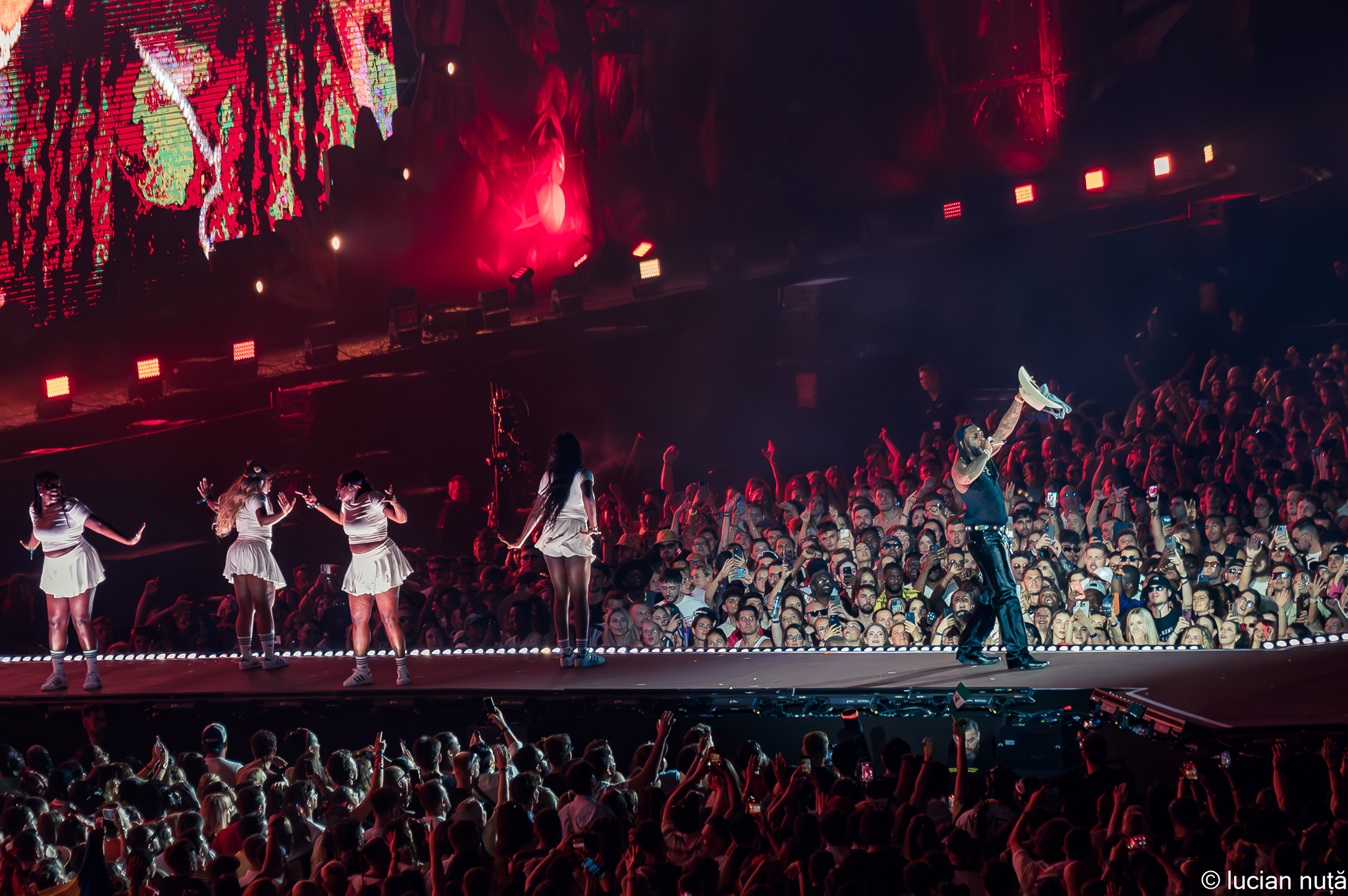
Burna Boy at the Untold Festival in Romania 2024. Image credit Lucian Nuță CC BY-SA 2.0.
Videos recently circulated of Burna Boy driving through Lagos with Very Dark Man (VDM), cash in hand, on their way to a prison to “randomly” free inmates. The clips were edited for social media: gates, uniforms, handshakes, gratitude. It looked like generosity. It also looked like content.
Burna Boy is not just another celebrity dabbling in philanthropy. He is Afrobeats’ most globally legible figure, an artist whose success now sits at the intersection of African cultural production and Western institutional recognition. Few musicians embody the genre’s circulation as convincingly. Precisely because of that stature, his performance of charity deserves scrutiny rather than automatic praise. What matters is not only whether celebrities help, but what their help does politically, what it displaces, and who it is ultimately for.
Burna Boy has long been uneasy about where his legitimacy comes from. While promoting I Told Them, he dismissed Afrobeats productions as musically inconsequential, a remark that sounded less like critique than anxious self-exceptionalism. It was a curious move from someone whose career is inseparable from the genre’s global expansion. Yet the impulse to stand apart, to appear elevated above the field he inhabits, continues to shape how he negotiates recognition, authority, and global validation.
With the next Grammy Awards approaching, Burna Boy is again nominated, including for Best African Music Performance and Best Global Music Album. These nominations matter not only because they reward sound, but because the Grammys increasingly reward posture and moral legibility. The institution does not simply crown music. It curates what a “responsible” global artist should look like. African musicians, in particular, are expected to appear humane, socially aware, and politically readable to transnational audiences.
In this sense, the Grammys function less as a neutral stage than as a disciplining institution. They shape the kinds of musical and moral performances that circulate upward into prestige. They not only evaluate art; they train artists on how to be seen. The question becomes not just what an artist sounds like, but also what ethical figure they present themselves to be, and for whom that performance is staged. Increasingly, the audience is not local publics, but global gatekeepers, industry voters, and liberal spectators who reward moral visibility alongside sonic innovation.
It is in this context that Burna Boy’s appearance with VDM becomes legible. The two were filmed driving to a Lagos prison carrying cash, framed as an attempt to free prisoners. The visit was documented, edited, and circulated online. This did not come across as quiet philanthropy. It appeared more like spectacle.
For an artist of Burna Boy’s stature, the form of the gesture matters as much as its intention. He has the capacity to support prison reform through legal aid organizations, rehabilitation programmes, bail funds, policy advocacy, or sustained institutional partnerships. Nigeria’s prison crisis is not one of missing charity, but of governance: overcrowding, prolonged pretrial detention, lack of legal representation, and slow courts. A large share of inmates await trial for extended periods, often because they cannot navigate bail, lawyers, or administrative delays.
In this context, a convoy of cash does nothing to reform the reality. It performs relief. Whether Burna Boy’s choice was calculated, intuitive, or shaped by social media incentives, the consequence is the same. Charity becomes visible before it becomes structural.
This is where celebrity humanitarianism reveals its political superficiality. Even when motivated by genuine concern, spectacular charity recenters authority, narrative, and moral judgment in the hands of the celebrity. The story becomes about who gave rather than what changed. Systems recede while the individual shines. Institutions are bypassed while optics are amplified. What looks like intervention often displaces harder political work: public debate about sentencing, policing, court delays, and funding for legal aid. Celebrity charity does not simply respond to existing struggles. It reorganizes them. It substitutes governance with performance, politics with affect, and collective demand with individualized rescue. The prison becomes content, prisoners become symbols, and reform becomes something imagined through visibility rather than through law, policy, or sustained organizing.
VDM’s presence sharpens this logic. He occupies a distinctive position in Nigeria’s public sphere as a confrontational digital figure whose work oscillates between activism and content creation. Though he prefers the label “online police,” his practice is rooted in exposure, populist accountability, and public shaming. Unlike many commentators who monetize Nigerian crises from abroad, VDM is physically present in Nigeria, and this grants him credibility and moral capital.
By aligning publicly with VDM, Burna Boy taps into that capital. The gesture signals proximity to “the people” and to popular justice. At the same time, it folds popular accountability into celebrity narrative. The prison becomes a stage, the prisoners recede into the background, and the camera becomes the main beneficiary. What circulates is not reform, but reputation.
The timing is revealing, though not conspiratorial. The prison spectacle followed backlash from an incident in the US, when Burna Boy demanded that a sleeping fan be removed from his concert or he would stop performing. The episode circulated widely, casting him as petulant and cruel, hardly the moral image one wants circulating ahead of Grammy voting. Public figures rarely act from a single motive. Reputation, pressure, conscience, and institutional incentives blur together. What matters is how those forces translate into behavior inside systems that reward moral display.
Seen this way, the prison visit functions as reputational repair. It reframes Burna Boy as compassionate and socially attentive. Whether prisoners were meaningfully assisted becomes secondary to how the story travels. In the economy of celebrity activism, circulation often outweighs consequence.
This anxiety around legitimacy is not new. Burna Boy’s Grammy win for Twice as Tall was later complicated by the controversies surrounding Sean “Diddy” Combs, the album’s executive producer. His aggressive response to online mockery linking his success to Diddy, including the arrest of Speed Darlington, revealed how sensitive he is to the narratives that authenticate his success. Recognition is not simply earned. It is curated and defended.
Since the US incident, restraint has become the strategy. No scandals. No excesses. Just careful positioning. In that light, the VDM-led charity spectacle reads less as generosity than as rehearsal, an exercise in moral visibility suited to an award culture that rewards not only talent, but also virtue that photographs well.
Critical scholarship on celebrity humanitarianism has long noted this pattern. Public charity mediated through cameras privileges performance over structure, visibility over transformation, and affect over accountability. The celebrity becomes interpreter, rescuer, and narrator, while institutions and communities become the supporting cast.
None of this diminishes Burna Boy’s musical brilliance. But it exposes a contradiction in contemporary celebrity power in Africa. Artists are expected to be musicians, diplomats, moral figures, and global ambassadors at once. Institutions such as the Grammys intensify that pressure.
When charity poses for a Grammy, the issue is not sincerity. It is power. What looks like generosity operates as a performance calibrated for circulation and institutional recognition. The danger is not that celebrities intervene in social life, but that intervention becomes theatre. And when theatre replaces politics, visibility becomes a substitute for justice.