What Kwame Nkrumah knew about profit shifting
From colonial accounting tricks to modern tax havens, Nkrumah understood how capital escapes, and why political independence was never enough.
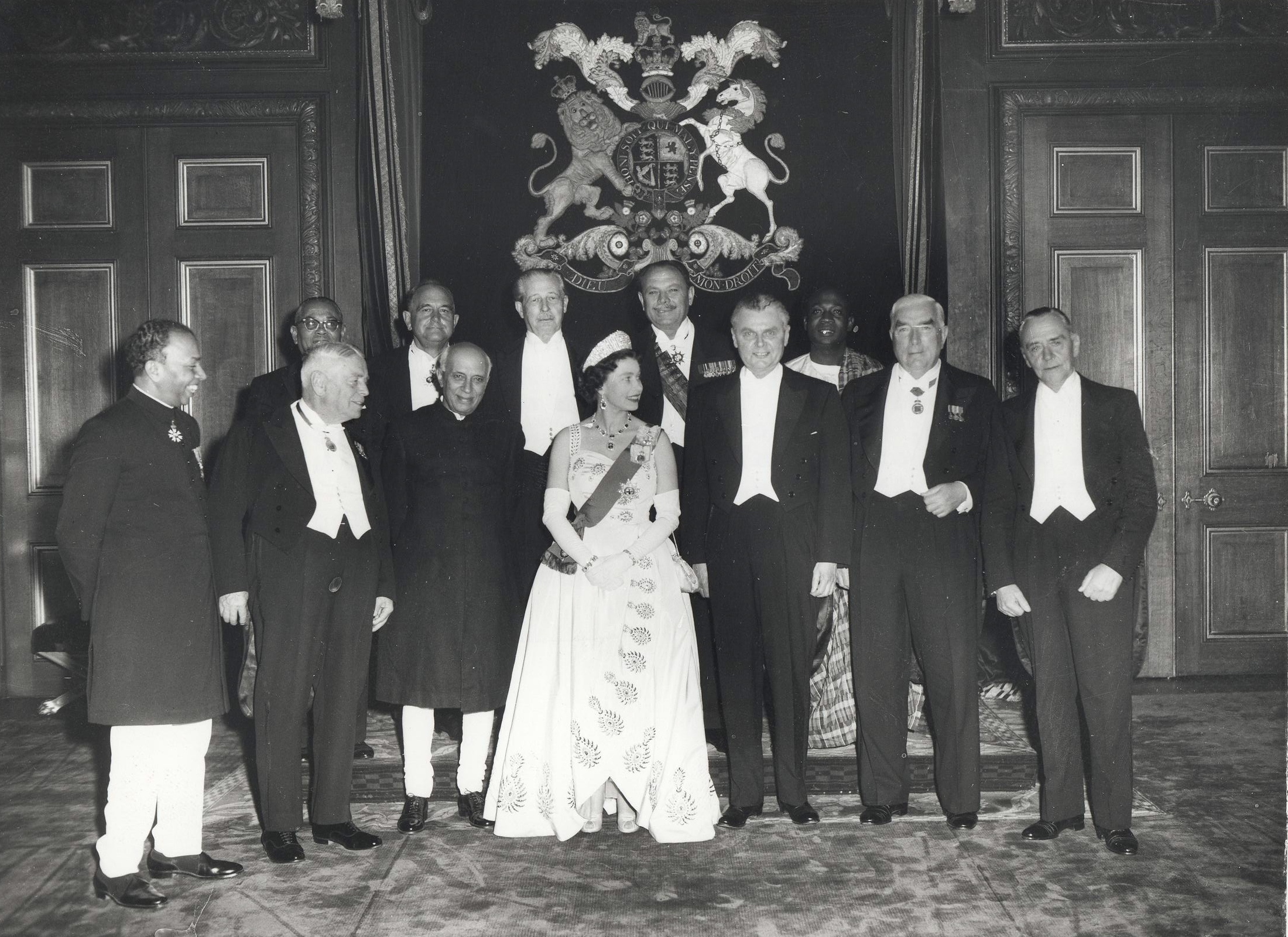
Queen Elizabeth II stands with Commonwealth prime ministers, including Jawaharlal Nehru and Kwame Nkrumah, at the
You won’t find the words “tax haven” or “profit shifting” among the pages of Kwame Nkrumah’s Neocolonialism, the Last Stage of Imperialism, published 60 years ago. Yet Ghana’s first president and pan-Africanist recounts a familiar story of corporate greed and capital flight, where imperial corporations with their complex multi-jurisdiction structures, aggressive tax practices, and clandestine deals are a “drain on resources from the less developed countries to the highly developed ones.”
From Liberia’s rubber to the Congo’s copper, Nkrumah tells story after story of how the control over resources and finance was in the hands of corporations created or backed by former colonial powers.
“And when independent African countries attempt to establish a certain rectification by leveling taxes on company profits,” Nkrumah writes, “they draw resentment that is echoed in dire warnings in the imperialist press that they will stifle foreign investment if they continue such encroachments upon expatriate rights.”
We can tell a similar tale today. The Tax Justice Network’s Corporate Tax Haven Index, updated in December 2025, shows that European countries enable more than 50% of the total tax abuse perpetrated by multinational corporations, while African countries enable less than 5%.
Multinational corporations use a web of tax havens, woven together with unfair tax treaties, to pay proportionally far less tax than many people, even though their own employees pay, and yet still argue they can’t increase wages. The most corrosive corporate tax havens are Switzerland and two British Overseas Territories—the British Virgin Islands and the Cayman Islands.
A particularly insidious device is the patent box regime. Originally designed to incentivize innovative research and development, such as vaccines, multinational corporations tend to move their patents out of the places where they develop, make, or sell their goods and services, and into corporate tax havens, allowing them to underpay tax. Forty-two countries of the 70 countries monitored on the Corporate Tax Haven Index, which together host 87% of global foreign direct investments, have patent box rules or fully exempt multinational corporations from paying tax.
French pharma company Sanofi established a regional hub in South Africa to produce polio vaccines. A tax treaty between the countries prevents South Africa from taxing royalty payments made in the course of drug manufacturing at the usual 15%. Sanofi’s South African subsidiary likely pays royalties to its French company for using the patent to manufacture the vaccines. The company essentially pays itself to use its own knowledge, reducing the taxes it owes in South Africa.
US pharmaceutical companies Johnson & Johnson and Pfizer are following suit with manufacturing plants in South Africa, where the US-South Africa tax treaty means South Africa imposes no tax on royalty payments from South African subsidiaries to American multinationals, similar to the France-South Africa treaty. The intellectual property tax discount that the US, Ireland, France, UK, and other countries offer helps multinational corporations to shift profits away from countries like South Africa, where drugs are actually manufactured.
All countries lose out to tax abuse, but the impacts are greatest for those most historically plundered nations. Global North countries forgo huge sums of tax revenue with patent box regimes, and South Africa is estimated to lose more than US$450 million due to intellectual property profit shifting.
Exploiting patent box regimes is just one reason Africa continues to lose close to $90 billion each year to illicit financial flows. The other challenge is a century-old global tax system that was designed by the League of Nations when most African countries were still colonies, which taxes multinational corporations based on where they declare profits rather than where they do business, employ workers, extract resources, make products, and sell services.
The scale of the losses and the inability (or unwillingness) of the club of rich countries—the OECD—to effectively and inclusively address the problem is why African countries are acting.
Taking heed of Nkrumah’s words that Africa’s structural transformation from the “financial and economic empires [that] are pan-African [ . . . ] can only be challenged on a pan-African basis,” the African Group at the UN has successfully tabled a resolution to start negotiations on a UN tax convention, which will conclude in 2027.
In November, negotiations on the UN Framework Convention on International Tax Cooperation—as it is known—happened for the first time on African soil, in Nairobi, Kenya. Countries discussed a new approach to taxing multinational corporations based on the principle of the “fair allocation of taxing rights,” which would allocate profits to countries based on real economic activity and tax them accordingly, rather than allowing profits to be squirreled away in tax havens.
Fairer taxing rights would be supported by transparency tools that disclose the real (beneficial) owners of companies, allow tax authorities to automatically exchange information on residents, and require companies to publicly report their activity on a country-by-country basis.
Most countries agree that tax rules need to be fairer, but OECD countries, including notorious tax havens like Switzerland and the Netherlands, would prefer existing fora, rules, and processes to continue to apply.
If Nkrumah were alive today, there’s no question he would be backing another attempt to break Africa free from old rules that only work for their old masters. As he wrote, “With economic unity, [of] countries in Africa [ . . . ]. We would all be in a better bargaining position [ . . . ] to establish adequate taxation of foreign factor earnings. In fact, a whole new pattern of economic development would be made possible.” How different the pattern might have been had those words been heeded at the time.