The twins who shaped Egyptian football
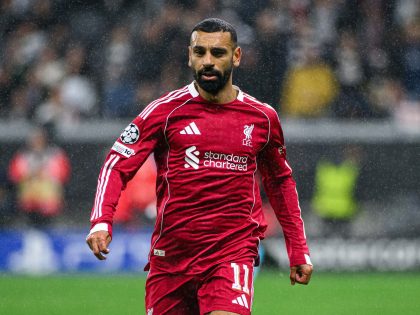
While international media focuses on the legacy of Mohamed Salah during this Africa Cup of Nations, Egyptians are focused on a pair of identical twin brothers.
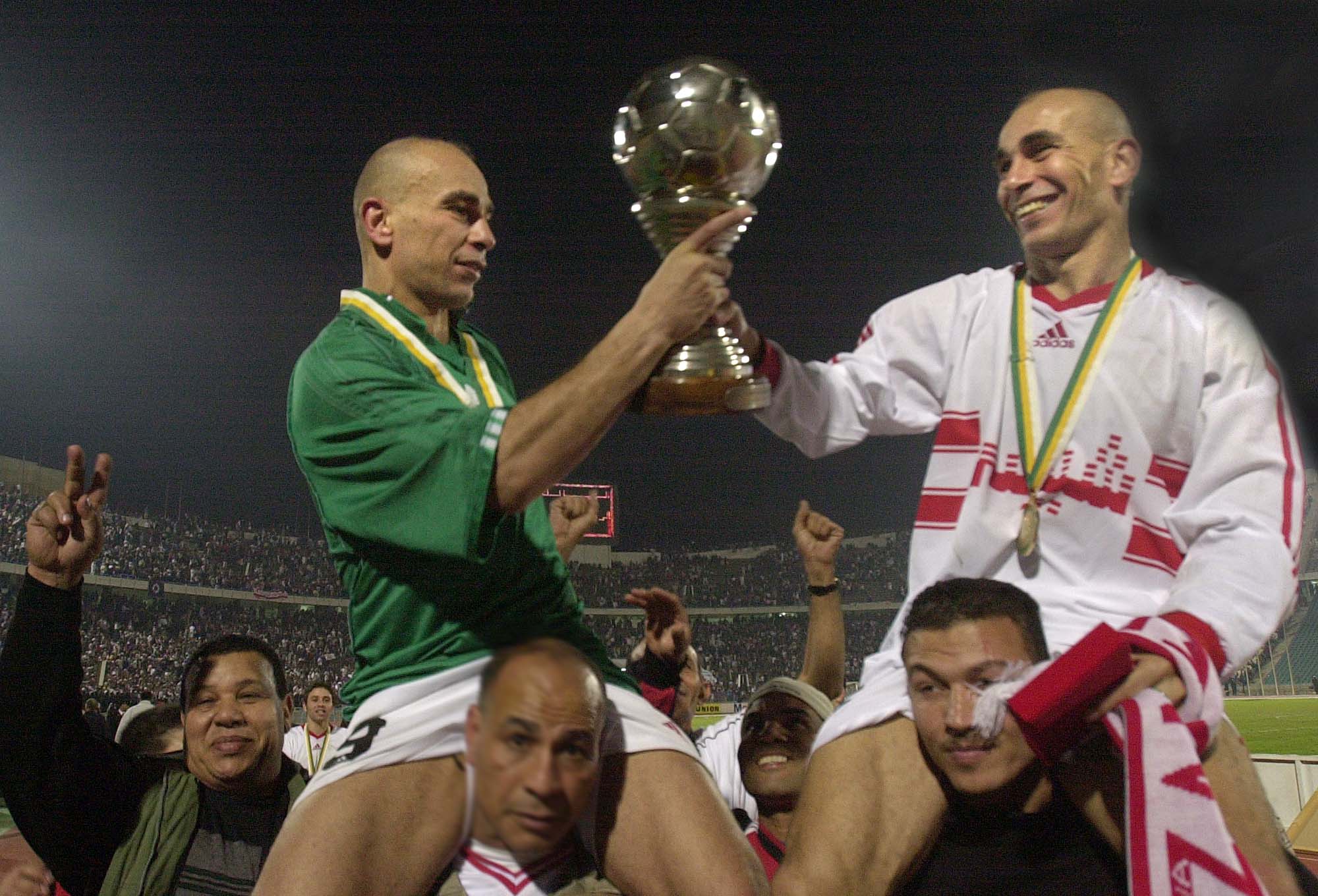
The Hassan twins winning the African Champions League’s cup in 2002. Credit Amr Nabil for AP
Speaking to the sporting press in Agadir last week, a calm Hossam Hassan, coach of the Egyptian national team, expressed his distaste for holding the Africa Cup of Nations in four year cycles. The 59-year-old’s words were strong, albeit in a much calmer demeanor than what Egyptian football fans have come to expect from him: “Can you change the European system? You can’t. I’m not speaking in my capacity as the Egypt national team coach, but as an African player. God willing, we will fight for our rights.”
His words were uncharacteristically lacking self-recognition, referring to himself as “an African player.” Just an African player, as if to blend with the myriad players who belong to this illustrious continent and its rich footballing history.
Or, perhaps this was his way of diffusing the attention from the real story for a lot of Egyptian fans during this edition of the Africa Cup of Nations. Much of the international coverage surrounding Egypt centers on Mohamed Salah and his pursuit of an eighth continental crown for The Pharaohs. Omnipresent and unresolved in footballing conversations in Egypt are the whispers about Hassan and his appointment as coach, as well as the appointment of the national team director who occasionally sits beside him in the dugout, his identical twin brother Ibrahim.
For those previously unaware, Hossam Hassan is the Egyptian national team’s all-time top goalscorer. He has won AFCON three times, lifting the trophy as captain twice (in 1998 and 2006). He has more goals in the competition than Sadio Mane, Mohamed Salah, Riyad Mahrez, and the same amount of goals as Didier Drogba (in fewer games). Hossam’s notoriety is not just about records and accolades. Growing up in Egypt, Hossam Hassan was the first footballer I was able to recognize, because he and Ibrahim embodied Egyptian football itself. Ask 100 Egyptians to pick the country’s best ever XI, nearly all of them would have Hossam Hassan up front and Ibrahim Hassan at right-back. So revered and famous were both of them that they’re usually just referred to as “The Twins.”
For almost the entirety of their playing careers, Hossam and Ibrahim were inseparable. In fact, before Ibrahim’s hair transplant six or seven years ago, a lot of casual fans found it very difficult to tell them apart. (For die-hards it was easy: Ibrahim looks considerably more mean.) This inseparability can be illustrated by a rumor that once circulated about their development as players. As the story goes, Ibrahim was originally a forward, but ended up sacrificing to play at right-back because Hossam could only play as a striker. Even though neither of them have ever confirmed the veracity of the matter, it’s a story that fits both of their profiles very well. While Hossam was a lethal striker, Ibrahim was a complete footballer who just so happened to play at right-back. (During their stint at Swiss club Neuchatel Xamax in 1991/92, he wore the number 10, would often be deployed in midfield, and curled a free-kick to record a famous win for Roy Hodgson’s men against Real Madrid.) Whether this origin story of brotherly sacrifice is true or not remains unimportant in the grand scheme of things. They were inextricably linked both on the field and off—having a joint wedding and children born on the same day.
When The Twins—who came through the ranks at Al Ahly—joined Zamalek on a free transfer in the summer of 2000, it marked another defining moment in their careers. Known as the transfer that shook Egyptian football to its core, it is widely acknowledged to have come about after Al Ahly refused to offer Ibrahim a new deal, believing that he was in the twilight of his career. Hossam refused to part from his brother, and so they made the move together. Ultimately, Al Ahly were proven wrong. Despite both being 34 at the time, their move to Zamalek sparked a very successful period in the club’s history, including three league titles and one CAF Champions League. The main takeaway can be summed up by Ibrahim’s words following Zamalek’s 3–1 win over Al Ahly in March 2001: “Anyone who comes after Hossam and Ibrahim, God makes the earth swallow him up.” Hossam and Ibrahim against the world. It has always been that way, and it will always be that way. It’s never been about Al Ahly, or Zamalek, or—arguably—the Egyptian national team either.
Two insanely serial winners whose careers have been draped in controversy as much as success, The Twins never shied away from the battlefield, literally. For starters, Ibrahim Hassan never won the AFCON. He was banned from going to the 1998 edition by the Egyptian FA (which Egypt ended up winning and with Hossam finishing as joint top scorer), because he showed the middle finger to Moroccan fans at a qualifier in Rabat. Around two years earlier, the brothers got into a huge melee in Lebanon during a friendly match between the Egyptian national team and a joint XI composed of players from Lebanese teams Al Nejmeh and Al Ansar. The fight grew so big that the Lebanese army had to interfere, and Ibrahim, suspecting an army officer was about to strike his brother with an assault rifle, grabbed the gun from the officer.
It doesn’t end there.
In 1996, The Twins assaulted a police officer at a nighttime checkpoint in Heliopolis, and in the same year, Ibrahim Hassan faced a prison sentence after a citizen accused him of physical assault in Nasr City. In 2008, Ibrahim Hassan was handed a five year ban by FIFA because he physically assaulted a referee in Al Masry’s game against MO Bejaia in Algeria, topping it off by insulting the Algerian fans in attendance. Eight years later, in July 2016, Hossam Hassan verbally and physically assaulted a photographer then smashed his camera on live TV.
So, when Hossam Hassan was appointed coach of the Egyptian national team in February 2024 following Rui Vitoria’s disastrous AFCON 2023, question marks were (rightfully) raised. For fans, it was almost as if the appointment of Hossam (and Ibrahim) evoked the same feelings they did as players, highly controversial but revered. The dilemma on one hand, was that there were arguably better candidates for the positions. On the other hand, The Twins were the reason why a lot of fans in Egypt started loving football in the first place. A lot of Egyptians have a core memory associated with the Hassan brothers that they couldn’t possibly shrug off if, even if they tried.
There’s always this discrepancy in football between the pragmatic and the emphatic. We strive for the result, but, perhaps unknowingly, we’d choose to root for the inspirational narrative every single time. There’s a larger-than-life feeling you get when an ex-player returns to coach a team they have history with. Sure, other candidates might’ve been better suited for the job, but their appointment may leave fans feeling flat. With ex-players, it feels like Odysseus’ 10-year-journey home to Ithaca from the Trojan War. Games become battles, wins become victories, and rationality is thrown out the window.
The fight on the field then becomes more about conquering the script, not just for the players, but for the followers and fans who carried the story in their hearts. The game becomes contested for the collective memory that binds generations of fans together, across cities, governorates, and eras. Such symbolic reminders allow the Egyptian fan, in particular, to remember a time when they felt heard not marginalized, when clubs had followers not employees, and when the national team’s presence was felt day to day. To dismiss these feelings in favor of pragmatism is to dismiss fandom itself. And football, at its core, has always belonged to those who remember.
Hossam and Ibrahim Hassan might’ve not been the best candidates to lead the Egyptian national team. But, their divisiveness and larger-than-life status has given football fans from all around the country a reason to follow the national team. To borrow Manchester United’s bio on X, Hossam and Ibrahim Hassan are hated, adored, but never ignored. Leonidas didn’t die in Thermopylae the same way Maradona’s legend didn’t die in Cape Town. So, whichever way it ends, we’ll live to tell the tale. Because without tales, football would be dead anyway.