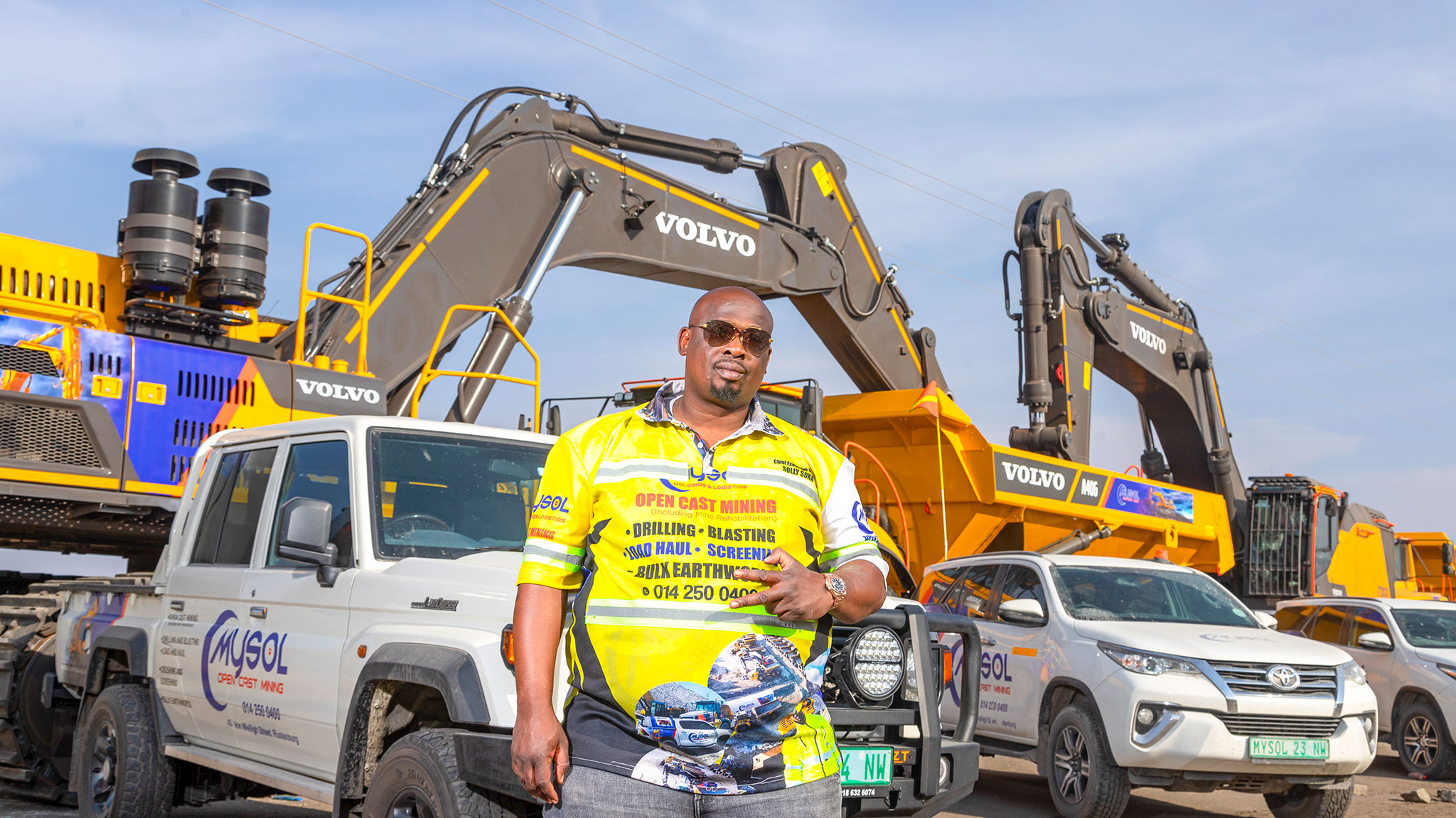
Image via MySol website. Over the weekend, South African mining and logistics magnate Solly “MySol” Soka Madibela unveiled a Rolls-Royce Cullinan in a hangar full of cameras. The car, a custom Cullinan reportedly worth more than R30 million (about 2 million USD), was built to his specifications by Rolls-Royce’s bespoke program and presented as a birthday present to himself. Online, the reactions split along a familiar fault line. For some, this was proof that black industrialists have finally arrived at the top table; for others, a grotesque spectacle in a country where most people don’t have savings, let alone food. Watching the clips, I felt as if the real question shouldn’t be “How rich is MySol, really?” It was the more basic and more uncomfortable one that keeps surfacing in our politics: should billionaires exist at all? In the United States, that question is no longer confined to the margins. On a recent podcast with the comedian Ilana Glazer, New York congresswoman Alexandria Ocasio-Cortez put it bluntly: “You can’t earn a billion dollars.” You can acquire market power, she argued, you can write the rules in your favor, you can pay people less than the value they create for you; but there is no straightforward moral path from a normal working life to a 10-digit fortune. Her critics rushed to defend the mythology. At The Hill, law professor Jonathan Turley scolded her for promoting “socialist fables,” insisting that billionaires like Elon Musk and Jeff Bezos simply worked hard, took risks and now pay “the vast majority of taxes” in the United States. Against this, a different picture has been forming: of extreme wealth as something structurally unearned, and therefore politically illegitimate. What is striking is not just the disagreement, but the tone. On earnings calls and in interviews, some of the world’s wealthiest people have started describing the phrase “tax the rich” as if it were a racial slur, an act of hate speech rather than a policy demand. Vornado Realty Trust CEO Steve Roth told investors that New York City Mayor Zohran Mamdani’s plan to tax luxury second homes owned by non-residents was “just as hateful” as certain racist slogans, and said he now hears “tax the rich” the way others hear “from the river to the sea.” Hedge-fund billionaire Ken Griffin admitted that being named in Mamdani’s announcement video left him feeling “unsafe” and “triggered,” as if a surtax on his pied-à-terre were a form of trauma. Bill Ackman, the Pershing Square founder who has compared his tweeting to standing up to McCarthyism, has likewise cast criticism of the ultra-rich as a kind of persecution. On the West Coast, Google co-founder Sergey Brin, opposing California’s proposed billionaire tax, invoked his childhood under Soviet rule: “I fled socialism with my family in 1979,” he warned, and did not want California to “end up in the same place.” You do not need to be a revolutionary to sense that something is off here. The richest people on the planet have begun to borrow the language of vulnerability and oppression to describe the experience of being, very mildly, taxed. In a different register, figures like Turley insist that their fortunes are the natural reward for genius and effort, and that any attempt to question this is an attack on aspiration itself. What disappears in both stories is the fact that no one, however brilliant or industrious, builds a billion-rand or billion-dollar fortune alone. There are always other people’s time and other people’s constraints in the background: workers whose wages are costs to be minimized, communities whose land becomes a “resource,” public institutions that absorb risk and provide infrastructure. In Capital in the Twenty-First Century,the French economist Thomas Piketty argues that, left to itself, the rate of return on wealth tends to exceed the rate of growth in the real economy. In other words, money that is already money grows faster than wages, faster than productive investment, faster than the underlying society it sits on. His favorite illustration is a simple comparison: Bill Gates, the founder of Microsoft, working for 25 years as CEO of the most profitable firm in human history, ends up less rich than Liliane Bettencourt, the L’Oréal heiress who merely sits on a vast fortune and lets it compound; and once Gates retires and becomes a full-time investor, “Bill Gates, investor” makes more money than “Bill Gates, CEO” ever did. The lesson is not that entrepreneurship does not matter. It is that once wealth crosses a certain threshold, it belongs to a different regime. It no longer behaves like the product of work, but behaves like what it really is: power. From that perspective, the billionaire is not simply an unusually successful individual. They are a node in a system whose basic logic is to convert social cooperation––the fact that wealth is created by many––into private claims. What makes this system so durable is not just coercion, but consent. Of course the boss has a right to discipline you. Of course your job can disappear at a moment’s notice. Of course the “market” has decided. A great deal of intellectual labor has gone into naturalizing this order: insisting that capitalism is simply the only way complex societies can organize production; that any alternative is either fantasy or gulag. In that story, billionaires appear as proof of concept, as living evidence that the system rewards talent, that anyone could in principle join the club. Set against that, another tradition has tried to remind us that capitalism is not a law of nature, but a very specific way of organizing life with its own metaphysics. It says that what matters most about you is your ability to sell your time, that freedom is best measured in consumer choice, that the highest good is the endless expansion of production and profit. On this view, the billionaire is not an aberration but a kind of saint: the person who has most fully embodied the system’s values, the one whose every hour has been successfully converted into someone else’s obligation. To question the legitimacy of billionaires, then, is to question the liturgy itself, not just the behavior of its most devout practitioners That brings us back to the Rolls-Royce in the hangar. To be sure, it is unclear whether MySol is a billionaire, nor even what his net worth is. Online sources emphasize what can be verified: a fortune built on industrial-scale mining services, open-cast operations, logistics, and reinvestment; contracts won, machines bought, staff hired, a company grown from a small operation into a serious player. Whatever the source or sum of his wealth, the question remains whether the optics of a 2 million USD Cullinan in one of the world’s most unequal societies should be read as a victory or an indictment. Supporters saw proof that black South Africans can now occupy spaces once monopolized by white capital. Critics—including media personality Nota Baloyi, who has argued that luxury car ownership should not be conflated with sustainable wealth—warned that confusing conspicuous consumption with durable security is a mistake, and that in a country built on mining and dispossession, a collection of imported cars is a very strange hill to plant a flag of “freedom” on. This is the local form of a global question. In Silicon Valley, billionaires like Brin, Andreessen, and Musk, whose companies grew out of publicly funded research ecosystems, now call attempts to tax them “socialism” and spend tens of millions to stop voters from modestly redistributing some of the gains back to the institutions that made them possible. In New York, Roth and Griffin describe municipal surtaxes on vacant penthouses as if they were racial persecution. In South Africa, a mining magnate’s customized SUV becomes a proxy battlefield over who is allowed to enjoy conspicuous wealth, and in what forms. In every case, the debate circles around the same axis: can there be a democratic society in which some individuals are allowed to accumulate such disproportionate claims on collective life. The standard answer is to retreat to the individual: this billionaire gives to charity; that one has built jobs; this one invests in start-ups; that one sponsors bursaries. All of that may be true. It is also beside the point. If Piketty is right, the problem is not the personality of any given tycoon but the fact that a system geared toward turning wealth into more wealth will, left to itself, keep producing fortunes of a scale that bend politics, law, and everyday life around themselves. You can have a benevolent oligarch or a vindictive one; in either case, decisions with enormous consequences for everyone else are being made in private, answerable only to their own interests and moods. Taxing those fortunes more heavily, breaking up monopolies, limiting the conversion of economic power into political power—these are not acts of envy. They are the basic self-defense mechanisms of any society that does not want to live under permanent guardianship. So: should billionaires exist? A defensible answer might be that a society serious about equality, democracy, and the finite nature of our world will, over time, make it impossible for them to arise. That does not mean everyone earns the same salary, or that once genuine equality of opportunity is guaranteed everyone has the same outcomes. It means that no single person’s claims over the lives and time of others are allowed to grow so vast that they become, effectively, untouchable. In that kind of society, a man unveiling a custom-made vehicle could still draw a crowd. However, he would no longer be the horizon of our aspirations, nor the measure of what is possible. – William Shoki, editor |