Blood and nation
In today’s India, stories of terrorism and national humiliation are being reworked into fantasies of decisive power — blurring the line between memory, myth, and politics.
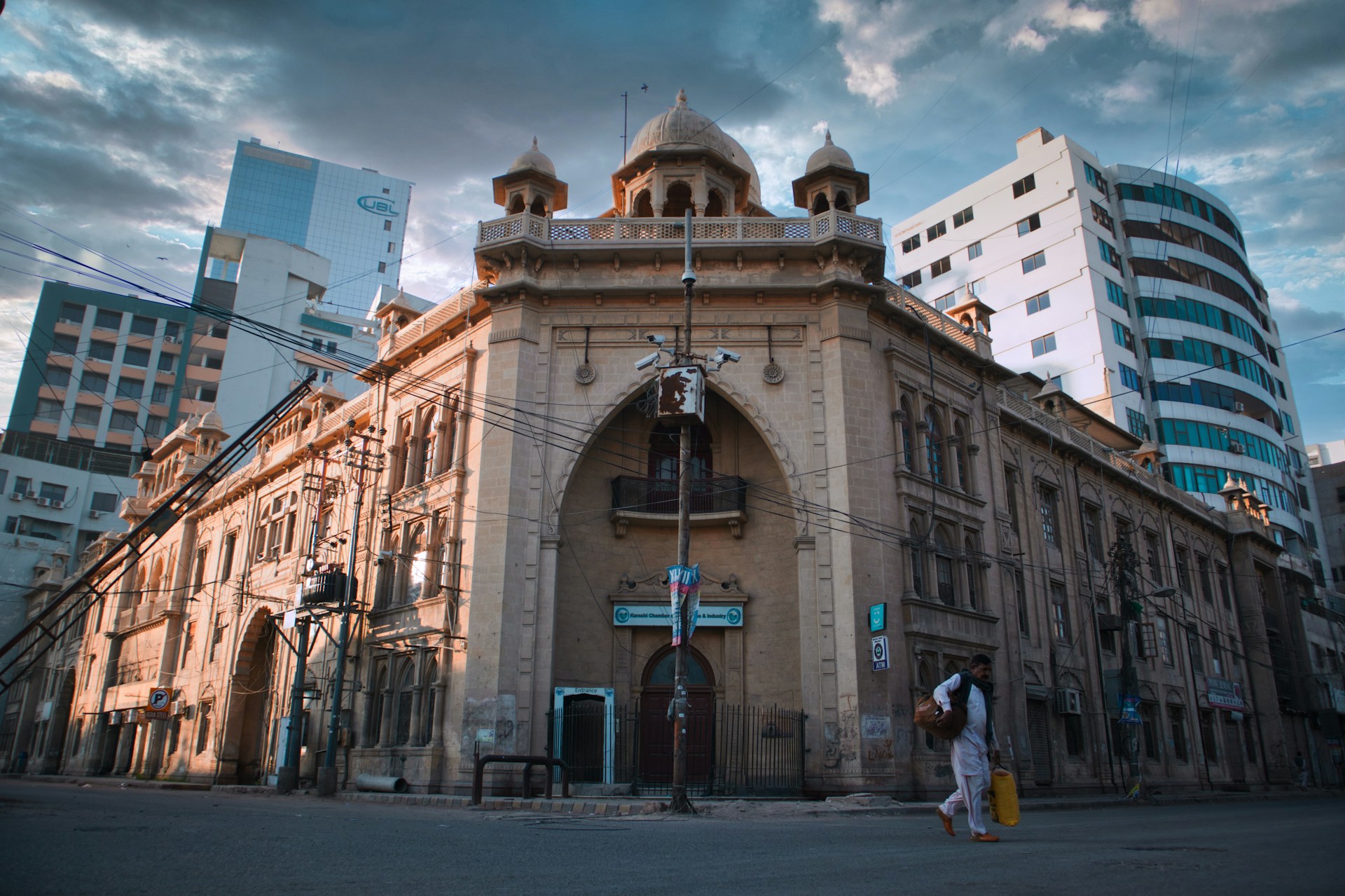
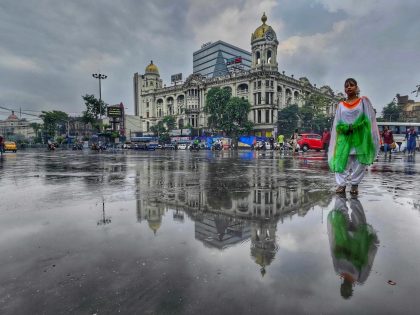
Saddar Karachi, Pakistan. Photo by Arfat Jabbar on Unsplash.
On March 19, the vibe was—as the Danes would say—hygge at a small, volunteer-run movie theater in the southwestern district of Valby in Copenhagen. On offer was the Bollywood flick Dhurandhar: The Revenge. Diaspora Indian families, young Indian students with their European classmates, and desi expats with their Danish partners had all flocked to the theater to watch this highly anticipated film.
Dhurandhar: The Revenge is the final installment of a duology that follows an Indian intelligence officer who infiltrates a Karachi crime syndicate and Pakistani politics while undercover as a Baloch named Hamza Ali Mazari, to upend the economic and political network that sustains terrorism in India. The first part, Dhurandhar, released in December last year, shocked but also endeared audiences with its gratuitous violence, jingoism, Islamophobia, and muscular Hindu nationalism. It became the highest-grossing Bollywood film of 2025 and is now the third-highest-earning Hindi movie of all time. For many fans, the second instalment did not disappoint. In fact, it turned up the dial on the gory violence and the blatant Islamophobia. It has now overtaken the first installment and become the second-highest-grossing Hindi film of all time.
The Dhurandhar duology is indeed a cultural phenomenon. This is evident to a global audience, not least to the Finnish President Alexander Stubb, who, while jogging with the Canadian Prime Minister Mark Carney in Hyde Park, was heard saying that his Instagram following received a huge boost in India when he mentioned that he had seen Dhurandhar before his recent visit to the country.
This was also evident to me during the screening of the final installment of the duology in Copenhagen. The audience celebrated when Hamza Ali Mazari ripped out the guts, tore off the limbs, or crushed the skulls of the “terrorists.” They erupted with laughter when the film’s leading men delivered quippy one-liners sprinkled into scenes of brutal violence. And when the blood-soaked Mazari emerged victorious and stood over his vanquished enemy, they swooned. Some even snuck in selfies, with the triumphant hero on screen in the background.
Why are the Dhurandhar films such a phenomenon? Because they relay an appealing story of a new India that is willing and able to enter the pits of unequivocal evil—which, for Dhurandhar fans, is personified by Pakistan—and eliminate the scourge of terrorism.
This framing of the new India is very much an extension of Prime Minister Narendra Modi’s own brand as a leader who can keep the nation safe. On the campaign trail in 2019, he routinely uttered the phrase “Ghar mein ghus ke marenge” or “We will enter your home to kill you.” This was in reference to the airstrikes carried out by India in early 2019 against Jaish-e-Mohammed (JeM) in Balakot, Pakistan. They were in response to an attack on Indian security forces in Pulwama, carried out by a JeM member.
The same filmmaker behind the Dhurandhar films also made Uri: The Surgical Strike, which was released a few months before the 2019 Indian general elections and dramatized India’s 2016 operation across the Line of Control in Pakistan-administered Kashmir. It was—as the Government of India put it—a surgical strike inside enemy territory in response to an attack by JeM on an Indian army base in Uri in Indian-administered Kashmir.
Of course, the Dhurandhar duology also works because of the way in which it relays this story of a new India and its “War on Terror.” It strings the narrative arc around real events that have been a source of collective pain, trauma, and national humiliation.
The first in the series begins by depicting the 1999 hijacking of Indian Airlines Flight 814 by members of Harkat-ul-Mujahideen. After negotiations, and in exchange for the hostages, the Indian government agreed to release three militants. The film then depicts the 2001 Indian parliament attack, where one of the militants killed by the Indian security forces was also one of the Flight 814 hijackers. The film also references the 2008 Mumbai terror attacks carried out by Lashkar-e-Tayyiba operatives that killed more than 160 people.
Who are the culprits? In the Dhurandhar storyline, they are the radical Muslim evildoers, amply supported by the enemy within (namely, corrupt Indian politicians, Muslim criminals, and Sikh separatists). They are driven by the singular, pathological goal of destroying India. They all seem to coalesce around the criminal and political network in the Lyari neighborhood of Karachi. Here, crime bosses, currency counterfeiters, and illicit businessmen readily collaborate with politicians and the highest-ranking operatives of Pakistan’s intelligence agency. Together, they provide the funding, the political backing, the logistical support, and the weapons to carry out terror attacks in India.
The characters that appear in the film are based on real people like Rehman Dakait, the Lyari-based Baloch crime boss; Ilyas Kashmiri, the former member of Pakistan’s Special Service Group and Harkat-ul-Jihad-al-Islam (HuJI) and al-Qa’ida operative; Altaf Sattar Khanani, the Karachi-based money launderer; and Ajmal Kasab, the militant who participated in the Mumbai attacks along with mastermind David Headley. Even the Indian gangster Dawood Ibrahim, who is said to be behind the 1993 Bombay bombings, makes an appearance in the second instalment.
With evil depicted in this manner, Mazari emerges as the embodiment of the wounded but deadly nation, ready to seek revenge. Indeed, the onscreen violence is meant to represent the cathartic outburst of the Hindu nation. As if to drive home this point, one of the Flight 814 hijackers reappears in the final instalment. In the opening scenes of the first film, this individual triumphantly says that Hindus are a cowardly people. In the closing scenes of Dhurandhar: The Revenge, he is made to say “Bharat Mata ki jai” or “Victory to Mother India” as Mazari holds a gun to his head, before being shot dead.
The films also serve as vindication of Modi’s brand of politics, blurring the boundary between fact and fiction. In the films, the radical Muslim evildoers are portrayed as petrified by his rise to the political helm in India. For instance, one of the many illicit Karachi businessmen is shown as visibly anxious, watching the results of the 2014 Indian general elections on television. He is stunned that Modi emerges victorious despite all the money funneled into the rights groups, journalists, and civil society. Notably, Indian authorities frequently justify the crackdown on Modi’s critics by accusing them of carrying out “anti-national activities,” funded by illicit foreign entities.
Even the Modi government’s 2016 demonization drive is dramatized in Dhurandhar: The Revenge. The move that took 86 percent of banknotes in use out of circulation has often been described as a policy failure. Scores died as a direct consequence of the chaos created by this policy, some collapsing while in line waiting to withdraw money at an ATM. Yet, demonetization—repackaged as Operation Green Leaf—is portrayed in the film as a policy that stopped the flow of millions in counterfeit banknotes from Pakistan. No publicly available record concretely proves that this was, in fact, the real purpose of the demonetization drive.
To be sure, there is always a gulf between discourse and reality. The slick, cunning, and covert anti-terror operation depicted in the Dhurandhar duology may seem a far cry from the security and intelligence lapses that led to the 2025 Pahalgam attack in Indian-administered Kashmir. The Indian response across the Line of Control in the form of Operation Sindoor was meant to underline the “military asymmetry between India and Pakistan.” But the initial losses of “air assets” took the shine off the purported tactical successes of this mission.
Nonetheless, stories and narratives matter. And the narrative of the Dhurandhar films serves the purpose of boosting India’s self-perception as strong and uncompromising in its quest to vanquish what it regards as the forces of terror and evil in the world today.