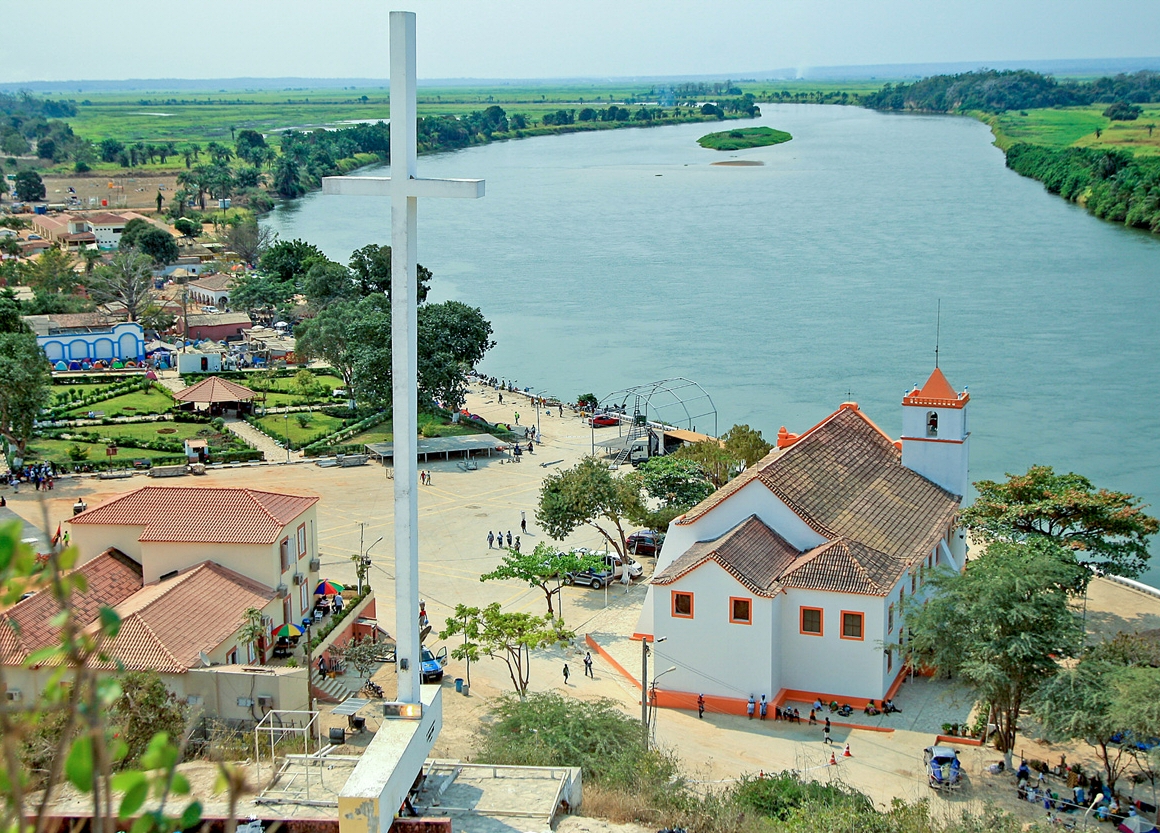
Nossa Senhora de Muxima. Image via Hoteis Angola. This past Saturday morning, Pope Leo XIV stood inside a church called Our Lady of Muxima, on the Angolan coast. It is a Marian sanctuary, more than 500 years old, built at the edge of the Atlantic. Enslaved Africans were brought here to be baptised before they were loaded onto ships to the Americas. Whether they were asked, whether the sacrament was offered or imposed, the record does not say with any care. What the record does say is that Muxima was a waystation of the Middle Passage—one of the places where a civilization carried out what it had decided, at the highest levels of theology and statecraft, was acceptable. I am a lapsed Catholic, one who in teenagehood almost considered the priesthood (but judge me not, so did Chris Hani. And, er, Stalin). I say this to give context, because it shapes the specific kind of attention I have been paying to Leo’s 11-day trip through Algeria, Cameroon, Angola, and Equatorial Guinea—the attention of someone who grew up inside a particular vocabulary and left it, or left most of it, and now finds himself watching someone speak that vocabulary with an unusual degree of precision and asks what he is supposed to do with that. There is something that keeps pulling in a direction I cannot entirely explain. What has been pulling me is not the political drama, though the drama is real. It is a sentence Leo delivered at the presidential palace in Luanda, in a speech that was otherwise full of the formal diplomatic address these occasions require: Without joy there is no renewal; without interiority there is no liberation; without encounter there is no politics; without the other there is no justice. |
It is a sentence a philosopher might write—it has the shape of a Hegelian ladder, each term depending on the one before it. But it was delivered to a head of state in a palace, at a moment when the man who said it was simultaneously being called weak and political by the US President for having suggested that a war being prosecuted in his name was unjust. There is something to sit with in that: the insistence on interiority, on joy, on encounter, as the ground of politics—spoken from inside the very arrangements that have most systematically destroyed those things. In earlier editions of this newsletter, I have been trying to work through what Charles Taylor calls inarticulacy—the systematic erosion of the moral vocabulary through which people might say what they actually want and why. The conditions of modern capitalism and our hyper-mediated, bureaucratic existence actively produce this erosion. We sense that something is missing. We reach for the nearest available language of opposition, but it turns out to be something else that reproduces the maladies that afflict us, but dressed in different garb. We are scratching in the wrong place because we have lost the words for where it actually hurts. What strikes me about Leo’s language—not just in Luanda, but across everything he has said and written since his election—is that he seems to have kept the words, or recovered them. His first apostolic exhortation, Dilexi te, denounces what he calls “the dictatorship imposed by economic disparity” and insists that caring for the poor means combating the systemic roots of poverty, not just performing individual works of charity. He says the poor are not there by chance. He says there is no determinism that condemns us to inequality—the root problem is not a lack of resources but unjust distribution that can be changed “with morality and honesty.” He criticizes ideologies that uphold the unbridled freedom of the marketplace and financial speculation, which falsely promise that a free market will automatically resolve poverty. He describes a wealthy elite living in a bubble of comfort and luxury alongside the poor who are increasingly numerous, and calls this contrast intolerable for Christians. We are used to hearing clergy speak the language of personal virtue or individual conversion, but Pope Leo was speaking, with surprising clarity, the language of structure—of systems that produce outcomes, of arrangements that are chosen and can be unchosen. Capitalism is a displaced religion, carrying its own liturgy, sacraments, and eschatology. What Leo XIV is doing, in the tradition of Catholic social teaching running from Leo XIII’s Rerum novarum to liberation theology (a tradition he would know well, having spent three decades being shaped by the Peruvian church of which Gustavo Gutiérrez was a major figure), is performing a counter‑exorcism—insisting that the liturgy of capital is not natural, not inevitable, not the final word on what human life is for. “There is no determinism that condemns us to inequality.” That sentence could have been written by Marx. The fact that it comes from a pope does not make it any less true or any less rare in the current landscape of institutional utterance, marked by moral incoherence. In Yaoundé, Leo told university students that when simulation becomes the norm, the human capacity for discernment weakens, social bonds close in on themselves, and we come to live in bubbles impermeable to one another. This language is strikingly Baudrillardian. Baudrillard’s great insight, developed across the 1980s and largely vindicated since (as I have covered here), was that we had passed into a condition of pure simulation—a world in which images no longer pointed to anything beyond themselves, in which representation swallowed reality so completely that the outside ceased to exist. The US was his central exhibit: not a country among others but a total environment, a dream that had forgotten it was one. Leo was describing exactly the world Baudrillard mapped. But where Baudrillard arrived at a kind of cold, glittering fatalism, Leo insists on the opposite: that simulation is a condition, not a destiny; that the capacity for genuine encounter remains available; that the account is not closed. Still, there is a complication I do not want to slide past. Cameroon’s President Paul Biya has been in office since 1982. As David Ngong recently pointed out on our pages, every papal visit to Cameroon has coincided with a moment when the Biya regime needed external legitimacy—the failed coup of 1984, the rigged election of 1992, the constitutional revision of 2008. The Vatican was warned. It went anyway. Leo held his masses; Biya and his wife were, as they always are on these occasions, center stage. The institution that speaks of joy, encounter, and the systemic roots of poverty is also the institution that keeps arriving to sanctify arrangements that produce the opposite. This is not a new problem—it is, in some sense, the problem—and it does not resolve itself because the language being spoken at presidential palaces is genuine. What I am trying to hold is both things at once: the sentence about interiority and encounter and what they require for politics to be real, and the image of the man who said it standing in a room with a man who has spent forty years demonstrating that politics survives perfectly well without any of those things. Institutions are not the same as the ideas they carry. The ideas can survive the institution’s failures. Whether they do depends partly on whether people outside the institution are willing to receive them without accepting the institution’s account of itself, which is, I think, roughly the position of the lapsed Catholic, and perhaps also of the secular left, and perhaps also of the African traditions that have been in tension with Catholic universalism since the first missionaries arrived. Agostinho Neto, the Angolan poet and independence leader, wrote from within that tension—the Christianity of the colonizer refracted through the experience of the colonized, the language of the oppressor used to name the oppression. His poem “Western Civilisation” describes a man crushed by the weight of someone else’s idea of progress, surviving on almost nothing, dreaming still. That Leo is standing in Neto’s country, at a site that concentrates the full weight of that history, while simultaneously insisting that there is no determinism that condemns us to inequality—the juxtaposition is almost too much. I do not know if Leo has read Neto, but it does not matter. They are pointing at the same wound from different sides of the same wall. What Leo is doing, imperfectly and contradictorily and within all the constraints of the institution he leads, is making an argument about what the human being is and what she needs. She needs joy that is not bought. She needs interiority that is not performed. She needs encounter that is not optimized. She needs to be seen as someone from whom the world has not yet exhausted the capacity for surprise. And she needs systems that are structured so these things are possible, rather than ones that actively work to prevent them. Material poverty and spiritual poverty are not two conditions but one—produced by the same arrangements, requiring the same transformation. Faith, in this account, does not supplement the social from outside; it names the social’s deepest requirement, which is that persons be seen as irreducible to their function, that joy and interiority and encounter are not luxuries but the conditions under which genuine human life becomes possible at all. I did not expect to find this argument being made, however imperfectly, from an altar at Muxima. I am not sure what to do with the finding. But the place where it actually hurts—the thing we keep reaching for the words for—I think he is pointing at it. That seems worth naming, even from across a distance of lapsed faith and institutional wariness, even at the risk of receiving the message without the institution that carries it. – William Shoki, editor |