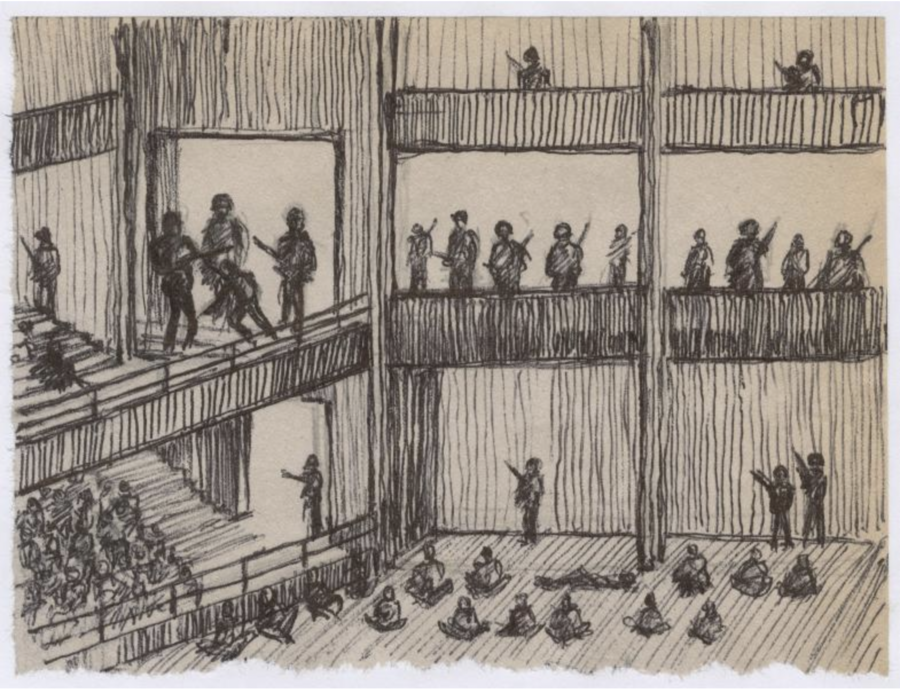
Drawing of Estadio Chile during military occupation / Government of Chile Janan Ganesh had a piece in the FT last week worth reading, making the simple and sharp observation that the world doesn’t feel new so much as familiar. A Gulf war, an oil spike, great-power rivalry, Europe’s anxiety about its own defences—these are not the symptoms of a transformed world order but of an old one reasserting itself. His explanation is largely biographical: the leaders driving events are men in their seventies, shaped by the Cold War, acting out obsessions that trace back to the century in which they came of age (for example, Trump was a teenager during the Bay of Pigs). Change the generation, change the era. He ends with a concession—if lives and livelihoods were not on the line, he would adore the nostalgia. The explanation is curiously thin for such an astute observer. If old men are eventually replaced, we are left with the question of why their successors so reliably reach for the same instruments, and why the institutions and classes that might have built something different have consistently chosen not to. Ganesh doesn’t ask who benefits from the old world returning, or why the vocabulary of opposition so quickly resolves into a rearrangement of the existing pieces rather than a genuine alternative. His account treats geopolitical repetition as a function of individual psychology rather than structural interest, or something more fundamental still: the progressive erosion of our capacity to imagine anything different in the first place. That deeper erosion is worth coming to grips with. Because the question of what all this is actually for—what we are fighting toward, what the good life looks like on the other side of the geopolitical drama—is precisely the question that few seem able to answer, or willing to tackle. Even though it is now trite to observe that Francis Fukuyama was wrong (history did not end after the fall of the Berlin Wall and the dissolution of the Soviet Union), the question he was trying to answer did not go away with his answer. What does a good life look like, once the wars are over? What are we actually building toward? His answer collapsed, but nothing replaced it. And the philosopher Alexandre Kojève, whose lectures on Hegel shaped Fukuyama’s thinking, had a name for what fills that vacuum: the animalized man, the last man, who has comfort and stimulation but no genuine desire for recognition, no sense that anything is at stake beyond the management of appetites. This figure is not the product of peace. They are the product of a particular simulation of it—the peace of the scroll, the news cycle, the permanent low-intensity excitement that generates heat without light. And the geopolitical chaos we are living through is not their refutation. It is their natural environment. Interesting times are what the animalized man reaches for when they grow bored of their comfort. The philosopher Charles Taylor spent much of his career trying to understand why modern life makes it so difficult to think clearly about the good life at all. His diagnosis was inarticulacy: not stupidity, not apathy, but a systematic erosion of the moral vocabulary through which people might say what they actually want and why. The conditions of modern capitalism and bureaucratic existence actively produce this erosion, Taylor argued—an inarticulate population is a manageable one. We sense that something is missing. We reach for the nearest available language of opposition. It turns out to be another superpower’s currency, or a strongman’s discipline, or the clean drama of geopolitical conflict. We are scratching in the wrong place because we have lost the words for where it actually hurts. This is what Ganesh’s piece, for all its intelligence, cannot quite reach. His skepticism about transformation is itself a form of this condition—not dishonest, but operating entirely within the existing vocabulary, unable to ask what we actually want the world to look like. The old world is back, he observes, and the old world has a certain legibility. What he doesn’t ask is what it costs to live inside that legibility, or whether legibility is enough. This past weekend, Eid al-Fitr was celebrated across the world—the fast broken, families gathering, children in new clothes, the specific texture of days that belong to communities rather than to the news cycle. Then Monday morning arrived. At 7:04 am ET, Donald Trump announced that the US and Iran had held productive discussions toward ending the war. The S&P 500 surged 240 points in six minutes, adding two trillion dollars in market capitalization. Twenty-seven minutes later, Iran denied that any contact had taken place. The market fell back, erasing a trillion dollars. A three trillion dollar swing in 56 minutes, on a statement that was false when it was made. Notice what the market was tracking: a signal, a post on TruthSocial, the prospect of resumed oil flows, and reduced risk premiums. Notice what it was not tracking: the number of people who had died that week, the families still under bombardment, the children who did not get to celebrate Eid because the bombs had already fallen. These things do not move the index. In the language of the system, they are externalities—costs that exist but are not counted. This is Kojève’s animalized man as an institutional fact: a world organized so thoroughly around the accumulation of capital that human life appears in it, if at all, only as a variable affecting the price of oil. There is a counter-tradition in Hegel that cuts against his image as the philosopher of grand historical drama. Genuine ethical life and freedom, when it is functioning well, does not feel like history. It feels like Monday. The family, the community, the web of recognitions through which people sustain each other, these are not experienced as achievements when they are working. They are simply the medium through which life is lived. The good life, in this account, is not exciting. It is the slow, largely unremarked work of being with other people over time. Hegel’s owl of Minerva flies only at dusk—we understand what we had only once it is gone. The people who know this most intimately are not philosophers, but anyone who has watched a community be destroyed, a city be bombed, a web of ordinary life be unmade by forces that find the spectacle of its unmaking interesting. Victor Jara wrote “El derecho de vivir en paz”— the right to live in peace in 1971, in solidarity with the Vietnamese people then being bombed by the US. Two years later, after Pinochet’s US-backed coup, he was arrested, tortured, and killed in the National Stadium in Santiago. He was 38. The right to live in peace is not the right to be comfortable, or entertained, or to watch history happen on a screen. It is the right to be left alone to do the work that makes a life: tend to the sick, plant things, argue with the people you love, be bored in ways that matter. It is what Taylor’s inarticulacy makes us unable to name, and what Hegel’s ethical life describes from the inside. And it is precisely this—not abstract freedom, not geopolitical advantage, not the reserve currency—that is extinguished when the old world reasserts itself, when the old men with their old obsessions reach for the instruments they have always used. The question the good life poses is not one that can be answered by watching the multipolar world take shape. A world of competing empires, each with its own account of order, does not address it. It defers it, under the cover of geopolitical excitement, for another generation. May we live in boring times. Not as resignation, and not as a wish for the comfortable vacancy of the last man. As a demand for the conditions under which the actual work of human life can be done. For the Monday that feels like nothing special, because nothing has gone wrong. For the right, which is not guaranteed and has never been free, to live in peace. – William Shoki, editor |