The mountains we miss
Freetown belongs as much to those who live there permanently as it does to those who left years, decades, or even generations ago.
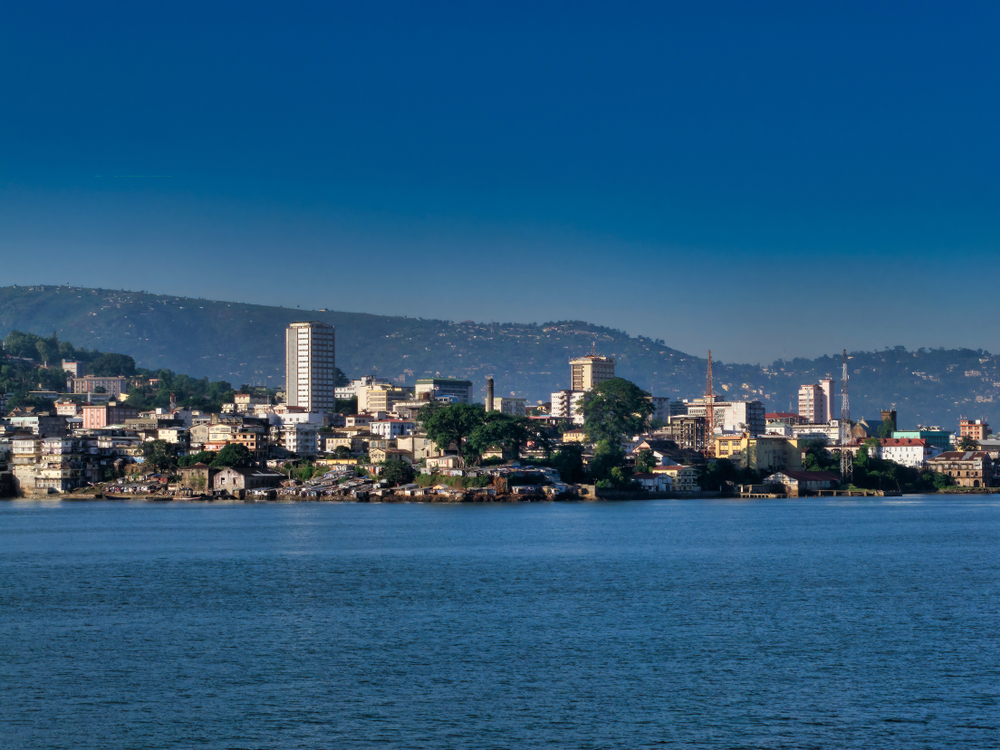
A view of Freetown, Sierra Leone, from across its harbor. Photo: Leonardo Viti/Shutterstock.
Ahmed Koroma’s Freetown Echoes: Tales from Along the Odokoko traces a city in the process of transformation through the eyes of a boy becoming. The novel is a collection of stories, sitting somewhere between fiction, folklore and memoir, in which a young Ahmed and his friends are shaped by their community, like rocks in the stream that flows through it. The cadence and colorful cast of characters in the stories are distinctly Sierra Leonean, while the tension, optimism and anticipation dripping through the pages will be familiar to anyone, African or otherwise, who knows the necessary unease of surrendering to an environment with energy greater than the sum of its inhabitants.
The novel paints a portrait of Freetown in its prime: lush green hills towering over a bubbling metropolis, where market-women, morimen and ministers mingle under the hot sun, everyone hustling for their daily bread. Along the Odokoko, a decade on from independence, things progress and pause to the pulse of a youthful, overzealous nation, where the prospect of perpetually “developing” has not yet been corrupted into the geopolitical hallmark of damnation that it is today. As someone born toward the tail of Sierra Leone’s civil war, Ahmed’s Freetown is not a Freetown that I recognize. It is, however, a Freetown I can embrace with open arms, and respect immensely, like one would the grandparent of a close friend.
The Freetown I know is rebellious and resigned in equal measure. Its hills still loom majestically over a bright and busy coastline, but much of the greenery has been replaced, razed in favor of concrete compounds. The city is in a constant state of construction, never quite finished. The hustlers, in the many forms they take, grow in number by the day, always hungry, too consumed by the never-ending grind to stop and acknowledge each other properly. By night, my Freetown becomes a playground much like the riverbank where Ahmed and his friends would run riot. It’s a place where I can party, free of all inhibition, from dusk until daybreak.
The resulting atmosphere is a chaos that enchants me on my frequent visits from the UK. From a perspective hued by privilege, I see Freetown as a boot camp for my patience, one I enter willingly. I can look upon the frequent blackouts, traffic bottlenecks, broken-down buildings on beach road, overpriced entertainment complexes and overcrowded malls, cramped club dancefloors and palm-body slums with affection or righteous indignation. I’ve no use for the armor of apathy worn by full-time Freetonians with no alternative home.
In Ahmed’s Freetown—one he looks back on from comforts hard-won in California—the Cotton Tree still stands tall; Victoria Park is lush with greenery and the Sierra Leone Library is a free and accessible sanctuary for bookworms across the city. More than just fuel for nostalgia, memorializing Freetown’s history in this way allows us to imagine (and thus enact) better for Freetown’s future. But this book is not a call to arms. It makes no judgments about the country’s politics and presents no arguments as to where things went wrong. It is reflective, retrospective and seductive in its simplicity, leaning on age-old traditions of Sierra Leonean storytelling. Because it’s written from a personal place, concerned more with capturing emotional truths of the protagonist’s childhood than anything else, it avoids the traps of preachiness and didacticism that African historical fiction sometimes falls victim to.
Silky prose and dynamic dialogue usher the reader through a series of tragedies and triumphs, weaving in wives’ tales and local legends for cultural grounding. The country’s layered spiritual tapestry comes to the fore in stories like Aladura, Eku Mason and The Girl Who Has Eyes; in When Death Came, and A Child is Born, we see both grief and glory held collectively as sacrament; and in The Days of Elephant, Baby Moon, and Bad Kahina we see how the rhythms of a community can be shifted by a handful of imposing individuals. Each story provides its own window into different aspects of the Sierra Leonean psyche. We meet dancers, chiefs, teachers, thieves, nurses, herbalists, pastors, psychics, among many others, all through the equalizing lens of boyhood.
I think much of the novel’s charm can be attributed to that spirit of youth which Ahmed captures so well. It’s a spirit that leads with curiosity, unafraid to call things into question and test its theories, and not yet too proud to concede to mysteries beyond its understanding. The relationships between Ahmed and his group of friends possess a candid purity that almost certainly fades with age. They represent a mischievous innocence that I feel is less and less common among children these days, for it requires a connection with nature and a tolerance for boredom that technology seems to be stealing from us all.
The hijinks of Ahmed and his posse made me think about the young boys of today’s Freetown who, despite how much the city has changed, ravaged by war, a viral epidemic, and ceaseless corruption, still play football on unmarked fields. They still embellish the stories they tell one another to appear braver than they are, and pick fights they know they’re going to lose just for the thrill. I wish the adrenaline of their boyish misadventures was enough to sustain them all well into adulthood; that they could be protected indefinitely from the ever-encroaching threat of derailment, through drugs, violence, or having adult responsibility thrust upon their shoulders far too soon.
All in all, the book left me with conflicted feelings: reverence and anguish and a deep desire to keep on reading. I imagine revisiting the stories, fishing for fresh meaning every time. I can see myself speaking them over a fire at Burreh beach, a lukewarm Mutzig in hand as my home-base friends (half-listening) stare out at the sea. I’d recite them again surrounded by fellow diasporans in a cozy Camberwell living room, jointly picturing the mountains that we miss.
This novel is a reminder, timely and pertinent, that Freetown belongs as much to those who live there permanently as it does to those who left years, decades or even generations ago. Sierra Leone is in an increasingly precarious place, politically, economically, and socially. Alone, neither the weariness and frustration of an exhausted population, nor the self-indulgent survivor’s guilt and naïve ambition of returnees and diasporans can begin to address our problems.
That being said, I believe there is enormous utility in an idealistic diaspora working in tandem with a pragmatic population on the ground. As evidenced in the novel, the streets of Sierra Leone instill in those raised by them an intrinsic intelligence, a sharpening of instinct, and an understanding of unwritten communal code that cannot be learned elsewhere. But Freetown’s echoes, the traces of that education, can be heard anywhere, if one listens closely enough. I’m glad this book exists as a site to train the ear.