Where the mouse eats the cat
Inside Cameroon’s most overcrowded prison, a recording studio turned incarcerated men into artists. Its founders spent six years filming what it became.
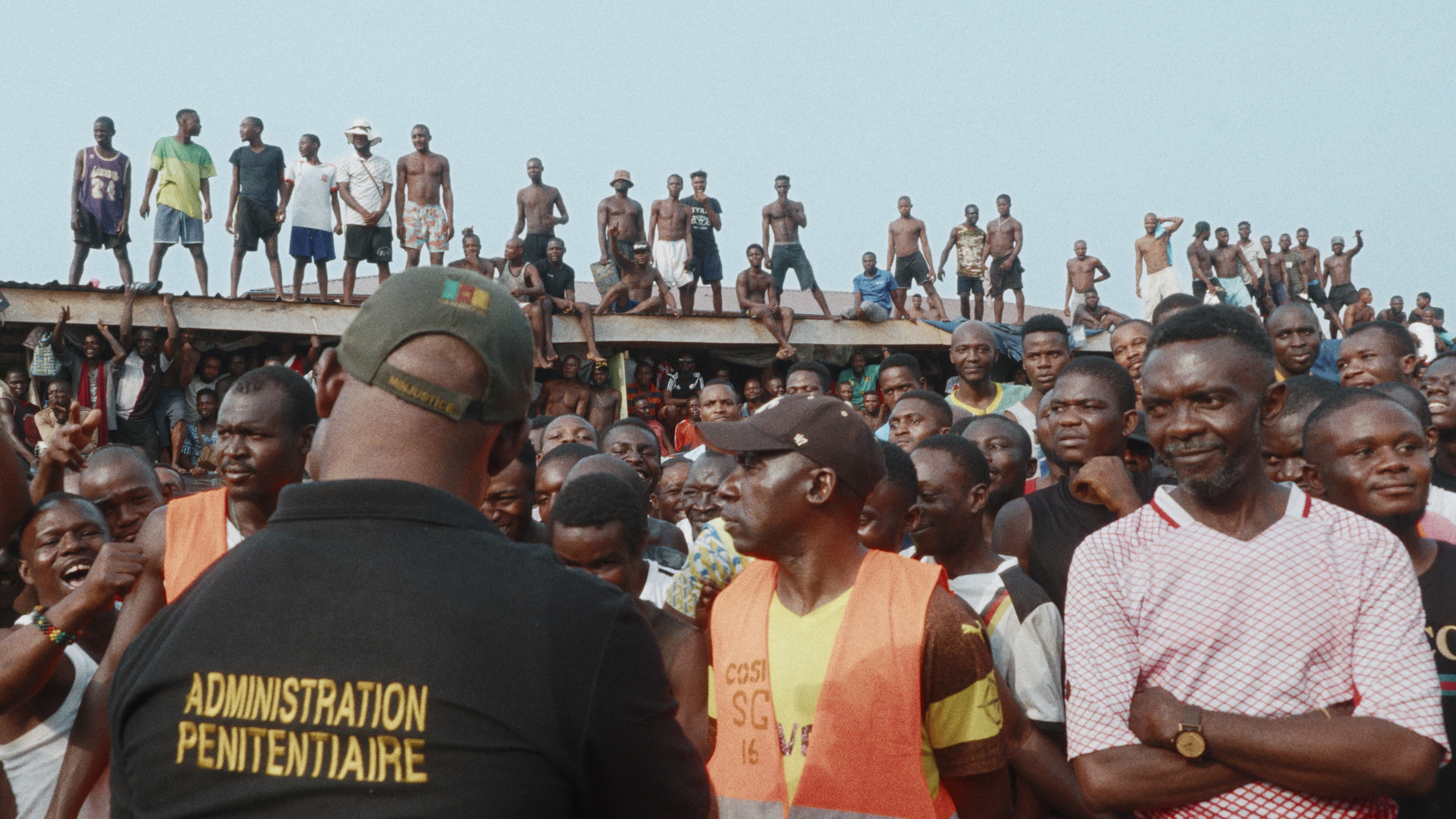
Inmates gather inside New Bell Prison in Douala, Cameroon, where Jail Time Records established a recording studio in 2018. Photo: Jail Time Records/Dione Roach.
- Interview by
- Feven Merid
“Welcome to the Central Prison of Douala,” La PJ, an inmate and a star of the documentary Jail Time Records, says in an opening scene of the film. “The place where the mouse eats the cat.” Dione Roach, one of the film’s directors, offered me an interpretation: “The world is upside down in prison; the mouse can be more shrewd,” she said. The intimate glimpse into the Central Prison of Douala, also known as New Bell Prison, does indeed reveal an upside-down world. Like many prisons, its inmates recreate the contours of outside life on the inside, but in New Bell it’s taken to another level. There are actual neighborhoods like the Latin Quarter, home to the Emperor and his gang known as the Latinos, and the Base, where the prisoners who make up the quasi police squad reside. There’s a marketplace for people to sell fried foods and taxis, except these taxis are inmates who swiftly run through the congested prison to hand-deliver messages. They even have a “homeless” population, those who must sleep outside in the courtyard because there aren’t enough beds. Their neighborhood is dubbed House of the Penguins.
This all comes into focus when you learn New Bell is notoriously overcrowded—it was built for 800 people but currently holds almost 6,000. Thus, the prison has been transformed into a mini city, colloquially referred to by inmates as the 11th province of Cameroon (there are officially 10). La PJ, a lanky and charismatic man dressed in his uniform of a conductor’s hat, blazer, and tie, steps in as mayor to give us the lay of the land. “Our jewel of jewels,” he says, as he approaches his final stop on this tour—a recording studio. Specifically, it’s the Jail Time Records studio, for which the film is named and the reason for its making.
Jail Time Records, the recording studio, is the first to be put in an African prison, according to the film’s directors and the studio’s founders Dione Roach and Steve Happi. The two run it as a nonprofit music label for inmates and those who are readjusting to life outside of prison. From its start in 2018, the duo has been documenting the studio’s impact; first, inadvertently, through shooting music videos and then with the intention to make a documentary. Roach, who is from Italy and has been based in Cameroon since 2017, has served as the studio’s artistic director, and Happi, who is from Cameroon, as its lead producer (Happi was incarcerated at New Bell for two years, during which time he met Roach and helped get the studio up and running). Shot over six years, they’ve created a film that captures the curiosities of New Bell remarkably well (Jail Time Records won top prizes at Tribeca Film Festival in New York). A few weeks ago, I spoke to the two directors over Zoom about what it’s like documenting New Bell, the music of their main characters, and how the film let them show a fuller picture of life in prison. This interview has been edited for clarity and length.
Feven Merid
How did you start Jail Time Records and when did you realize you wanted to make a film about it?
Dione Roach
I was volunteering, doing art courses, and I came across a group of really talented musicians. They were incarcerated, and I just had the idea to do an album with them. And then I was even like, why just an album? Why don’t we actually build something that can stay and be used by many people? And so I proposed the recording studio to the prison, and they accepted, and we got it built. And then that’s when I met Steve, who was incarcerated at the time, and he was already a music producer and sound engineer. Someone introduced us, and I was finished volunteering, so I left him the keys of the studio. I came back a few months after, and they’d been doing like so much work and recording, and it had really become this like place of like extreme creativity and outlet.
Steve Happi
Before even starting the movie, I was already doing music videos and having access with the camera inside prison when I was still incarcerated. So as she said, it was just a natural process, and having access with the camera and such intimate moments of our life and our journey, we started recording everything.
Feven Merid
What was it like to film inside such a crowded place?
Dione Roach
At the start, we went with a friend who had like a gigantic camera, and he didn’t already work in prison as well, like so they didn’t know him, and so it just wasn’t really the right setup, you know, for that kind of space and situation. You need something very discreet, and it’s better the closer you are to the people, the more they know you, the more you know them, the better it is, obviously. So then we just shot with a very small little camera, a handheld camera. It’s a very hot place, and yeah, I mean it’s overcrowded; it’s hard. Like, you really have to think if you want to have deeper, more confessional moments with the guys. You really have to think around sound, noise and like where you’re gonna go to shoot and for the place to be quiet for the parts that were kind of more directed. A lot of what we did was just spontaneous and following life, and we’re in prison a lot just doing the work for Jail Time Records, so beyond the film, so we just always had the camera with us.
Feven Merid
Steve, you were in Douala for two years, and now you continue to do work with the prison through Jail Time Records and the film that requires you to return often. What’s that experience like?
Steve Happi
As soon as I went out, like the day after, I was already back there, in the studio as a free man. But I went back there straight to record with the guys and continue projects. So I’m just feeling like it’s part of the journey, and you know we are trying to pull out the best part of each other and see how we can lift our project, how we can push it to the max.
I don’t think of myself as a film director. Naturally, I started being involved in filming, in sharing ideas with Dione, brainstorming, like pushing the narrative where the film’s going to go, so that’s how I end up being a director. But it wasn’t intentional; I just want to be the director of doing music. As she said, it’s really a collaborative project, and that’s even with the guys inside; we taught them how to record with the [sound] boom. So it’s really participative; it’s like a family business.
Even recently, going to Tribeca, we were just there to share the movie with people, and we ended up winning trophies, and from my point of view, it wasn’t really intentional. Like, we started this journey little by little, and we were discovering ourselves. I’m discovering myself.
Feven Merid
In addition to La PJ, there are three main characters you follow in the film: Transporter, Emperor, and Stone. What stood out to me was that they made three distinct-sounding types of music; Stone was reflective and serious, Transporter was more electronic-dance, and Emperor’s sound was very hard. How did they come to be the main three?
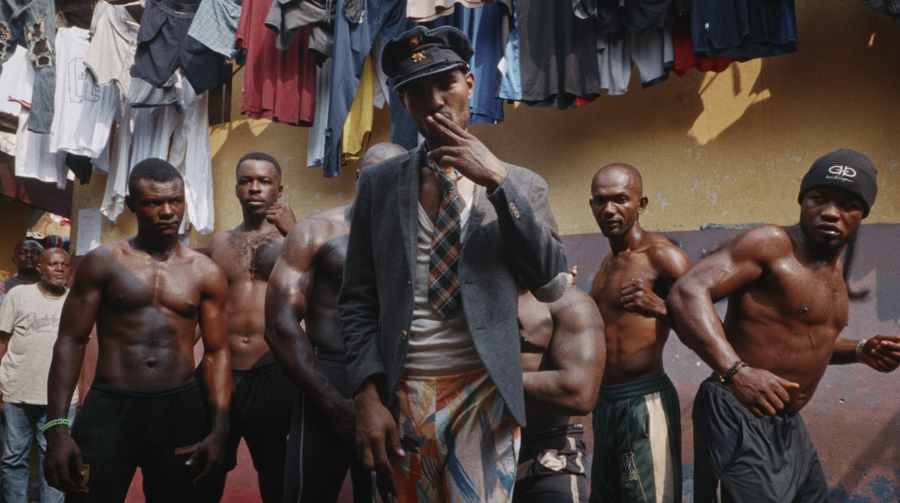
La PJ, the charismatic guide to New Bell Prison in Jail Time Records, surrounded by fellow inmates. Photo: Jail Time Records/Dione Roach. Dione Roach
I think the three of them, it was always clear that they would be like the main characters, but there were other ones that we would have loved to show more of, but it just had to be reduced. As you said, they just have three different energies. They represent three different parts of masculinity, of humanity, of reasons for being in prison, of different ethnic groups in Cameroon, different music. It just made sense. Stone is this rock and is the person that’s, I think, for a normal person or the public, more easy to identify with. He’s got a daughter outside. Transporter is just this kind of incredible Trickster character, and Emperor is like a force of nature, and they’re also the guys that often we were closer to for many periods.
Steve Happi
Emperor was my best friend in prison. My cell and his cell were neighbors, as you say. A character like Transporter, he really wanted to be in the movie. At the beginning, he wasn’t too interested about the music, but he was really interested in the movie. He was always around and made sure to be in every frame, and he started revealing himself.
Feven Merid
How did everybody else around them feel about being filmed? Because you see people like Transporter, La PJ, who were very comfortable on camera and had a lot of energy, but then you see other people, and you’re reminded that this is a hard place to be and this is a low point for people. So how did other people feel about being on camera?
Steve Happi
Generally speaking, they loved it. We’ve been working there for so many years. They are used to the camera already. That’s why you have people doing their normal life, their daily routine. You might see some of them maybe hiding themselves, but people really love to be part of the project, and they love being filmed. This attention that is mostly coming from outside, the energy from the outside, and being seen like in music videos or the film- they don’t know where the project is going to land, but from my observation, they’re always ready for the camera to be there. Most of the time, people are people surrounding us.
Feven Merid
The film won several awards at Tribeca this year, including Best Documentary Feature. How did everyone feel about the film’s success?
Dione Roach
We rang them immediately, Stone and Transporter, and they were super happy, but then the best moment for them was a few weeks ago. It took a bit of time, but it became viral in Cameroon because the BBC did an article, and then all the Cameroonian media started doing articles, and they were like, “we won the Oscar!”
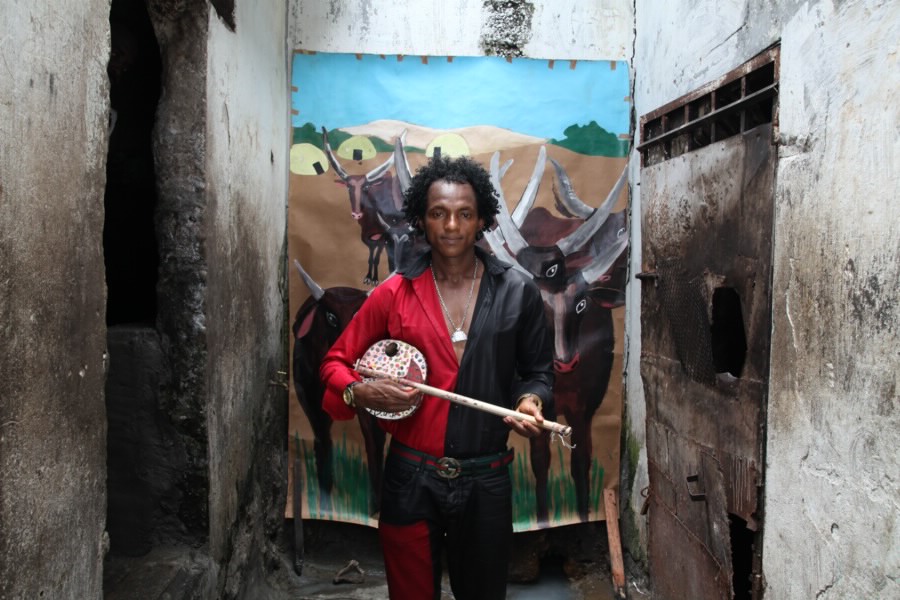
Transporter, one of the three incarcerated artists at the center of Jail Time Records, inside New Bell Prison in Douala. Photo: Jail Time Records/Dione Roach. Steve Happi
That’s how we call everything related to films. We call it “Oscar”. We called all the guys, and they were screaming, “We won the Oscar!”
Feven Merid
Why do you think rap is the sound, the musical form that people gravitate to the most inside?
Steve Happi
Right now in Africa, to be honest, we don’t listen that much to hip hop anymore. It’s more about Afrobeat, Afro rhythm. So what is really more popular right now is Mbolé and Coupé-Décalé, like what Transporter is doing in some of his songs: fast-paced rhythm beats, rapping fast on top of that. People are listening to hip hop less and less, maybe more melodic and auto-tune type of hip hop, but less and less. With Emperor, we created this new breed [of music]. I have many tracks we didn’t release, but he really represents the sounds of Jail Time.
Feven Merid
Dione, what was your experience like as a woman filming in a crowded, all-men prison?
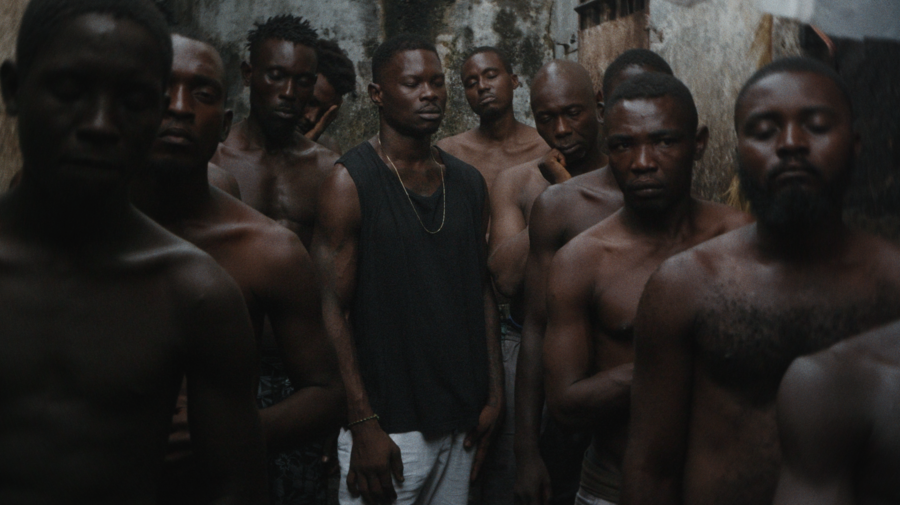
A scene from Jail Time Records, filmed over six years inside New Bell Prison in Douala. Photo: Jail Time Records/Dione Roach. Dione Roach
I think because usually it’s always like men filming men and men getting perspectives on men, or like women talking about women, I think there’s very little of women talking about men, and especially prison, it’s such a male world. So I think the fact that I was a woman did help with the guys opening up. Most of the confessions they told me before [filming], even. And then I would ask them how they felt while on camera, and I think because I was a woman, it allowed them to feel they could be more vulnerable.
I never really had issues. I’m quite tough in there as well, quite a tomboy. When you work in the prison, you have to be very ironical, and in Cameroon in general, when someone speaks to you, you have to answer in like a funny and shrewd way, and they like it, and so once you get the hang of that, they really respect you and you’re joking with them, and it kind of brings down barriers.
There are things they might have done that are really difficult to hear because you know these people and you’re friends, you love them, you’ve been together for years with them. When you’re working in prison, it’s expected that a lot of people are there because they have committed acts, but you get to see all sides of people that, if you only read in the news about them, you’d be judging them really negatively. Here you get to see the 360, and that’s the beauty. That’s humanity because I think we are all such a mixture of good and bad and of circumstances, so you definitely become less judgmental.