The radical openness of the popular economy
From traders’ credit circles to self-built water networks, Africa’s urban majority keeps finding ways to thicken city life. Can these popular economies still decouple the future from capital’s calculations, even as they open new frontiers for capture?
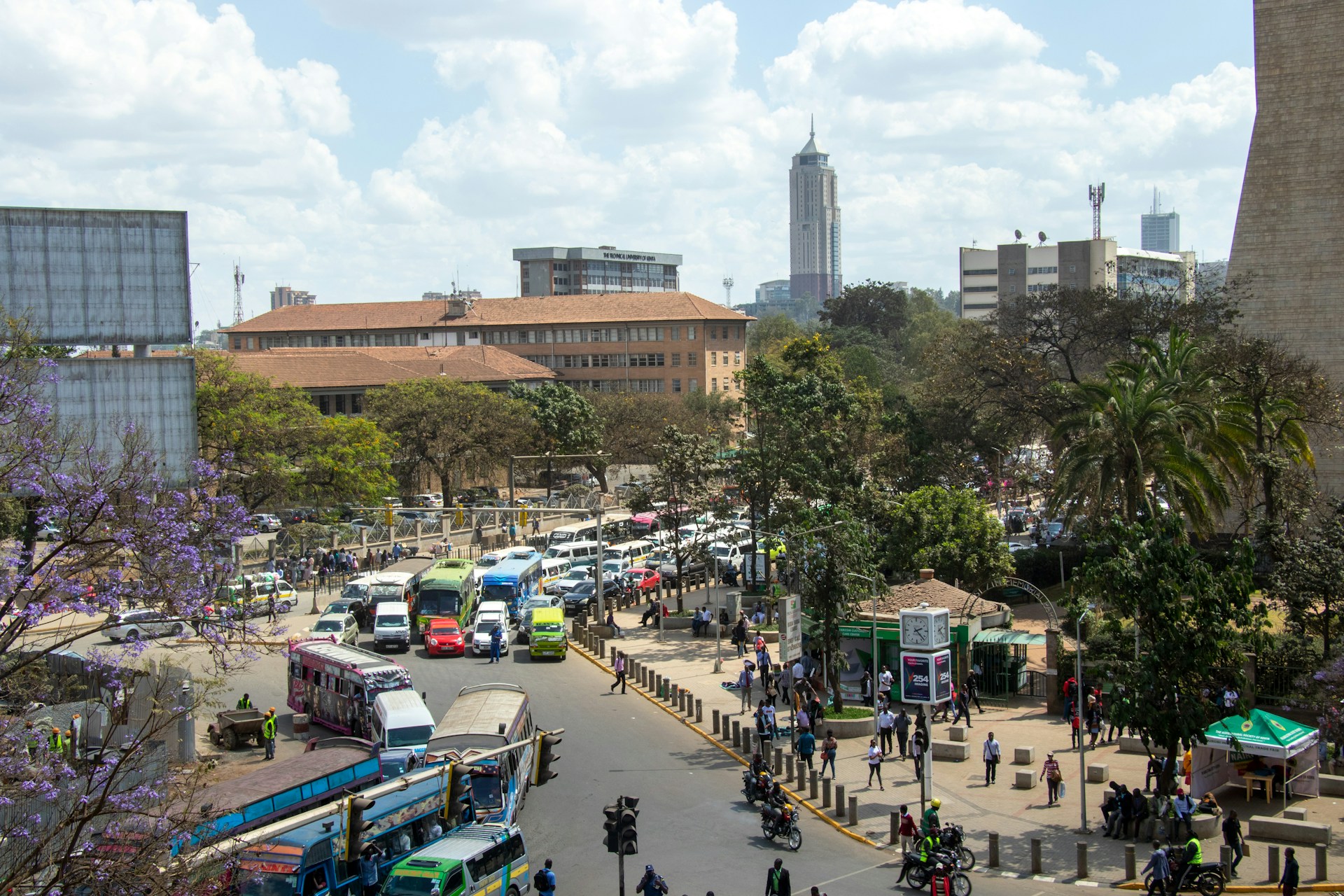
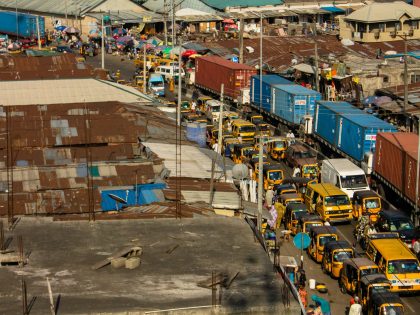
Pedestrians and traffic on a busy street in Nairobi, Kenya. Photo by Michael Njoroge on Unsplash.
Urban Africa is constantly finding ways to thicken urban life with new resourcefulness: from makeshift maker labs to the vast associations of traders with their own home-grown, expansive financial systems—where remittances circulate alongside locally generated credit and savings—to self-generated webs of electricity and water provisioning under the radar, to neighborhood investments in shared containers of imported goods, to local circuits of production and distribution of foodstuffs, intermingled with diverse labor arrangements across regions and borders. These are what we call popular economies.
Residents inhabit environments replete with different land statuses, regulatory frameworks, histories of economic specialization, repositories of cultural memory, behavioral styles, and social arrangements. Urban popular economies entail how these various components of an archive are pieced together and interrelated to produce specific mobilities and access to resources and opportunities. It is a move toward an expanded diversification of how accumulation, social reproduction, and livelihood get built. African cities are renowned for their informal sectors, self-built neighborhoods, as well as histories of piracy, brigandage, circumvention, smuggling, and subversion. The popular economy intersects with these elements in a continuous unfolding and elaboration of more overarching efforts to create distinctive processes of urbanization within and outside the hegemonic structures of capital accumulation and political domination.
In April 2026, researchers and activists from various African cities gathered in Nairobi to reflect on the popular economy. They explored questions related to orientations, practices, political engagements, and spatial arrangements that might offer ways to inhabit contemporary urban conditions differently. If the future, as a horizon of multiple disjunctions and possibilities, is captured by the reign of probabilities and adversarial networks, then what is the terrain of the improbable? Given the multiple temporalities that characterize territorial operations underpinning popular economies, can we think of a way of life not indebted to calculation, redemption, or culmination?
Popular economies and their various forms of organization seek different ways of inhabiting the present and thus recuperating the insurgencies of both pasts and futures. Euro-American notions of the human have long emphasized a progressive, developmentalist trajectory of improvement and enhanced capacity: a life moving toward a straight timeline, toward the fulfillment of unbounded human potential. This has intensified global turbulence, unsettled ways of living among the majority, and withheld the time needed for society to be a living force in itself—generating vulnerabilities and fragmentation on a planetary scale.
As Timothy Mitchell argues in his book The Alibi of Capital: How We Broke the Earth to Steal the Future on the Promise of a Better Tomorrow, this temporal movement acts to constitute a future from which a wide range of payments can be extracted; a future already encumbered by debts continuously owed to those who acquired, at a discount, the rights to those payments. This is a violence done to time itself, one that limits future dispositions to a mere surplus of the present. The future is foreclosed, not primarily through the threat of extinction, but rather through an investment in what can be extracted from that future and monetized now.
This same logic operates at the level of knowledge. Dominant knowledge functions as information: in Achille Mbembe’s terms, a juxtaposition of words stripped of ambiguity, which reduces the capacities of all localities when circulated and imposed. Pattern recognition becomes geared toward preemption; time is reoriented to the number of steps a program needs to reach completion, and space to the memory required to scale a specific function to execute a program—all of this coupled with increasingly enormous expenditures of energy, as Wolfgang Ernst and Rob Kitchin have shown. Localized knowledge has been generalized to the scale of what Bernard Stiegler called a biospheric locality, an upscaling made possible by reducing knowledge to data amenable to computation and by eliminating whatever resists that reduction. Localities become points along the same line, subject to measures of comparability and proportion—the more or less—with the subsequent fight to become more than what is lesser. Understanding one’s place in the world increasingly means referring to that with which one is apparently not.
Under such urban conditions, the “popular” takes place as a fundamental displacement, a shifting of what is vital, valued, and necessary into something besides these attributions. It entails a mode of conveyance, a leap that extends the efforts of survival into uncharted terrain and relations that are pursued opportunistically. It involves people using the terrain, institutions, networks, and other resources available to them as a means of piecing together a territory of operations that takes the stuff of the city—its materials, events, bodies, and spaces—and associating them, moving through them in unconventional and improbable ways.
When one navigates diverse urban spaces, it is evident how people spend time in seemingly useless activities and groupings. They may have their stores, jobs, houses, and responsibilities, but spend time in conversations and exchanges that seemingly produce nothing. But it is within these thousands of micro-exceptionalities to productive behavior that capacities for a cross-fertilization of knowledge and transactions off the map are forged; capacities that, in many cases, are translated into enhanced provisioning of various urban services and logistical actions. This creates new spaces that move beyond social and material boundaries. Itineraries take precedence over location, redefining entangled geographies around restive temporal lines and generating forms of extension through which residents stretch their life-worlds across circuits legible only in fragments.
What takes shape in these territories of operation will often remain opaque, indeterminate, but generative of tensions that provisionally resolve themselves through unanticipated breakthroughs and messy negotiations. What ensues is an always-new logistics of urban living, a way of decoupling the future from capitalist logics of foreseeability and from knowledge reduced merely to authoritative or actuarial information. These operations may or may not endure, may or may not produce something substantial, but they provide important knowledge and confidence for subsequent efforts. It is this mutuality, never depending on any one person alone, that gives the city its “popular way,” where everybody counts for something, and no one is left to carry that weight through individual agency alone.
The continuous mutating experiments of popular economies always take place within new forms that extract the energies, times, and hopes of the urban majority. Ways of life and survival practices become market frontiers through means that move across legality and plunder, law and crime, deals and the use of force, as research on informal real estate in São Paulo’s peripheries has shown. In part, this is precipitated by the attainments of popular economies themselves in terms of significant increases in the accumulation and diversification of wealth. These attainments might not mitigate precarity at all and instead open the way to new forms of capture: predatory real estate markets and forms of entrepreneurialism that fracture webs of social intimacy. Belonging or exclusion are violently imposed through discriminatory legal and political frameworks that sort “insiders” from “outsiders” within popular territories. These practices of delineation fall hardest where urban popular economies operate, where goods, money, and people move interdependently.
In addition, generalized militarization across urban territories is not only an intensification of domination, but also continuously transforms what people desire and how, targeting the capacity for innovation and adaptation that makes popular economies vital. Contemporary modalities of territorial control and articulation take on diverse forms of rentier extraction and management of circulation. They increasingly rely on nebulous borders among legal and illegal, public and private, formal and informal spheres. They function more as markers to navigate divergent flows of authority and resources, where the assemblage of efficacy requires not consolidation but excess, the capacity to go beyond what is inscribed as normative protocols, standards, and operating procedures. As urban governmentality becomes the “curation” of multiple knowledge resources, technological innovations, military logics, and continuously refigured alliances among different financial and political resources, do popular economies still manage to simultaneously circumvent, appropriate, and transform these logics?
Popular economies are centered on a necessary shared practice, rather than adherence to a specific, consensually agreed-upon protocol. Sharing means not the conjoined implementation of a specific task with a clear meaning, but a sense of the task derived in the performance of doing together or just being on the same beat of time. Within the processes of self-built urban neighborhoods or extensions, the mobilization of labor, the acquisition of materials, the designation of a plot, the articulation to sources of needed inputs, the modalities and rights of access, the curation of what is to be visible and sayable, the explicit and tacit responsibilities of each to each other, the deflections of interference or scrutiny—none of these were separate tasks available for a division of labor, but were worked out in terms of each other, generating an archive of localized meaning continuously updated as the implementation of these different “tasks” generated both anticipated and unanticipated implications. This is where the radical openness of the popular economy lies: things and people unpredictably brought together around a shared meal, on the market, in the street.
And yet this continuous sharing is under threat of fracturing. Popular economies have always been heterogeneous; at times, these heterogeneities operate as fractures. Take the various forms of self-valorization ranging from the demonizing of one’s peers to the indifference toward any form of collective progression. Take the lures of inhabitants into various security apparatuses, and, at the same time, the intensification of counterattacks, where conflict and violence become the very modality of popular endurance, while wars, genocides, extreme forms of violence, and sieges stretch the lifelines of many people. It is important, then, to think and work through these contrasting, often contradictory forms of self-valorization, especially as the fault lines become increasingly racialized.
This is the task we set ourselves at the end of our week in Nairobi: not to resolve these fractures, but to hold them alongside the radical openness from which they emerge, to expand our understanding of popular living and its territories, and of their unraveling into ever-changing constellations.