Is "khawa khawa" a North African myth?
Political rivalries increasingly overshadow the bonds between Algerians, Moroccans, and Tunisians, as social media amplifies the contradictions of Maghrebi identity.
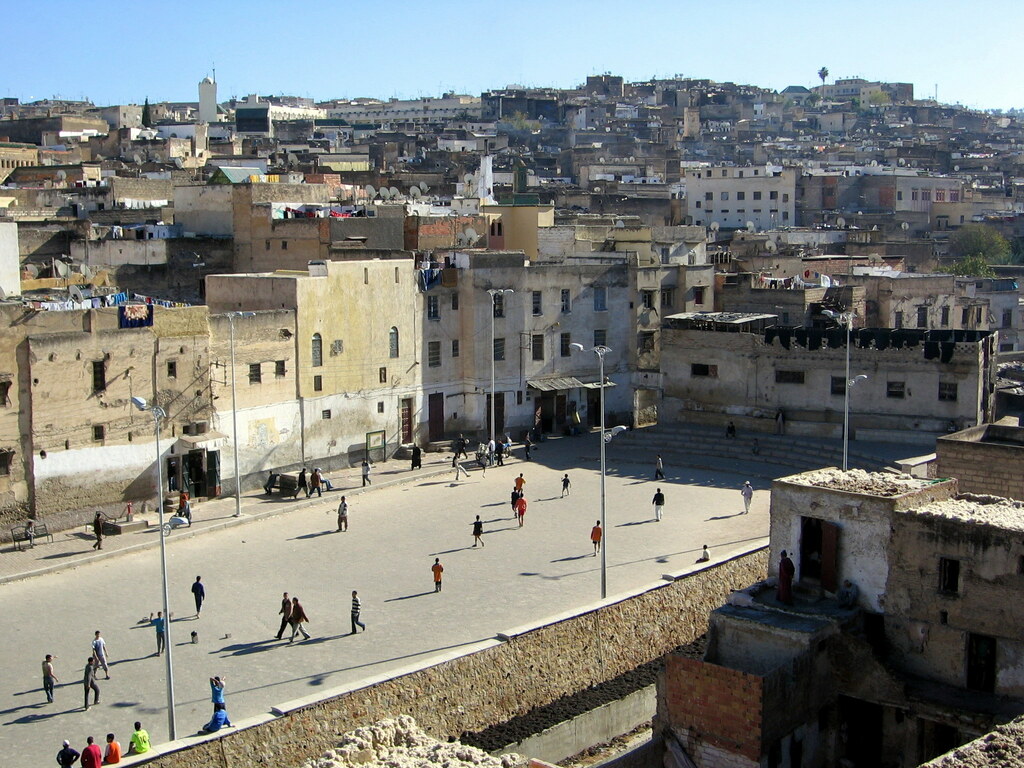
Residents play football and walk across a public square surrounded by densely packed buildings in Morocco. Source: Carlos ZGZ/PxHere (CC0).
In the haze of el ghorba—the strangeness and alienation of living abroad—I gravitate toward the Maghrebi diaspora. For a moment, we relax our tongues from the unnatural twists of Arabic dialects foreign to us and speak in the Maghrebi darijas. Desperate to latch onto whatever whispers of home exist elsewhere, we claim that we are khawa khawa.
Among the Algerians, Moroccans, and Tunisians, khawa khawa is an official nod to an unofficial alliance, loosely translating to brotherhood. It is an ode to our shared cultures and history in the face of North African identity discourses.
But what began as a salve for colonialism was lost in the monotonous chants for brotherhood.
Before the 19th century, North African states were “undefined” to European cartographers and authorities alike. Hence, like the concept of the Middle East and the Sahel, the Maghreb was prone to imperial invention. Unsurprisingly, this coincided with the Scramble for Africa—when the insatiable greed of European colonial powers took interest in dividing the African continent among themselves.
Encompassing other colonial legacies, the borders born out of the Scramble engineered the ethnic rivalries that persist in Africa today. Through the newly devised borders and the infamous “divide and conquer” regimes, the Maghreb was branded as distinct.
Despite the existing racial diversity of the region, the French colonial regimes rebranded the Maghreb as a biracial society: Amazigh or Arab. While the Amazigh identity was mislabeled in proximity to the whiteness of Europe, the Arab identity became an accusation of settler colonialism. North Africa became a geographic body for the Francophonie world, distanced from its neighboring regions’ cultures, politics, and society.
In 1962, Algeria—the last of France’s Maghrebi colonies—declared independence. In the years that followed, the Maghrebi people looked inwards and toward rebuilding the identity of North Africa. Thus, khawa khawa was born and reinforced by the diaspora that fled their homes in the wake of political instability. It became a card dealt in moments of desperation to bond to something, or someone, that vaguely resembled home.
Khawa khawa, and the brotherhood that blossomed with it, became the means to redress an identity obscured by European colonialism.
True khawa khawa culture demands communal harmony void of ego. But when politics becomes inevitably entangled in the national identity of communities, the culture of Maghrebi brotherhood falls flat.
Shortly after 1962, newly independent Algeria and Morocco fell into border disputes. The following decades spiraled into attempted land grabs, fits of cultural monopolies, and accusations of expansionist ambitions. In response, the people cried out khawa khawa; our governments do not define our brotherhood!
But too often, the politics override the social bonds of Algerians and Moroccans (and occasionally, Tunisians). With the rise of the internet, discourse shifted, and social media became a useful mirror for the abstractions of the Maghrebi identity.
Most recently, the khawa khawa culture was dramatically pronounced dead on social media platforms, following the 2025 African Cup of Nations (AFCON). Almost overnight, the football tournament became a litmus test for Algerian-Moroccan relations and spiraled into a warped perception of North African relations. A futile online back-and-forth that began as shared banter turned into personal attacks and political scrutiny.
The post-AFCON guerre between Algerians and Moroccans—which coincided with the recent UN support for Moroccan plans over the Western Sahara, disapproved by the Algerian government—is a recurring phenomenon of how Maghrebi culture wages war parallel to the political tensions of its respective countries. Despite the adamant denial, online Maghrebi communities fall into the habit of using our governments to verify the authenticity of khawa khawa.
The problem rests in the fact that both communities—Algerian and Moroccan—fall into the habit of claiming the minority of hateful comments as the consensus among the entirety of both nations. We see assertions made that we cannot prove, except that they are too insulting and their wounds far too inflicting to recover from. It has become a pattern of malice between both nations that resurfaces regardless of how loudly khawa khawa is chanted.
Perhaps the fault is also in the fragility of how we materialize our cultural bonds. We claim that khawa khawa is an Islamic brotherhood, yet some grow secular. In the absence of religious backing, khawa khawa becomes a proverb of the old world. Then, we claim that khawa khawa is a call for pan-Arabism, yet some grow weary of Arabization. In the face of the Amazigh renaissance, khawa khawa becomes a proverb of the imperial world.
Perhaps, much like the colonists, we, too, have confined the Maghrebi identity to arbitrary borders of existence, repackaged in the khawa khawa culture, while we feed into the delusions of European-drawn borders. And so, khawa khawa becomes a hollow reminder of colonial fractures.
While we cannot divorce our identities from politics, the Maghrebi community must forgo the egos that are founded in political symbolism. We should understand that an enforceable unity can exist if we acknowledge that each community upholds legitimate, separate interests.
As long as we treat khawa khawa as nothing more than a symbolic slogan that dissipates under the legacy of French colonialism and the futility of online disputes, Maghrebi relations will live on as a North African myth of brotherhood.
Khawa khawa is a brotherhood that encompasses the lived and nuanced identities of the Maghreb; let us not reduce it to mere grounds of conflict for North African communities.
Alas, in el ghorba, it is always among the Maghrebi diaspora that I find remnants of my home.