Measured bodies and moving men
In apartheid South Africa, Drum magazine showed Black readers what it meant to be modern. But not everyone got to be modern in the same way.
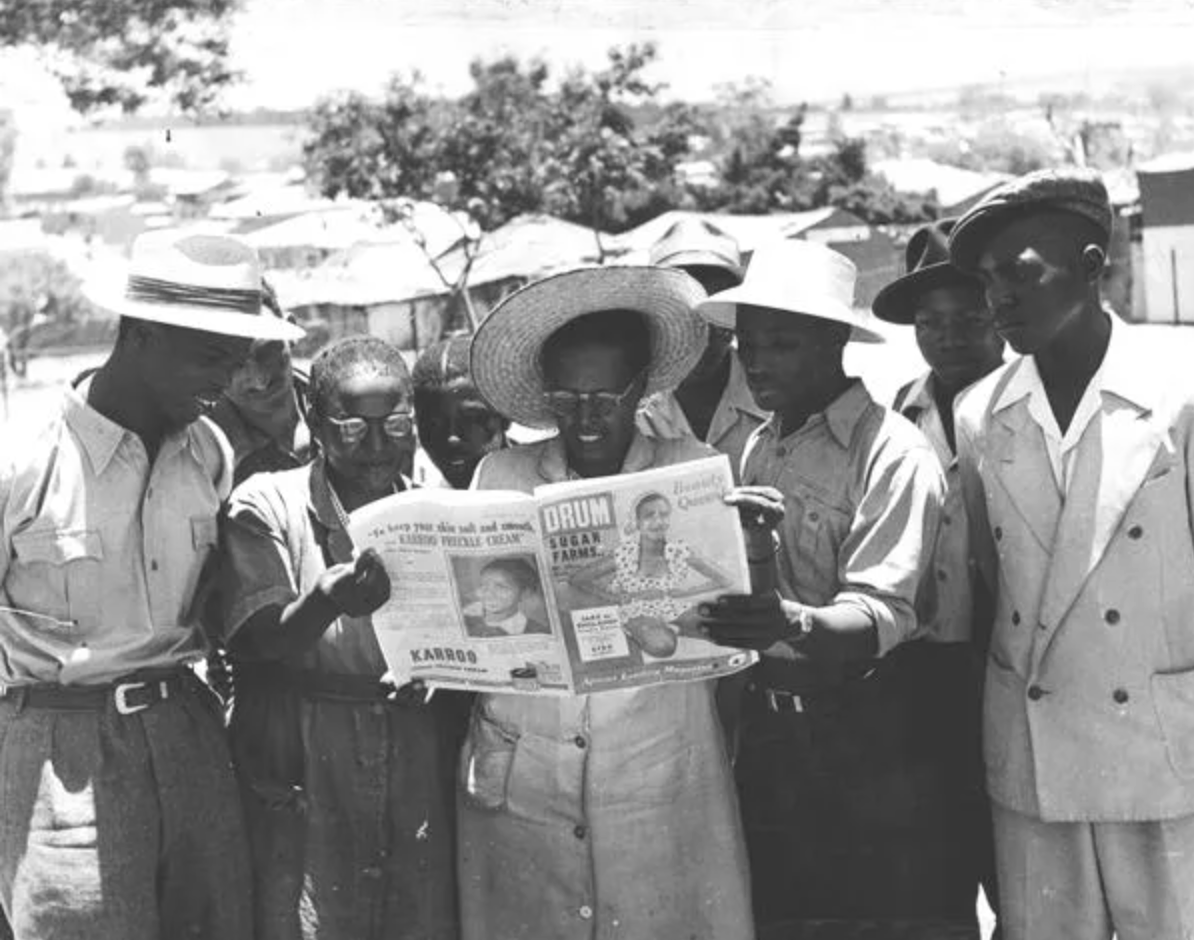
Readers examine the February 1953 edition of Drum magazine, featuring Henry Nxumalo’s investigation on South Africa’s sugar plantations alongside cover stories including “Beauty Queen!” and “Jake in England.” Source: South African History Online.
In 1950s apartheid South Africa, visibility was never neutral. To appear publicly as Black, urban, fashionable, and modern carried political meaning in a society built on racial segregation and control. It was within this environment that Drum magazine emerged as one of the most influential publications for Black readers across the country. Founded in Johannesburg in 1951, the magazine documented township life, jazz culture, fashion, sport, politics, and everyday urban experiences. Its pages offered images of Black modernity at a moment when apartheid attempted to confine and regulate Black life.
Alongside its reporting on township life, Drum regularly featured beauty contests, fashion spreads, musicians, athletes, and political figures, offering readers images of Black modernity at a time when apartheid sought to deny it. Yet the magazine did not present modernity in the same way for everyone. Women were more often associated with beauty, fashion, and respectability, while men tended to be portrayed through music, sport, politics, and public life. Two covers published only a year apart reveal how differently the magazine represented young African women and men.
The August 1956 issue, titled “Special Beauty Page—Inside,” shows a young Black woman standing in a fitted yellow dress while several men surround her with tape measures. One crouches near her legs. Another measures her waist. Others observe her body from different angles. At first glance, the image appears glamorous and playful, almost theatrical. The woman stands confidently at the center of the frame, her bright dress sharply contrasting with the darker suits around her.
Yet the longer one looks, the stranger the image becomes. The tape measures divide her body into sections: waist, hips, height. The men lean inward, forming a loose circle around her. While she is the focal point of the cover, she is also its object. Her visibility depends on being evaluated. Even her posture feels restrained. Her arms rest slightly behind her back rather than confidently occupying space. She does not look directly at the viewer or at the men measuring her. Instead, she appears distant from the activity surrounding her, as though the image is happening around her rather than with her.
The cover reflects what scholar Rachel Johnson describes as the figure of the “modern miss” in Drum magazine, where young women became highly visible as symbols of urban modernity while simultaneously remaining tied to scrutiny, beauty standards, and respectability politics. Fashionable clothing and public visibility offered women new ways of imagining themselves as modern subjects, but that visibility was rarely free from regulation. On the beauty-page cover, modernity arrives through measurement. Glamour becomes inseparable from inspection.
A year earlier, Drum presented a very different image of Black modernity. The August 1955 cover features a Black male jazz saxophonist captured mid-performance. Unlike the woman on the beauty-page cover, he appears alone. There are no figures surrounding him, no visible systems of judgment, no tools measuring or evaluating him. His body is not fragmented into parts but defined through movement. The diagonal line of the saxophone creates a sense of rhythm and motion across the frame. His posture feels active and fluid. Even though only the upper half of his body is visible, he appears more expansive than the woman, whose entire body occupies the previous cover.
What matters is not simply that one image depicts a woman and the other a man. It is that the two covers imagine modernity differently. The woman’s body becomes the site through which modernity is assessed and disciplined. The musician’s body becomes the site through which modernity is performed.
This contrast becomes especially revealing within apartheid South Africa, where Black visibility itself was already shaped by surveillance and restriction. Drum is often remembered for challenging racist representations by portraying Black South Africans as cosmopolitan, stylish, and culturally sophisticated. And in many ways, it did. Jazz musicians, beauty queens, athletes, writers, and urban youth all appeared throughout the magazine’s pages as part of a modern African world that apartheid ideology attempted to deny. At the same time, these images also reveal how unevenly that freedom was distributed.
The beauty-page cover places the woman at the center of the frame, yet her visibility intensifies control rather than autonomy. The more visible she becomes, the more closely she is measured. Her body is transformed into something legible and standardized, open to judgment and comparison. The saxophonist occupies visibility differently. His body is associated with action, rhythm, and expression rather than evaluation. He appears absorbed in performance rather than aware of being watched.
Yet even this freedom is partial. The image removes the pressures shaping Black male life under apartheid: police surveillance, economic precarity, pass laws, and racial violence remain outside the frame. Freedom becomes aestheticized. The musician appears self-contained partly because the conditions limiting him are invisible.
Looking at the two covers together reveals how media images do not simply reflect social reality but actively organize it. This broader relationship between representation and identity is also reflected in the work of scholar Mamadou Diouf, who argues that representations of African youth and public space help shape how modern identities are imagined rather than simply reflecting existing social realities. Drum offered Black readers powerful images of urban modernity, but it also reproduced different conditions for how femininity and masculinity could appear in public space. Women were often made visible through beauty, discipline, and evaluation. Men were more often represented through movement, performance, and cultural expression.
What makes these covers striking today is how contemporary they still feel. The beauty-page image resembles digital cultures where women remain hypervisible yet constantly assessed through beauty standards, desirability, and online scrutiny. The jazz musician, meanwhile, anticipates forms of masculine visibility still associated with movement, performance, and creative freedom.
Long before social media transformed visibility into a daily performance, Drum already understood something important: visibility is never simply about being seen. It is also about who gets to move freely within the frame.