Africa’s last philosopher king
Although Nelson Mandela lacked the oratory of Nkrumah and the theory of Senghor, his contribution to the world of ideas was something rarer: pragmatism.
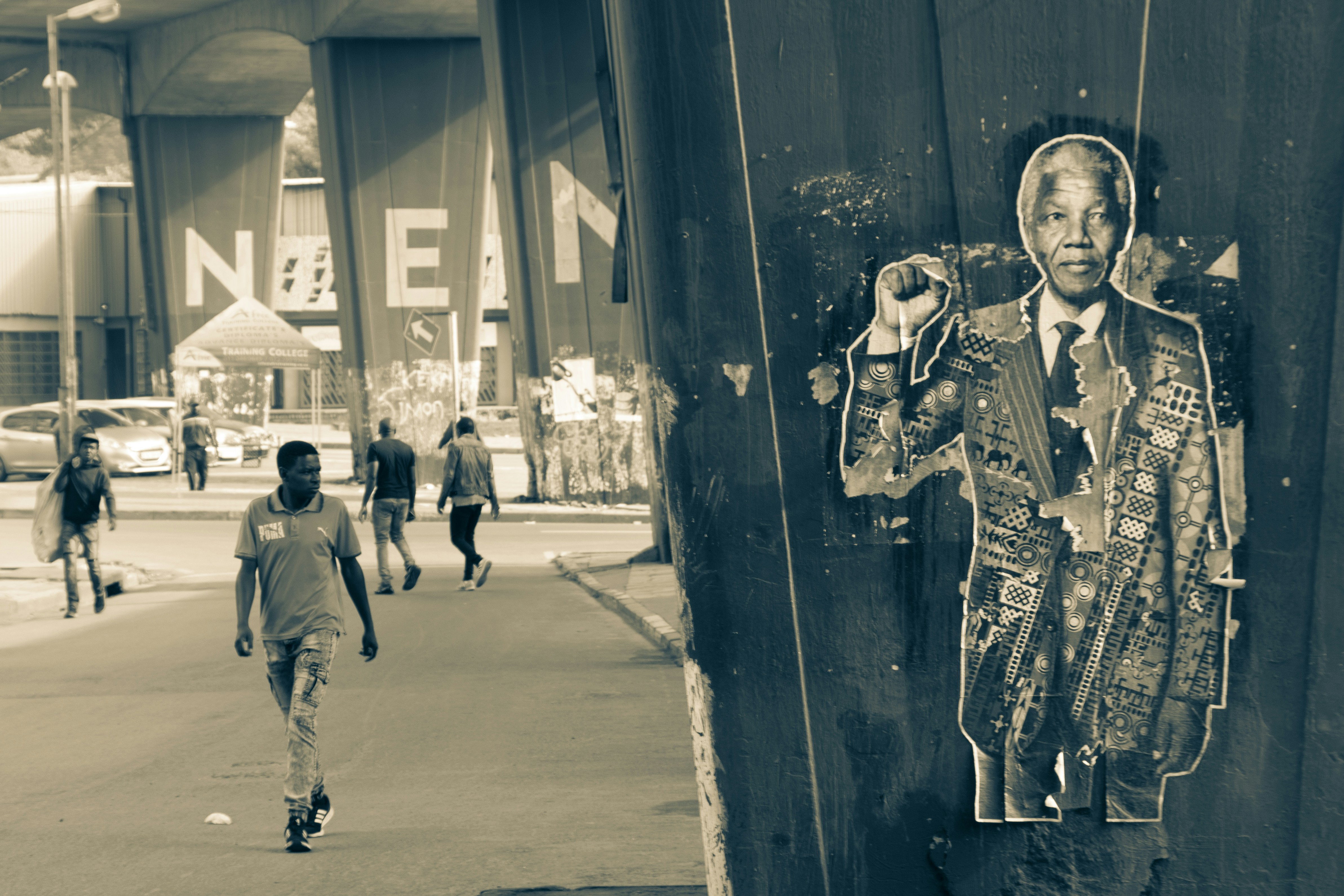
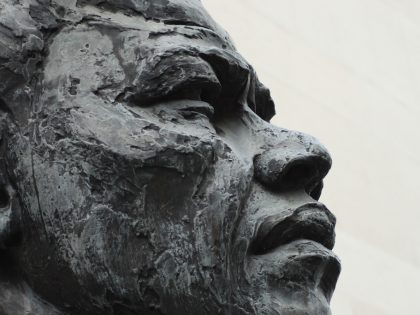
Photo by Gregory Fullard on Unsplash.
Nelson Mandela, the first democratic president of South Africa (1994–1999), secured a catalytic and at times confounding place in world history. He was neither an enthralling orator, an imposing Great Man, nor a formidable intellectual. Yet his birthday, July 18, has been marked by the United Nations as “Nelson Mandela International Day.” He is the only former head of state in contemporary times to enjoy such transnational iconic status. Here, I claim that his unique place in history can be explained by how closely he resembles a philosopher king.
The “philosopher king” or “philosopher ruler” is a western philosophy concept that originates in the following claim by Greek philosopher Socrates, found in his mentee Plato’s book The Republic: “The human race will have no respite from evils until those who are really philosophers acquire political power or until, through some divine dispensation, those who rule and have political authority in the cities become real philosophers.”
South African philosopher Mabogo Percy More adds that a philosopher is not only a scholar of the subject, but also “an individual who has the capacity to make an original contribution to the development of philosophical thought and to the world of ideas irrespective of his [her] training in the discipline.”
Although the concept referred to state rule by the monarchy or aristocracy when The Republic was written (between 380 and 375 BCE), in contemporary democratic politics the term is not used literally. It has come to refer to heads of state such as presidents, prime ministers, and chancellors, as well as the remaining monarchs. It simultaneously captures the Janusian contradiction of an ideal form of rational and ethical leadership (the philosophical element) and a caution of autocratic leadership (the king, ruler, or political element).
Africa’s first post-independence heads of state, also referred to as “Africa’s Founding Fathers,” were conferred this mantle because they were not only political leaders but also thought leaders. Political scholar Vusi Gumede asserts that a “thought leader is someone who possesses the right kind of knowledge needed to challenge an existing paradigm in order to advance new thinking and to inspire others as well.” They challenged Western imperialist and colonial paradigms.
Despite their flaws, Africa’s Founding Fathers became beacons of inspiration for their people during the euphoric era of independence and decolonization. Collectively, as Africa’s philosopher kings, they formulated or promoted theories and concepts, delivered eloquent speeches, and wrote influential works pertaining to African communalism, African nationalism, African socialism, Afrocentrism, Négritude, Nkrumaism, Consciencism, and Ujamaa.
South Africa is a unique outlier in this landscape. After the colonial settlement of the Dutch from the 17th century—predating the European Scramble for Africa (1880–1914)—together with Britain’s colonial stake in the late 19th century, the country endured a further four decades of white minority, Afrikaner nationalist, and apartheid (separate development) rule. Thus, South Africa’s liberation was only realized in 1994.
Hence, Mandela became the last 20th-century post-independence leader on the continent to assume office. The delayed independence of South Africa provided Mandela with a unique vantage point to observe the successes and failures of other African leaders over four decades. Mandela read and studied widely throughout his 27-year prison term. He had the opportunity to contemplate, in solitude and together with fellow imprisoned comrades, the state of a nation and continent in crisis. Those reflections, the letters he wrote, and the meetings he held while still in prison refined his philosophy and politics.
His brand of philosophical leadership can be distinguished from that of his African (and global) peers by the absence of ideological purism and the presence of ideological pragmatism. This is his original and philosophical contribution to the world of ideas. Whereas purism leaves no room for the dialectical tensions inherent in human existence, pragmatism navigates gray areas, straddles contradictions, embraces paradoxes, and facilitates synthesis of equal and competing interests.
Arguably, this cultivated in him a range of ideal attributes that the philosopher king should possess:
For they are lovers of the knowledge of the eternal and of all truth; they are haters of falsehood; their meaner desires are absorbed in the interests of knowledge; they are spectators of all time and all existence. . . . Also they are of a social, gracious disposition, equally free from cowardice and arrogance. They learn and remember easily; they have harmonious, well-regulated minds; truth flows to them sweetly by nature.
Socrates acknowledges that it would be very rare to find someone who possesses all these qualities. I suggest that Mandela came remarkably close.
He was born into the Xhosa Thembu aristocracy and was destined to succeed his father as a chief but instead traded that role to pursue becoming a lawyer. He later became a leader of ethnic groups beyond his own as the nation’s “Madiba”—his family clan name. Those who met him speak of how he exuded nobility—Socrates’s “social, gracious disposition.” At the same time, he was “equally free from cowardice and arrogance,” as he was both assertive and humble. Giving up his inherited chieftaincy and stepping down after one presidential term distinguished him from African peers who aspired to lifelong presidential power.
As he rose the political leadership ladder, he straddled several ideological positions and tensions. At once, he promoted the African nationalism and socialism that undergirded much of postcolonial Africa and his party, the African National Congress (ANC). He subscribed to communism as a secret member of the South African Communist Party (SACP). He became a patron of the multiracial United Democratic Front (UDF) while an inmate of Pollsmoor Prison in 1983. Ultimately, he presided over the architecture of the new Constitution of the Republic of South Africa (1996), which is acclaimed as a beacon of liberal democracy. Holding all these ideologies cultivated his proficiency in political, social, cultural, and ethical pluralism.
He initially advocated nonviolence when he joined the ANC in the 1940s, then changed his strategy as a founding commander-in-chief of the ANC’s Umkhonto we Sizwe paramilitary wing in the 1960s. During the transition to democracy, he subsequently pivoted definitively to nonviolence. The ability to entertain the continuum of violence from pacifism to radicalism inculcated his discernment of when violence serves a greater purpose and when it is merely gratuitous.
Once he was released from prison, he modeled the surmounting of “meaner desires” such as retribution by championing forgiveness and reconciliation. He became a leader who mediated between victims and villains to bring about a synthesis greater than the interests of either side.
Even though he is sometimes accused of abandoning the more substantive and economic claims of the Freedom Charter of 1955 when he became president, his moral compass was firmly trained on the charter’s preamble: “South Africa belongs to all who live in it, black and white.” The values of nonracialism and multiculturalism drove his proactive engagement with stakeholders of all races, ethnicities, religions, identities, and interests.
Affectionately known as “Tata” (the isiXhosa term for father), he displayed the kind of unconditional love that a “father” strives to have toward “children” of diverging personalities, different capacities, and competing interests. An apt demonstration of his cultural pluralism was his embrace of rugby (a sport historically dominated by the white minority as players and fans) when South Africa hosted the 1995 Rugby World Cup, and his successful support of the bid to host the 2010 FIFA World Cup in football (a sport dominated by the black majority).
As a revolutionary activist, he made the terrorist lists of many countries, only to be awarded the 1993 Nobel Peace Prize—none of the other African philosopher kings had this privilege. He went on to become a consummate statesman who received more than 250 honors for his life’s work. His name became shorthand for “moral leadership.”
Haig Patapan, in his book Modern Philosopher Kings: Wisdom and Power in Politics (2023), argues that “democracy appears as the most formidable obstacle to all modern attempts to secure philosopher kings.” Yet paradoxically, there is a need for “noble attempts to civilize power and to empower wisdom.” We should bear in mind, though, that while “politics is open to wisdom and philosophy, there are also powerful elements within it resistant to such a union.”
Mandela’s ideological pragmatism intuitively and strategically located the sweet spot where democracy and aristocracy, wisdom and power, philosophy and politics meet.