Now what?
What’s in store for the Congolese national team, now that they’ve reached the World Cup?
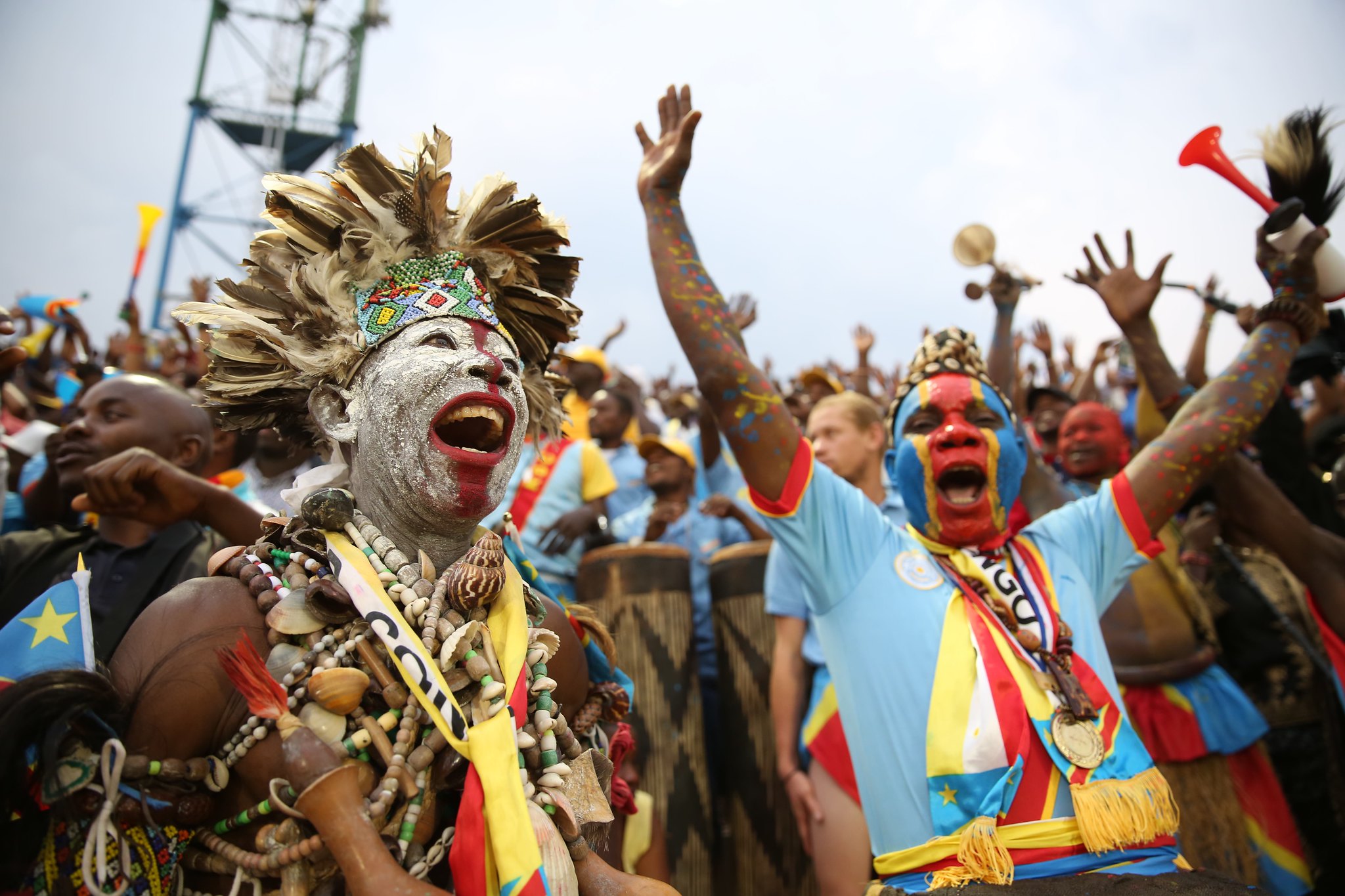
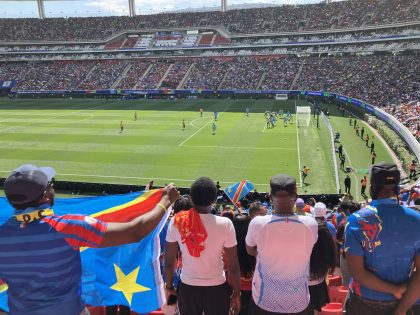
Congolese fans in Kigali, Rwanda during the 2016 African Nations Cup (CHAN) final between DR Congo and Mali. Photo by Abel Kavanagh for MONUSCO via Flickr CC BY-SA 2.0
More than a month has passed since the Democratic Republic of Congo qualified for their second World Cup, their first after 52 years. The intercontinental playoff was one of the most emotionally intense moments that I’ve experienced in my life. I can still hear the “Congo, hermano, ya eres mexicano!” chants echoing in my head. For a country that had waited and suffered, it was a collective release. But now that ample time has passed, the question that continues to resurface is: Now what? What can this moment actually bring to Congo at this critical juncture?
To answer that question, I think back to the beginning of my trip to Guadalajara, which was cobbled together at the final minute. The Congolese government included our media outlet on a chartered airplane that arrived on March 30, the eve of the match. After a long journey aboard an obscure Bulgarian airline, we landed in Mexico. My back was killing me, but the sheer excitement drowned out the pain.
It was my first time in Mexico, yet the airport felt strangely familiar. I decided to Google the airport to figure out why, and I saw that weeks earlier, I had seen it on television following the killing of El Mencho, the leader of the Jalisco cartel. His death and the subsequent retaliation by the Jalisco New Generation Cartel caused widespread panic.
Yet, beyond the tension, there was a sense of order and structure about Guadalajara. After taking a stroll in the city center, I remarked that the streets could put Paris or New York to shame in terms of cleanliness. It is a simplistic way of thinking about things, but visiting Guadalajara—the cultural heart of this global South country of 130 million people—inspired me to imagine possibilities for my own country. If them, why not us?
In the streets, our Congolese delegation and traveling fans did not go unnoticed with our flags, chants, and colors. The local Mexican population responded by beeping horns and beaming smiles our way.
“Vamos Congo!”
All of a sudden, the corny slogans of football politicians make sense when they talk about our sport, “bringing the world together.” Although it was only for two days, I felt the solidarity in real time.
It didn’t help our opponents Jamaica that Mexico has a nominal regional rivalry with them during CONCACAF competitions. Therefore, support in Guadalajara drifted naturally toward the Congolese. The match itself was far from perfect. It was played at 1,500 meters above sea level under the effects of jet lag and very harsh sunlight. It was only natural, therefore, that the Leopards performance was tense and sometimes messy. Congo mostly dominated but couldn’t finish.
Earlier that morning, Cédric Bakambu’s father had told me, with unexpected calm: “We’re going to qualify. I had a dream. Look what is going to happen.”
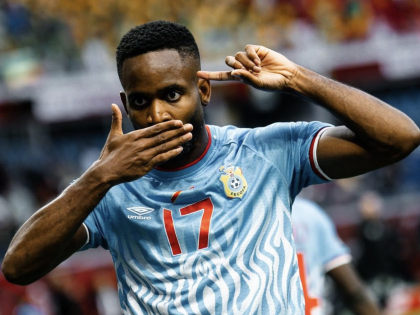
I tried to remember his words of wisdom even after two of his son’s goals were ruled offside. But Papa Bakambu was right. In the 99th minute, Axel Tuanzebe rose to meet a corner. It wasn’t a beautiful goal, but that didn’t matter. The stadium erupted.
Born in Bunia, Ituri, a region scarred by conflict, Tuanzebe had just delivered a moment of collective release for a nation that had learned how to endure. The ball crossed the line, and with it, 52 years of waiting were erased. It felt fitting because this qualification was never going to be about being perfect; it was more about resilience. Tuanzebe’s unconventional but decisive goal was the third consecutive time Congo eliminated World Cup playoff opponents after 90 minutes. For years, mental fragility had been one of the team’s weaknesses; now, it is arguably our greatest strength.
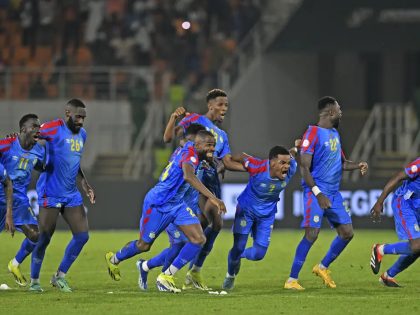
After the final whistle, the scenes were unlike anything I had experienced. Congolese and Mexicans celebrated together in communion as the stadium vibrated with the chant: “Congo, hermano, ya eres mexicano!” A Mexican boy, maybe sixteen, begged one of my friends to give him his huge Congolese flag, and got emotional when my friend wrapped him up in it. In those moments, football transcended linguistic or cultural barriers. Suddenly, I no longer saw Congo and Mexico as distant worlds, but as two societies of the global South shaped by similar energies: hospitality, loud joy, music, and a deep attachment to ancestral traditions. . . . and football.
Back in Congo, the celebrations spread everywhere from Kinshasa, of course, to Goma and Bukavu—regions marked by conflict and occupation. People took to the streets and sang the national anthem in scenes of pure joy. In Ituri, the birth region of goalscorer Tuanzebe, the celebrations were particularly important. The eastern province, home of the beautiful and endemic Okapi, is also rich in gold and cocoa. Their long-lost son’s success uplifted a region that badly needed it. In a country threatened by political balkanization and ethnic division, football had once again done what little else could: It reminded us that Congo is still one.
Now what? I think most casual fans would be content with sitting around and waiting for the World Cup to roll around in June, and who could blame them? Yet, my mind is already thinking about how we ensure that it doesn’t take another 50 years to get back to the World Cup. Because, what the Leopards’ qualification also exposed was the contradictions of Congolese football. Of the 26 players selected, only five played football as youngsters in Congo. Our diaspora carries our national team. That is an undeniable strength that we must tap into, but also a symptom of deep-lying structural issues.
For a country of over 100 million people, the untapped potential is immense. Congolese youth were blessed with football talent, yet due to a lack of infrastructure and qualified coaching, very few are scouted, let alone make it to the top.
This qualification must be an inflection point. It should mean that the Federation and the state invest in youth development and talent identification across all provinces. Without that, Congolese football will remain dependent on external systems. On one hand, that shouldn’t be a surprise. Many structures in our country are propped up on external foundations. Yet, football doesn’t have to follow that path; it can become a powerful tool only if there is a vision.
Upgrading football infrastructure is one obvious example. Professional stadiums are lacking in the Congo, but so are even more basic amenities, such as accessible community pitches. In Kinshasa, playing football on a decent pitch is not free, and far too expensive for most young athletes—a cruel irony considering football is supposed to be “the people’s game.” In many Western countries, and even elsewhere in Africa, such as Morocco, small quality football pitches have multiplied in working-class neighborhoods, allowing young people to practice in decent conditions instead of on dusty, uneven grounds.
Solutions do not necessarily require enormous creativity. One could imagine the government requiring foreign corporations extracting Congo’s vast mineral wealth to fund local sports infrastructure projects as part of their contracts. A football pitch here. A community facility there. The idea may sound simple, but it reflects a broader truth: foreign investment in Congo should not only extract, but also build.
Talent detection and youth development remain another major issue. Unlike Côte d’Ivoire, Mali, or even Cameroon, Congo still lacks a globally recognized football academy system. Yet sometimes, a single academy can transform an entire football culture. Paradou Academy in Algeria helped develop many of the local pillars of the current national team. In Congo, TP Mazembe’s Katumbi Football Academy—founded in the 2010s by then-president and former Katanga governor Moïse Katumbi—remains the only notable example. Still, it is a private initiative rather than part of a national structure.
External structures such as FIFA Forward funds, when properly managed, can also become transformative tools. Mauritania—ranked 206 in the world in 2013 and nowhere near the continental elite stage—used these programs to renovate infrastructure, modernize its federation, scout talent, and thereby qualify for three consecutive Africa Cup of Nations tournaments between 2019 and 2023.
Meanwhile, Congo is preparing to end four years of FIFA-led normalization with federation elections scheduled for May 20. Among the leading candidates is Veron Mosengo Omba, the well-connected but controversial former FIFA official who helped oversee the implementation of the FIFA Forward program worldwide.
As outlined, perhaps the worst part about the position the country’s infrastructure is in is that solutions are readily available. The diagnosis is not difficult or complex; the only uncertainty is in the possibility of successfully implementing far-reaching measures while the country remains in such a precarious situation.