Pope Leo and the strongmen
The Pope’s African tour tested whether the papacy can speak to ordinary people without becoming a prop for authoritarian power.
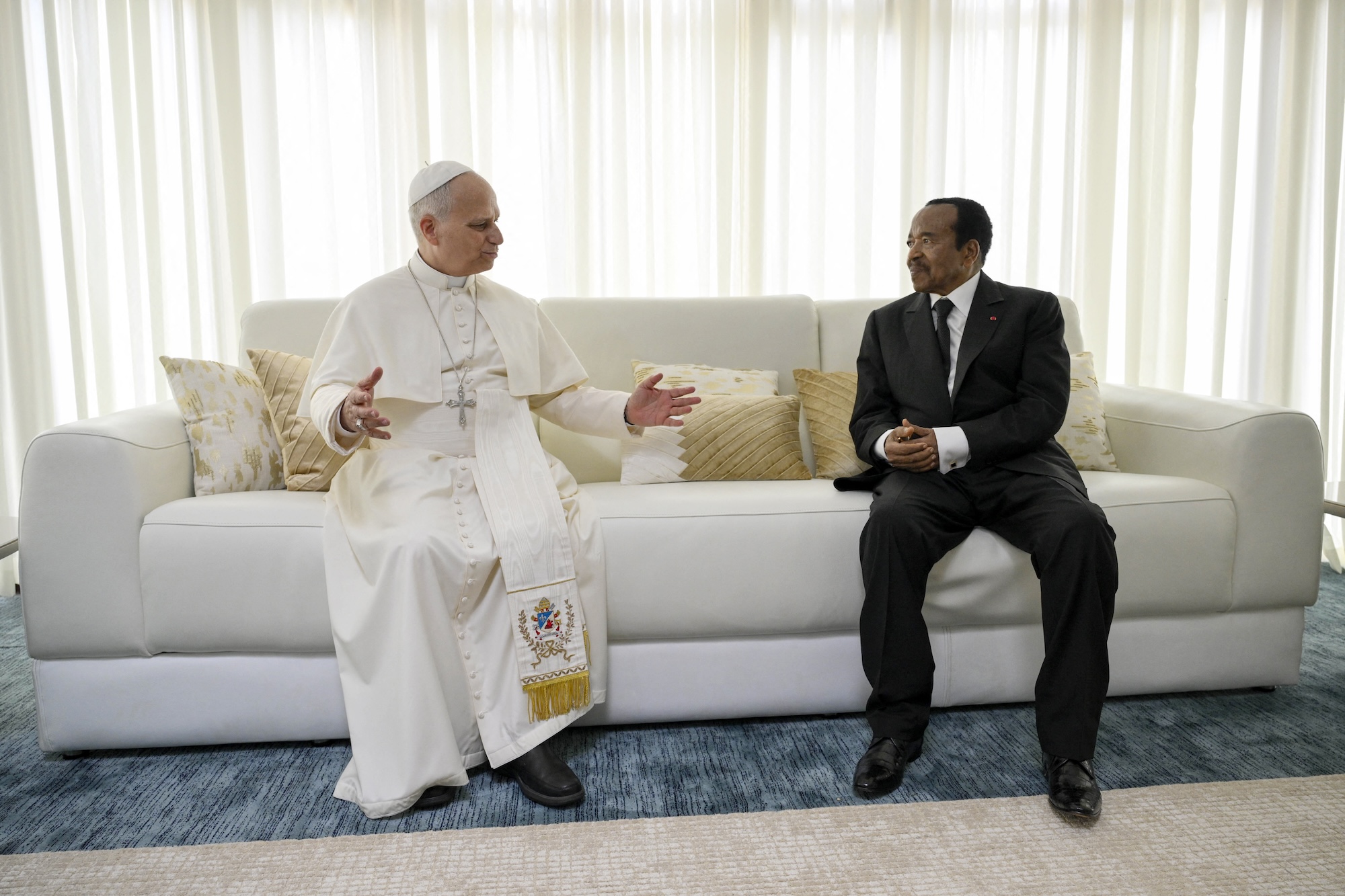
Pope Leo XIV and President Paul Biya of Cameroon saying farewell at Yaoundé's airport on April 18, 2026. Photo by (EV) Simone Risoluti/Vatican Media/Abaca/Sipa USA(Sipa via AP Images)
They say there’s no point preaching to the converted, but on his African tour, Pope Leo XIV went further, speaking hard truths to those who least wanted to hear them. His visits to Algeria, Cameroon, Angola, and Equatorial Guinea were scrutinized across the world, and the choice of these countries raised questions among human rights and individual freedoms advocates. Why would the pope travel to Algeria when several Algerians remain detained for their opinions? Why go to Cameroon, where President Paul Biya has been in power for 44 years, or to Equatorial Guinea, where President Teodoro Obiang Nguema Mbasogo has reigned for 47?
Those questions kept the tour under a microscope. Yet Leo XIV walked a careful line, keeping his distance from the political establishments while genuinely connecting with ordinary people. Known to be discreet and reserved, Pope Leo XIV revealed a different side of himself in Africa.
The pope calls himself a “son of Saint Augustine.” That is why his visit to Algeria, which he decided to undertake shortly after the beginning of his pontificate in May 2025, carried such deep meaning. On a personal level, it was his third visit to the country, but his first as pope. Catholics are a small minority in the North African nation, with roughly 8,500 worshippers, most of which are expatriates and students.
Before the pope’s arrival in Algeria, NGOs, including Human Rights Watch, sent him a letter urging him to challenge the authorities on violations of individual freedoms and religious freedom, citing in particular the closure of Protestant churches in the country. In Algeria, Protestants—and especially evangelicals—are kept under close watch. Proselytizing aimed at converting Muslims is banned under Algerian law, as it is considered an attack on the foundations of the state.
These questions of individual freedoms and religious practice were not publicly addressed by the pontiff during his visit. Nevertheless, he called on the authorities to promote “a living, dynamic and free civil society.”
On his first day in Algeria, standing before President Abdelmadjid Tebboune, the pope called on leaders “not to dominate, but to serve the people and their development.” A pointed critique, given that at least 200 political detainees are still imprisoned after being arrested during the Hirak protests of 2019 and 2020, which were peaceful demonstrations that led to the resignation of former President Abdelaziz Bouteflika, who had been in power for 20 years.
He delivered a similar message days later in Cameroon, facing Paul Biya, who was reelected in October 2025 for an eighth consecutive term amid violence that left at least 20 protesters dead. Ranked 142nd out of 182 countries on Transparency International’s corruption index, Cameroon gave the pope an unmissable opening. He took it—likening corruption to “idolatry” and insisting that “true gain is the integral development of human beings.” He called for transparency in public resource management and respect for the rule of law, as Biya sat stone-faced beside him.
In a curious episode, Cameroon’s state broadcaster, CRTV, cut its live feed of the papal address mid-speech. Officials blamed a fiber optic failure, but that claim was flatly contradicted by Camtel, the network’s own operator, which said no technical fault had been detected. Deliberate censorship or a coincidence? The question remains.
In Angola, the pope addressed a crowd of 100,000 faithful and didn’t soften his message. One-third of Angolans live in poverty—despite the country being Africa’s fourth-largest oil producer and the world’s third-largest diamond producer. Leo XIV condemned the “logic of exploitation” of natural resources that generates “social and environmental catastrophe,” taking clear aim at the foreign corporations and domestic elites that pocket the country’s wealth.
“Many people no longer believe in elections,” said Angolan journalist Omar Prata, describing a climate of deep polarization and social unrest. Still, he noted that in the days following the papal visit, the government announced emergency measures to assist thousands of families displaced by flooding in Benguela. That was a limited but tangible shift in attention toward those most in need, particularly with the increased cost of living due to America’s war in Iran.
In Equatorial Guinea, the final stop, the pope pressed on. “The greed for mineral and oil wealth fuels wars in contempt of international law and the self-determination of peoples,” he declared. The visit was shadowed by a pre-arrival scandal: Reports, gathered by AFP, alleged that civil servants and soldiers had seen wages docked to fund the papal preparations, while university students in Malabo were reportedly required to purchase their own matching uniforms for the occasion.
The last pope to visit Equatorial Guinea was John Paul II in 1982. Back then, Teodoro Obiang had been in power for just three years, having overthrown his own uncle in a military coup. Forty-four years later, Leo XIV arrived to meet the same man in office, now as the longest-serving non-monarchical head of state in the world.
In a country of two million people, over 1.4 million are Catholic. The Church’s influence is immense. And that weight cuts both ways. Critics argue that papal visits, however well-intentioned, ultimately serve as a form of international legitimization for authoritarian rulers, offering them a boost in global image and a dose of credibility with their own populations.
In a piece published on our website, Cameroonian theology professor David Tonghou Ngong argues that the Catholic Church has a troubling habit of providing moral and political cover to the Biya regime precisely when it needs it most and that the pope’s visit, coming during an ongoing Anglophone conflict in the country’s northwest, benefits the very power it appeared to challenge.
However, it is worth noting that separatist groups in Cameroon declared a three-day ceasefire to mark the pope’s arrival. Leo XIV traveled to Bamenda, the epicenter of the crisis, where he called for peace and reconciliation.
Cameroonian journalist Eugene Ndi sees it differently. “He didn’t mince his words in front of our president,” he said, noting that Leo XIV openly told Biya that breaking the chains of corruption is a precondition for peace. “It is now incumbent on the government to move forward, through the Church, through civil society, through diplomacy. The pope has done his part. What remains is for the government of Cameroon to make sure what he started bears fruit.”
Through unambiguous messages delivered face-to-face with some of Africa’s most entrenched rulers, Pope Leo XIV emerged as an unlikely spokesman for the voiceless. This tour seemed to reveal who he really is: a pontiff determined not to let the papacy, or religion itself, be used as a prop by those in power, whether in Africa or anywhere else.