The arrest protocol on my fridge
A year after ICE detained Columbia activist Mahmoud Khalil, pro-Palestinian organizers in the United States are living under the threat of arrest, detention, and deportation.
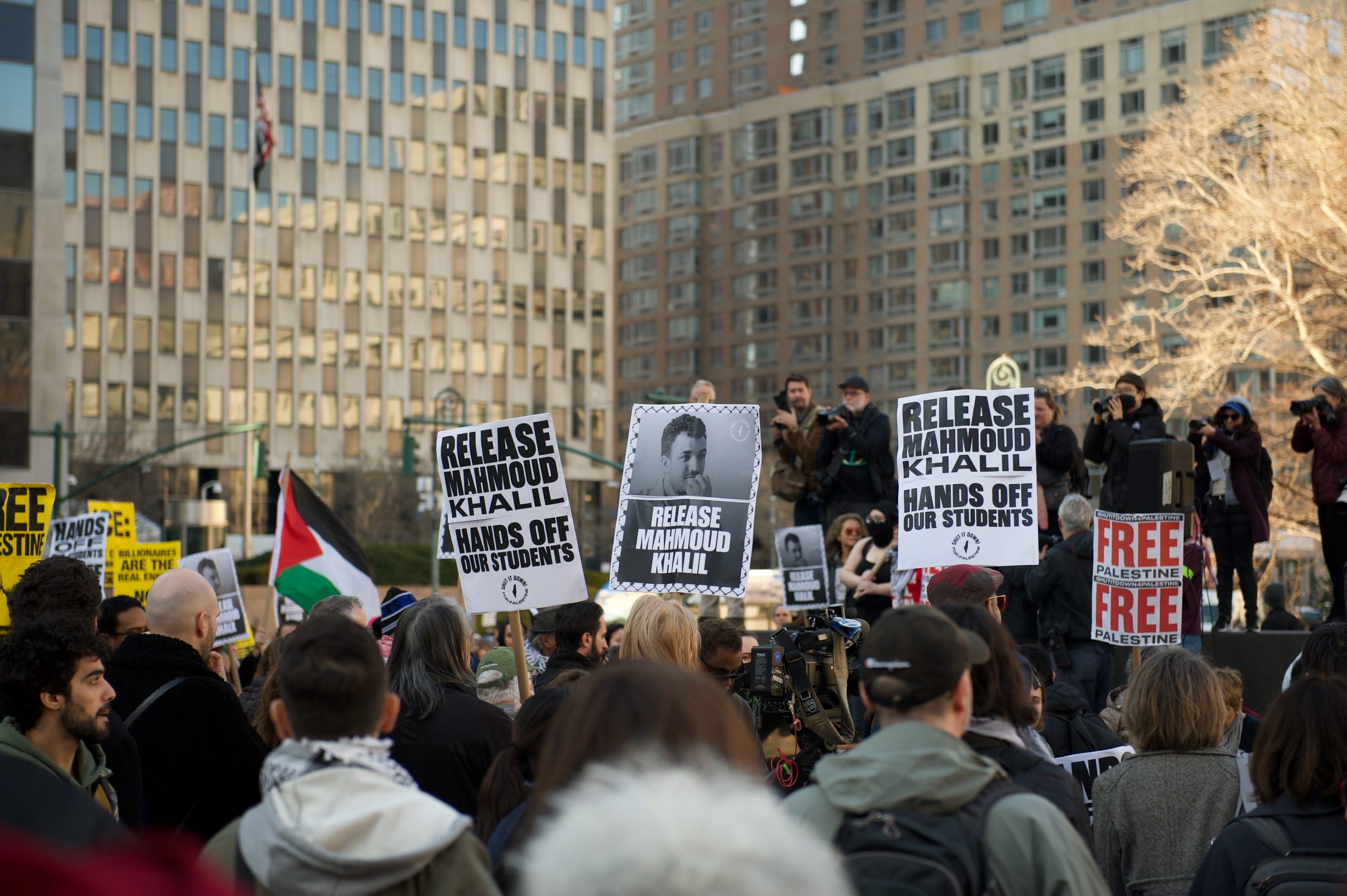
Protesters gather in New York City demanding the release of Mahmoud Khalil following his detention. Credit
On the fridge in our rent-stabilized New York City apartment, there is a small, printed document titled ICE Arrest Protocol. Wedged between photographs of our family in Cape Town and the artwork my son Biko brings home from first grade, the document is unremarkable. Just a list of names. Phone numbers. A sequence of people to call if I am taken: my criminal defense lawyer, my immigration attorney, my civil rights counsel, my wife, a trusted neighbor. But the first instruction sits apart from the rest, heavier than the others: Ensure Biko’s safety above all else.
The arrest protocol has been taped on our fridge for nearly a year following the abduction of Columbia University student, Mahmoud Khalil, in March 2025 by US Immigration and Customs Enforcement (ICE). Mahmoud was taken from the lobby of his apartment building and held for 104 days. Since then, several pro-Palestinian activists have been detained or threatened with deportation. Leqaa Kordia, a 33-year-old Palestinian woman, remains in ICE custody.
In March 2025, the pro-Israeli doxxing group Canary Mission released a video on X ominously titled Uncovering Foreign Nationals. The video names six people affiliated with Columbia University who, under Donald Trump’s executive order on antisemitism, could be targeted for deportation. First on the list is Mahmoud Khalil. Second, is Mohsen Mahdawi, another Columbia student activist taken by ICE while attending his naturalization interview.
My name appears third—held in that narrow space between the detained and those still waiting.
I am included on the list because I was an assistant professor at Columbia who stood publicly with pro-Palestinian student activists when the institution preferred silence. As a South African foreign national and a member of Columbia’s Faculty and Staff for Justice in Palestine, my disobedience was enough to render me deportable.
Canary Mission took credit for Mahmoud’s detention. In a subsequent court case, a senior official testified that ICE assembled a team in early 2025 to investigate pro-Palestinian protestors based on a list of 5,000 people identified on the Canary Mission website.
I knew I could be next.
After consulting with nearly a dozen lawyers, we understood that ICE needs a warrant signed by a judge to enter our home. The safest option, paradoxically, was to stay inside. For 30 days, I did not leave my apartment. The city continued without me—sirens, school buses, the low argument of traffic outside the window—but inside, time thickened.
Against the scale of the genocide unfolding in Palestine—engineered starvation, families erased, life methodically destroyed—my own fear of arrest and detention felt obscene. My family’s precarity felt small. My silence felt like complicity. And yet it is exactly within this collision—between personal risk and collective catastrophe—that resistance clarifies itself.
The US Department of Homeland Security (DHS) offers the option of self-deportation. It sounds almost benign, even responsible. According to DHS, this “dignified” option decreases the cost of deportation by 70 percent. The math was precise. The average cost of arrest, detention, and removal, they noted, was $17,121.
Dignity, here, was rendered as a budget line.
For a moment, it was tempting. South Africa waited on the other side. Our families are there. The rhythms of our lives would be easier. And for all its contradictions, South Africa has been unambiguous in its support for Palestinian liberation. Leaving would have been safer. Quieter.
But self-deportation, like my own self-imposed house arrest, offered only the illusion of control. The self in both was already diminished, reduced by the quiet coercion of anticipation. To choose disappearance over confrontation felt less like dignity than retreat.
What the Trump administration fails to understand is that dignity does not reside in efficiency. There is dignity in resistance. There is dignity in staying. There is even dignity in arrest and detention, when refusal is the only language left. And so I have decided—for now—that if the US wants to deport me, it will have to do so at full cost.
My decision to remain in the US is, in the end, a small act of resistance. It is also an act weighted with privilege. I understand the legal system. I have access to half a dozen lawyers. I can write, reflect, and narrate my fear into meaning. If I choose, I can still return to South Africa. Most people facing ICE have none of this. That asymmetry sharpens the obligation. If I can stay and fight—even quietly, even imperfectly—then I must.
Mahmoud continues his fight in the courts, refusing to disappear into the machinery that seeks to deport him. Leeqa remains in ICE detention, her life suspended inside a legal system designed to exhaust the spirit. My resistance is quieter. I have chosen to stay because leaving would concede the very ground that people like Mahmoud and Leeqa continue to defend. I stay so that my son’s name is not tied to an arrest protocol on the fridge, but to Steve Biko’s memory of resistance.
We no longer stop to read the piece of paper as we reach for the milk or the blueberries. And yet it hums—low, constant, impossible to switch off. A reminder that the ground beneath us is provisional, and that the smallest acts of resistance may carry consequences that, for some of us, arrive as masked agents at the front door.
Above all, the piece of paper on our fridge is a provocation, a prompt: to what do you want to be devoted?