Whose story gets to be heard?
A new film investigates the long-standing land disputes between Kenyans, the government, and multinational corporations, whose expansive plantations are the site of much of the Kikuyu people’s hardship.
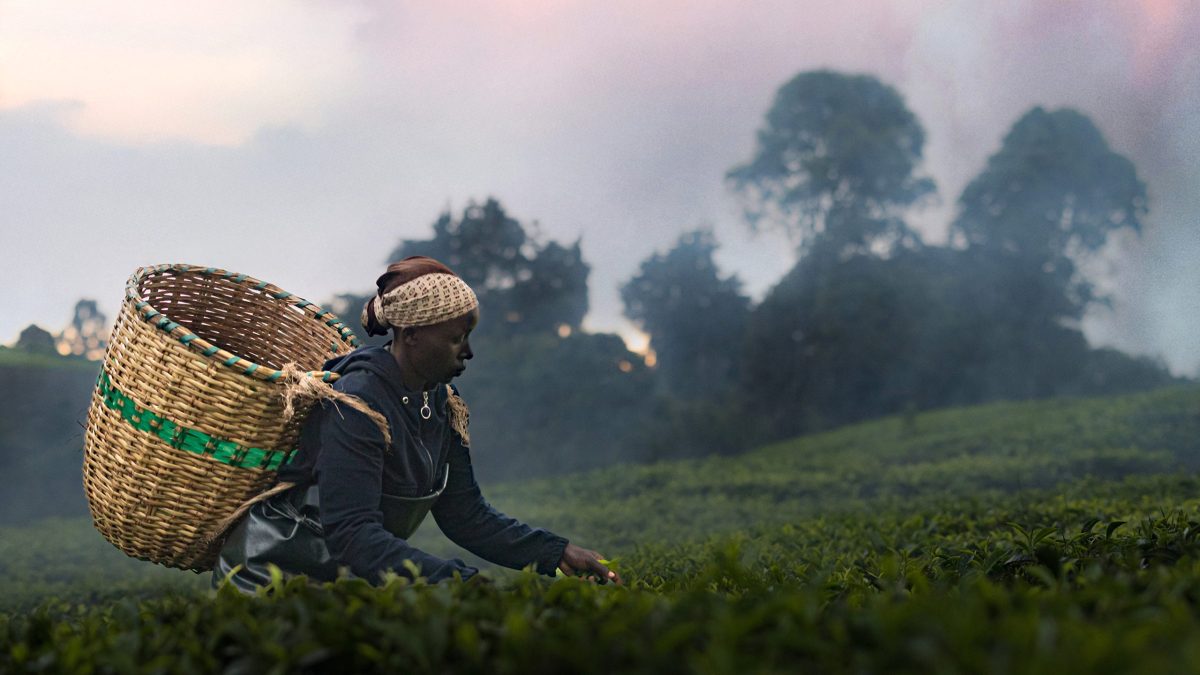
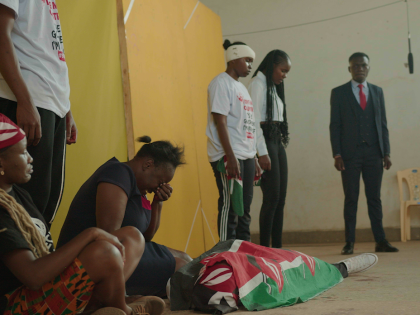
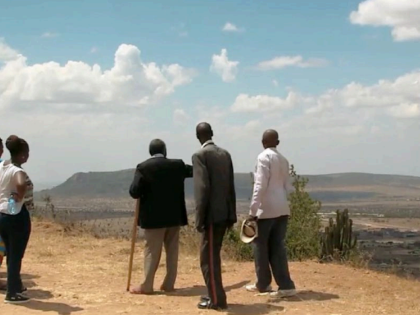
Still from Kikuyu Land (2025). Courtesy of the Sundance Institute. Photograph by Andrew H. Brown.
- Interview by
- Feven Merid
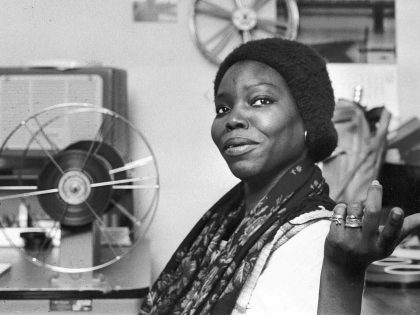
What is the purpose of a story? To change something or to protect it? Is it similar to the purpose of white lies and half-truths? In the documentary film Kikuyu Land, Kenyan journalist Bea Wangondu is entangled in the possibilities. Wangondu co-directed with Andrew H. Brown, who also shot and edited the film, to investigate the long-standing land disputes between Kenyans, the government, and multinational corporations, whose expansive plantations are the site for much of the Kikuyu peoples’ hardship.
One of the film’s early scenes shows a bird’s-eye view of lush green fields of tea plants. Little specks of blue, purple, and red are the clothes of workers moving in the fields. On their backs are baskets that could fit the workers themselves. They are to be filled with tea leaves; close-up shots reveal the swift hands that collect and deposit the plant. While this plays out, a voice from the past speaks; it is revealed to be Kenya’s British colonial governor from the 1950s. “A great many of African peoples, including the Kikuyu, live in a part of the country where the soil is very good,” he says. “We have plans for improvement in many ways in those areas, it’s one to turn out Africans to be artisans in the factories of Kenya.” Against the present-day scenes, we can infer that that quaint-sounding idea is anything but, and, throughout the rest of the film, Wangondu and Brown go to lengths to show just how big of a lie it was.
The film does so by expertly weaving together many threads. It starts with Kenyans like Mr. Mungai, an older Kikuyu man whose family’s land was stolen and his adult son, Njenga, a self-described “tea child” who grew up on plantations. Njenga, long wanting to tell this story, helped Brown covertly get into the farms to capture glimpses of plantation life (filming is strictly prohibited). We hear from different women workers who are faced with extreme working conditions and rampant sexual abuse under their field managers. We see the “middle men” or the “hustlers,” the Kenyans who are the spiritual successors of their colonial archetypes and keep the network of exploitation alive and well long after Kenya’s 1964 independence (William Roto, Kenya’s current president, has called himself the “hustler-in-chief”). The film even winds itself into Wangondu’s own family history, where she learns how her grandfather secured their family’s vast property. It all falls under the umbrella of corporations like Unilever, whose Lipton tea is the product of this network [edit–Unilever sold Lipton in 2022], and which denied any comment on workers’ conditions.
Wading into these areas is high stakes. People can be punished or outright killed for pursuing these lines of inquiry. As one anonymous officer with the National Intelligence Service tells Wangondu, “You are showing everything, and you don’t know what will happen next.” In the end, Wangondu and Brown uncover several ugly truths, even truths about stories. Oftentimes, the volume of the storyteller matters more than the veracity of the story being told. However, in Kikuyu Land, Wangondu wants you to remember one thing: “The real story is the one that is often told with a whisper.” Last week, while showing the film at the Sundance Film Festival, Wangondu and Brown spoke to me about depicting the enduring grasp of colonialism, uncovering family secrets, and why they pursued this story. This conversation has been edited for length and clarity.
Feven Merid
Can you talk about how you approached showing the effects of Kenya’s colonial history on the present?
Bea Wangondu
The most important thing right now is to discuss and have conversations around “this happened to me, and is there an action to what happened to me?” The fatigue about colonialism and what they did is already painful as it is. It’s been over 100 years, and not much has changed.So talking about them is referenced, but not the principal element of what we’re trying to do here.
Andrew H. Brown
Coming from a Western perspective, oftentimes we try to place colonialism in the past, and so it was really important to us that we provided some context, because we can’t trust that people actually understand Kenyan history, and they haven’t been told by a Kenyan like Mr. Mungai exactly what happened from his perspective. But we knew if we put too much weight in the past, people would say, “Well, the past is the past.” So we wanted to make sure that people had a context of what happened historically, and how those systems were set up and put into motion. But most importantly, we wanted people to see how those systems are still controlling the well-being of households in communities like the Kikuyu community today. So we really wanted to show that, you know, this is a story that we could have probably filmed 80 years ago or told 80 years ago or 100 years ago, unfortunately.
Feven Merid
There were definitely some scenes that stood out for looking like they could’ve been from several different periods; I’m thinking of the scenes of women workers picking tea leaves. In the morning they leave their tiny wooden shacks which are also on the plantation; out in the field, the managers are holding machetes telling them they have to meet their quotas or face being kicked out onto the street. Then the sexual abuse they face at the hands of the managers.
Bea Wangondu
Sometimes people don’t have—especially if you don’t know the history of colonization, you don’t have a visual or the slightest idea of what it looks like. When you see the offices of the colonialists, and you see the workers in the tea plantations, then you begin to understand that what you hear people talking about is not made up.
Andrew H. Brown
I have split time in Kenya and North Carolina. A lot of my childhood was in Louisiana. Every time that I entered those spaces, what I was seeing in front of me resonated with what I read in history books about the South throughout my childhood. Instead of tea, it was cotton or other cash crops here. The history that now many people here in the United States are trying to erase. There wasn’t a day while I was on the plantation that that thought didn’t come to my mind. And while I was filming these women, I understood how those images would hit Western audiences.
Feven Merid
Can you talk about the approach of highlighting not just these huge multinational corporations, but the role of the middlemen beyond the plantations?
Bea Wangondu
My grandfather is a good example of how the whole system is set up by colonialism. To local Kenyans, it looked lucrative. It looked like capitalism, it had components that people thought was the way to advance in life. So it was important to show all of that, because my journey to discovery is actually what finally gets me to see my grandfather as he was. I always had an instinct, but this is how I found out, my goodness, not only was he a chief, but he was also one of those who were used and the impact of that has been detrimental for what Kenya is today. What you’re experiencing is neocolonialism.
Andrew H. Brown
It’s the same playbook that we see, whether it’s in Kenya or here in the US. It is turning neighbors on neighbors, and that’s how you, as a society, stay focused on the wrong things and not towards the actual people pulling the strings. They create cracks in the system where oftentimes, bad men step in willingly to harm their own communities. I can’t help but think about ICE right now. These are people that willingly put on a mask, and they’re going out into their own communities to hurt, kill, and terrorize their own community. It’s not creative; it’s cruelty.
Feven Merid
At one point your family forbade you from pursuing your grandfather’s story and even banned you from your grandparents’ house. What was it like eventually getting to a place where you could sit down and talk with your uncles about their father?
Bea Wangondu
I couldn’t go to my grandmother’s house or even have conversations at all about my grandfather with anybody from that side of the family. But there is also a cultural thing that is present in my community, where, even when they’re like that, they still want to come off as we just want peace. And I feel like I took advantage of that cultural element when I reached out after a long time to my uncle. I knew he was still upset, especially because I had put him in this awkward position where he was now looking bad to the family. And I come from a very big family. He was now looking like he’s the one who opened a door for me to make his family and his father look bad. So when I called again, this time he knew to sanitize his image. This is very cultural where you can have a fight with somebody and never say you’re sorry, and the next time you meet, you act like no, no it’s OK. And that’s how we were able to go back in. And this time he brought his brothers, my other uncles. And that’s how we were able to have a conversation. And you hear it in the film when I say, “I just want peace.” If we started any other way, we were never going to have that conversation.
Feven Merid
So the adversarial way was not going to work. I recognize that element in my own culture, and it was so interesting to see play out on screen. You were managing different generational, cultural, and personal dynamics in this scene. Did you find that the process helped you understand more about why your uncles want to keep your grandfather’s history private?
Bea Wangondu
Even to the point of empathy. It hit me, they grew up in a space where colonization happened to them and they had to fight for their independence. And to fight for independence meant that they had to keep secrets. The colonialist was to not know what they were up to, their plans, nothing. Nobody was allowed to talk about what they were doing. So that seeped into our culture. That’s why abuse will be happening in families in many different countries across the continent, but you can never talk about it. It’s just a thing. We keep it locked. “We’ll be fine; time will heal us.” Also the idea of white lies is to sanctify, to clean up the image of whoever to almost get past difficult situations without ever having to talk about. Even though now we might want to blatantly say, “You were wrong.”
So I sympathize with people who have lived with the pain of whatever it is that happened to them. I had the opportunity to just be in a place to understand that I’m not going to get the answers I’m looking for directly from them. I’m talking to [my uncles] in the same way they talk in the film. And yet there’s a lot they admitted to without necessarily going there.
Andrew H. Brown
Going in, I felt a little fearful for Bea. It felt a bit like a trap. I mean, she was going in there to speak directly to the patriarchal leaders of her family, and you know, they kind of had the goal of “We know you’re not going away, so let’s give you enough.” She held her ground while extending grace and allowing them to to tell their story in the way that they want to tell their story. Obviously, with the film coming out, she’s not following their wishes of keeping it in the family, but she’s extending the olive branch, saying, “I understand that their lies are how they learned that this is the only way to protect ourselves.”
Feven Merid
In the end, Bea, you say in the film that you used to think stories were the most powerful thing in the world, but now you’re seeing it’s the storyteller and how loud their voice is that determines how powerful a story is. In light of that, what made you still want to go through and tell this high-risk story?
Bea Wangondu
Over 100 years ago, corporations such as those mentioned in the film established themselves a certain way, and that has meant that the roots have only gone deeper. It was very important to contextualize. In the case of Mr. Mungai, for example, whose land was taken and now is living in very small quarters in Kenya and not able to advance in the way he’d like, it was important to show what that looked like and what that has meant for someone like Mr. Mungai. That’s the voice of a journalist. Because with corporations, you are talking about power, you’re talking about big money, regimes. How do we begin to solve that? If we had to go up against that, it might be a losing battle, so you tell the story you need to tell in a way that allows you to tell it, and use every resource available to find a way to have people see it.
Andrew H. Brown
While we were building this story, we understood that independent film doesn’t always have the biggest megaphone. We knew that these women were taking the risk giving us their story. Mr. Mungai was taking the risk, and so we felt a burden as a steward of their voices. And we’ve always known what we were up against, the type of people who own the lands, whether it’s corporations or powerful men locally. It’s very clear that they have a louder voice than us. Creatively, that’s why we tried to use their own voice against them; through showing their commercials, looking at their website as they talk about all the good that they do and allow people to decide if that lines up with the reality that they’re seeing. You won’t see in our film Bea ever addressing the president or any other politician. We just simply use their own words and how they talk about things. In the case of Unilever, when Bea did not make any accusation, she just said, “I am doing a story, I’d love to talk,” and you see whether they’re interested in having a conversation about the treatment of workers. They’re very quick to put amazing commercials out about all the good that they do, which costs a lot more time and money than to answer someone’s questions.