Progress is exhausting
Pedro Pinho’s latest film follows a Portuguese engineer in Guinea-Bissau, exposing how empire survives through bureaucracy, intimacy, and the language of “development.”
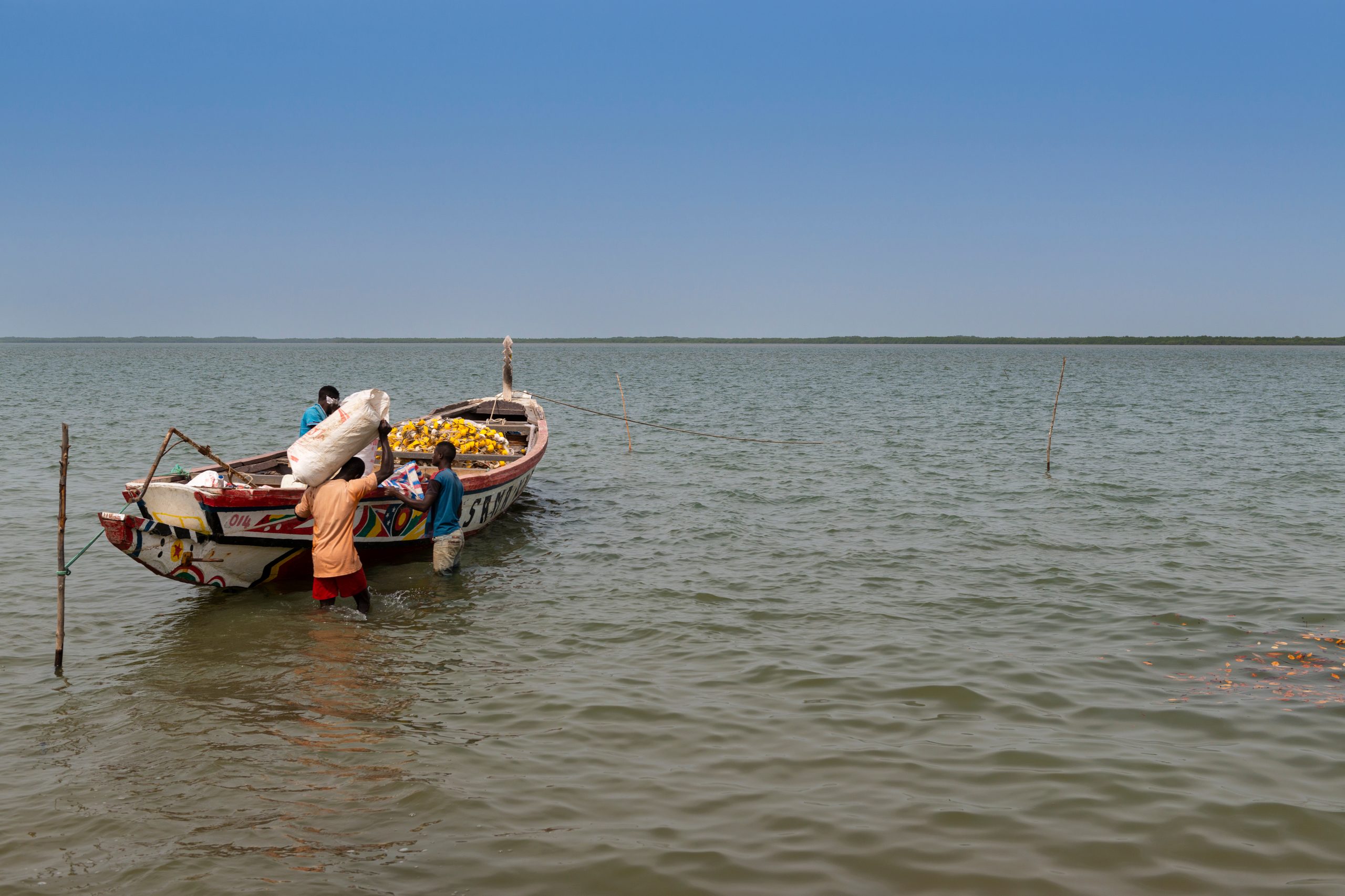
Fishermen preparing their canoe in the port of the city of Cacheu, in Guinea Bissau. TLF
The road in I Only Rest in the Storm never gets built. Dust gathers, workers disappear, and the hum of generators fills the silence left by the promise of progress. Pedro Pinho’s latest film, which premiered in Cannes before bowing at New York Film Festival last fall, lingers on this suspension. Through Sérgio, a Portuguese environmental engineer adrift in Guinea-Bissau, the film captures the fatigue of a postcolonial world where movement is constant but arrival impossible.
I Only Rest in the Storm extends Pinho’s fascination with the afterlives of labor and ideology, themes the director first explored in his 2017 feature The Nothing Factory. Whereas that earlier work dissected capitalism’s collapse within Europe, I Only Rest in the Storm moves its inquiry outward—to Africa, to the legacy of empire, to the contradictions of Europe’s humanitarian self-image.
Sérgio (played by Sérgio Coragem), a Portuguese environmental engineer working for a European NGO, has traveled from Lisbon to West Africa to oversee a road project financed by a consortium of European and Chinese investors. His role, at least on paper, is to assess the environmental impact of the proposed road and coordinate with local communities and project intermediaries. But what unfolds is less a focused mission than a languorous drift. Meetings blur into parties, technical briefings turn into flirtations, fieldwork becomes another mode of self-doubt. The film loses interest in goals altogether and becomes a cartography of confusion—a mapping of Europe’s liberal paralysis abroad.
Sérgio’s demeanor sets I Only Rest in the Storm’s tone. He is polite, inquisitive, and well-meaning, yet perpetually hesitant. His body language—characterized by half-smiles, prolonged silences, glances toward the horizon—reveals a man both self-conscious and self-exonerating. He wants to help, but he is inert. Pinho uses that passivity to expose a deeper form of complicity: the comfort of empathy without engagement. In scene after scene, Sérgio lingers through the frame like a bystander to his own life. He listens as local elders recount Guinea-Bissau’s revolutionary past, nods during NGO meetings where “development” is reduced to spreadsheets, and drifts through nightlife spaces where conversations oscillate between political weariness and sensual intrigue. His hesitations, like the road’s delays, are symptoms of a larger paralysis in which colonial guilt becomes another excuse for inaction.
What makes Sérgio compelling is not what he does but what he represents: the European subject caught between critique and reproduction of empire. He recognizes the power imbalance between himself and the locals, yet he continues to reap the benefits, most starkly when he refuses a €150,000 payment tied to his environmental report, calling it “dirty money,” while continuing to draw a salary from the same development apparatus that sustains such transactions. He questions the project’s motives while cashing the paycheck that sustains it. Pinho doesn’t formalize this contradiction; instead, he frames it as an existential condition. The engineer’s liberal self-awareness is a decorative effort at best.
The unfinished road becomes the film’s central metaphor—a portrait of persistence without purpose. Financed by the World Bank and managed by overlapping bureaucracies, the road is meant to connect rural and urban Guinea-Bissau—linking desert and forest—yet it produces little beyond paperwork and friction. In the same way, Sérgio’s relationships, both professional and romantic, fail to bridge the distances they promise to close.
When Sergio begins an affair with Diára (played by Cleo Diára), a local businesswoman and bar owner, and later with Gui, a nonbinary Brazilian expat, the film shifts toward intimacy as another site where postcolonial hierarchies reproduce themselves. Unlike Sérgio, Diára moves with precision and authority. Her wit cuts through the haze of bureaucratic jargon that defines the environmental engineer’s world, most pointedly in their confrontation over the environmental report. When Sérgio refuses a €150,000 payment tied to his assessment, insisting it would be “dirty money,” Diára exposes the hypocrisy of his stance: What he frames as moral integrity is, for her, a luxury made possible by unequal conditions. In that moment, his ethical posture collapses under scrutiny, and his role as a neutral arbiter is revealed as a fiction. Through Diára, Sérgio encounters not an exoticized “other” but a mirror reflecting his uncertainty and dependence on the very system he claims to critique. If Sérgio’s passivity embodies Europe’s inertia, Diára embodies the exhaustion of being continually evaluated, managed, and desired under the guise of progress.
His relationship with Gui refracts this dynamic differently. Where Diára confronts Sérgio from a position shaped by local survival, Gui occupies a more ambiguous, intermediary space—close enough to Sérgio’s world to share its privileges, yet marked by their own experiences of displacement and marginality. Together, these relationships map intimacy as another arena in which postcolonial hierarchies persist, even when they appear consensual, queer, or self-aware.
Pinho constructs the film like the road itself: long, uneven, and pocked with perpetual interruptions. The narrative unfolds through fragments from meetings, briefings and parties. Interviews with elders are stitched together by silences and static long takes. Rather than driving toward resolution, the story loops back on itself, and each detour erodes the illusion of linear progress.This circular structure is not only stylistic but ideological. It rejects the teleological logic of development, the belief that time moves forward, that problems are solved, that the road will one day be complete. I Only Rest in the Storm immerses us in what postcolonial theorists like Achille Mbembe have described as “the entropic temporality” of the African postcolony: a time of endless transition, where colonialism’s end never quite arrives.
The film’s hybrid form shapes this argument. Pinho weaves fiction and documentary until they become indistinguishable. Interviews with real villagers, many of them elders reflecting on the revolutionary era, puncture Sérgio’s narrative, reminding us of the historical depth his liberal angst can’t contain. Likewise, scenes with European NGO staff and consultants are shot with an ethnographic detachment that verges on satire. The camera watches them watching others, creating a mise en abyme of observation.
In one of the film’s most striking sequences, an NGO representative presents data on “local engagement” while the camera lingers on a dirt road stretching into nothing. The juxtaposition is devastating: progress rendered as paperwork, connection as abstraction. Here, the film’s visual rhythm—patient, repetitive, insistently observational—becomes its politics. What I Only Rest in the Storm understands so well is how colonial power survives through language and formality. The NGO meetings, the progress reports, the “stakeholder consultations” all are rituals of control disguised as cooperation. In these moments, Pinho’s dry humor shines. The dialogue is filled with jargon (“capacity-building,” “sustainability framework,” “inclusive growth”) so lifeless that they feel surreal. By stretching these scenes to the point of discomfort, Pinho exposes their emptiness. The camera refuses to cut, forcing us to sit through the monotony of good intentions. It’s here that I Only Rest in the Storm’s documentary sensibility meets its moral one: Observation becomes indictment. The NGO’s discourse of “help” begins to sound indistinguishable from colonial administration.
This slow, bureaucratic pacing also defines the film’s visual grammar. Pinho’s camera rarely moves. It waits, and the stillness mimics both the physical stasis of the road project and the moral inertia of those overseeing it. Every shot feels suspended, caught between possibility and exhaustion.
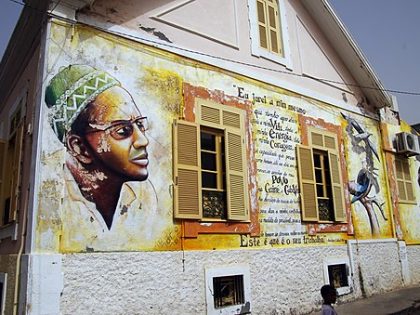
Guinea-Bissau’s revolutionary past hovers like a ghost over the I Only Rest in the Storm present. The elders’ testimonies recall the optimism of the Amílcar Cabral era, when liberation was synonymous with self-determination. But their tone is weary, their recollections tinged with disillusionment. Independence brought new hierarchies, new dependencies, and the same structural fatigue. By integrating these voices into the narrative, Pinho ensures that his film never collapses into European self-analysis. I Only Rest in the Storm belongs as much to those who speak from the margins as to those who occupy the center. It’s not just about Europe’s failure to decolonize; it’s about Guinea-Bissau’s struggle to live with the debris of both revolution and reform.
In both content and form, I Only Rest in the Storm is a film about exhaustion of systems, ideologies, and emotions. Pinho’s world is populated not by villains but by weary participants, engineers, consultants, lovers, workers, all caught in a choreography of futility. By merging fiction and documentary, Pinho finds a language that mirrors the contradictions he depicts: ironic yet sincere, distant yet intimate. His cinema rejects catharsis; it lingers instead in the discomfort of complicity. In the end, Sérgio remains as he began: waiting. The road lies unfinished, the project unresolved, the relationships unsteady. But what feels like failure is also revelation. I Only Rest in the Storm is not about what could be built but about what cannot be finished. It’s about roads that lead nowhere, gestures of care that repeat violence, and the uneasy quiet that follows the empire’s retreat. Through its patient gaze and drifting rhythm, the film reminds us that sometimes to rest—in all its ambiguity—is the most political act of all.