The untameable Victor Osimhen
The volcanic temperament and irresistible brilliance of the footballing star converge as the Super Eagles close in on continental glory.
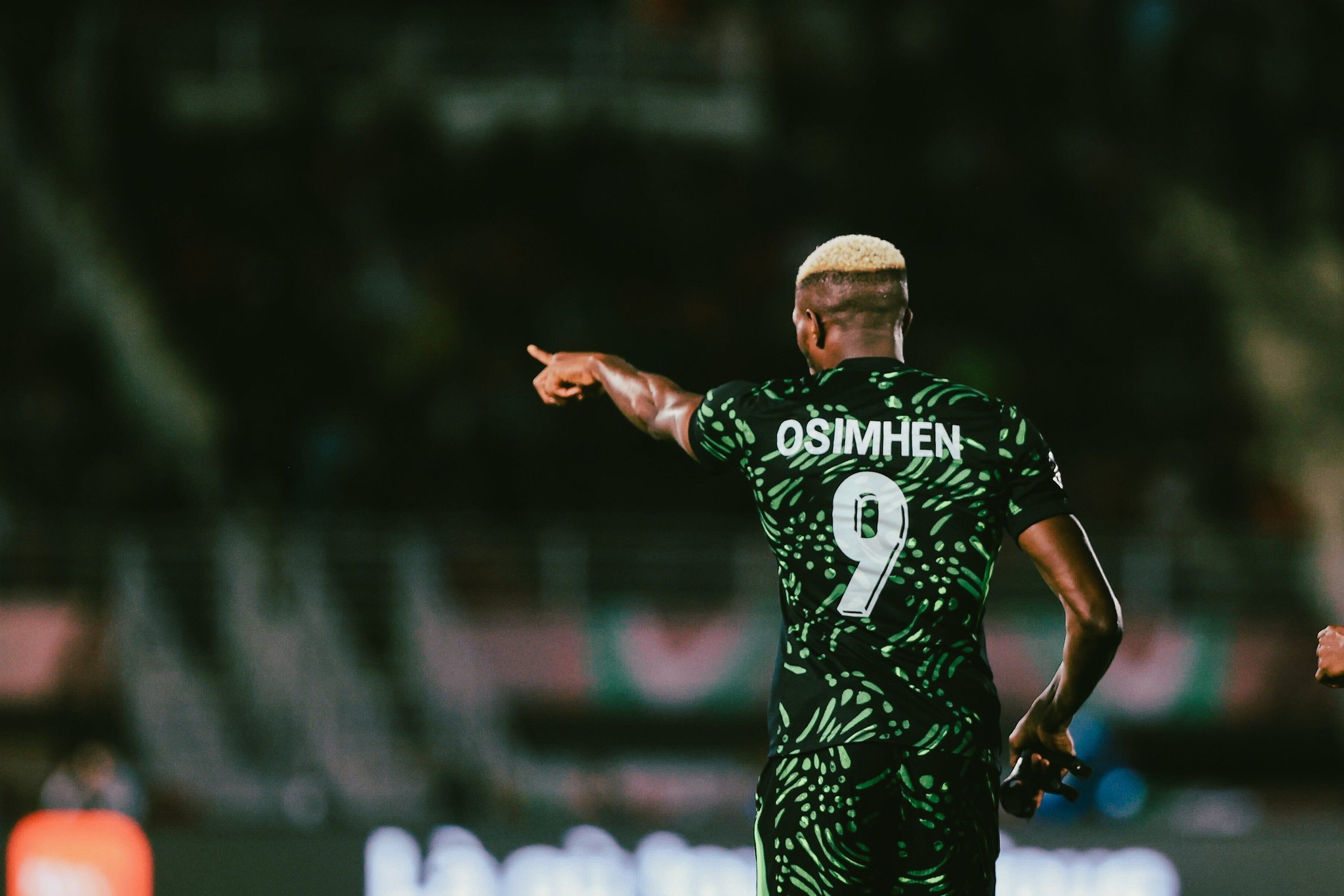
Victor Osimhen during Nigeria’s 4–0 win over Mozambique at AFCON 2025. Screenshot from CAF’s Instagram, used
There is a class of footballer, to which Victor Osimhen now unmistakably belongs, against whom the only useful preparation is a steeling of the mind. To face up against those in this cadre is to know what is coming, but be powerless to prevent it. Against Algeria in the 2025 Africa Cup of Nations quarterfinal, poor Ramy Bensebaini had the best view in Stade Marrakech, bearing witness as the striker took flight, laughed in the face of gravity, and headed home. As has been his wont for half a decade now. Dread it, run from it, Osimhen arrives just the same, with the certitude of destiny.
The fact that he was able to produce, as the spearhead of a brilliant Nigeria side, such a strong performance against the Desert Foxes was bizarre in light of events from five days earlier. In the round of 16 against Mozambique, with the Super Eagles ahead 3–0 and coasting, Osimhen took umbrage at a pass that did not come his way from left back Bruno Onyemaechi, got into a shouting match with Ademola Lookman, stopped running and asked to be substituted.
It was an appalling implosion, a show of impetuousness that was all the more shocking considering that, in the wake of Nigeria’s failure to qualify for the 2026 World Cup, there had been a strong clamour for him to be made captain. It was a popular, if odd, movement, mainly because, for all his gifts, this was a player for whom making headlines for the wrong reasons was not unprecedented. Twice before, Osimhen had, via social media, lashed out at criticism, real and alleged, from Victor Ikpeba and Finidi George, two certified legends of Nigerian football. On both occasions, the court of public opinion just about found in his favor, and coming away from those incidents with little censure (in tongue-in-cheek fashion, he was, in fact, given the Yoruba nickname “Jagun Jagun”—a warmonger—off the back of the latter incident) seemed to suggest he was invincible, above any law. The Mozambique incident, however, was different, and not just for how publicly it played out: For the first time since he broke out at the 2015 U-17 World Cup, the tide was firmly against the country’s golden calf.
Born into the miasma of a giant, odious landfill in Olusosun, Osimhen is, in a sense, very much a product of his environment, toxicity roiling just beneath the surface and occasionally spilling over. It is no surprise that the loss of his mother at an early age shaped the person he would become, especially as his father lost his ability to provide for the family not long after, forcing the children onto the mean streets of Lagos. Being the youngest in the family, much of the responsibility for minding Osimhen will have fallen on his two brothers and four sisters. With less direct parental oversight and behavior modeled on the typically combative dynamics between older siblings, it is not unusual for a willful, stubborn streak to develop in younger children, and the effect of that is plain to see even now in his adult life.
However, in much the same way as he transcended the circumstances of his birth, he is more than his outbursts. He is the determination that got him out of the muck and through a chaotic, free-for-all screening process for the U-17 national team; the generosity that prompts him to become Olusosun’s Santa Claus at Christmas time, giving back to the community that raised him; the humility that, in truth, makes him far more accessible than he has any need to be. Against this backdrop, it would be too easy to speak of the volatility within him as some malignancy that needs excision, thereby missing what makes him special—that same unruliness is crucial to how he plays. It is the obstinacy, the refusal to come to heel, the railing against convention that powers every run into the channel, every leap. This is less “Dr. Jekyll and Mr. Hyde” and more Marvel Comics’ Hulk, whose heaving fury Bruce Banner must accept as a part of himself in order to find tranquility.
Of course, there is a delicate balance between being true to oneself and being defiant when in the wrong. While speculation flew as to the state of affairs within the squad, it is understood that clear-the-air talks were held in the immediate aftermath, with the rest of the squad making their displeasure known to Osimhen in no uncertain terms. The grievance, once aired, was quickly quashed, and while no apologies were made, none were expected. There is an understanding within the squad of his personality: When he lashes out, there is seldom malice or vanity involved; it is because he cares a little too much, because he takes things too personally.
It was instructive, then, that after he teed up Akor Adams for the second against Algeria, much of the acclaim from his teammates went to him. The show of unity was important, but even beyond that, it was a strikingly selfless bit of play from a man who stands just two goals away from equalling the Nigeria national team goals record set by the late, great Rashidi Yekini.
That mark of 37, set in February 1998 by the one who was called “Goalsfather,” has outlived many great strikers—Julius Aghahowa, Yakubu Aiyegbeni, Obafemi Martins, to name a few. Osimhen has been at pains to keep any comparisons at bay but, in many ways, his campaign in Morocco has not only inched him closer with each match, but has been about addressing much of the criteria by which many would seek to downplay his claim to the pantheon of Nigerian football.
With much of his international tally coming into the tournament consisting of goals scored in qualifiers against weaker opponents, there was a suspicion in some quarters that he was something of a flat-track bully. That, coupled with his agonies in front of goal at AFCON 2023, meant he had a point to prove at this edition. It was all well and good putting the likes of São Tomé and Sierra Leone to the sword, but in the form of Yakubu and Ikechukwu Uche, Nigeria have recent experience of great strikers whose legacies are tarnished by the absence of defining tournament performances.
Osimhen’s goal against Algeria, therefore, was significant in more than one sense. Not only was it his first in a competitive fixture against an opponent ranked higher than Nigeria in the FIFA rankings, it also nudged the Super Eagles closer to a fourth title, which would tie them with arch rivals Ghana. Yekini scored against a higher caliber of opponents, with just under half of his strikes coming at major tournaments, but if by the end of proceedings in Morocco, Osimhen has the record (joint or singular) as well as AFCON gold around his neck, the particulars of his conduct will be but a footnote in his legend.